
lovethailand home >North Travel Attractions >Chiang Mai Travel Attractions >San Pa Tong >Yu Wa > Wat Ku Kham
TL;DR: Wat Ku Kham is located at Ban Don Tan, Moo 12, Yu Wa Subdistrict, San Pa Tong District, Chiang Mai Province, open Daily, hours 08.00 – 17.00.

Wat Ku Kham
Open Days: Daily
Opening Hours: 08.00 – 17.00
Wat Ku Kham is located at 129 Ban Don Tan, Moo 12, Yu Wa Subdistrict, San Pa Tong District, Chiang Mai Province. It is a local Mahanikaya Buddhist temple built in 1877 and remains an important religious center of Ban Don Tan. The temple is meaningful not only as a place of worship but also as a community temple connected with irrigation canals, local roads, villagers’ orchards, and the everyday landscape of Yu Wa Subdistrict.
The name “Wat Ku Kham” is culturally interesting. In northern Thai usage, “ku” often refers to a stupa, shrine, or sacred masonry structure, while “kham” carries an auspicious meaning associated with gold, value, or beauty. Although the recorded history does not fully explain the origin of the temple name, the temple’s important sacred object is a square-based stupa. This connection makes the name Wat Ku Kham closely associated with the stupa and the community’s devotion to sacred Buddhist structures.
Ban Don Tan, Moo 12, is a village in Yu Wa Subdistrict, San Pa Tong District. The surrounding landscape includes irrigation canals, local roads, agricultural land, and village orchards. Wat Ku Kham stands within this landscape, so it should be understood not only through its temple buildings but also through its relationship with water, agriculture, and local community life. This is a common character of Lanna village temples, where temples, water systems, fields, and homes are deeply connected.
The temple land covers 2 rai, 3 ngan, and 82 square wah under title deed number 1108, land number 51, survey page 965. To the north, the temple borders an irrigation canal. To the south, it borders a road and irrigation channel. To the east and west, it borders villagers’ orchards. These boundaries show that Wat Ku Kham is embedded in a semi-agricultural village setting rather than an urban commercial zone.
Wat Ku Kham also has 2 plots of monastic land. The first plot is under title deed number 1109, land number 52, survey page 967. It borders irrigation channels to the north, south, and east, and a road to the west, covering 1 ngan and 81 square wah. The second plot is under title deed number 1110, land number 50, survey page 966. It borders a road to the north, an irrigation channel to the south, land number 48 to the east, and an irrigation channel to the west, covering 1 ngan and 5 square wah. These details emphasize the temple’s strong connection with local water systems.
The relationship between the temple, irrigation canals, and orchards is important. In northern Thai communities, irrigation channels are not merely waterways. They are community-managed systems connected with farming, cooperation, and village livelihood. A temple located within this landscape often becomes both a religious center and a social gathering place where villagers meet, organize merit-making, and maintain community relationships.
Wat Ku Kham was built in 1877. At that time, village temples in San Pa Tong played a central role in worship, Buddhist learning, merit-making, and community life. A temple was not only a sacred site but also a place where villagers gathered, listened to Dhamma, organized ceremonies, and preserved community memory. Wat Ku Kham therefore developed as a temple closely tied to Ban Don Tan and the wider Yu Wa community.
The temple received its royal consecrated boundary, or Wisungkhamsima, on July 4, 1883. The boundary measures 5 meters wide and 11 meters long. In Thai Buddhist practice, the Wisungkhamsima is required for formal monastic ceremonies such as ordination and Sangha acts. Receiving the boundary only a few years after the temple was built shows that Wat Ku Kham became a complete religious institution for the community at an early stage.
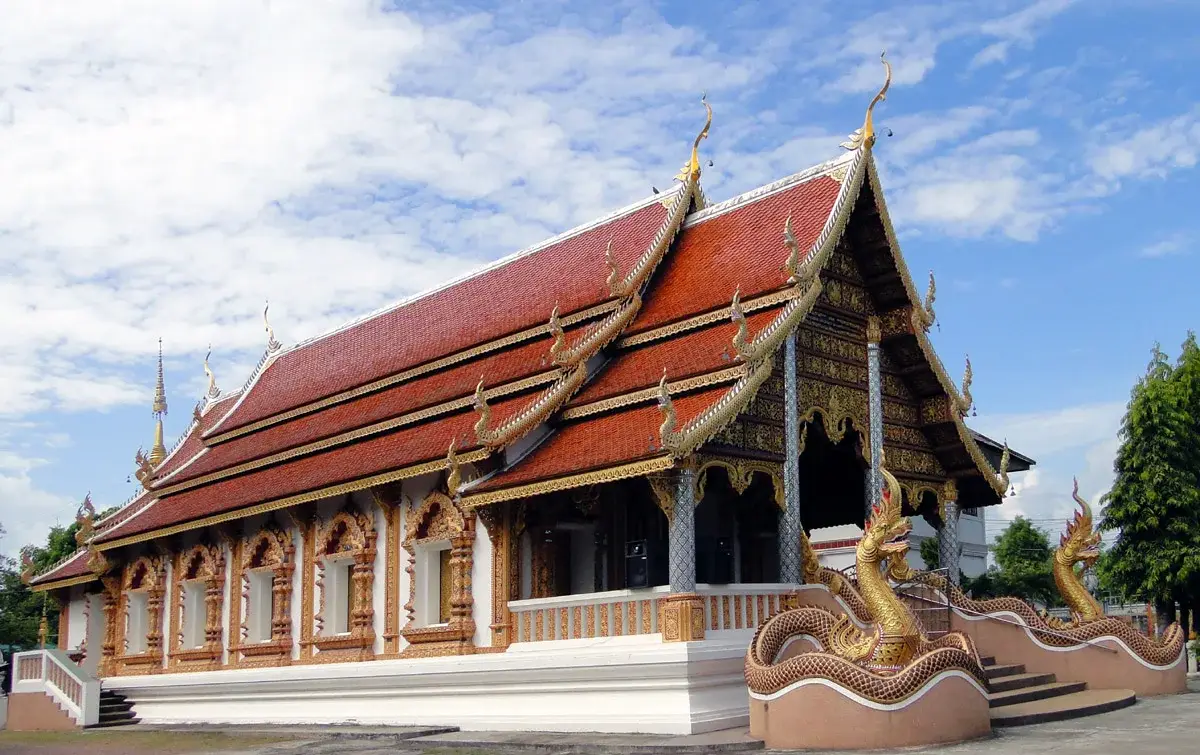
The temple buildings include an ordination hall, monks’ residence, viharn, pavilion, and kitchen. The ordination hall supports formal monastic ceremonies. The viharn is the main devotional space for villagers to worship, make merit, and listen to sermons. The monks’ residence allows monks to live and practice at the temple. The pavilion supports community activities. The kitchen plays an important role during merit-making ceremonies and events that require food preparation for monks and participants.
The kitchen is a practical but important part of a village temple. In northern Thai Buddhist culture, merit-making often involves collective cooking, offering food, welcoming participants, and supporting community gatherings. A temple kitchen therefore reflects the living role of the temple as a place where religious practice and everyday cooperation come together.
The most important sacred object of Wat Ku Kham is its square-based stupa. In Lanna Buddhist culture, a stupa is a major symbol of devotion and a focus of worship. The square form also gives the temple a distinctive sacred feature connected with the meaning of the name “Ku Kham.” Visitors should pay special attention to the stupa because it represents the temple’s religious identity and local memory.
The temple’s value does not come from large-scale grandeur. Its character lies in the quietness of a working village temple, the meaning of its stupa, and its relationship with the surrounding canals, orchards, and local roads. For travelers interested in old temples and Lanna community life, Wat Ku Kham offers a grounded and authentic view of Buddhist practice in San Pa Tong.
The current abbot of Wat Ku Kham is Phra Khru Suwan Sitthichot, Phra Athit Itthichoto. Recent public news connects him with Wat Ku Kham in Yu Wa Subdistrict, San Pa Tong District. The abbot’s role in a village temple includes caring for the temple, guiding local devotees, preserving religious practice, organizing ceremonies, and maintaining the relationship between monks and villagers.
Older temple information records Phra Khru Phanatapaphi Rak Khunatharo as an abbot of Wat Ku Kham. This reflects a previous period in the temple’s administrative history. For current visitor information, the name Phra Khru Suwan Sitthichot, Phra Athit Itthichoto should be used as the current abbot.
Wat Ku Kham serves Ban Don Tan on several levels. Spiritually, it is a place for worship, merit-making, and reflection. Ritually, it supports Buddhist ceremonies, memorial rites, and village merit-making. Socially, it is a gathering place for local residents. Culturally, it preserves the relationship between the temple, irrigation canals, community roads, orchards, and Buddhist practice in Yu Wa Subdistrict.
Religious events at Wat Ku Kham follow the rhythm of northern Thai Buddhist village life. These include Buddhist holy days, Buddhist Lent, the end of Buddhist Lent, Kathin, Pha Pa, merit-making ceremonies, memorial rites, and village activities. The viharn, ordination hall, pavilion, and kitchen help support these activities in an organized way.
The atmosphere of Wat Ku Kham is calm and local. The temple is suitable for travelers interested in old temples, Lanna village culture, irrigation landscapes, and cultural routes in Yu Wa and San Pa Tong. Visitors can pay respect to the Buddha images, observe the square-based stupa, and walk quietly around the temple grounds to understand how the temple fits into the surrounding village landscape.
Important things to see at Wat Ku Kham include the square-based stupa, ordination hall, viharn, monks’ residence, pavilion, kitchen, and the temple’s setting near irrigation canals, roads, and villagers’ orchards. Visitors should view the temple as a living community temple rather than a large tourist attraction.
Visitors should dress respectfully, speak quietly, and avoid entering monks’ private areas without permission. If a merit-making ceremony, funeral rite, or community activity is taking place, visitors should give priority to local people and follow temple etiquette. Wat Ku Kham remains an active religious site for Ban Don Tan, so respectful conduct is essential.
Getting There is most convenient by private car, rental car, or local hired transport. From Chiang Mai city, take Highway 108, the Chiang Mai–Hot Road, toward San Pa Tong District. Continue into Yu Wa Subdistrict and Ban Don Tan, Moo 12. When using a map application, search for “Wat Ku Kham Yu Wa San Pa Tong” to avoid confusion with temples of the same name in Nan, Lampang, or other provinces.
A suitable connected route includes temples and communities in Yu Wa Subdistrict. Visitors can combine Wat Ku Kham with Wat San Pa Tong, Wat Kiu Lae Luang, Wat Ton Phueng, Ban Don Tan, the Yu Wa woodcarving route, and the Kiu Lae Luang–Kiu Lae Noi craft area. For a broader historical route, visitors can continue to Ban Klang Subdistrict to visit Wat Sri Nawarat, Wat Tha Kan, and Wiang Tha Kan Archaeological Site.
Overall, Wat Ku Kham is a meaningful old community temple in Yu Wa Subdistrict. Its key elements include its construction in 1877, royal consecrated boundary in 1883, temple land connected with irrigation canals and villagers’ orchards, square-based stupa, ordination hall, viharn, pavilion, kitchen, and its role as the spiritual center of Ban Don Tan. It is a suitable destination for travelers who want to understand Chiang Mai through Lanna village temples, local agriculture, and the quiet Buddhist life of San Pa Tong.
| Name | Wat Ku Kham (Yu Wa) |
| Location | Ban Don Tan, Moo 12, Yu Wa Subdistrict, San Pa Tong District, Chiang Mai Province |
| Address | 129 Ban Don Tan, Moo 12, Yu Wa Subdistrict, San Pa Tong District, Chiang Mai 50120, Thailand |
| Highlights | An old Ban Don Tan community temple built in 1877, with a square-based stupa, ordination hall, viharn, monks’ residence, pavilion, kitchen, and a landscape connected with irrigation canals, roads, and villagers’ orchards |
| History | Built in 1877 as a community temple of Ban Don Tan, Yu Wa Subdistrict, San Pa Tong District |
| Consecrated Boundary | Granted on July 4, 1883; the Wisungkhamsima measures 5 meters wide and 11 meters long |
| Temple Land | Temple land covers 2 rai, 3 ngan, and 82 square wah under title deed number 1108, land number 51, survey page 965 |
| Monastic Land | 2 plots of monastic land: the first plot covers 1 ngan and 81 square wah, and the second plot covers 1 ngan and 5 square wah; both are connected with irrigation channels, roads, and nearby land |
| Boundaries | North: irrigation canal; South: road and irrigation channel; East: villagers’ orchards; West: villagers’ orchards |
| Landscape | A village temple in Ban Don Tan, set within a landscape of irrigation canals, local roads, and villagers’ orchards |
| Main Areas / Zones | Ordination hall, viharn, monks’ residence, pavilion, kitchen, stupa area, and community religious activity areas |
| Important Structures | Ordination hall, monks’ residence, viharn, pavilion, and kitchen |
| Sacred Object | Square-based stupa |
| Current Abbot / Caretaker | Phra Khru Suwan Sitthichot, Phra Athit Itthichoto |
| Historical Abbot Information | Older temple information records Phra Khru Phanatapaphi Rak Khunatharo as an abbot of Wat Ku Kham |
| Local Importance | A spiritual center of Ban Don Tan and a community temple connected with irrigation canals, roads, villagers’ orchards, and Buddhist village life in Yu Wa Subdistrict |
| Travel Information | Travel from Chiang Mai city via Highway 108, the Chiang Mai–Hot Road, toward San Pa Tong. Continue into Yu Wa Subdistrict and Ban Don Tan, Moo 12. Private car, rental car, or local hired transport is recommended. |
| Current Status | A registered Mahanikaya community temple serving Ban Don Tan |
| Open Days | Daily |
| Opening Hours | 08.00 – 17.00 |
| Main Contact Number | 053-311-038 |
| Facilities | Ordination hall, viharn, monks’ residence, pavilion, kitchen, and community religious activity areas |
| Nearby Tourist Attractions | 1. Wat San Pa Tong, about 3 km 2. Wat Kiu Lae Luang, about 4 km 3. Yu Wa Woodcarving Craft Center, about 4 km 4. Ban Kiu Lae Noi Woodcarving Village, about 5 km 5. Wat Ton Phueng, about 5 km 6. Kaomai Estate 1955, about 8 km |
| Nearby Restaurants | 1. Tam Sang Phochana Near San Pa Tong Hospital, about 3 km, Tel. 093-154-8468 2. Cafe Vintage1980 San Pa Tong, about 8 km, Tel. 096-084-0462 3. Kuai Tiao Ton Kok, about 8 km, Tel. 092-872-6536 4. Baan Plai Suan Restaurant San Pa Tong, about 9 km, Tel. 063-847-3142, 093-321-0885, 062-541-2652 5. Lake View @ San Pa Tong, about 10 km, Tel. 097-079-8448 6. Saming Cha Cafe, about 10 km, Tel. 095-447-0110 |
| Nearby Accommodations | 1. Kaomai Lanna Resort, about 8 km, Tel. 053-481-201 2. Lan Long Khao Cafe & Resort, about 9 km, Tel. 093-571-5888 3. Tai Resort Sanpatong, about 10 km, Tel. 063-096-7000 4. Huen Hom Kham Homestay, about 10 km, Tel. 086-183-1327 5. Bannoi Himsuan, about 11 km, Tel. 090-329-6108 6. Baan Suan Kaew Huen Kham @ San Pa Tong, about 11 km, Tel. 081-366-2382 |
Frequently Asked Questions (FAQ)
Q: Where is Wat Ku Kham (Yu Wa) located?
A: Wat Ku Kham is located at 129 Ban Don Tan, Moo 12, Yu Wa Subdistrict, San Pa Tong District, Chiang Mai Province.
Q: When was Wat Ku Kham built?
A: Wat Ku Kham was built in 1877 as a community temple of Ban Don Tan in Yu Wa Subdistrict.
Q: When did Wat Ku Kham receive its consecrated boundary?
A: Wat Ku Kham received its Wisungkhamsima on July 4, 1883. The boundary measures 5 meters wide and 11 meters long.
Q: What are the main things to see at Wat Ku Kham?
A: The main feature is the square-based stupa. Visitors can also see the ordination hall, viharn, monks’ residence, pavilion, and kitchen.
Q: Who is the current abbot of Wat Ku Kham?
A: The current abbot is Phra Khru Suwan Sitthichot, Phra Athit Itthichoto.
Q: Why is Wat Ku Kham important to the local community?
A: It is a spiritual center of Ban Don Tan and is closely connected with irrigation canals, local roads, villagers’ orchards, and Buddhist community life in Yu Wa Subdistrict.
Q: How can travelers get to Wat Ku Kham?
A: Travelers can take Highway 108, the Chiang Mai–Hot Road, from Chiang Mai city toward San Pa Tong, then continue into Yu Wa Subdistrict and Ban Don Tan, Moo 12.
Q: What nearby places can be visited with Wat Ku Kham?
A: Nearby places include Wat San Pa Tong, Wat Kiu Lae Luang, the Yu Wa woodcarving craft center, Ban Kiu Lae Noi, Wat Ton Phueng, and Kaomai Estate 1955.
 Category: ●Places of Worship
 Group: ●Temple
Last Update : 6 DayAgo
 Last Update : 6 DayAgo
 Click to Access the Navigation Map GPS
 Muang Chiang Mai(121)Chom Thong(47)Mae Chaem(25)Chiang Dao(33)Doi Saket(68)Mae Taeng(85)Mae Rim(69)Samoeng(29)Fang(71)Mae Ai(59)Phrao(70)San Pa Tong(103)San Kamphaeng(66)San Sai(73)Hang Dong(73)Hot(32)Doi Tao(22)Omkoi(11)Saraphi(74)Wiang Haeng(15)Chai Prakan(28)Mae Wang(32)Mae On(22)Doi Lo(34)Galyani Vadhana(1)


