
lovethailand home >North Travel Attractions >Chiang Mai Travel Attractions >San Pa Tong >Ban Klang > Wat Rong Than
TL;DR: Wat Rong Than is located at Ban Rong Than, Moo 1, Ban Klang Subdistrict, San Pa Tong District, Chiang Mai Province, open Daily, hours 08.00 – 17.00.

Wat Rong Than
Open Days: Daily
Opening Hours: 08.00 – 17.00
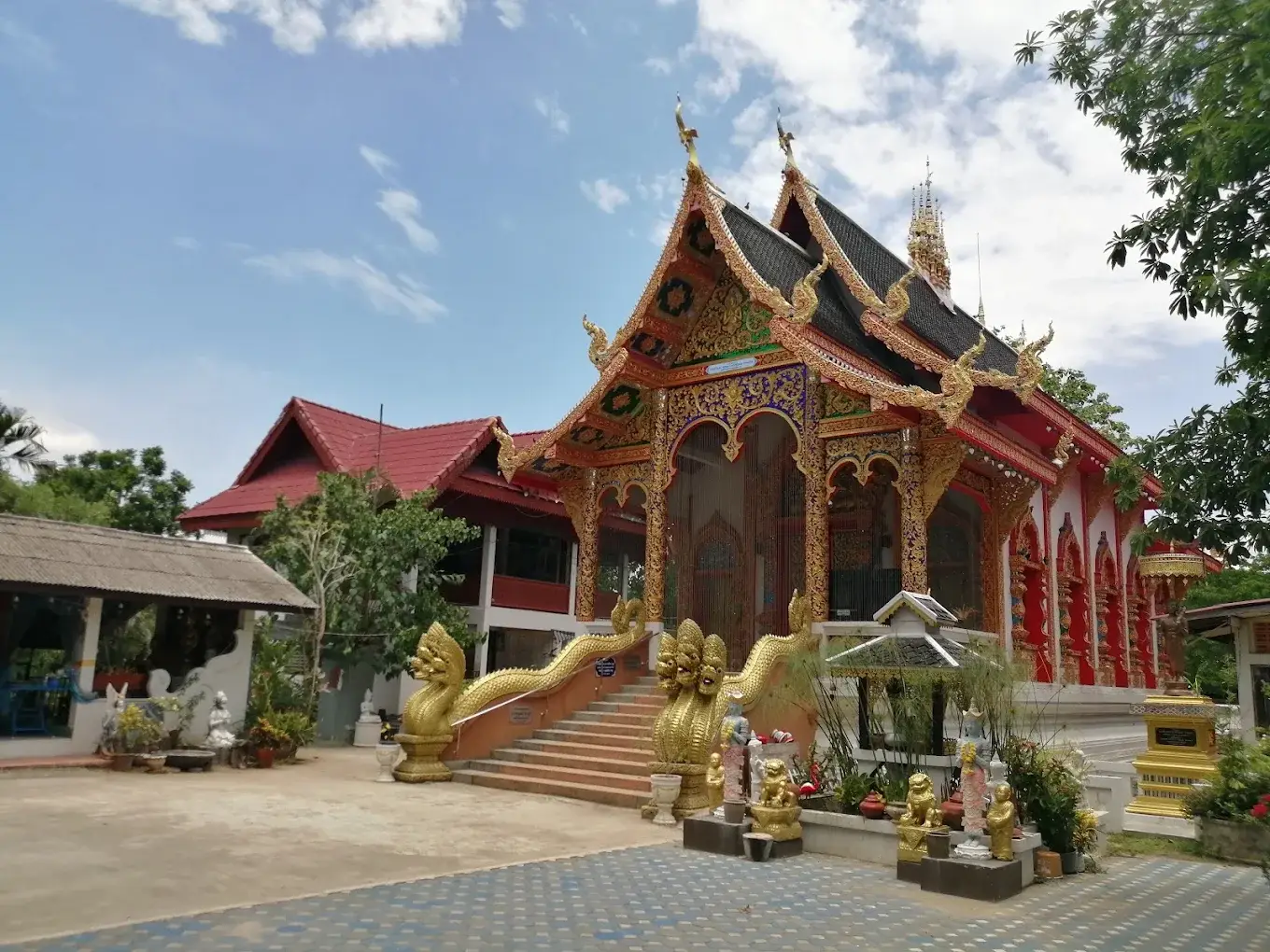
Wat Rong Than is located at 76 Ban Rong Than, Moo 1, Ban Klang Subdistrict, San Pa Tong District, Chiang Mai Province. It is a local Mahanikaya Buddhist temple founded on March 15, 1732. The temple remains an important religious and community center of Ban Rong Than and reflects the quiet character of a northern Thai village temple. Its setting in a lowland area near the Mae Khan River, irrigation channels, village land, and rice fields gives the temple a strong connection with local agricultural life and the cultural landscape of Ban Klang.
Wat Rong Than is not a large commercial tourist attraction. Its value lies in its history, community role, old stupa, ordination hall, viharn, sermon hall, multipurpose hall, Buddha images, and village setting. The temple is suitable for travelers who want to understand Chiang Mai through active community temples rather than only through famous city landmarks. A visit here offers a quieter and more local view of San Pa Tong.
The temple was founded on March 15, 1732. According to community memory, monks and novices had lived and practiced at the temple over generations. One early abbot mentioned in the temple’s history is Phra Athikan Jina, also known as Noi. After his passing, monks continued to care for the temple. This history shows that Wat Rong Than is sustained not only by formal records but also by community memory and the continuing faith of local villagers.
The name “Rong Than” is meaningful when viewed together with the temple’s landscape. Although the earliest origin of the name is not clearly recorded, the word “than” suggests a connection with flowing water, streams, or irrigation. This matches the environment of the temple, which is located in a lowland community near the Mae Khan River and public irrigation channels. The temple therefore reflects a village landscape shaped by water, agriculture, and Buddhist faith.
Wat Rong Than has a royal consecrated boundary, or Wisungkhamsima, measuring 9 meters wide and 19 meters long. In Thai Buddhist practice, this boundary is important because it defines the sacred area used for formal monastic ceremonies. Its presence shows that Wat Rong Than has the religious structure required for monastic acts and ordination-related ceremonies.
The temple land covers 6 rai, 2 ngan, and 85 square wah under title deed number 20902. To the north, the temple borders land of Nai Chai Suphan. To the south, it borders public-benefit land. To the east, it borders a public path. To the west, it borders public irrigation-channel land. These boundaries show the temple’s close relationship with village land, public routes, and the water-management landscape of the community.
The temple grounds are lowland. The surrounding environment includes the village, the Mae Khan River, softwood vegetation, and villagers’ rice fields. This setting gives Wat Rong Than a clear identity as a village temple within an agricultural landscape. It is not isolated from everyday life; it stands within the same environment where villagers live, farm, travel, and gather for religious activities.
The Mae Khan River is an important part of the landscape of Ban Klang and San Pa Tong. Rivers and irrigation systems in northern Thai communities are closely connected with farming, settlement, local routes, and community identity. Because Wat Rong Than is connected with this kind of landscape, it should be understood as part of a wider cultural ecology of water, fields, village life, and Buddhism.
The main religious buildings at Wat Rong Than include an ordination hall, sermon hall, viharn, multipurpose hall, and monks’ residence. The ordination hall measures 5 meters wide and 12.50 meters long. It was built in 1991 with a reinforced-concrete structure. This building is used for important monastic ceremonies and is connected with the temple’s consecrated boundary.
The sermon hall was built in 1977 and serves as a space for listening to Buddhist teachings, meetings, merit-making, and community religious activities. In a northern Thai village temple, a sermon hall is a practical and symbolic space linking monks and laypeople. It supports both religious education and community use.
The viharn was built in 1964. It is one of the key worship spaces where villagers pay respect to Buddha images, make merit, listen to sermons, and participate in Buddhist ceremonies. The viharn is often the building most closely connected with the devotional life of villagers because it is used regularly for community Buddhist activities.
The multipurpose hall measures 3.50 meters wide and 25 meters long and was built in 1983. It supports many kinds of temple and village activities, including merit-making, meetings, ceremonies, and gatherings. Wat Rong Than also has a monks’ residence, allowing resident monks to continue religious practice and serve the community.
Wat Rong Than has around 3 resident monks each year and 2 novices. This makes the temple a living religious site rather than a place preserved only as a historic location. Resident monks and novices allow the temple to continue daily Buddhist routines, chanting, ceremonies, merit-making, and support for the local community.
The most important sacred object at Wat Rong Than is an ancient stupa that has been restored several times. The stupa measures 5 by 5 meters at its base and rises 17 meters to the top. In northern Thai temples, a stupa is a major focus of devotion and a visible symbol of Buddhist faith. The repeated repairs also show the community’s continuing care for the temple’s sacred heritage.
In addition to the stupa, the temple contains Buddha images in the ordination hall and viharn. These Buddha images are central to worship and merit-making. Visitors should pay respect to the Buddha images with quietness and proper conduct, as these are active religious spaces used by monks and villagers.
The temple plays several roles in Ban Rong Than. Spiritually, it is a place where villagers make merit, pray, and seek peace. Ritually, it supports Buddhist ceremonies, merit-making, memorial rites, and community events. Socially, it is a gathering place for the village. Culturally, it preserves the memory of Ban Rong Than through oral history, temple buildings, the ancient stupa, and the continuing life of a Lanna village temple.
Religious events at Wat Rong Than follow the rhythm of northern Thai Buddhist life. These include Buddhist holy days, Buddhist Lent, the end of Buddhist Lent, Kathin, Pha Pa, merit-making ceremonies, memorial rites, and village events. The viharn, sermon hall, multipurpose hall, and ordination hall allow these activities to take place in an organized way.
The atmosphere of Wat Rong Than is calm and rooted in local life. Visitors can observe the ordination hall, viharn, sermon hall, multipurpose hall, ancient stupa, and Buddha images. The temple is best appreciated slowly, with attention to how the buildings relate to the village, the Mae Khan River, irrigation channels, and rice fields.
Important things to see at Wat Rong Than include the ancient stupa measuring 5 by 5 meters and 17 meters high, the reinforced-concrete ordination hall built in 1991, the viharn built in 1964, the sermon hall built in 1977, the multipurpose hall built in 1983, and the Buddha images in the ordination hall and viharn. These features give the temple both religious and local-historical value.
Visitors should dress respectfully, speak quietly, and remember that Wat Rong Than is an active village temple. If monks or villagers are holding a ceremony, visitors should give them space and follow local etiquette. This respectful approach is especially important at small community temples where the temple remains part of daily village life.
Wat Rong Than can be included in a cultural route through Ban Klang Subdistrict. Nearby places include Wat Puang Sanuk, Wat Phra Chao Thong Thip, Wat Pa Sak, Wat Ton Kok, Wat Tha Kan, Wat Si Nawarat, Wat San Hao, Wat Sam Lang, and Wiang Tha Kan Archaeological Site. This route helps travelers understand Ban Klang as an area of village temples, agricultural communities, and historical remains.
Wiang Tha Kan is an important archaeological site in Ban Klang. It contains traces of an ancient city, moats, earthen walls, old temple sites, stupas, viharn bases, and archaeological evidence from multiple periods. Combining Wat Rong Than with Wiang Tha Kan gives travelers a broader view of San Pa Tong, from living village temples to ancient city heritage.
Getting There is most convenient by private car, rental car, or local hired transport. From Chiang Mai city, take Highway 108, also known as the Chiang Mai–Hot Road, toward San Pa Tong District. Continue into Ban Klang Subdistrict and Ban Rong Than, Moo 1. When using a map application, search for “Wat Rong Than Ban Klang San Pa Tong” to avoid confusion with similarly named temples in other provinces.
Daytime travel is recommended because the temple is in a local community setting with village roads, fields, and nearby waterways. A half-day route can include Wat Rong Than, Wat Puang Sanuk, Wat Phra Chao Thong Thip, Wat Pa Sak, and Wat Ton Kok. A longer route can continue to Wat Tha Kan and Wiang Tha Kan Archaeological Site.
Overall, Wat Rong Than is a meaningful old temple of Ban Klang with religious, historical, and community value. Its key elements include its founding on March 15, 1732, the memory of Phra Athikan Jina (Noi), its consecrated boundary, ordination hall, viharn, sermon hall, multipurpose hall, ancient stupa, and its landscape connection with the Mae Khan River, irrigation channels, rice fields, and the Ban Rong Than community. It is a suitable destination for travelers who want to understand Chiang Mai through village temples, Lanna culture, and the quieter side of San Pa Tong.
| Name | Wat Rong Than |
| Location | Ban Rong Than, Moo 1, Ban Klang Subdistrict, San Pa Tong District, Chiang Mai Province |
| Address | 76 Ban Rong Than, Moo 1, Ban Klang Subdistrict, San Pa Tong District, Chiang Mai 50120, Thailand |
| Highlights | An old Ban Rong Than community temple founded on March 15, 1732, with an ancient stupa, ordination hall, viharn, sermon hall, and landscape connected with the Mae Khan River and local irrigation channels |
| History | Founded on March 15, 1732; community memory mentions Phra Athikan Jina (Noi) as an early abbot and records that monks continued to care for the temple after his passing |
| Consecrated Boundary | The Wisungkhamsima measures 9 meters wide and 19 meters long |
| Temple Land | Temple land covers 6 rai, 2 ngan, and 85 square wah under title deed number 20902 |
| Boundaries | North: land of Nai Chai Suphan; South: public-benefit land; East: public path; West: public irrigation-channel land |
| Landscape | Lowland temple grounds surrounded by village land, the Mae Khan River, softwood vegetation, and villagers’ rice fields |
| Main Areas / Zones | Ordination hall, viharn, sermon hall, multipurpose hall, monks’ residence, ancient stupa, and community religious activity areas |
| Important Structures | Ordination hall measuring 5 by 12.50 meters, built in 1991 with reinforced concrete; sermon hall built in 1977; viharn built in 1964; multipurpose hall measuring 3.50 by 25 meters, built in 1983 |
| Sacred Objects | Ancient stupa measuring 5 by 5 meters and 17 meters high, along with Buddha images in the ordination hall and viharn |
| Early Abbot Mentioned In Temple History | Phra Athikan Jina (Noi) |
| Monks And Novices | Approximately 3 resident monks each year and 2 novices |
| Local Importance | A long-established village temple of Ban Rong Than and a spiritual center connected with the Mae Khan River, irrigation channels, rice fields, and Ban Klang community life |
| Travel Information | Travel from Chiang Mai city along Highway 108, the Chiang Mai–Hot Road, toward San Pa Tong. Continue into Ban Klang Subdistrict and Ban Rong Than, Moo 1. Private car, rental car, or local hired transport is recommended. |
| Current Status | A registered Mahanikaya community temple serving Ban Rong Than |
| Open Days | Daily |
| Opening Hours | 08.00 – 17.00 |
| Facilities | Ordination hall, viharn, sermon hall, multipurpose hall, monks’ residence, and community merit-making spaces |
| Nearby Tourist Attractions | 1. Wat Puang Sanuk, about 1.5 km 2. Wat Phra Chao Thong Thip, about 3 km 3. Wat Pa Sak, about 4 km 4. Wat Ton Kok, about 5 km 5. Wat Tha Kan, about 5 km 6. Wiang Tha Kan Archaeological Site, about 5 km |
| Nearby Restaurants | 1. Mama Station Korean Sauce Fried Chicken Soi 7 Rong Than, about 1 km, Tel. 093-098-9509 2. Rong Than Ruang Khao San Pa Tong, about 4 km, Tel. 091-078-4618 3. Baan Plai Suan Restaurant San Pa Tong, about 4 km, Tel. 063-847-3142, 093-321-0885, 062-541-2652 4. Cafe Vintage1980 San Pa Tong, about 5 km, Tel. 096-084-0462 5. Thoe Na Cha Chob Tam Sang San Pa Tong, about 6 km, Tel. 096-694-7277 6. Nam Fai Restaurant, about 6 km, Tel. 093-231-3988, 080-124-0002 |
| Nearby Accommodations | 1. Rong Than Ruang Khao, about 4 km, Tel. 091-078-4618 2. Kaomai Lanna Resort, about 5 km, Tel. 053-481-201 3. Mae Khan Pool Villa, about 7 km, Tel. 086-831-9164 4. Huen Hom Kham Homestay, about 7 km, Tel. 086-183-1327 5. Bannoi Himsuan, about 8 km, Tel. 090-329-6108 6. Tai Resort Sanpatong, about 8 km, Tel. 063-096-7000 |
Frequently Asked Questions (FAQ)
Q: Where is Wat Rong Than located?
A: Wat Rong Than is located at 76 Ban Rong Than, Moo 1, Ban Klang Subdistrict, San Pa Tong District, Chiang Mai Province.
Q: When was Wat Rong Than founded?
A: Wat Rong Than was founded on March 15, 1732 and remains one of the old community temples of Ban Klang Subdistrict.
Q: What are the main things to see at Wat Rong Than?
A: Key things to see include the ancient stupa, ordination hall, viharn, sermon hall, multipurpose hall, and Buddha images in the ordination hall and viharn.
Q: What is significant about the stupa at Wat Rong Than?
A: The ancient stupa measures 5 by 5 meters and rises 17 meters to the top. It has been restored several times and remains an important sacred object of the temple.
Q: Why is Wat Rong Than important to the local community?
A: It is a spiritual center of Ban Rong Than and supports Buddhist ceremonies, merit-making, memorial rites, and community activities in Ban Klang Subdistrict.
Q: What kind of traveler is Wat Rong Than suitable for?
A: It is suitable for travelers interested in old temples, Lanna village culture, peaceful Buddhist sites, agricultural landscapes, the Mae Khan River, and temple routes in San Pa Tong.
Q: How can travelers get to Wat Rong Than?
A: Travelers can take Highway 108, the Chiang Mai–Hot Road, from Chiang Mai city toward San Pa Tong, then continue into Ban Klang Subdistrict and Ban Rong Than, Moo 1.
Q: What nearby places can be visited with Wat Rong Than?
A: Nearby places include Wat Puang Sanuk, Wat Phra Chao Thong Thip, Wat Pa Sak, Wat Ton Kok, Wat Tha Kan, and Wiang Tha Kan Archaeological Site.
 Category: ●Places of Worship
 Group: ●Temple
Last Update : 1 WeekAgo
 Last Update : 1 WeekAgo
 Click to Access the Navigation Map GPS
 Muang Chiang Mai(121)Chom Thong(47)Mae Chaem(25)Chiang Dao(33)Doi Saket(68)Mae Taeng(85)Mae Rim(69)Samoeng(29)Fang(71)Mae Ai(59)Phrao(70)San Pa Tong(103)San Kamphaeng(66)San Sai(73)Hang Dong(73)Hot(32)Doi Tao(22)Omkoi(11)Saraphi(74)Wiang Haeng(15)Chai Prakan(28)Mae Wang(32)Mae On(22)Doi Lo(33)Galyani Vadhana(1)


