
lovethailand home >North Travel Attractions >Chiang Mai Travel Attractions >San Pa Tong >Ban Klang > Wat Puang Sanuk
TL;DR: Wat Puang Sanuk is located at Ban Puang Sanuk, Moo 1, Ban Klang Subdistrict, San Pa Tong District, Chiang Mai Province, open Daily, hours 08.00 – 17.00.

Wat Puang Sanuk
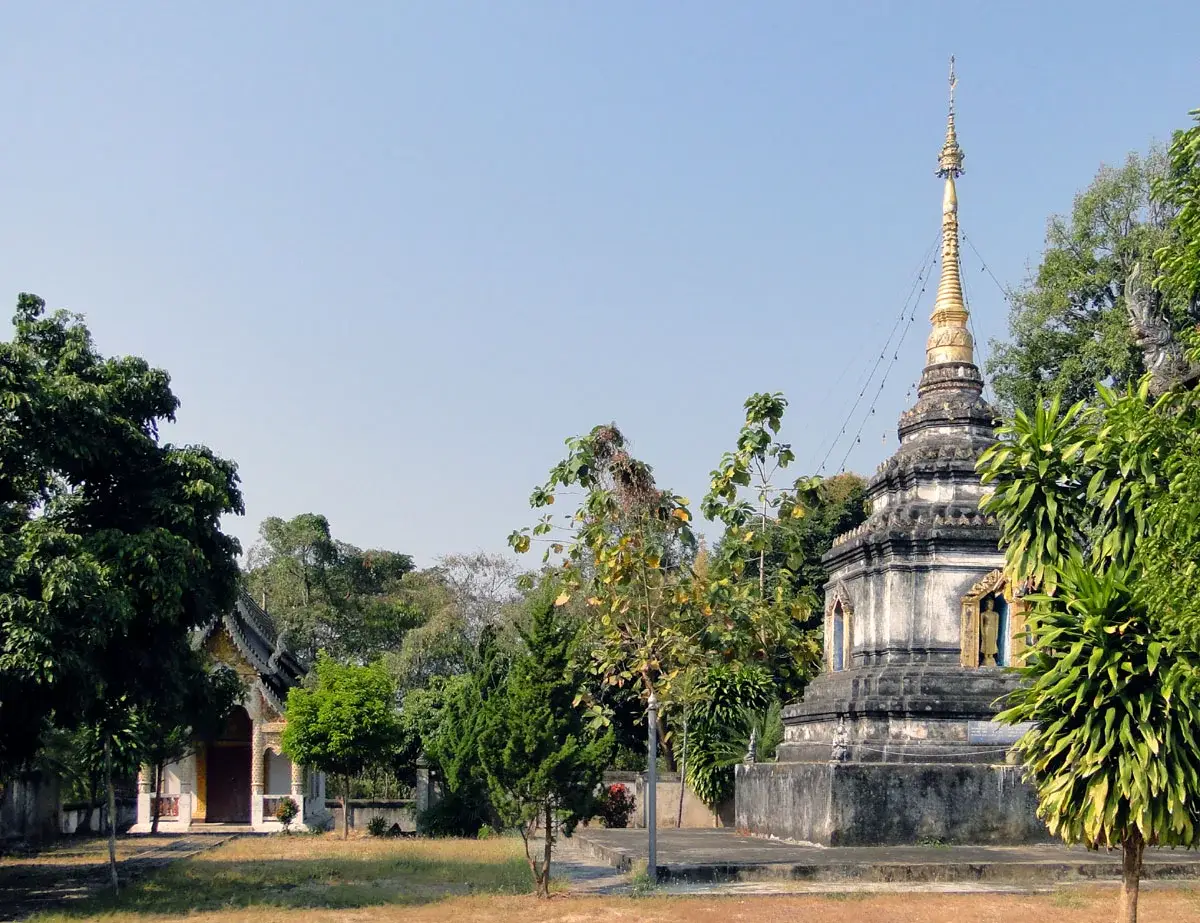
Open Days: Daily
Opening Hours: 08.00 – 17.00
Wat Puang Sanuk is located at 67 Ban Puang Sanuk, Moo 1, Ban Klang Subdistrict, San Pa Tong District, Chiang Mai Province. It is a local Mahanikaya Buddhist temple with a history dating back to 1682. The temple remains an important spiritual center of Ban Puang Sanuk and reflects the quiet character of a northern Thai village temple. Its value lies in its long history, Lanna religious buildings, sacred objects, relationship with the Mae Khan River, and continued role in community Buddhist life.
The temple was originally a place where monks stayed for practice and residence during the Buddhist rains retreat. It later developed into a formal monastery and eventually received its royal consecrated boundary. This origin gives Wat Puang Sanuk a clear identity as a temple rooted in meditation, monastic residence, and community faith rather than tourism. The temple’s story shows how many old Lanna village temples began from simple religious practice areas and gradually became complete community temples.
Wat Puang Sanuk was founded in 1682. It received its royal consecrated boundary, or Wisungkhamsima, in 1907. The consecrated boundary measures 10 meters wide and 16 meters long. In Thai Buddhist tradition, this boundary is essential for formal monastic ceremonies such as ordination and Sangha acts. Its presence confirms the temple’s formal religious status and its long-standing role in the Buddhist life of the Ban Puang Sanuk community.
The temple land covers 3 rai under title deed number 60900. To the north, the temple borders private land. To the south and east, it borders public roads. To the west, it borders the Mae Khan River. The temple also has 2 plots of monastic land covering 16 rai, 1 ngan, and 82 square wah in Ban Klang Subdistrict. The temple grounds are described as an area of longan orchards and bamboo groves, placing the temple within an agricultural landscape typical of San Pa Tong.
The temple’s western boundary along the Mae Khan River gives Wat Puang Sanuk a strong local character. In northern Thai communities, rivers and irrigation systems are closely connected with settlement, farming, village routes, and community identity. A temple located near a river often served not only as a place of worship but also as a central landmark within the life of the village. Wat Puang Sanuk can therefore be understood as a religious site connected with water, agriculture, and the everyday rhythm of Ban Klang.
The name Wat Puang Sanuk is directly tied to Ban Puang Sanuk, Moo 1 of Ban Klang Subdistrict. This close connection between temple and village is important. A village temple is not created for sightseeing alone. It exists because the community needs a place for merit-making, sermons, funerals, community ceremonies, and the transmission of Buddhist values. Wat Puang Sanuk continues to represent this role as a center of faith and social gathering.
The religious buildings at Wat Puang Sanuk include an ordination hall, viharn, sermon hall, monks’ residences, multipurpose hall, and merit-making halls. The ordination hall measures 4 meters wide and 8 meters long. It was built in 1907 and follows a Lanna-style structure. Although compact in size, the ordination hall is one of the most important buildings in the temple because it is directly related to the consecrated boundary and formal monastic ceremonies.
The sermon hall measures 6 meters wide and 13 meters long. It was built around 1919 in a Thai Lanna architectural form. In a village temple, the sermon hall is a practical and symbolic space. It supports listening to Buddhist teachings, merit-making, community meetings, and temple activities. This building shows how the temple serves both religious education and community use.
The viharn measures 7 meters wide and 15 meters long and was built around 1710. The viharn is a key worship space where villagers come to pay respect to Buddha images, make merit, listen to sermons, and take part in Buddhist ceremonies. Since it dates to an early phase of the temple’s history, the viharn is one of the important elements that expresses the continuity of faith at Wat Puang Sanuk.
The temple has 4 monks’ residences, all described as half-concrete and half-wood structures. This form is commonly found in local Thai temples because it combines durability with traditional building materials. The monks’ residences allow the temple to maintain active monastic life. Wat Puang Sanuk also has a multipurpose hall measuring 8 meters wide and 10 meters long, built in 1993, and 3 concrete merit-making halls. These buildings support merit-making, memorial rites, funerals, and community gatherings.
The sacred objects of Wat Puang Sanuk include a Lanna-style stupa, a Lanna-style sermon pulpit, Phra Singh Sam, Phra Singh Nueng, a brass Buddha image in meditation posture, and several other Buddha images. There is also one Buddha image in the merit-making hall and one stupa built around 1689. These sacred objects give the temple a strong Lanna Buddhist identity and make it a meaningful site for visitors interested in local Buddhist art.
The Lanna-style stupa is one of the most important features to observe. In northern Thai temples, a stupa often acts as a central object of devotion and a visible symbol of Buddhist faith. The stupa at Wat Puang Sanuk, associated with the early history of the temple, adds depth to the site and connects the present temple to its older religious foundation.
The Lanna-style sermon pulpit is another important object. A sermon pulpit is not only a piece of furniture; it represents the act of teaching and receiving the Dhamma. In northern Thailand, the culture of listening to sermons has long been central to village Buddhist life. The pulpit at Wat Puang Sanuk helps preserve that tradition within the temple’s physical space.
Phra Singh Sam and Phra Singh Nueng are also significant because the “Phra Singh” form is deeply associated with northern Thai Buddhist art and devotion. These Buddha images connect Wat Puang Sanuk to Lanna artistic traditions. The brass Buddha image in meditation posture further reinforces the temple’s atmosphere of calmness, practice, and inner reflection, which matches the temple’s original role as a place for monastic practice.
The abbot of Wat Puang Sanuk is Phra Athikan Som Chakkawaro. In a village temple, the abbot has a central role in caring for religious buildings, supporting monks, organizing Buddhist ceremonies, guiding laypeople, and maintaining the relationship between the temple and the community. This leadership allows the temple to remain a living religious site rather than a place preserved only as a historic location.
Wat Puang Sanuk plays several roles in Ban Puang Sanuk. Spiritually, it is a place where villagers make merit, pray, and seek peace. Ritually, it supports Buddhist ceremonies, memorial rites, funerals, and merit-making events. Socially, it is a gathering space for local people. Culturally, it preserves Lanna-style buildings, sacred objects, sermon traditions, and the village temple way of life.
Religious events at Wat Puang Sanuk follow the rhythm of Thai Buddhist and northern village life. These include Buddhist holy days, Buddhist Lent, the end of Buddhist Lent, Kathin, Pha Pa, merit-making ceremonies, and memorial rites. The presence of a multipurpose hall, merit-making halls, sermon hall, and viharn allows the temple to support these community activities in an organized way.
The temple’s setting among longan orchards, bamboo groves, public roads, and the Mae Khan River gives it a quiet rural atmosphere. This makes Wat Puang Sanuk suitable for travelers who prefer calm cultural visits rather than crowded tourist sites. The temple is best appreciated slowly, by observing its buildings, sacred objects, river-side setting, and community context.
Important things to see at Wat Puang Sanuk include the Lanna-style ordination hall built in 1907, the viharn built around 1710, the Thai Lanna-style sermon hall built around 1919, the Lanna-style stupa, the Lanna-style sermon pulpit, Phra Singh Sam, Phra Singh Nueng, and the brass Buddha image in meditation posture. These features help visitors understand the temple as both a place of worship and a record of local Lanna heritage.
Visitors should dress respectfully, speak quietly, and remember that Wat Puang Sanuk is an active village temple. If monks or villagers are holding a ceremony, visitors should give them space and follow local etiquette. Respectful travel is especially important at small community temples because the temple remains part of everyday local life.
Wat Puang Sanuk can be included in a cultural route through Ban Klang Subdistrict. Nearby places include Wat Pa Mai Daeng, Wat Rong Som Poi, Wat Si Pan Ngoen, Wat Ton Kok, Wat Tha Kan, Wat Pa Sak, Wat Phra Chao Thong Thip, and Wiang Tha Kan. This route helps travelers understand Ban Klang as an area of village temples, agricultural communities, and historical sites.
Wiang Tha Kan is one of the important ancient sites in Ban Klang Subdistrict. It contains traces of an old city, moats, earthen walls, old temple sites, and archaeological evidence from multiple historical periods. Combining Wat Puang Sanuk with Wiang Tha Kan gives visitors a broader view of San Pa Tong, from living Buddhist village temples to the archaeological remains of an ancient settlement.
Getting There is most convenient by private car, rental car, or local hired transport. From Chiang Mai city, take Highway 108, also known as the Chiang Mai–Hot Road, toward San Pa Tong District. Continue into Ban Klang Subdistrict and Ban Puang Sanuk. When using a map application, search for “Wat Puang Sanuk Ban Klang San Pa Tong” to avoid confusion with similarly named temples in other provinces.
The surrounding roads pass through local communities, so visitors should drive carefully, especially near homes, schools, intersections, and village paths. Daytime travel is recommended for easier navigation and for enough time to visit the temple and nearby places. A half-day route can include Wat Puang Sanuk, Wat Pa Mai Daeng, Wat Rong Som Poi, Wat Si Pan Ngoen, and Wat Ton Kok. A longer route can continue to Wat Tha Kan and Wiang Tha Kan.
Overall, Wat Puang Sanuk is a meaningful old temple of Ban Klang with religious, cultural, and community value. Its key elements include its founding in 1682, royal consecrated boundary in 1907, Lanna-style ordination hall, old viharn, Thai Lanna-style sermon hall, Lanna stupa, sermon pulpit, Phra Singh images, meditation Buddha image, and connection with the Mae Khan River. It is a suitable destination for travelers who want to understand Chiang Mai through quiet village temples, Lanna Buddhist heritage, and the living culture of San Pa Tong.
| Name | Wat Puang Sanuk |
| Location | Ban Puang Sanuk, Moo 1, Ban Klang Subdistrict, San Pa Tong District, Chiang Mai Province |
| Address | 67 Ban Puang Sanuk, Moo 1, Ban Klang Subdistrict, San Pa Tong District, Chiang Mai 50120, Thailand |
| Highlights | An old Ban Puang Sanuk temple founded in 1682, with a Lanna-style ordination hall, old viharn, Lanna stupa, Lanna sermon pulpit, and important Buddha images |
| History | Originally a monastic practice and residence site; formally founded in 1682 and granted its Wisungkhamsima in 1907 |
| Consecrated Boundary | Granted in 1907; the Wisungkhamsima measures 10 meters wide and 16 meters long |
| Temple Land | Temple land covers 3 rai under title deed number 60900; the temple also has 2 monastic land plots covering 16 rai, 1 ngan, and 82 square wah |
| Boundaries | North: private land; South: public road; East: public road; West: Mae Khan River |
| Landscape | The temple grounds are associated with longan orchards and bamboo groves within the agricultural landscape of Ban Klang |
| Main Areas / Zones | Ordination hall, viharn, sermon hall, monks’ residences, multipurpose hall, merit-making halls, stupa area, and sacred-object area |
| Important Structures | Ordination hall measuring 4 by 8 meters, built in 1907 in Lanna style; viharn measuring 7 by 15 meters, built around 1710; sermon hall measuring 6 by 13 meters, built around 1919 in Thai Lanna style |
| Community Buildings | 4 half-concrete, half-wood monks’ residences; multipurpose hall measuring 8 by 10 meters, built in 1993; and 3 concrete merit-making halls |
| Sacred Objects | Lanna-style stupa, Lanna-style sermon pulpit, Phra Singh Sam, Phra Singh Nueng, brass Buddha image in meditation posture, other Buddha images, and a stupa built around 1689 |
| Abbot / Caretaker | Phra Athikan Som Chakkawaro |
| Local Importance | A long-established village temple of Ban Puang Sanuk and a spiritual center connected with agriculture, community life, and the Mae Khan River |
| Travel Information | Travel from Chiang Mai city along Highway 108, the Chiang Mai–Hot Road, toward San Pa Tong. Continue into Ban Klang Subdistrict and Ban Puang Sanuk. Private car, rental car, or local hired transport is recommended. |
| Current Status | A registered Mahanikaya temple and an active religious site of the Ban Puang Sanuk community |
| Open Days | Daily |
| Opening Hours | 08.00 – 17.00 |
| Facilities | Multipurpose hall, merit-making halls, sermon hall, monks’ residences, viharn, ordination hall, and community merit-making spaces |
| Nearby Tourist Attractions | 1. Wat Pa Mai Daeng, about 1 km 2. Wat Rong Som Poi, about 1 km 3. Wat Si Pan Ngoen, about 1.5 km 4. Wat Ton Kok, about 3.5 km 5. Wat Tha Kan, about 4 km 6. Wiang Tha Kan Archaeological Site, about 4 km |
| Nearby Restaurants | 1. Khrua Tam Jai Puang Sanuk, about 1 km, Tel. 061-458-9642 2. Saming Cha Cafe, about 3 km, Tel. 095-447-0110 3. Cafe Vintage1980 San Pa Tong, about 4 km, Tel. 096-084-0462 4. Tree Corner Coffee, about 4 km, Tel. 062-302-9447 5. Anda Peka San Pa Tong Ban Klang, about 5 km, Tel. 063-975-8842 6. Thoe Na Cha Chob Tam Sang San Pa Tong, about 6 km, Tel. 096-694-7277 |
| Nearby Accommodations | 1. Lucky House Long Stay Chiang Mai, about 0.65 km 2. Kaomai Lanna Resort, about 5 km, Tel. 053-481-201, 086-428-7481 3. Huanhomkham Homestay, about 6 km, Tel. 086-183-1327 4. Mae Khan Pool Villa, about 7 km, Tel. 086-831-9164 5. Bannoi Himsuan, about 8 km, Tel. 090-329-6108 6. Baan Suan Kaew Huen Kham @ San Pa Tong, about 10 km, Tel. 081-366-2382 |
Frequently Asked Questions (FAQ)
Q: Where is Wat Puang Sanuk located?
A: Wat Puang Sanuk is located at 67 Ban Puang Sanuk, Moo 1, Ban Klang Subdistrict, San Pa Tong District, Chiang Mai Province.
Q: When was Wat Puang Sanuk founded?
A: Wat Puang Sanuk was founded in 1682. It originally served as a monastic practice and residence site before developing into a formal temple.
Q: When did Wat Puang Sanuk receive its Wisungkhamsima?
A: Wat Puang Sanuk received its Wisungkhamsima in 1907. The consecrated boundary measures 10 meters wide and 16 meters long.
Q: What are the main things to see at Wat Puang Sanuk?
A: Key things to see include the Lanna-style ordination hall, old viharn, Thai Lanna-style sermon hall, Lanna-style stupa, Lanna sermon pulpit, Phra Singh Sam, Phra Singh Nueng, and the brass meditation Buddha image.
Q: Why is Wat Puang Sanuk important to the local community?
A: It is a spiritual center of Ban Puang Sanuk and supports Buddhist ceremonies, merit-making, memorial rites, and community gatherings in Ban Klang Subdistrict.
Q: What kind of traveler is Wat Puang Sanuk suitable for?
A: It is suitable for travelers interested in old temples, Lanna village culture, quiet Buddhist sites, rural San Pa Tong, and cultural routes connected with Wiang Tha Kan.
Q: How can travelers get to Wat Puang Sanuk?
A: Travelers can drive from Chiang Mai city along Highway 108, the Chiang Mai–Hot Road, toward San Pa Tong, then continue into Ban Klang Subdistrict and Ban Puang Sanuk.
Q: What nearby places can be visited with Wat Puang Sanuk?
A: Nearby places include Wat Pa Mai Daeng, Wat Rong Som Poi, Wat Si Pan Ngoen, Wat Ton Kok, Wat Tha Kan, and Wiang Tha Kan Archaeological Site.
 Category: ●Places of Worship
 Group: ●Temple
Last Update : 1 WeekAgo
 Last Update : 1 WeekAgo
 Click to Access the Navigation Map GPS
 Muang Chiang Mai(121)Chom Thong(47)Mae Chaem(25)Chiang Dao(33)Doi Saket(68)Mae Taeng(85)Mae Rim(69)Samoeng(29)Fang(71)Mae Ai(59)Phrao(70)San Pa Tong(103)San Kamphaeng(66)San Sai(73)Hang Dong(73)Hot(32)Doi Tao(22)Omkoi(11)Saraphi(74)Wiang Haeng(15)Chai Prakan(28)Mae Wang(32)Mae On(22)Doi Lo(33)Galyani Vadhana(1)


