
lovethailand home >North Travel Attractions >Chiang Mai Travel Attractions >San Pa Tong >Ban Klang > Wat Tha Kan
TL;DR: Wat Tha Kan is located at Ban Tha Kan, Moo 5, Ban Klang Subdistrict, San Pa Tong District, Chiang Mai Province, open Daily, hours Daytime Visit Recommended.
Wat Tha Kan
Open Days: Daily
Opening Hours: Daytime Visit Recommended
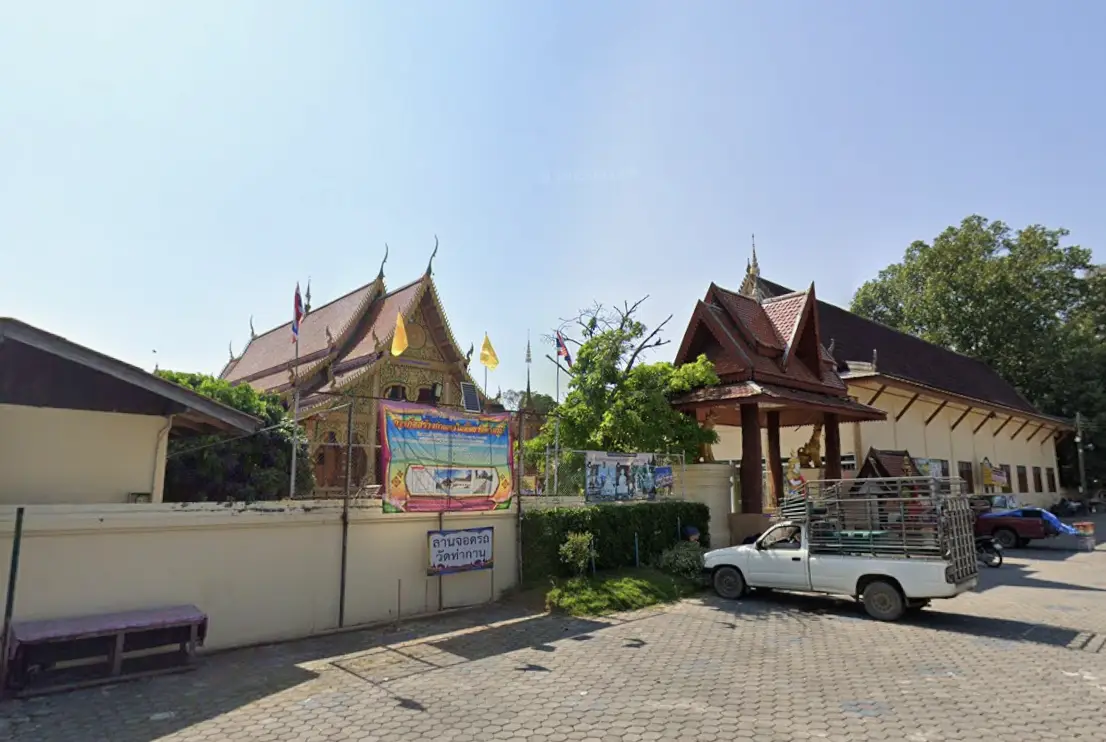
Wat Tha Kan is located at 20 Ban Tha Kan, Moo 5, Ban Klang Subdistrict, San Pa Tong District, Chiang Mai Province. It is a local Mahanikaya Buddhist temple situated at the heart of Ban Tha Kan, a community closely connected with Wiang Tha Kan, one of the most important ancient settlements in the southern part of Chiang Mai. Wat Tha Kan is not only a village temple; it is also a living religious site that links present-day Buddhist practice with the archaeological remains of an old city. Within the temple grounds are an ordination hall, viharn, sermon hall, monks’ residence, merit-making hall, surrounding wall, stupa, old Buddha images, and cultural objects that reflect the long history of the area.
The core significance of Wat Tha Kan lies in its role as a community temple within a major historical landscape. The temple was founded on May 20, 978 CE, corresponding to Buddhist Era 1521. It received its royal consecrated boundary, or Wisungkhamsima, on March 20, 1982, with a boundary measuring 5 meters wide and 10 meters long. The boundary ceremony was completed on March 23, 1982. These details show that Wat Tha Kan combines ancient local history with a formal status as an active Buddhist temple.
The location of Wat Tha Kan is especially important because the temple stands in the center of the village, with houses surrounding it on all 4 sides. The temple grounds are located on lowland terrain, consistent with the landscape of Wiang Tha Kan, an ancient city situated in a fertile plain of San Pa Tong. To the west, the temple adjoins an abandoned temple area with an old original stupa associated with Wiang Kan or Wiang Tha Kan. This setting allows visitors to read the history of the place through both the current temple and the surrounding archaeological remains.
Wat Tha Kan covers 3 rai, 3 ngan, and 60 square wah under title deed number 27840. To the north, the temple borders a road for about 42 wah. To the south, it borders the orchard of Nai Chan Thip for about 42 wah. To the east, it borders a walking path for about 33 wah and 2 sok. To the west, it borders land belonging to an abandoned temple for about 33 wah and 2 sok. The temple also has 11 plots of monastic land covering 38 rai in Ban Klang Subdistrict. These land details show how deeply the temple is embedded in village roads, footpaths, orchards, community land, and old religious ruins.
Ban Tha Kan gives the temple a much deeper meaning than an ordinary village temple. Wiang Tha Kan is an ancient settlement with traces from the Hariphunchai period and later Lanna period. Archaeological remains in the area include old temple ruins, stupas, viharn bases, bricks, roof tiles, votive tablets, Buddha images, and Chinese ceramics from the Yuan dynasty. Ban Tha Kan is therefore not simply a rural community in San Pa Tong. It stands on layers of history that extend across many centuries, and Wat Tha Kan serves as one of the key entry points for understanding that history.
The temple’s religious buildings include an ordination hall, viharn, sermon hall, monks’ residence, merit-making hall, and surrounding wall. The ordination hall measures 5 meters wide and 10 meters long. It was built in 1989 and follows a Thai-style structure. This hall is important because it is directly related to the consecrated boundary and formal monastic ceremonies. Its presence confirms the temple’s role as a proper Buddhist institution for the community.
The viharn measures 10 meters wide and 22 meters long and was built in 1976. It serves as a major worship area where local Buddhists make merit, pay respect to Buddha images, listen to sermons, and take part in temple activities. In northern Thai village temples, the viharn is often the building most closely connected with laypeople because it is used frequently for community religious events. The viharn at Wat Tha Kan therefore represents the living devotional life of Ban Tha Kan.
The sermon hall measures 7.50 meters wide and 27 meters long and was built in 1997 as a single-storey building. It functions as a flexible space for learning, gatherings, religious events, and community activities connected with the temple. The monks’ residence is a half-concrete, half-wood building, providing living space for monks. The temple has about 2 resident monks each year and 4 novices, which helps maintain its active religious role in the community.
The merit-making hall is a concrete building used for community ceremonies, memorial rites, merit-making events, and gatherings. The temple also has a surrounding wall, which defines the sacred space of the temple clearly. In a village setting surrounded by homes, roads, and ancient ruins, this wall helps separate the religious compound from the everyday movement of the community while keeping the temple closely connected to village life.
Wat Tha Kan has a rich group of sacred objects and cultural items. These include a stupa, Chiang Saen-period Buddha images, wooden Buddha images, bronze Buddha images, a gold Buddha image, brass Buddha images, and blue-and-white porcelain. One Buddha image is kept in the sermon hall, and another metal Buddha image in the merit-making hall was made in 1999. These objects reflect continuity of faith, Buddhist art, and local devotion across different periods.
The old Buddha images associated with Wat Tha Kan are especially important because they connect the temple with the older history of Wiang Tha Kan. Local records mention Luang Pho Phet and several old Buddha images connected with the ancient city. These images allow visitors to see the temple not only as a place of worship but also as a site where Buddhist art and local history remain visible.
The blue-and-white porcelain associated with Wat Tha Kan is another important clue to the area’s past. Wiang Tha Kan has yielded Chinese ceramics from the Yuan dynasty, reflecting the wealth, exchange networks, and cultural importance of the old settlement. Objects like these give Wat Tha Kan a strong educational value because they help connect Buddhist practice with archaeology, trade, and the social status of the ancient city.
The abbot of Wat Tha Kan is Phra Khru Winaithon Theerapol Santachitto, who has served as abbot since 2001. He also serves as chairman of a public training unit. His educational background includes a bachelor’s degree from Mahachulalongkornrajavidyalaya University, Lamphun campus. His role therefore extends beyond temple administration into community development, education, and the continuing relationship between the temple and local residents.
The recorded succession of abbots at Wat Tha Kan shows the continuity of temple leadership. The list includes Phra Athikan Ai Suphatto, Phra Athikan Ngoen Apiwongso, Phra Phraiwan Inthapanyo, Phra Sawat Aphakaro, Phra Thana Thanawaro, Phra Sutham Chittadhammo, Phra Mit Thitathammo, Phra Thon Inthapanyo, Phra Khru Udom Thanaro, and Phra Khru Winaithon Theerapol Santachitto. This continuity helps explain how the temple has remained active from earlier generations into the present.
The relationship between Wat Tha Kan and Wiang Tha Kan is the key to understanding this temple. Wiang Tha Kan is an ancient city area with remains of moats, walls, abandoned temples, stupas, viharn bases, and many artifacts. It was an important settlement in the Hariphunchai period and continued into the Lanna period. Wat Tha Kan, standing at the center of Ban Tha Kan, connects the living Buddhist community with the ruins and memories of the ancient city.
Wat Tha Kan is also connected with the Thai Cultural Community Network Center of Wiang Tha Kan. This center was created to gather information about Wiang Tha Kan, preserve artifacts, and support learning about religion, art, and culture for young people, local residents, and visitors. This role makes the temple valuable not only as a religious site but also as a place for cultural learning.
As a community temple, Wat Tha Kan supports Buddhist holy days, Buddhist Lent, the end of Buddhist Lent, Kathin, Pha Pa, merit-making ceremonies, memorial rites, and other local events. The temple area is also associated with contemporary community activities such as local markets and cultural events. This makes Wat Tha Kan a living center where religion, culture, and community participation continue to meet.
The temple’s role in Ban Tha Kan can be understood in several dimensions. Spiritually, it is a center of faith. Ritually, it is a place for Buddhist ceremonies and merit-making. Socially, it is a gathering place for the village. Culturally, it preserves the memory of Wiang Tha Kan through Buddha images, ancient objects, learning spaces, and local storytelling.
Important things to see at Wat Tha Kan include the viharn built in 1976, the ordination hall built in 1989, the sermon hall built in 1997, the stupa, Chiang Saen-period Buddha images, wooden Buddha images, bronze Buddha images, the gold Buddha image, brass Buddha images, blue-and-white porcelain, and the cultural learning area linked with Wiang Tha Kan. Visitors with time should also explore the nearby abandoned temple area and archaeological remains to understand the wider historical setting.
The atmosphere of Wat Tha Kan is best suited to cultural travelers, history enthusiasts, those interested in Lanna temples, and visitors who want to understand the relationship between an active village temple and an ancient city. It is not a commercial tourist attraction. Its appeal lies in its quiet setting, living community role, and layers of religious and archaeological history. Visitors should dress respectfully, speak quietly, and avoid disturbing monks or local ceremonies.
Getting There is convenient by private car, rental car, or local hired transport. From Chiang Mai city, take Highway 108, also known as the Chiang Mai–Hot Road, through San Pa Tong District. Turn toward Ban Tha Kan near the Ban Thung Siao junction, then continue into the community for about 2 km. Since Wat Tha Kan is close to Wiang Tha Kan Archaeological Site, travelers should allow enough time to visit both the active temple and the surrounding ruins.
A suitable connected route is the Ban Tha Kan–Wiang Tha Kan cultural route. Visitors can begin at Wat Tha Kan and the local cultural center, then continue to Wiang Tha Kan Archaeological Site, Wat Ton Kok, Wat Sam Lang, Wat San Hao, Wat Phra Chao Thong Thip, and Wat Puang Sanuk. This route shows both living temples and ancient ruins, making it more meaningful than visiting a single site in isolation.
Overall, Wat Tha Kan is an important temple of Ban Tha Kan with a long foundation history, formal consecrated boundary, complete religious buildings, diverse sacred objects, old Buddha images, artifacts linked with Wiang Tha Kan, and an active role as a community center. It is especially valuable for travelers who want to understand Chiang Mai through ancient city heritage, village Buddhism, and Lanna cultural continuity.
| Name | Wat Tha Kan |
| Location | Ban Tha Kan, Moo 5, Ban Klang Subdistrict, San Pa Tong District, Chiang Mai Province |
| Address | 20 Ban Tha Kan, Moo 5, Ban Klang Subdistrict, San Pa Tong District, Chiang Mai 50120, Thailand |
| Highlights | A central temple of Ban Tha Kan linked with Wiang Tha Kan, an ancient Hariphunchai and Lanna settlement, with multiple religious buildings and sacred objects |
| History | Founded on May 20, 978 CE; received its Wisungkhamsima on March 20, 1982; boundary ceremony completed on March 23, 1982 |
| Temple Land | Temple land covers 3 rai, 3 ngan, and 60 square wah under title deed number 27840; it also has 11 monastic land plots covering 38 rai |
| Boundaries | North: road; South: orchard of Nai Chan Thip; East: walking path; West: abandoned temple land |
| Distinctive Features | Located at the center of the village and surrounded by homes on all 4 sides; the west side adjoins an abandoned temple area with an old original stupa of Wiang Kan |
| Main Areas / Zones | Ordination hall, viharn, sermon hall, monks’ residence, merit-making hall, surrounding wall, stupa, sacred-object area, and Thai Cultural Community Network Center of Wiang Tha Kan |
| Important Structures | Ordination hall measuring 5 by 10 meters, built in 1989; viharn measuring 10 by 22 meters, built in 1976; sermon hall measuring 7.50 by 27 meters, built in 1997 |
| Sacred Objects | Stupa, Chiang Saen-period Buddha images, wooden Buddha images, bronze Buddha images, gold Buddha image, brass Buddha images, blue-and-white porcelain, and metal Buddha image made in 1999 |
| Abbot / Caretaker | Phra Khru Winaithon Theerapol Santachitto |
| Monks And Novices | Approximately 2 resident monks each year and 4 novices |
| Local Importance | A community temple and cultural learning site connected with religion, art, local history, and Wiang Tha Kan heritage |
| Travel Information | Travel from Chiang Mai city via Highway 108, the Chiang Mai–Hot Road, through San Pa Tong. Turn toward Ban Tha Kan near Ban Thung Siao and continue about 2 km into the community. |
| Current Status | A registered Mahanikaya temple and an important religious site of Ban Tha Kan community |
| Open Days | Daily |
| Recommended Visiting Time | Morning or late afternoon is suitable for temple visits and walking around nearby archaeological remains |
| Facilities | Sermon hall, merit-making hall, monks’ residence, religious activity areas, and cultural learning space in the community |
| Nearby Tourist Attractions | 1. Wiang Tha Kan Archaeological Site, about 0.5 km 2. Wiang Tha Kan Information Center, about 0.5 km 3. Wat Ton Kok, about 2 km 4. Wat Puang Sanuk, about 3 km 5. Wat Phra Chao Thong Thip, about 4 km 6. Wat Pa Sak Ban Klang, about 4 km |
| Nearby Restaurants | 1. Som Tam Pa Nak Beside Wat Tha Kan, about 0.2 km, Tel. 053-829-515 2. Wiwa Latdara Tha Kan San Pa Tong, about 1 km, Tel. 082-624-7453 3. Song Nakhon Restaurant San Pa Tong, about 4 km, Tel. 098-771-7581 4. Kuai Tiao Ton Kok, about 4 km, Tel. 092-872-6536 5. Cafe Vintage1980 San Pa Tong, about 6 km, Tel. 096-084-0462 6. Baan Plai Suan Restaurant San Pa Tong, about 7 km, Tel. 063-847-3142, 093-321-0885, 062-541-2652 |
| Nearby Accommodations | 1. Kaomai Lanna Resort, about 3 km, Tel. 053-481-201 2. Bannoi Himsuan, about 7 km, Tel. 090-329-6108 3. Mae Khan Pool Villa, about 8 km, Tel. 086-831-9164 4. Huen Hom Kham Homestay, about 8 km, Tel. 086-183-1327 5. Muan Jai Hotel, about 9 km, Tel. 081-884-7545 6. Baan Suan Kaew Huen Kham @ San Pa Tong, about 10 km, Tel. 081-366-2382 |
Frequently Asked Questions (FAQ)
Q: Where is Wat Tha Kan located?
A: Wat Tha Kan is located at 20 Ban Tha Kan, Moo 5, Ban Klang Subdistrict, San Pa Tong District, Chiang Mai Province.
Q: When was Wat Tha Kan founded?
A: Wat Tha Kan was founded on May 20, 978 CE and received its Wisungkhamsima on March 20, 1982.
Q: How is Wat Tha Kan connected with Wiang Tha Kan?
A: Wat Tha Kan is located in Ban Tha Kan, within the Wiang Tha Kan historical area, where old temple ruins, stupas, viharn bases, and artifacts from several historical periods can still be found.
Q: What are the main things to see at Wat Tha Kan?
A: Key features include the ordination hall, viharn, sermon hall, stupa, Chiang Saen-period Buddha images, wooden Buddha images, bronze Buddha images, gold Buddha image, brass Buddha images, and blue-and-white porcelain.
Q: Who is the abbot of Wat Tha Kan?
A: The abbot of Wat Tha Kan is Phra Khru Winaithon Theerapol Santachitto.
Q: What kind of traveler is Wat Tha Kan suitable for?
A: It is suitable for travelers interested in old temples, Lanna community temples, archaeological sites, Wiang Tha Kan, Buddhist art, and local history in San Pa Tong.
Q: How can travelers get to Wat Tha Kan?
A: Travelers can take Highway 108 from Chiang Mai city through San Pa Tong, then turn toward Ban Tha Kan near Ban Thung Siao and continue about 2 km into the community.
Q: What nearby places can be visited with Wat Tha Kan?
A: Nearby places include Wiang Tha Kan Archaeological Site, Wiang Tha Kan Information Center, Wat Ton Kok, Wat Puang Sanuk, Wat Phra Chao Thong Thip, and Wat Pa Sak Ban Klang.
 Category: ●Places of Worship
 Group: ●Temple
Last Update : 1 WeekAgo
 Last Update : 1 WeekAgo
 Click to Access the Navigation Map GPS
 Muang Chiang Mai(121)Chom Thong(47)Mae Chaem(25)Chiang Dao(33)Doi Saket(68)Mae Taeng(85)Mae Rim(69)Samoeng(29)Fang(71)Mae Ai(59)Phrao(70)San Pa Tong(103)San Kamphaeng(66)San Sai(73)Hang Dong(73)Hot(32)Doi Tao(22)Omkoi(11)Saraphi(74)Wiang Haeng(15)Chai Prakan(28)Mae Wang(32)Mae On(22)Doi Lo(33)Galyani Vadhana(1)


