
lovethailand home >North Travel Attractions >Chiang Mai Travel Attractions >San Pa Tong >Nam Bo Luang > Wat Huai Thong
TL;DR: Wat Huai Thong is located at Ban Huai Thong, Nam Bo Luang Subdistrict, San Pa Tong District, Chiang Mai Province, open Daily, hours 08.00 AM – 05.00 PM.

Wat Huai Thong
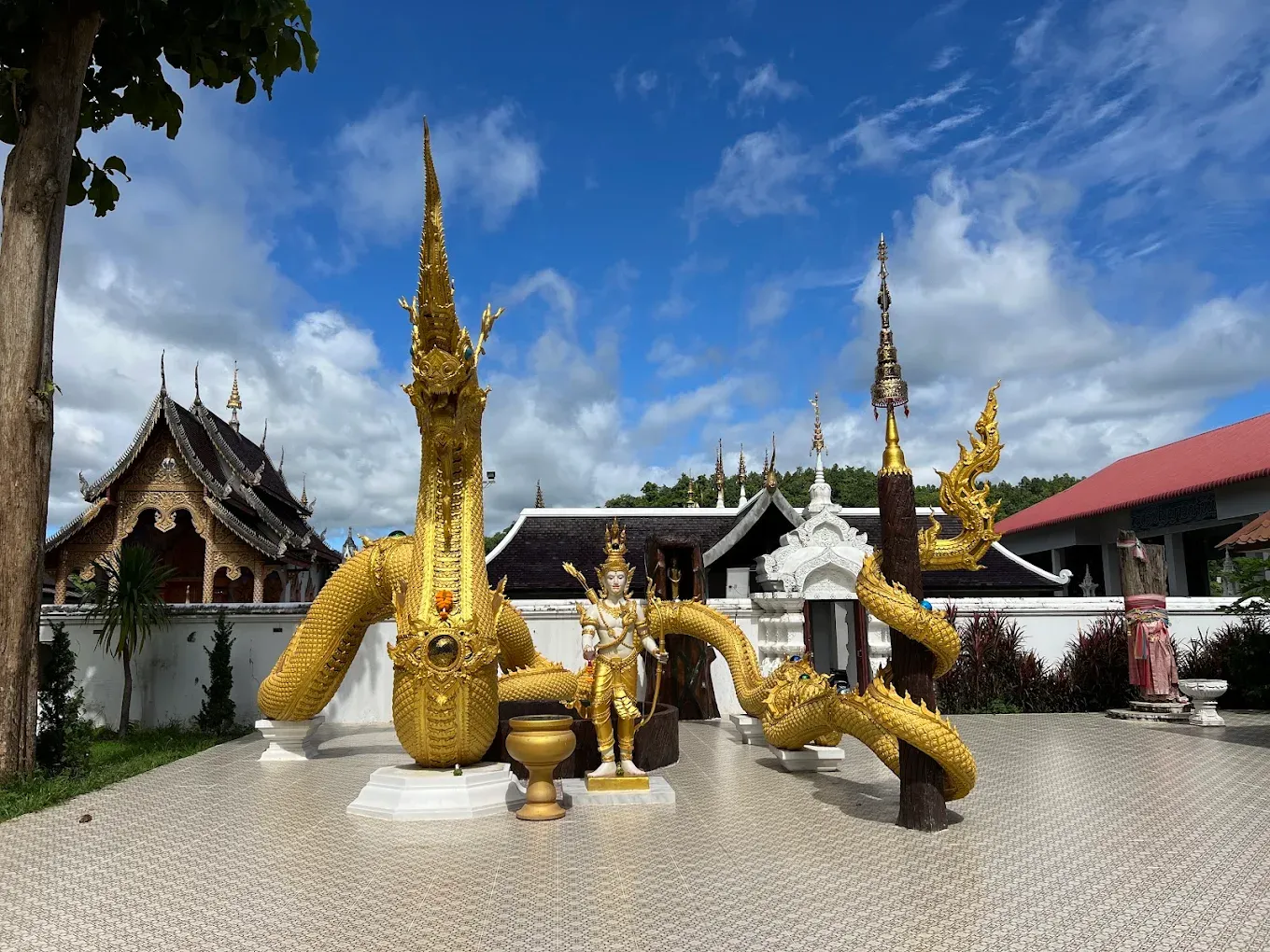
Open Days: Daily
Opening Hours: 08.00 AM – 05.00 PM
Wat Huai Thong is a Mahanikaya community Buddhist temple located at No. 9, Ban Huai Thong, Nam Bo Luang Subdistrict, San Pa Tong District, Chiang Mai Province. The temple was formerly associated with Village No. 7 of San Klang Subdistrict before being recorded in Nam Bo Luang Subdistrict. The temple land covers 5 rai, 2 ngan, and 54 square wah, with one monastic land plot of the same size. Founded in 1912 under the leadership of Phra Un, the temple later became abandoned before being restored as a temple with resident monks on 21 January 1974. It was also officially permitted as a temple in 1974. Important structures include the viharn, monks’ residence, sermon hall, dining hall, and chedi. The temple is administered by Phra Udon Chanthathammo.
Wat Huai Thong is a community Buddhist temple in Ban Huai Thong, Nam Bo Luang Subdistrict, San Pa Tong District, Chiang Mai Province. Located at No. 9, the temple belongs to the Mahanikaya monastic order and has long served as a religious center for the Ban Huai Thong community. It supports merit-making, Dhamma listening, food offerings, Buddhist ceremonies, and community gatherings throughout the year. Its importance comes from its founding in 1912, its period as an abandoned temple, its official revival in 1974, and its location between village life, gardens, public roads, and reserved forest.
The name Wat Huai Thong is directly connected with Ban Huai Thong, the village where the temple is located. In Lanna village culture, a temple is often both a religious institution and a marker of community identity. Wat Huai Thong therefore represents more than a place for ceremonies. It is a familiar spiritual landmark where villagers gather during Buddhist holy days, annual merit-making, family rites, and community activities.
The temple land covers 5 rai, 2 ngan, and 54 square wah. Wat Huai Thong also has one monastic land plot covering 5 rai, 2 ngan, and 54 square wah. This land base supports the temple’s main religious structures, worship areas, monastic residence, and community event space. The temple is not a large commercial tourist attraction; it is a living village temple designed to support worship, monastic life, and community merit-making in a practical and peaceful setting.
The temple boundaries reflect its village and natural surroundings. To the north, it borders private garden land. To the south, it borders a public road. To the east, it borders reserved forest. To the west, it borders villagers’ houses. These boundaries place Wat Huai Thong between forest, gardens, roads, and homes, giving it a setting that combines religious life, nature, agriculture, and community movement.
The eastern boundary adjoining reserved forest is especially important to the atmosphere of the temple. Nam Bo Luang Subdistrict contains forested and foothill landscapes as well as village and agricultural areas. A temple near reserved forest naturally feels quieter and more connected with the landscape than a temple located in a dense urban setting. At the same time, its connection with homes and a public road keeps the temple accessible and close to daily village life.
Wat Huai Thong was founded in 1912 under the leadership of Phra Un. This founding history reflects the development of a Lanna community temple through the faith of monks and villagers. Phra Un played an important role in establishing the temple as a Buddhist center for Ban Huai Thong, allowing local people to have a place for merit-making, Dhamma listening, and religious ceremonies close to home.
Later, Wat Huai Thong became abandoned. It was revived when the Ministry of Education declared the abandoned temple to be a temple with resident monks on 21 January 1974. It was also officially permitted as a temple in 1974. This revival is one of the most important parts of the temple’s history because it shows how a religious site that had fallen into disuse returned to active Buddhist life. The temple’s story is therefore one of founding, abandonment, and revival.
The restoration of an abandoned temple into an active temple has deep meaning for a local community. A temple with resident monks can support regular ceremonies, merit-making, blessings, Dhamma teaching, and community activities. For Ban Huai Thong, the revival of Wat Huai Thong returned a spiritual center to the village and allowed the temple to resume its role as a place of worship and communal gathering.
The temple is administered by Phra Udon Chanthathammo, who is listed as the abbot. In a community temple, the abbot’s role includes caring for monks, maintaining buildings, receiving lay supporters, conducting Buddhist ceremonies, organizing merit-making events, and preserving the temple as a peaceful and appropriate religious space. For a temple with a history of revival, continuous stewardship is especially important.
The main structures at Wat Huai Thong include the viharn, monks’ residence, sermon hall, dining hall, and chedi. These structures form the functional core of a village temple. The viharn supports worship and Buddhist ceremonies. The monks’ residence supports resident monks. The sermon hall supports Dhamma listening and community gatherings. The dining hall supports food offerings and monastic meals. The chedi serves as an important sacred object and spiritual landmark.
The viharn is the most important place for visitors to begin their visit. In a Lanna community temple, the viharn is usually the heart of lay worship. It is used for paying respect to the Buddha, receiving precepts, chanting, listening to sermons, and participating in Buddhist holy day activities. Visitors should begin by paying respect in the viharn before walking around the temple grounds.
The monks’ residence allows Wat Huai Thong to maintain continuous monastic life. Resident monks receive offerings, conduct ceremonies, give blessings, teach Dhamma, and support villagers in both regular Buddhist practice and family rites. The monks’ residence is therefore not simply accommodation; it is part of the foundation that keeps Buddhist practice active in Ban Huai Thong.
The sermon hall is an important space for Dhamma talks, lay gatherings, Kathin, robe-offering ceremonies, memorial rites, and other merit-making events. In a village temple, the sermon hall often becomes the place where villagers gather during important occasions. It has both religious and social value because it helps the temple serve the wider community.
The dining hall reflects the merit-making culture of the local community. Offering food to monks is a regular part of Buddhist life in Lanna villages. The dining hall supports meal offerings, temple events, and the practical relationship between monks and lay supporters. It shows that temple life is sustained not only through ceremonies but also through everyday acts of generosity.
The chedi is the main sacred object of Wat Huai Thong. In Lanna Buddhist culture, a chedi often represents accumulated merit, Buddhist continuity, and the faith of generations. It gives the temple a clear spiritual focus and adds to the devotional atmosphere of the grounds. Visitors should approach the chedi respectfully and observe the surrounding area with care.
The chedi also gives Wat Huai Thong a visual and symbolic center. It is not merely an architectural feature but a sacred structure respected by the local community. Visitors should treat the chedi as a place of reverence, not simply as a photo spot. Walking quietly around the temple grounds allows visitors to better appreciate its meaning within village Buddhist life.
The atmosphere of Wat Huai Thong is simple, peaceful, and connected with nature. One side of the temple adjoins reserved forest, while other sides connect with homes, gardens, and a public road. This setting suits visitors who want to experience a quiet community temple rather than a large commercial attraction. It offers a view of Lanna temple life at village level, where religion, nature, and community coexist.
Wat Huai Thong serves as a spiritual center for Ban Huai Thong. It supports Buddhist holy days, merit-making, food offerings, Kathin, robe-offering ceremonies, and community rites. The temple is also a meeting place where elders, families, monks, and lay supporters come together in a religious atmosphere. This gives the temple both spiritual and social importance.
Annual and seasonal activities at Wat Huai Thong follow the Buddhist calendar, including Buddhist holy days, Buddhist Lent, the end of Buddhist Lent, Kathin, robe-offering ceremonies, and community merit-making. These activities help villagers support the temple, maintain religious practice, and strengthen community ties. Merit-making at a village temple is both a religious act and a social practice that keeps the community connected.
During Buddhist Lent and the end of Buddhist Lent, community temples such as Wat Huai Thong become especially important. Laypeople often visit the temple to make merit, listen to Dhamma, offer food, observe precepts, and renew their commitment to Buddhist practice. The presence of resident monks gives the village a clear rhythm of religious life throughout the rainy-season retreat.
Kathin and robe-offering ceremonies are also important for the relationship between temple and community. These events allow villagers and supporters to help maintain the temple, repair or support temple structures, provide necessary items, and express collective faith. At Wat Huai Thong, such activities help sustain the temple’s role as the spiritual center of Ban Huai Thong.
The distinctive value of Wat Huai Thong lies in its history of founding, abandonment, and revival. Founded in 1912, revived in 1974, and located between gardens, road, homes, and reserved forest, the temple reflects the resilience of village Buddhism. It is suitable for visitors interested in Lanna community temples, local temple history, and quieter cultural routes in Nam Bo Luang.
Important areas to see at Wat Huai Thong include the viharn, chedi, sermon hall, dining hall, monks’ residence, temple courtyard, and the surrounding landscape connected with reserved forest, gardens, homes, and public roads. Visitors should walk slowly and respectfully, beginning with worship in the viharn before paying respect at the chedi and observing other areas of the temple.
Visitors should dress respectfully, speak quietly, avoid disturbing monks’ living areas, avoid touching the chedi or sacred objects unnecessarily, and avoid entering private or restricted areas. If a merit-making event or community activity is taking place, visitors should follow the guidance of monks, temple committee members, or local caretakers.
Getting There is most convenient by private car, rental car, or local hired transport. From Chiang Mai city, travel toward San Pa Tong District, then continue into Nam Bo Luang Subdistrict and Ban Huai Thong. To avoid confusion with temples of similar names in other provinces, travelers should search for Wat Huai Thong Nam Bo Luang or Wat Huai Thong San Pa Tong.
A meaningful cultural route can begin at Wat Huai Thong, then continue to Lam Nam Khan at Ban Huai Thong, Wat Nam Bo Luang, Wat Thung Fa Ham, Wat Rong Wua, Wat Chom Chaeng, Ban Nam Bo Luang Community Market, or Wat Mai Hua Fai. This route connects old temples, forest temples, village temples, water landscapes, local markets, and the Lanna cultural setting of southern Chiang Mai.
Overall, Wat Huai Thong is a valuable religious and cultural site in San Pa Tong District. Its importance comes from its founding in 1912, its revival from an abandoned temple in 1974, its main village temple structures, its chedi, and its role as the spiritual center of Ban Huai Thong. For travelers seeking a quiet and authentic view of Chiang Mai’s living village temples, Wat Huai Thong is worth visiting with respect.
| Name | Wat Huai Thong |
| Location | Ban Huai Thong, Nam Bo Luang Subdistrict, San Pa Tong District, Chiang Mai Province |
| Address | No. 9, Ban Huai Thong, Nam Bo Luang Subdistrict, San Pa Tong District, Chiang Mai Province, Thailand |
| Former / Current Area | Formerly Village No. 7, San Klang Subdistrict; Currently In Nam Bo Luang Subdistrict, San Pa Tong District |
| Monastic Order | Mahanikaya |
| Temple Type | Community Temple |
| Open Days | Daily |
| Opening Hours | 08.00 AM – 05.00 PM |
| Temple Land | 5 Rai, 2 Ngan, And 54 Square Wah |
| Monastic Land | 1 Plot, 5 Rai, 2 Ngan, And 54 Square Wah |
| Boundaries | North: Private Garden Land; South: Public Road; East: Reserved Forest; West: Villagers’ Houses |
| History | Founded In 1912 By Phra Un; Later Became Abandoned; Declared A Temple With Resident Monks On 21 January 1974 |
| Temple Permission | Officially Permitted As A Temple In 1974 |
| Abbot / Caretaker | Phra Udon Chanthathammo |
| Important Structures | Viharn, Monks’ Residence, Sermon Hall, And Dining Hall |
| Sacred Object | Chedi |
| Main Areas / Zones | Viharn, Chedi, Monks’ Residence, Sermon Hall, Dining Hall, Temple Courtyard, And Community Merit-Making Area |
| Highlights | Community temple founded in 1912, revived from an abandoned temple in 1974, with a chedi and a peaceful setting connected with reserved forest, gardens, homes, and public road |
| Traditions / Merit-Making | Buddhist Holy Days, Buddhist Lent, The End Of Buddhist Lent, Kathin, Robe-Offering Ceremonies, And Community Merit-Making |
| Phone | 087-178-2824 |
| Current Status | Active Community Temple In Ban Huai Thong, Nam Bo Luang Subdistrict, San Pa Tong District, Chiang Mai Province |
| Travel Information | Travel From Chiang Mai City Toward San Pa Tong District, Then Continue Into Nam Bo Luang Subdistrict And Ban Huai Thong; Private Car, Rental Car, Or Local Hired Transport Is Recommended |
| Nearby Tourist Attractions | 1. Lam Nam Khan At Ban Huai Thong, About 2 Km 2. Wat Nam Bo Luang, About 5 Km 3. Wat Thung Fa Ham, About 6 Km 4. Wat Rong Wua, About 7 Km 5. Ban Nam Bo Luang Community Market, About 7 Km |
| Nearby Restaurants | 1. MIRACLE COFFEE Nam Bo Luang, About 6 Km, Tel. 086-917-8080 2. Tea Tree House, About 7 Km, Tel. 089-431-7600, 091-075-7478 3. DeeTorJai Home & Cafe, About 8 Km, Tel. 080-336-7373 4. Coffee & Craft In Home, About 8 Km, Tel. 096-014-6459 5. Hong Lap Mae Wang 88, About 10 Km, Tel. 081-062-2544 |
| Nearby Accommodations | 1. Deetorjai FarmStay, About 6 Km, Tel. 098-645-2652 2. Tea Tree House, About 7 Km, Tel. 089-431-7600 3. Baan Suan Kaew Huen Kham @ San Pa Tong, About 9 Km, Tel. 081-366-2382 4. Nakamaharuy Khun Nueng Art & Gallery, About 9 Km 5. Lake View @ Sanpatong, About 11 Km |
Frequently Asked Questions (FAQ)
Q: Where Is Wat Huai Thong Located?
A: Wat Huai Thong is located at No. 9, Ban Huai Thong, Nam Bo Luang Subdistrict, San Pa Tong District, Chiang Mai Province.
Q: What Are The Opening Days And Hours Of Wat Huai Thong?
A: Wat Huai Thong is open daily from 08.00 AM to 05.00 PM.
Q: When Was Wat Huai Thong Founded?
A: Wat Huai Thong was founded in 1912 under the leadership of Phra Un.
Q: Was Wat Huai Thong Once An Abandoned Temple?
A: Yes. Wat Huai Thong later became abandoned before being declared a temple with resident monks on 21 January 1974 and officially permitted as a temple in 1974.
Q: What Important Structures Are Found At Wat Huai Thong?
A: Important structures include the viharn, monks’ residence, sermon hall, dining hall, temple courtyard, and community merit-making area.
Q: What Is The Main Sacred Object At Wat Huai Thong?
A: The main sacred object of Wat Huai Thong is the chedi.
Q: Who Is The Abbot Of Wat Huai Thong?
A: Phra Udon Chanthathammo is listed as the abbot of Wat Huai Thong.
Q: What Nearby Places Can Be Visited Together With Wat Huai Thong?
A: Nearby places include Lam Nam Khan at Ban Huai Thong, Wat Nam Bo Luang, Wat Thung Fa Ham, Wat Rong Wua, and Ban Nam Bo Luang Community Market.
 Category: ●Places of Worship
 Group: ●Temple
Last Update : 1 WeekAgo
 Last Update : 1 WeekAgo
 Click to Access the Navigation Map GPS
Wat Huai Thong Map
Recommend

 Muang Chiang Mai(121)Chom Thong(47)Mae Chaem(25)Chiang Dao(33)Doi Saket(68)Mae Taeng(85)Mae Rim(69)Samoeng(29)Fang(71)Mae Ai(59)Phrao(70)San Pa Tong(103)San Kamphaeng(66)San Sai(73)Hang Dong(73)Hot(32)Doi Tao(22)Omkoi(11)Saraphi(74)Wiang Haeng(15)Chai Prakan(28)Mae Wang(32)Mae On(22)Doi Lo(33)Galyani Vadhana(1)


