
lovethailand home >North Travel Attractions >Chiang Mai Travel Attractions >San Pa Tong >Nam Bo Luang > Wat Rong Wua (Nam Bo Luang)
TL;DR: Wat Rong Wua (Nam Bo Luang) is located at Ban Rong Wua, Village No. 1, Nam Bo Luang Subdistrict, San Pa Tong District, Chiang Mai Province.
Wat Rong Wua (Nam Bo Luang)
Operating day: Daily
Operating time: 08.00 - 17.00
Wat Rong Wua (Nam Bo Luang) is a Mahanikaya community Buddhist temple located at No. 144, Ban Rong Wua, Village No. 1, Nam Bo Luang Subdistrict, San Pa Tong District, Chiang Mai Province. The area was formerly Village No. 4 of San Klang Subdistrict before being recorded as Village No. 1 of Nam Bo Luang Subdistrict. The temple was founded in 1749 under the leadership of Kruba Som Sopha and received Wisungkham Sima on 21 November 1989, with a consecrated boundary measuring 16 meters wide and 24 meters long. Important structures include the viharn, 700-year memorial sermon hall, monks’ residence, salabat hall, dining hall, ordination hall, chedi, and temple courtyard.
Wat Rong Wua (Nam Bo Luang) is an old community temple in Ban Rong Wua, Nam Bo Luang Subdistrict, San Pa Tong District, Chiang Mai Province. It is located at No. 144 in Ban Rong Wua and currently belongs to Village No. 1 of Nam Bo Luang Subdistrict. In the past, this area was recorded as Village No. 4 of San Klang Subdistrict. The temple belongs to the Mahanikaya monastic order and remains an important religious center for the Ban Rong Wua community.
The name Wat Rong Wua is directly connected with Ban Rong Wua, the village where the temple is located. This close relationship between temple name and village name shows how deeply the temple is embedded in local identity. For local people, the temple is not only a place for occasional ceremonies. It is a familiar community landmark used for merit-making, Buddhist holy day observances, family rites, annual events, and village gatherings across generations.
The temple land covers 7 rai, 2 ngan, and 36 square wah under Nor Sor 3 Kor document No. 1064. Wat Rong Wua also has monastic land under Nor Sor 3 Kor document No. 1733, covering 4 rai and 90 square wah, and Nor Sor 3 Kor document No. 1734, covering 7 rai and 50 square wah. This land base supports the temple’s religious functions and provides space for its viharn, sermon hall, monks’ residence, salabat hall, dining hall, ordination hall, chedi, and community activities.
The boundaries of Wat Rong Wua reflect its village and agricultural setting. To the north, the temple borders a walking path for about 35 wah. To the south, it borders an irrigation canal for about 35 wah. To the east, it borders a public road for about 66 wah. To the west, it borders private garden land for about 66 wah. These boundaries place the temple within a living landscape of roads, canals, gardens, and community movement.
The irrigation canal to the south is especially meaningful because Nam Bo Luang is closely connected with agriculture and water systems. The temple’s setting near walking paths, public roads, canals, and garden land shows that it is not isolated from daily life. It is part of the community’s real working landscape, where religious life, farming, travel, and village activities meet.
Wat Rong Wua was founded in 1749 under the leadership of Kruba Som Sopha. This makes it one of the old village temples in the San Pa Tong area. In Lanna culture, a kruba often played a role not only as a ritual leader but also as a guide for community faith, temple construction, and local religious development. The founding of Wat Rong Wua therefore reflects cooperation between a revered monk and local villagers who wanted to establish a stable Buddhist center for their community.
Kruba Som Sopha is an important figure in the temple’s early history. His role as the leader of the temple’s construction gives Wat Rong Wua a strong connection with the Lanna tradition of kruba-led community development. The temple should therefore be understood not only as a physical structure but also as the result of shared faith, collective labor, and the desire to preserve Buddhism in Ban Rong Wua.
Wat Rong Wua received Wisungkham Sima on 21 November 1989. The consecrated boundary measures 16 meters wide and 24 meters long. In Thai Buddhist tradition, Wisungkham Sima is important because it defines the formal boundary for Sangha acts, especially ceremonies connected with the ordination hall. A temple with an ordination hall and Wisungkham Sima has a clear ecclesiastical function within the monastic system.
The temple is administered by Phra Khru Siriwutthikorn, who is listed as the abbot. In a community temple, the abbot’s role includes caring for monks, maintaining temple structures, coordinating with lay supporters, organizing merit-making events, and preserving the temple as a peaceful and appropriate religious space. Because Wat Rong Wua has several important buildings and multiple monastic land plots, continuous leadership is important for maintaining its role in the community.
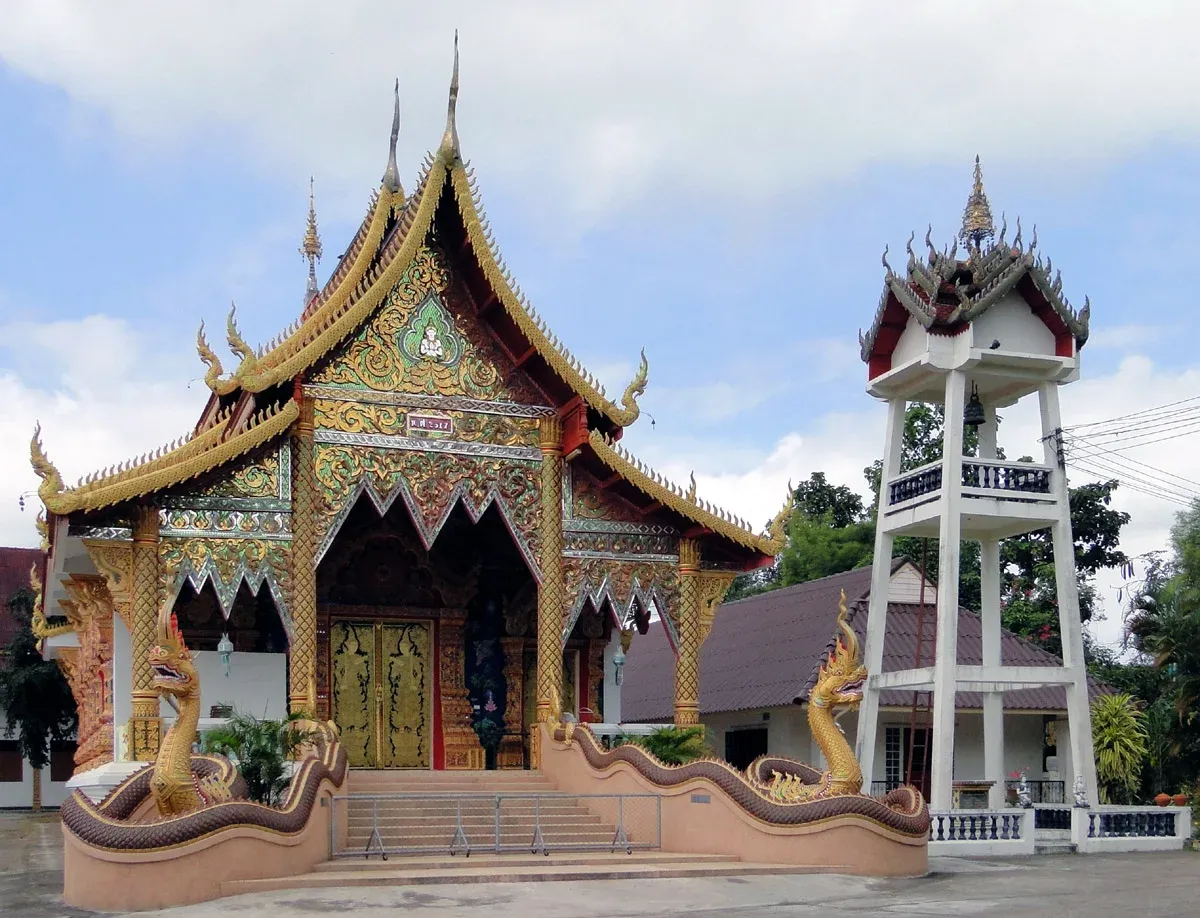
The main structures at Wat Rong Wua include the viharn, 700-year memorial sermon hall, monks’ residence, salabat hall, dining hall, ordination hall, and chedi. These structures allow the temple to support both monastic life and lay participation. The viharn is used for worship. The sermon hall supports Dhamma talks and gatherings. The monks’ residence supports resident monks. The salabat hall and dining hall support food offerings and merit-making. The ordination hall supports formal monastic acts. The chedi serves as a sacred landmark within the temple grounds.
The viharn is one of the first areas visitors should pay attention to. In a Lanna community temple, the viharn is often the heart of lay worship. It is used for paying respect to the Buddha, receiving precepts, chanting, listening to sermons, and joining Buddhist ceremonies. Visitors should begin their visit by paying respect in the viharn before observing other areas of the temple.
The 700-year memorial sermon hall has both practical and symbolic value. As a sermon hall, it supports Dhamma listening, merit-making, community meetings, Kathin, robe-offering ceremonies, memorial rites, and larger gatherings. Its memorial name connects the building with an important cultural or historical occasion, making it part of the temple’s shared memory as well as a functional religious space.
The monks’ residence supports year-round monastic life at Wat Rong Wua. Resident monks allow the temple to remain active through daily offerings, ceremonies, blessings, Dhamma guidance, and Buddhist holy day observances. In a village temple, the monks’ residence is not simply accommodation; it is part of the foundation that keeps Buddhist practice present in everyday community life.
The salabat hall and dining hall reflect the merit-making culture of the local community. Temple events often involve offerings of food, preparation of alms, reception of participants, and cooperation among villagers. These spaces help organize food-related activities and allow villagers to express faith through both donation and collective work.
The ordination hall is a sacred space connected with formal Sangha ceremonies, especially because the temple has received Wisungkham Sima. Visitors should treat the ordination hall with respect and follow temple guidance when entering or walking nearby. It is not merely an architectural feature but a key element of the temple’s ecclesiastical status.
The chedi is an important sacred landmark within Wat Rong Wua. In Lanna community temples, a chedi often represents accumulated merit, Buddhist continuity, and the faith of generations. It gives the temple grounds a clear spiritual focus and adds to the devotional atmosphere of the site. Visitors should approach the chedi respectfully and observe the surrounding temple area with care.
The annual bathing of Phra Borommathat is an important tradition associated with Wat Rong Wua. In Lanna Buddhist culture, relic-bathing ceremonies express respect for the temple’s sacred object, cleanse the mind symbolically, and bring the community together in shared merit. During such events, villagers often prepare offerings, organize the temple space, and participate with reverence.
In addition to the annual relic-bathing tradition, Wat Rong Wua supports regular Buddhist activities such as Buddhist holy days, Buddhist Lent, the end of Buddhist Lent, Kathin, robe-offering ceremonies, and memorial merit-making. These activities make the temple a living religious space rather than only a historical site. It continues to support the spiritual rhythm of Ban Rong Wua throughout the year.
Wat Rong Wua also serves as an important community center for Ban Rong Wua. Community information shows that Ban Rong Wua has active local cooperation in public activities, care for older residents, community development, and village-level support networks. The temple is part of this social structure because temple events bring people together, encourage cooperation, and maintain shared identity.
The temple’s relationship with the irrigation canal and private garden land reflects the agricultural character of the area. Wat Rong Wua stands near paths, roads, a canal, and local gardens, giving visitors a direct sense of village life in Nam Bo Luang. It is suitable for travelers who want to understand a living community temple rather than a highly commercial tourist attraction.
Important areas to see at Wat Rong Wua include the viharn, ordination hall, 700-year memorial sermon hall, monks’ residence, salabat hall, dining hall, chedi, and temple courtyard. Visitors should walk slowly and respectfully, beginning with worship in the viharn before observing the ordination hall and other buildings.
The temple’s distinctive value lies in its long history from 1749, its founding under Kruba Som Sopha, its Wisungkham Sima granted in 1989, and its continuing connection with Ban Rong Wua. Its value does not come from large-scale tourism but from community memory, religious continuity, and its role as a village spiritual center.
The atmosphere of Wat Rong Wua is suited to travelers interested in Lanna community temples, old temples of San Pa Tong, faith-based routes in Nam Bo Luang, and the relationship between temples and agricultural communities. It is a quiet local temple where visitors should pay attention to context, history, and respectful observation.
Visitors should dress respectfully, speak quietly, avoid disturbing monks’ living areas, avoid touching sacred objects unnecessarily, and refrain from entering restricted areas. If a ceremony or community event is taking place, visitors should follow the guidance of monks, temple committees, or local caretakers.
Getting There is most convenient by private car, rental car, or local hired transport. From Chiang Mai city, travel toward San Pa Tong District, then continue into Nam Bo Luang Subdistrict and Ban Rong Wua, Village No. 1. To avoid confusion with other temples of similar names, travelers should search for Wat Rong Wua Nam Bo Luang or Wat Rong Wua San Pa Tong.
A meaningful cultural route can begin at Wat Rong Wua, then continue to Wat Nam Bo Luang, Ban Nam Bo Luang Community Market, Wat Thung Fa Ham, Wat Chom Chaeng, Wat Pa Tueng Rong Wua, Wat Si Udom, or Lam Nam Khan at Ban Huai Thong. This route connects old temples, forest temple practice, local markets, irrigation systems, agricultural landscapes, and Lanna community life in southern Chiang Mai.
Overall, Wat Rong Wua (Nam Bo Luang) is a valuable religious and cultural site in San Pa Tong District. Its importance comes from its founding in 1749 by Kruba Som Sopha, its Wisungkham Sima granted in 1989, its complete set of community temple structures, its annual relic-bathing tradition, and its role as the spiritual center of Ban Rong Wua. For travelers seeking a quieter and deeper view of Chiang Mai’s living Lanna village temples, Wat Rong Wua is worth visiting with care and respect.
| Name | Wat Rong Wua (Nam Bo Luang) |
| Location | Ban Rong Wua, Village No. 1, Nam Bo Luang Subdistrict, San Pa Tong District, Chiang Mai Province |
| Address | No. 144, Ban Rong Wua, Village No. 1, Nam Bo Luang Subdistrict, San Pa Tong District, Chiang Mai, Thailand |
| Former Administrative Area | Formerly Village No. 4, San Klang Subdistrict; Currently Village No. 1, Nam Bo Luang Subdistrict |
| Monastic Order | Mahanikaya |
| Temple Type | Community Temple |
| Temple Land | 7 Rai, 2 Ngan, And 36 Square Wah Under Nor Sor 3 Kor Document No. 1064 |
| Monastic Land | Nor Sor 3 Kor Document No. 1733: 4 Rai And 90 Square Wah; Nor Sor 3 Kor Document No. 1734: 7 Rai And 50 Square Wah |
| Boundaries | North: About 35 Wah To A Walking Path; South: About 35 Wah To An Irrigation Canal; East: About 66 Wah To A Public Road; West: About 66 Wah To Private Garden Land |
| History | Founded In 1749 Under The Leadership Of Kruba Som Sopha |
| Wisungkham Sima | Granted On 21 November 1989; Consecrated Boundary Measures 16 Meters Wide And 24 Meters Long |
| Abbot / Caretaker | Phra Khru Siriwutthikorn |
| Important Structures | Viharn, 700-Year Memorial Sermon Hall, Monks’ Residence, Salabat Hall, Dining Hall, Ordination Hall, And Chedi |
| Main Areas / Zones | Viharn, Ordination Hall, Sermon Hall, Monks’ Residence, Salabat Hall, Dining Hall, Chedi, Temple Courtyard, And Community Merit-Making Area |
| Highlights | Old community temple founded in 1749, with Kruba Som Sopha’s founding history, Wisungkham Sima, ordination hall, sermon hall, chedi, and annual relic-bathing tradition |
| Traditions / Merit-Making | Annual relic-bathing tradition, Kathin, robe-offering ceremonies, Buddhist Lent, the end of Buddhist Lent, and community merit-making |
| Current Status | Active Community Temple In Ban Rong Wua, Village No. 1, Nam Bo Luang Subdistrict, San Pa Tong District, Chiang Mai Province |
| Travel Information | Travel From Chiang Mai City Toward San Pa Tong District, Then Continue Into Nam Bo Luang Subdistrict And Ban Rong Wua, Village No. 1; Private Car, Rental Car, Or Local Hired Transport Is Recommended |
| Nearby Tourist Attractions | 1. Wat Nam Bo Luang, About 4 Km 2. Ban Nam Bo Luang Community Market, About 4 Km 3. Wat Thung Fa Ham, About 5 Km 4. Wat Chom Chaeng, About 6 Km 5. Lam Nam Khan At Ban Huai Thong, About 8 Km |
| Nearby Restaurants | 1. MIRACLE COFFEE Nam Bo Luang, About 4 Km, Tel. 086-917-8080 2. Tea Tree House, About 5 Km, Tel. 089-431-7600 3. Coffee & Craft In Home, About 7 Km, Tel. 096-014-6459 4. Hong Lap Mae Wang 88, About 8 Km, Tel. 081-062-2544 5. Khrua Khun Daeng, About 8 Km |
| Nearby Accommodations | 1. Tea Tree House, About 5 Km, Tel. 089-431-7600 2. Baan Suan Kaew Huen Kham @ San Pa Tong, About 8 Km, Tel. 081-366-2382 3. Nakamaharuy Khun Nueng Art & Gallery, About 8 Km, Tel. 080-289-4923 4. Lake View @ Sanpatong, About 10 Km, Tel. 093-195-8098 5. Home At 9, About 12 Km, Tel. 088-636-2679 |
Frequently Asked Questions (FAQ)
Q: Where Is Wat Rong Wua (Nam Bo Luang) Located?
A: Wat Rong Wua is located at No. 144, Ban Rong Wua, Village No. 1, Nam Bo Luang Subdistrict, San Pa Tong District, Chiang Mai Province.
Q: When Was Wat Rong Wua Founded?
A: Wat Rong Wua was founded in 1749 under the leadership of Kruba Som Sopha.
Q: When Did Wat Rong Wua Receive Wisungkham Sima?
A: The temple received Wisungkham Sima on 21 November 1989, with a consecrated boundary measuring 16 meters wide and 24 meters long.
Q: What Important Structures Are Found At Wat Rong Wua?
A: Important structures include the viharn, 700-year memorial sermon hall, monks’ residence, salabat hall, dining hall, ordination hall, chedi, and temple courtyard.
Q: Who Is The Abbot Of Wat Rong Wua?
A: Phra Khru Siriwutthikorn is listed as the abbot of Wat Rong Wua.
Q: What Important Tradition Is Associated With Wat Rong Wua?
A: Wat Rong Wua is associated with an annual relic-bathing tradition, along with regular Buddhist merit-making such as Kathin, robe offerings, Buddhist Lent, and community ceremonies.
Q: How Can Travelers Get To Wat Rong Wua?
A: Travel from Chiang Mai city toward San Pa Tong District, then continue into Nam Bo Luang Subdistrict and Ban Rong Wua, Village No. 1 by private car, rental car, or local hired transport.
Q: What Nearby Places Can Be Visited Together With Wat Rong Wua?
A: Nearby places include Wat Nam Bo Luang, Ban Nam Bo Luang Community Market, Wat Thung Fa Ham, Wat Chom Chaeng, and Lam Nam Khan at Ban Huai Thong.
 Category: ●Places of Worship
 Group: ●Temple
Last Update : 1 WeekAgo
 Last Update : 1 WeekAgo
 Click to Access the Navigation Map GPS
Wat Rong Wua (Nam Bo Luang) Map
Recommend

 Muang Chiang Mai(121)Chom Thong(47)Mae Chaem(25)Chiang Dao(33)Doi Saket(68)Mae Taeng(85)Mae Rim(69)Samoeng(29)Fang(71)Mae Ai(59)Phrao(70)San Pa Tong(103)San Kamphaeng(66)San Sai(73)Hang Dong(73)Hot(32)Doi Tao(22)Omkoi(11)Saraphi(74)Wiang Haeng(15)Chai Prakan(28)Mae Wang(32)Mae On(22)Doi Lo(33)Galyani Vadhana(1)


