
lovethailand home >North Travel Attractions >Chiang Mai Travel Attractions >San Pa Tong >Nam Bo Luang > Wat Thung Fa Ham
TL;DR: Wat Thung Fa Ham is located at Ban Thung Fa Ham, Village No. 2, Nam Bo Luang Subdistrict, San Pa Tong District, Chiang Mai Province.

Wat Thung Fa Ham
Operating day: Daily
Operating time: 08.00 - 17.00
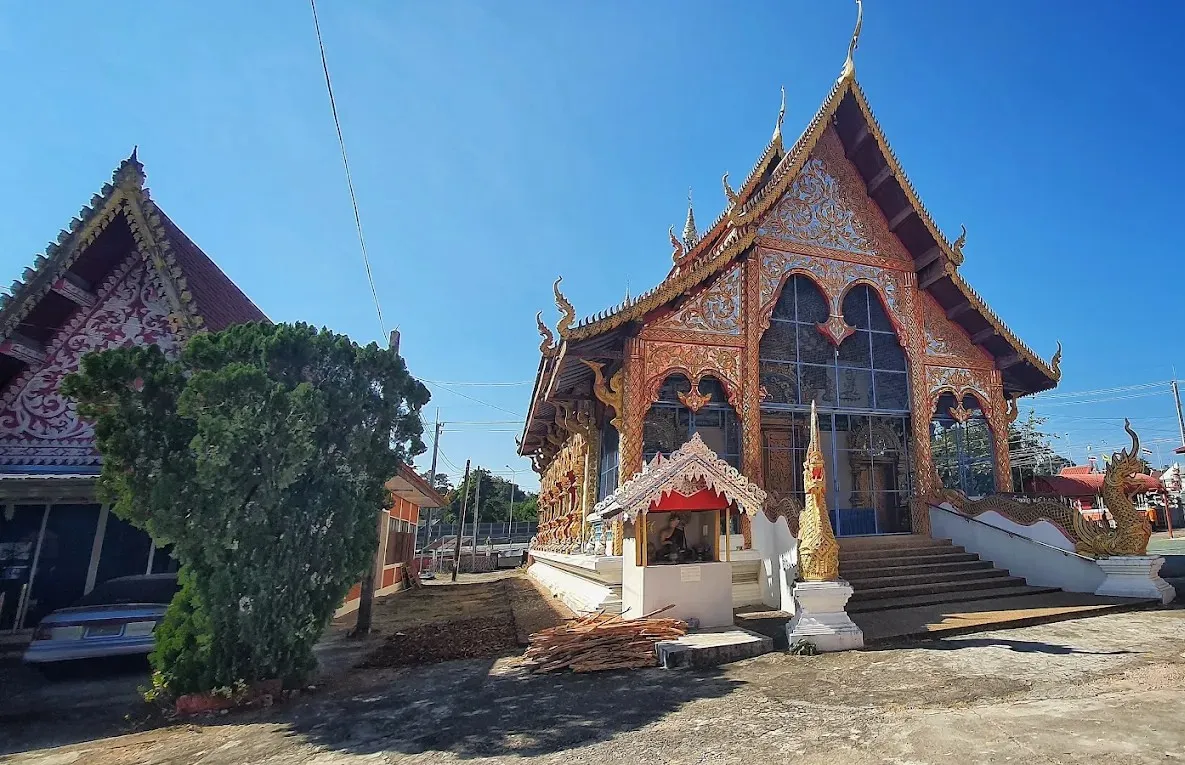
Wat Thung Fa Ham is a Mahanikaya community Buddhist temple located at No. 39, Ban Thung Fa Ham, Village No. 2, Nam Bo Luang Subdistrict, San Pa Tong District, Chiang Mai Province. The area was formerly Village No. 5 of San Klang Subdistrict before being recorded as Village No. 2 of Nam Bo Luang Subdistrict. The temple was originally known as Wat Tong Pha Ham, a name connected with a local story about more than one thousand monks traveling from Myanmar, staying in a fertile grassland, and hanging saffron robes across the open field. Important sacred objects include a Chiang Saen bronze Buddha image, an old Burmese-style marble Buddha image, a flower-pollen Buddha image, a brass principal Buddha image with two chief disciples, and the chedi.
Wat Thung Fa Ham is an old community temple in Nam Bo Luang Subdistrict, San Pa Tong District, Chiang Mai Province. It is located at No. 39, Ban Thung Fa Ham, Village No. 2. The temple belongs to the Mahanikaya monastic order and occupies 6 rai, 1 ngan, and 10 square wah under land title deed No. 19368. It also has one monastic land plot covering 4 rai and 63 square wah under Nor Sor 3 Kor document No. 679. This land base allows the temple to support monastic residence, worship, annual merit-making, and community activities.
The name Wat Thung Fa Ham comes from the older name Wat Tong Pha Ham. “Tong” or “thung” refers to an open field, while “pha ham” relates to the image of monks’ robes being washed and hung across the field. Over time, the old name evolved into the present name Wat Thung Fa Ham. This name preserves the memory of the temple’s origin, the local landscape, and the story of early monastic settlement in the area.
The temple history says that Wat Thung Fa Ham began as an ancient temple called Wat Tong Pha Ham. According to local tradition, more than one thousand monks traveled from Myanmar for Buddhist council-related practice and passed through several provinces in Thailand before reaching the old Mae District, which corresponds with present-day San Pa Tong. When they arrived at this fertile open grassland with abundant water, they chose it as a resting place and established a monastic settlement. Many monks stayed for the rainy-season retreat, and when they washed and hung their saffron robes, the entire field appeared golden. This scene gave rise to the name Tong Pha Ham.
This story gives Wat Thung Fa Ham a cultural depth beyond that of a typical village temple. It connects the temple with monastic travel, Myanmar, Tai Yai or Shan supporters, and the wider Lanna world. The history suggests that the temple area was shaped by movement, religious devotion, water resources, and fertile land. The temple therefore represents both a spiritual foundation and a starting point for community settlement.
Later, the lay supporters who had followed the monks from Myanmar, identified locally as Ngiao or Tai Yai people, began planting vegetables in the area. They found the soil fertile and the water plentiful, so they settled permanently. A village developed from this settlement. This shows how the temple and village grew together: religious residence, agricultural opportunity, and community formation all took place in the same landscape.
The temple was later established under Phra Athikan Chai Athinantho, an important figure in the temple’s development. As villagers cleared land for homes, rice fields, and gardens, the community continued to expand. Later, Phra Athikan Nu Anantho saw that the original temple site was low-lying and flooded throughout the year. He worked with villagers to move the temple to its present site in 1926. This relocation was a major turning point that allowed the temple to develop on more suitable land.
The relocation of the temple reflects the practical wisdom of monks and villagers. A village temple cannot be separated from its environment. If the original site is constantly flooded, religious practice, building maintenance, and community use become difficult. Moving the temple required collective effort, faith, and cooperation, showing the strong relationship between the Sangha and the people of Ban Thung Fa Ham.
The current boundaries of Wat Thung Fa Ham show its relationship with water systems, roads, gardens, and village life. To the north, the temple borders the Mae Taeng irrigation canal under the Ministry of Agriculture and Cooperatives. To the east, it borders Soi Wat Thung Fa Ham. To the west, it borders private garden land. To the south, it borders Thung Fa Ham Road. These boundaries place the temple within an agricultural and community landscape shaped by irrigation, local roads, and village gardens.
The Mae Taeng irrigation canal to the north is especially important because water is central to Nam Bo Luang and the surrounding agricultural areas. Although the temple’s main function is religious, its setting shows that it is part of a wider farming landscape. Roads, gardens, canals, and temple grounds all work together in the everyday life of the community.
The main structures at Wat Thung Fa Ham include the monks’ residence, viharn, sermon hall, salabat hall, and kitchen. These structures support both monastic and community functions. The monks’ residence supports daily monastic life. The viharn is the main worship space. The sermon hall supports Dhamma talks and larger gatherings. The salabat hall supports food offerings and merit-making. The kitchen supports community food preparation during temple events.
The viharn is the first important area visitors should pay attention to. In a Lanna community temple, the viharn is the heart of worship. It is where villagers pay respect to the Buddha, listen to teachings, chant, receive precepts, and gather during important Buddhist days. Visitors should begin by paying respect inside the viharn, then continue to the chedi and other areas of the temple.
Wat Thung Fa Ham has several important sacred objects. The first is a Chiang Saen bronze Buddha image, which has both devotional and artistic value. Chiang Saen-style Buddha images are significant in northern Thai art history. The presence of such an image gives the temple added cultural importance and makes it a meaningful place for visitors interested in Lanna Buddhist art.
The old Burmese-style marble Buddha image is another important sacred object. Its presence supports the temple’s historical connection with Myanmar and Tai Yai cultural links. Although detailed information about its exact age is not available, the temple history identifies it as an old object preserved since ancient times. Visitors should treat it as part of the temple’s long-standing devotional heritage.
The flower-pollen Buddha image adds another layer of ritual and symbolic meaning to the temple’s collection of sacred objects. Alongside the bronze image, marble image, brass principal Buddha image, and chedi, it reflects the temple’s accumulated faith across generations. These sacred objects should be understood together as the spiritual inheritance of Ban Thung Fa Ham.
The brass principal Buddha image with two chief disciples forms an important focus of worship. The principal Buddha image provides the central point for devotion, while the two chief disciples complete the Buddhist iconographic arrangement. Visitors should pay respect to the principal image before continuing to other sacred areas of the temple.
The chedi is another important sacred landmark of Wat Thung Fa Ham. In Lanna community temples, a chedi often represents accumulated merit, Buddhist continuity, and the faith of generations. Although detailed architectural information about this chedi is not available, its identification as one of the temple’s important sacred objects shows that it remains a meaningful point of respect for the community.
The sermon hall supports Dhamma teaching, community meetings, and larger merit-making events. In village temples, the sermon hall often functions as a flexible religious and social space. It can support Kathin, robe-offering ceremonies, Buddhist Lent activities, memorial merit-making, and gatherings of lay supporters.
The salabat hall supports food offerings, almsgiving, and the organization of merit-making activities. The kitchen reflects the cooperative character of northern Thai temple life. During festivals or community events, villagers prepare food, offer meals to monks, serve participants, and clean together. Through this work, Buddhist devotion becomes visible as shared labor and community care.
The monks’ residence allows the temple to remain active throughout the year. Resident monks support religious ceremonies, receive offerings, provide blessings, teach Dhamma, and maintain the temple’s role as a spiritual center for Ban Thung Fa Ham. The monks’ residence is therefore not merely accommodation; it is part of the foundation of Buddhist life in the village.
The temple is currently under the care of Phra Waranyu Wutthithammo as acting abbot. In a community temple, temple leadership involves care for monastic life, buildings, sacred objects, lay supporters, and community activities. Because Wat Thung Fa Ham has a long history, multiple sacred objects, and a sizeable temple area, continuous and attentive stewardship is essential.
Wat Thung Fa Ham serves as a spiritual center for Ban Thung Fa Ham and Nam Bo Luang. It supports merit-making, sermons, Buddhist holy day observances, Buddhist Lent, the end of Buddhist Lent, Kathin, robe-offering ceremonies, memorial merit-making, and other community activities. It is also a place where villagers meet, cooperate, and maintain inherited traditions.
Although a specific named annual festival for Wat Thung Fa Ham is not clearly documented, the temple functions within the regular Lanna Buddhist calendar. Kathin and robe-offering ceremonies support temple maintenance and community unity. Buddhist Lent and the end of Buddhist Lent encourage merit-making, Dhamma listening, and moral practice. Buddhist holy days give villagers a regular rhythm for entering the temple and renewing their connection with the Dhamma.
The temple’s distinctive value lies in its origin story: monks from Myanmar, Tai Yai supporters, fertile land, the image of saffron robes across an open field, and the emergence of a village around a sacred site. Combined with its Chiang Saen bronze Buddha image, Burmese-style marble Buddha image, flower-pollen Buddha image, brass principal Buddha image, and chedi, the temple has strong religious, artistic, and cultural significance.
Important areas to see at Wat Thung Fa Ham include the viharn, brass principal Buddha image with two chief disciples, Chiang Saen bronze Buddha image, Burmese-style marble Buddha image, flower-pollen Buddha image, chedi, sermon hall, salabat hall, monks’ residence, kitchen, and temple courtyard. Visitors should walk slowly and respectfully, beginning with worship in the viharn before observing the other sacred objects and structures.
The atmosphere of Wat Thung Fa Ham is suited to travelers interested in Lanna community temples, old temples of San Pa Tong, monastic travel stories, Burmese and Tai Yai cultural links, and cultural routes in Nam Bo Luang. It is not a large commercial tourist attraction. Its value lies in its community memory, sacred objects, and role as a living village temple.
Visitors should dress respectfully, speak quietly, avoid disturbing monastic areas, refrain from touching sacred objects unnecessarily, and avoid entering private or restricted spaces. If a merit-making event or community activity is taking place, visitors should follow the guidance of monks or temple caretakers.
Getting There is most convenient by private car, rental car, or local hired transport. From Chiang Mai city, travel toward San Pa Tong District, then continue into Nam Bo Luang Subdistrict and Ban Thung Fa Ham, Village No. 2. To avoid confusion with Fa Ham in Mueang Chiang Mai District, travelers should search using Wat Thung Fa Ham Nam Bo Luang or Wat Thung Fa Ham San Pa Tong.
A meaningful cultural route can begin at Wat Thung Fa Ham, then continue to Wat Nam Bo Luang, Ban Nam Bo Luang Community Market, Wat Chom Chaeng, Wat Rong Wua, Wat Si Udom, Wat Huai Thong, or Lam Nam Khan at Ban Huai Thong. This route connects temples, village life, irrigation systems, agriculture, and the Lanna cultural landscape of southern Chiang Mai.
Overall, Wat Thung Fa Ham is a valuable religious and cultural site in San Pa Tong District. Its importance comes from the old name Wat Tong Pha Ham, the story of monks and Tai Yai supporters, the relocation of the temple in 1926, its important sacred objects, and its role as the spiritual center of Ban Thung Fa Ham. For travelers seeking a quieter and deeper view of Chiang Mai’s living Lanna community temples, Wat Thung Fa Ham is worth visiting with care and respect.
| Name | Wat Thung Fa Ham |
| Former Name | Wat Tong Pha Ham |
| Location | Ban Thung Fa Ham, Village No. 2, Nam Bo Luang Subdistrict, San Pa Tong District, Chiang Mai Province |
| Address | No. 39, Ban Thung Fa Ham, Village No. 2, Nam Bo Luang Subdistrict, San Pa Tong District, Chiang Mai 50120, Thailand |
| Former Administrative Area | Formerly Village No. 5, San Klang Subdistrict; currently Village No. 2, Nam Bo Luang Subdistrict |
| Monastic Order | Mahanikaya |
| Temple Type | Community Temple |
| Temple Land | 6 Rai, 1 Ngan, And 10 Square Wah; Land Title Deed No. 19368 |
| Monastic Land | 1 Plot, 4 Rai And 63 Square Wah; Nor Sor 3 Kor Document No. 679 |
| Boundaries | North: Mae Taeng Irrigation Canal Under The Ministry Of Agriculture And Cooperatives; East: Soi Wat Thung Fa Ham; West: Private Garden Land; South: Thung Fa Ham Road |
| History | Originally An Ancient Temple Named Wat Tong Pha Ham; Relocated To The Present Site In 1926 And Later Known As Wat Thung Fa Ham |
| People Connected With The Temple’s Development | Built Under Phra Athikan Chai Athinantho; Later Relocated By Phra Athikan Nu Anantho Together With Local Villagers |
| Sacred Objects | Chiang Saen Bronze Buddha Image, Old Burmese-Style Marble Buddha Image, Flower-Pollen Buddha Image, Brass Principal Buddha Image With Two Chief Disciples, And Chedi |
| Important Structures | Monks’ Residence, Viharn, Sermon Hall, Salabat Hall, And Kitchen |
| Main Areas / Zones | Viharn, Chedi, Monks’ Residence, Sermon Hall, Salabat Hall, Kitchen, Temple Courtyard, And Community Merit-Making Area |
| Abbot / Caretaker | Phra Waranyu Wutthithammo, Acting Abbot |
| Phone | 053-835-660 |
| Current Status | Active Community Temple In Ban Thung Fa Ham, Village No. 2, Nam Bo Luang Subdistrict, San Pa Tong District, Chiang Mai Province |
| Travel Information | Travel From Chiang Mai City Toward San Pa Tong District, Then Continue Into Nam Bo Luang Subdistrict And Ban Thung Fa Ham, Village No. 2; Private Car, Rental Car, Or Local Hired Transport Is Recommended |
| Nearby Tourist Attractions | 1. Wat Nam Bo Luang, About 2 Km 2. Ban Nam Bo Luang Community Market, About 2 Km 3. Wat Chom Chaeng, About 5 Km 4. Wat Rong Wua, About 5 Km 5. Lam Nam Khan At Ban Huai Thong, About 8 Km |
| Nearby Restaurants | 1. MIRACLE COFFEE Nam Bo Luang, About 2 Km, Tel. 086-917-8080 2. Tea Tree House, About 3 Km, Tel. 089-431-7600 3. Khrua Khun Daeng, About 4 Km, Tel. 091-746-6296 4. Clay Oven Roasted Chicken, About 5 Km, Tel. 095-456-2493 5. Coffee & Craft In Home, About 6 Km, Tel. 096-014-6459 |
| Nearby Accommodations | 1. Tea Tree House, About 3 Km, Tel. 089-431-7600 2. Phanumat Long Stay Resort, About 5 Km 3. Nakamaharuy Khun Nueng Art & Gallery, About 5 Km, Tel. 080-289-4923 4. Baan Suan Kaew Huen Kham @ San Pa Tong, About 8 Km, Tel. 081-366-2382 5. Lake View @ Sanpatong, About 10 Km, Tel. 093-195-8098 |
Frequently Asked Questions (FAQ)
Q: Where is Wat Thung Fa Ham located?
A: Wat Thung Fa Ham is located at No. 39, Ban Thung Fa Ham, Village No. 2, Nam Bo Luang Subdistrict, San Pa Tong District, Chiang Mai Province.
Q: What was the former name of Wat Thung Fa Ham?
A: The temple was formerly known as Wat Tong Pha Ham, a name linked with the story of many monks hanging saffron robes across an open field.
Q: What important sacred objects are found at Wat Thung Fa Ham?
A: Important sacred objects include a Chiang Saen bronze Buddha image, an old Burmese-style marble Buddha image, a flower-pollen Buddha image, a brass principal Buddha image with two chief disciples, and the chedi.
Q: When was Wat Thung Fa Ham moved to its present site?
A: The temple was moved to its present site in 1926 after Phra Athikan Nu Anantho and local villagers found that the old site was low-lying and frequently flooded.
Q: What important structures are inside Wat Thung Fa Ham?
A: Important structures include the viharn, monks’ residence, sermon hall, salabat hall, kitchen, chedi, and temple courtyard.
Q: Who is the current caretaker or acting abbot of Wat Thung Fa Ham?
A: Phra Waranyu Wutthithammo is listed as the acting abbot.
Q: How can travelers get to Wat Thung Fa Ham?
A: Travel from Chiang Mai city toward San Pa Tong District, then continue into Nam Bo Luang Subdistrict and Ban Thung Fa Ham, Village No. 2 by private car, rental car, or local hired transport.
Q: What nearby places can be visited together with Wat Thung Fa Ham?
A: Nearby places include Wat Nam Bo Luang, Ban Nam Bo Luang Community Market, Wat Chom Chaeng, Wat Rong Wua, and Lam Nam Khan at Ban Huai Thong.
 Category: ●Places of Worship
 Group: ●Temple
Last Update : 2 WeekAgo
 Last Update : 2 WeekAgo
 Click to Access the Navigation Map GPS
 Muang Chiang Mai(121)Chom Thong(47)Mae Chaem(25)Chiang Dao(33)Doi Saket(68)Mae Taeng(85)Mae Rim(69)Samoeng(29)Fang(71)Mae Ai(59)Phrao(70)San Pa Tong(103)San Kamphaeng(66)San Sai(73)Hang Dong(73)Hot(32)Doi Tao(22)Omkoi(11)Saraphi(74)Wiang Haeng(15)Chai Prakan(28)Mae Wang(32)Mae On(22)Doi Lo(33)Galyani Vadhana(1)


