
lovethailand home >North Travel Attractions >Chiang Mai Travel Attractions >San Pa Tong >Nam Bo Luang > Wat Chom Cheang
TL;DR: Wat Chom Cheang is located at Ban Chom Chaeng, Village No. 4, Nam Bo Luang Subdistrict, San Pa Tong District, Chiang Mai Province, open Daily, hours 08.00 AM – 05.00 PM.
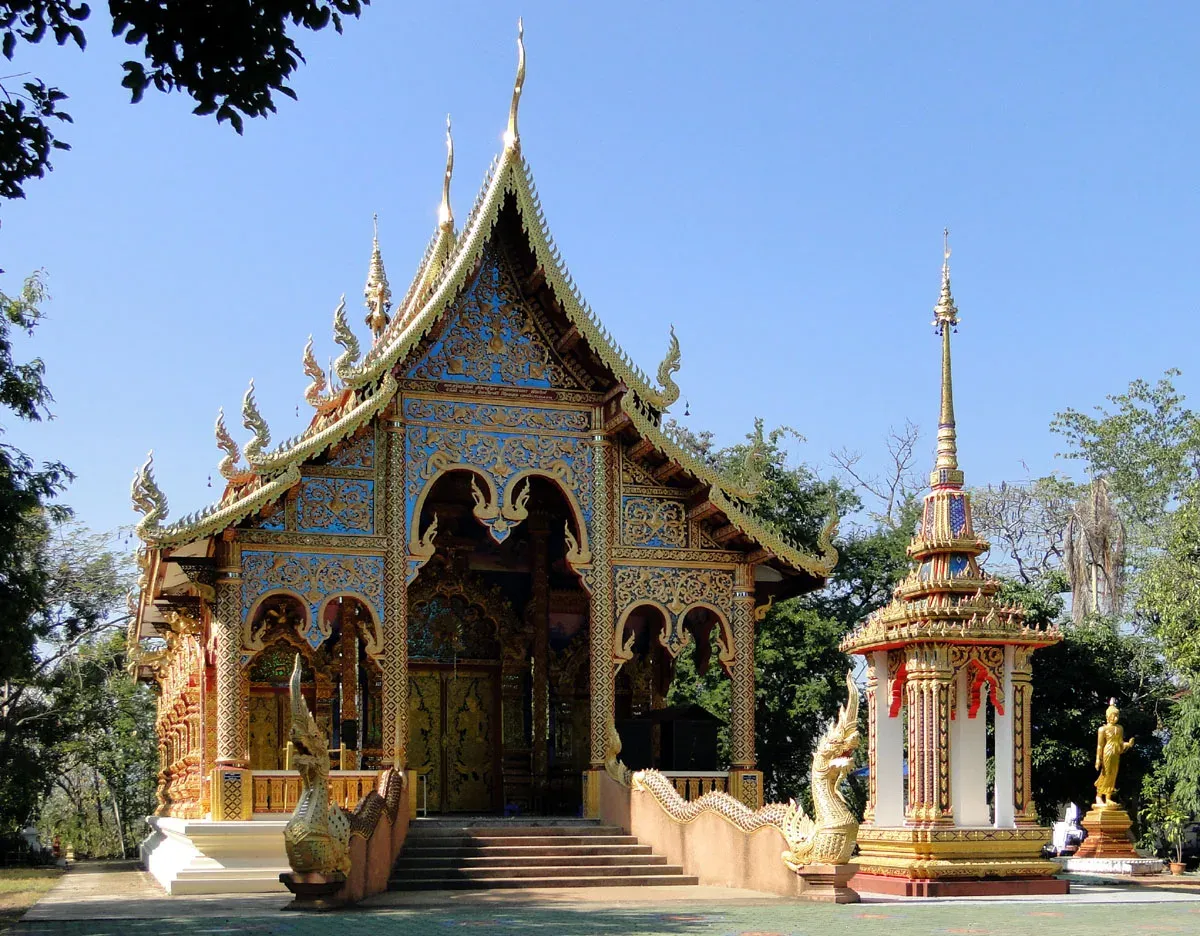
Wat Chom Cheang
Open Days: Daily
Opening Hours: 08.00 AM – 05.00 PM
Wat Chom Chaeng (Nam Bo Luang) is a Mahanikaya community Buddhist temple located at No. 199, Village No. 4, Nam Bo Luang Subdistrict, San Pa Tong District, Chiang Mai Province. Founded in 1913, the temple was formerly known as Wat Chom Klai or Wat Doi Pu Lan. Its main sacred landmark is Phra Borommathat Chom Chaeng, and the temple is especially known for the annual Wai Sa Phra Borommathat Chom Chaeng Ha Si tradition, which includes a sacred water procession, turmeric and som poi water, bathing the relic stupa, and ceremonial rockets offered in honor of the relic.
Wat Chom Chaeng (Nam Bo Luang) is located at No. 199, Village No. 4, Nam Bo Luang Subdistrict, San Pa Tong District, Chiang Mai Province. It belongs to the Mahanikaya monastic order, Region 7, and is classified as a community temple. The temple is closely connected with Ban Chom Chaeng, a local community shaped by streams, hillside forest, village roads, walking paths, and the rural landscape of San Pa Tong. Its significance comes from Phra Borommathat Chom Chaeng, the annual relic-bathing tradition, and the local stories that connect the temple’s name with dawn and sacred memory.
The temple’s boundaries clearly reflect its natural setting. To the north, it borders a stream. To the south, it also borders a stream. To the east, it adjoins forested hillside, while the west borders a road and walking path. This location places Wat Chom Chaeng between nature and village life. On one side, it connects with streams and hillside forest; on the other, it connects with roads, pathways, and the everyday movement of the community. The temple therefore stands as a meeting point between sacred space, natural landscape, and local life.
Wat Chom Chaeng was founded in 1913. Its former names were Wat Chom Klai and Wat Doi Pu Lan. These earlier names suggest a connection with hills, distance, and the elevated natural setting of the temple. The present name, Chom Chaeng, is linked with a local story preserved in Ban Chom Chaeng. According to community tradition, the area was associated with the moment of approaching dawn, or “chon chaeng,” which later became Chom Chaeng. This story gives the temple a stronger cultural meaning than a simple place name.
The temple was built by a wealthy local patron named Nai Lan. This origin reflects a common pattern in Lanna village temples, where a temple often began through the faith of local patrons and villagers who wished to establish a sacred place for Buddhist practice. Wat Chom Chaeng was therefore not just a building project; it was the result of religious devotion and collective community support. Over time, it became the spiritual center of Ban Chom Chaeng.
Wat Chom Chaeng received Wisungkham Sima on 20 May 1984. In Thai Buddhist tradition, Wisungkham Sima is connected with the formal boundary required for monastic acts, especially those related to an ordination hall. This gives the temple a formal ecclesiastical status and confirms its role as a complete Buddhist temple capable of supporting Sangha ceremonies according to monastic discipline.
The main structures at Wat Chom Chaeng include an ordination hall, viharn, hall, relic-bathing pavilion, Phra Borommathat, and monks’ residence. These structures support a full range of religious and community functions. The ordination hall is linked with formal monastic ceremonies. The viharn supports worship and sermons. The hall supports merit-making and community gatherings. The relic-bathing pavilion is directly connected with the annual bathing of Phra Borommathat. The monks’ residence supports monastic life and daily temple practice.
Phra Borommathat Chom Chaeng is the temple’s most important sacred landmark. It is the spiritual focus of the temple and the main reason the temple holds special importance in the local community. Visitors should approach it respectfully, pay homage quietly, and understand that the relic stupa is a sacred site deeply valued by the people of Ban Chom Chaeng.
The temple also keeps Buddha images in various postures as devotional objects. Although detailed information about each image is not available, their presence reflects the continuity of Buddhist worship and local patronage across generations. They also add to the devotional character of the temple as a living place of worship.
The ordination hall is one of the most important structures at Wat Chom Chaeng. Together with the temple’s Wisungkham Sima, it supports formal Sangha ceremonies. Visitors should treat the ordination hall as a disciplined and sacred monastic space. It is not merely an architectural feature but a core part of the temple’s ecclesiastical function.
The viharn is the main worship space for laypeople. It is used for paying respect to the Buddha, listening to sermons, chanting, and participating in Buddhist ceremonies. Visitors can begin their visit at the viharn, make merit, calm the mind, and then continue to Phra Borommathat and other important areas of the temple.
The hall supports community merit-making and temple activities. In Lanna village temples, halls are used for Dhamma talks, lay gatherings, memorial ceremonies, and large merit-making events. Because Wat Chom Chaeng hosts an important annual relic-bathing tradition, the hall plays an important role in organizing and supporting community participation.
The relic-bathing pavilion is one of the temple’s distinctive features because it is directly related to the annual bathing of Phra Borommathat Chom Chaeng. It is not just a supporting structure; it is part of the ritual system that connects local faith with the sacred relic stupa. This makes the pavilion an important feature of the temple’s religious identity.
The monks’ residence allows Wat Chom Chaeng to remain a living temple. Resident monks support daily offerings, ceremonies, Dhamma teaching, blessings, and the ongoing religious life of the community. In a village temple, the monks’ residence is not only accommodation; it is part of the foundation that keeps Buddhist practice active in the village.
The most important annual tradition is Wai Sa Phra Borommathat Chom Chaeng Ha Si, held on the 14th waxing day of the ninth lunar month. Around 500 to 600 people take part. The ritual includes a procession of sacred bathing water for Phra Borommathat, turmeric water, som poi water, bathing the relic stupa, and the firing of ceremonial rockets known as bong fai muen in honor of Phra Borommathat. This tradition is one of the clearest expressions of the temple’s Lanna identity.
Turmeric and som poi water are important in northern Thai ritual culture. They are associated with cleansing, blessing, and auspiciousness. Their use in the bathing of Phra Borommathat shows that the ceremony is both devotional and symbolic. The procession allows villagers to participate collectively, prepare offerings, carry sacred water, and express respect for the relic stupa in a public community ritual.
The firing of ceremonial rockets in honor of Phra Borommathat gives the tradition a distinctive local character. In village ritual contexts, rockets may be connected with merit, blessing, fertility, and collective devotion. At Wat Chom Chaeng, this activity is linked with the worship of the relic stupa, creating a ceremony that combines Buddhist faith, village cooperation, and local cultural expression.
On Makha Bucha Day, Wat Chom Chaeng organizes candlelight circumambulation around the relic stupa and the recitation of Makha Bucha devotional words. Around 150 participants join this observance. The ceremony emphasizes calmness, mindfulness, and remembrance of Buddhist teachings. The relic stupa becomes the ritual center around which devotees gather in reverence.
During Asalha Bucha and Buddhist Lent, the temple organizes morning almsgiving, moral training for laypeople and elders, Buddhist practice with the observance of the Eight Precepts, and sermons on Buddhist holy days throughout the three-month rainy-season retreat. These activities show that Wat Chom Chaeng is not only a site for annual celebration but also a place for regular moral and spiritual cultivation.
Wat Chom Chaeng functions as a spiritual center for Ban Chom Chaeng. It supports annual merit-making, Buddhist holy day observances, relic worship, community gatherings, and the preservation of local memory. Ban Chom Chaeng itself is known for natural resources and local wisdom. The temple is therefore part of a wider cultural structure that connects people with place, belief, and inherited community identity.
The wider landscape of Ban Chom Chaeng includes hillside forest to the east, residential areas along local roads, and agricultural land to the west connected with the Khan River and irrigation channels. This context makes the temple more meaningful. Wat Chom Chaeng is not separate from its environment; it is part of a community shaped by forest, water, farmland, and local craft knowledge.
Important areas to see at Wat Chom Chaeng include Phra Borommathat Chom Chaeng, the ordination hall, viharn, relic-bathing pavilion, hall, monks’ residence, and the temple grounds connected with streams and hillside forest. Visitors should walk slowly, begin with worship in the viharn, pay homage at Phra Borommathat, and observe the temple’s relationship with the surrounding community and landscape.
The atmosphere of Wat Chom Chaeng suits travelers interested in old community temples, Lanna Buddhist traditions, relic worship, local festivals, and cultural routes in Nam Bo Luang. It is not a large commercial tourist attraction. Its value comes from its sacred relic stupa, annual ritual cycle, local history, and continued use by the Ban Chom Chaeng community.
Visitors should dress respectfully, speak quietly, avoid disturbing monks’ living areas, avoid climbing or touching Phra Borommathat unnecessarily, and avoid entering restricted areas. During the annual Wai Sa Phra Borommathat Chom Chaeng Ha Si ceremony or other Buddhist events, visitors should follow the guidance of monks, temple committees, and local organizers.
Getting There is most convenient by private car, rental car, or local hired transport. From Chiang Mai city, travel toward San Pa Tong District, then continue into Nam Bo Luang Subdistrict and Ban Chom Chaeng, Village No. 4. Because several temples in Thailand have similar names, travelers should search for Wat Chom Chaeng Nam Bo Luang or Wat Chom Chaeng San Pa Tong to avoid confusion with temples in other provinces.
A meaningful cultural route can begin at Wat Chom Chaeng, where visitors can pay homage to Phra Borommathat. The route can then continue to Wat Nam Bo Luang, Wat Huai Thong, Lam Nam Khan at Ban Huai Thong, Wat Rong Wua, and Ban Chom Chaeng. This route connects temples, community life, nature, streams, hillside forest, and the Lanna cultural landscape of San Pa Tong.
Overall, Wat Chom Chaeng (Nam Bo Luang) is a valuable religious and cultural site in San Pa Tong District. Its significance comes from Phra Borommathat Chom Chaeng, its former names Wat Chom Klai and Wat Doi Pu Lan, its founding by Nai Lan in 1913, its Wisungkham Sima in 1984, the annual Wai Sa Phra Borommathat Chom Chaeng Ha Si tradition, and its role as the spiritual center of Ban Chom Chaeng. For travelers seeking a quieter and deeper view of Chiang Mai’s living Lanna community temples, Wat Chom Chaeng is worth visiting with care and respect.
| Name | Wat Chom Chaeng (Nam Bo Luang) |
| Former Names | Wat Chom Klai Or Wat Doi Pu Lan |
| Location | Ban Chom Chaeng, Village No. 4, Nam Bo Luang Subdistrict, San Pa Tong District, Chiang Mai Province |
| Address | No. 199, Village No. 4, Nam Bo Luang Subdistrict, San Pa Tong District, Chiang Mai, Thailand |
| Monastic Order | Mahanikaya, Region 7 |
| Temple Type | Community Temple |
| Open Days | Daily |
| Opening Hours | 08.00 AM – 05.00 PM |
| Boundaries | North: Stream; South: Stream; East: Forested Hillside; West: Road And Walking Path |
| History | Founded In 1913 By A Wealthy Patron Named Nai Lan; Received Wisungkham Sima On 20 May 1984 |
| Name Origin | Local tradition connects the name Chom Chaeng with the moment near dawn, later evolving from Chon Chaeng to Chom Chaeng |
| Sacred Landmark | Phra Borommathat Chom Chaeng |
| Sacred Objects | Phra Borommathat And Buddha Images In Various Postures |
| Important Structures | Ordination Hall, Viharn, Hall, Relic-Bathing Pavilion, Phra Borommathat, And Monks’ Residence |
| Main Areas / Zones | Ordination Hall, Viharn, Phra Borommathat, Relic-Bathing Pavilion, Hall, Monks’ Residence, Temple Courtyard, And Festival Area |
| Main Tradition | Wai Sa Phra Borommathat Chom Chaeng Ha Si, held on the 14th waxing day of the ninth lunar month, with sacred water procession, turmeric and som poi water, relic bathing, and bong fai muen rockets offered in honor of the relic |
| Makha Bucha Activity | Candlelight circumambulation around the relic stupa and Makha Bucha devotional recitation, with about 150 participants |
| Asalha Bucha / Buddhist Lent Activity | Morning almsgiving, moral training, Eight Precepts practice, and sermons on Buddhist holy days throughout the three-month rainy-season retreat |
| Current Status | Active Community Temple In Ban Chom Chaeng, Village No. 4, Nam Bo Luang Subdistrict, San Pa Tong District, Chiang Mai Province |
| Phone | 085-996-5295 |
| Travel Information | Travel From Chiang Mai City Toward San Pa Tong District, Then Continue Into Nam Bo Luang Subdistrict And Ban Chom Chaeng, Village No. 4; Private Car, Rental Car, Or Local Hired Transport Is Recommended |
| Nearby Tourist Attractions | 1. Ban Chom Chaeng, About 1 Km 2. Wat Nam Bo Luang, About 4 Km 3. Wat Rong Wua, About 5 Km 4. Wat Huai Thong, About 7 Km 5. Lam Nam Khan At Ban Huai Thong, About 8 Km |
| Nearby Restaurants | 1. Tea Tree House, About 3 Km, Tel. 089-431-7600, 091-075-7478 2. Khrua Khun Daeng, About 4 Km, Tel. 091-746-6296 3. Clay Oven Roasted Chicken, About 5 Km, Tel. 095-456-2493 4. Ban Khong Mae, About 6 Km, Tel. 084-948-9722 5. Hong Lap Mae Wang 88, About 8 Km, Tel. 081-062-2544 |
| Nearby Accommodations | 1. Phanumat Long Stay, About 2.8 Km 2. Wan Wan Lanna By Pat, About 3.8 Km 3. Nakamaharuy Khun Nueng Art & Gallery, About 5 Km, Tel. 080-289-4923 4. Home At 9, About 8 Km 5. Tai Resort, About 9 Km |
Frequently Asked Questions (FAQ)
Q: Where is Wat Chom Chaeng (Nam Bo Luang) located?
A: Wat Chom Chaeng is located at No. 199, Village No. 4, Nam Bo Luang Subdistrict, San Pa Tong District, Chiang Mai Province.
Q: What are the opening days and hours of Wat Chom Chaeng?
A: Wat Chom Chaeng is open daily from 08.00 AM to 05.00 PM.
Q: What were the former names of Wat Chom Chaeng?
A: The temple was formerly known as Wat Chom Klai or Wat Doi Pu Lan, and its present name is linked with a local dawn-related tradition.
Q: What is the main sacred landmark of Wat Chom Chaeng?
A: The main sacred landmark is Phra Borommathat Chom Chaeng, the spiritual center of the temple and the Ban Chom Chaeng community.
Q: What happens during Wai Sa Phra Borommathat Chom Chaeng Ha Si?
A: The tradition includes a sacred water procession, turmeric and som poi water, bathing the relic stupa, and ceremonial rockets offered in honor of Phra Borommathat.
Q: What kind of travelers should visit Wat Chom Chaeng?
A: It is suitable for travelers interested in Lanna community temples, relic worship, local traditions, and cultural routes in San Pa Tong.
Q: How can travelers get to Wat Chom Chaeng?
A: Travel from Chiang Mai city toward San Pa Tong District, then continue into Nam Bo Luang Subdistrict and Ban Chom Chaeng, Village No. 4 by private car, rental car, or local hired transport.
Q: What nearby places can be visited together with Wat Chom Chaeng?
A: Nearby places include Ban Chom Chaeng, Wat Nam Bo Luang, Wat Rong Wua, Wat Huai Thong, and Lam Nam Khan at Ban Huai Thong.
 Category: ●Places of Worship
 Group: ●Temple
Last Update : 1 WeekAgo
 Last Update : 1 WeekAgo
 Click to Access the Navigation Map GPS
 Muang Chiang Mai(121)Chom Thong(47)Mae Chaem(25)Chiang Dao(33)Doi Saket(68)Mae Taeng(85)Mae Rim(69)Samoeng(29)Fang(71)Mae Ai(59)Phrao(70)San Pa Tong(103)San Kamphaeng(66)San Sai(73)Hang Dong(73)Hot(32)Doi Tao(22)Omkoi(11)Saraphi(74)Wiang Haeng(15)Chai Prakan(28)Mae Wang(32)Mae On(22)Doi Lo(33)Galyani Vadhana(1)


