
lovethailand home >North Travel Attractions >Chiang Mai Travel Attractions >San Pa Tong >Thung Satok > Wat Sawang Arom (Thung Satok)
TL;DR: Wat Sawang Arom (Thung Satok) is located at Village No. 7, Thung Satok Subdistrict, San Pa Tong District, Chiang Mai Province, open Daily, hours 08.00 AM – 05.00 PM.

Wat Sawang Arom (Thung Satok)
Open Days: Daily
Opening Hours: 08.00 AM – 05.00 PM
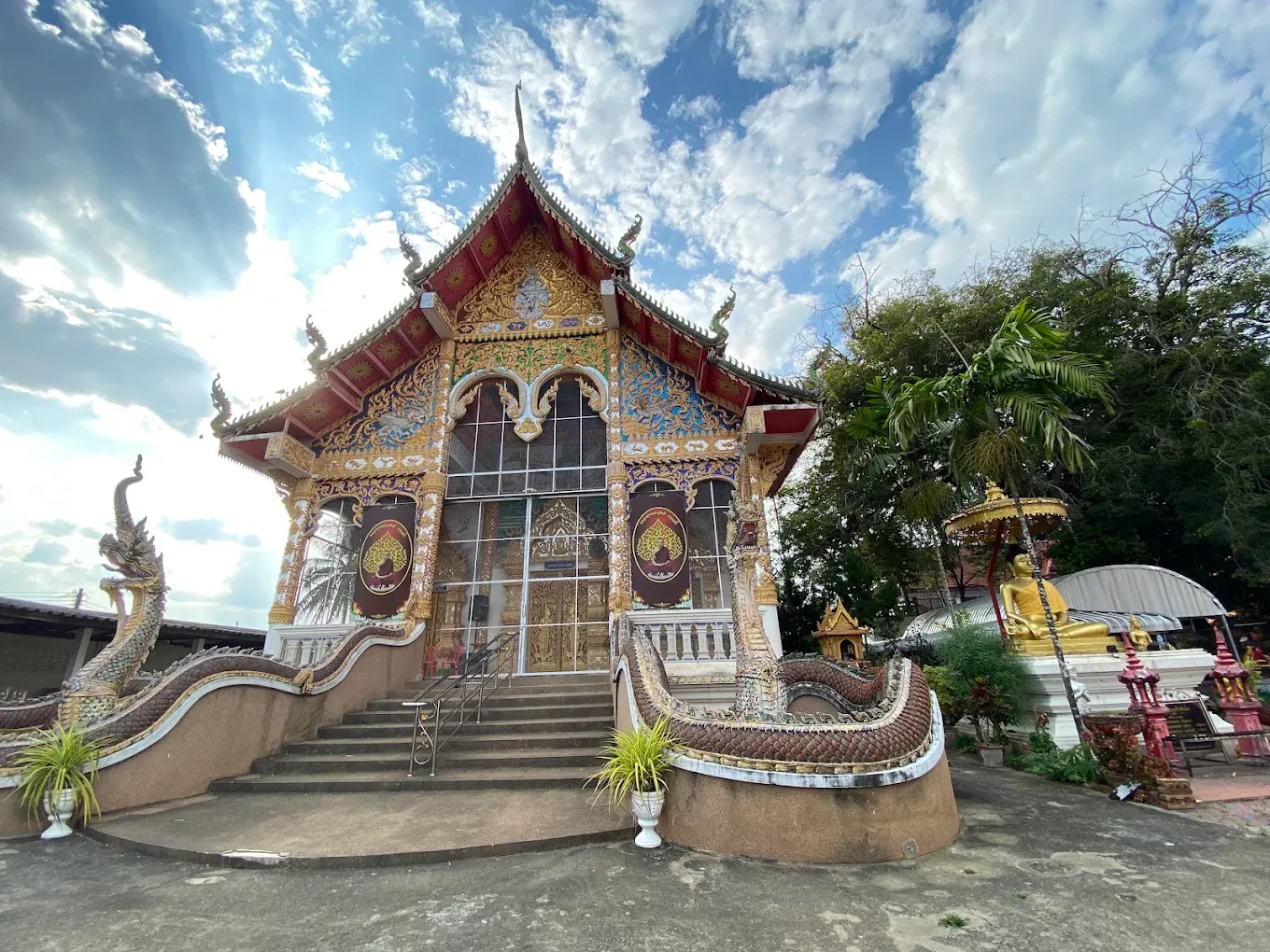
Wat Sawang Arom (Thung Satok) is a Mahanikaya Buddhist temple located at No. 86, Village No. 7, Thung Satok Subdistrict, San Pa Tong District, Chiang Mai Province. Locally, it was once known as Wat San Khwang because the temple stands on a ridge-like landform running across the direction of the wind. The temple land covers 3 rai and 30 square wah. Important structures include the viharn, monks’ residence, scripture hall, two salabat halls, sermon hall, kitchen, restrooms, and the temple’s key sacred objects: an old stucco Buddha image and an ancient square-shaped chedi.
Wat Sawang Arom (Thung Satok) is an old community Buddhist temple in Village No. 7, Thung Satok Subdistrict, San Pa Tong District, Chiang Mai Province. It belongs to the Mahanikaya monastic order and is located at No. 86. The temple land covers 3 rai and 30 square wah according to Sor Kor 1 land evidence dated 28 May 1955. Wat Sawang Arom remains an important religious site for the local community, supporting worship, merit-making, sermons, Buddhist ceremonies, and community activities in Thung Satok and nearby areas of San Pa Tong.
The present name, Wat Sawang Arom, carries an auspicious meaning connected with clarity, peacefulness, and brightness of mind. The older local name, Wat San Khwang, is closely tied to the temple’s landscape. Villagers called it by that name because the temple site lies on a ridge running crosswise to the direction of the wind. This earlier name preserves the memory of local geography and shows that the temple has always been connected with the physical environment of the village: fields, irrigation canals, school grounds, and rural settlement patterns.
The temple land was donated by local residents. This is one of the most important points in the history of Wat Sawang Arom because it shows that the temple was not formed by an isolated individual effort alone. It grew from the collective faith of villagers who offered land so that the community could have its own Buddhist temple. As a result, Wat Sawang Arom is a shared spiritual asset of the village. This sense of shared ownership has helped the temple survive, develop, and remain active across generations.
A key moment in the temple’s historical development came in 1835, when Phra Athikan Dhammapanyo began administering and maintaining the temple according to Sor Kor 1 evidence No. 465. This shows that the temple’s community roots go back earlier than the land evidence dated 1955. Wat Sawang Arom therefore has a long religious history in the area and has been maintained through cooperation between monks and lay supporters over many generations.
Phra Athikan Phonsit Dhammaro, also known as Rueanwin, is listed as the abbot in the temple history. In a community temple, the abbot’s role extends beyond the maintenance of buildings. He helps guide religious practice, coordinate with lay supporters, support merit-making events, maintain temple order, and preserve the relationship between the temple and the local community. Because Wat Sawang Arom has a viharn, chedi, sermon hall, salabat halls, scripture hall, monks’ residence, kitchen, and other functional spaces, continuous and structured temple leadership is essential.
The temple boundaries clearly reflect its agricultural and village setting. To the north, the temple borders villagers’ rice fields for about 6 wah. To the south, it borders villagers’ rice fields for about 10 wah. To the east, it borders an irrigation canal and a school for about 2 sen and 12 wah. To the west, it borders villagers’ rice fields for about 2 sen and 12 wah. These boundaries show that Wat Sawang Arom stands among rice fields, water systems, and educational space, making it part of the daily landscape of Thung Satok rather than a detached religious monument.
The relationship between the temple and the irrigation canal is particularly meaningful in a Lanna community context. Irrigation canals have long supported farming and daily life in northern Thai villages. The eastern side of the temple borders both a canal and a school, showing how religion, education, water management, and agriculture exist close together in the community. The temple therefore sits at the meeting point of worldly life and spiritual life.
The main monastic structures at Wat Sawang Arom include the viharn, monks’ residence, scripture hall, two salabat halls, one sermon hall, kitchen, and supporting facilities such as restrooms. These structures allow the temple to support Buddhist practice and community functions in a complete way. The viharn is the main worship hall. The sermon hall is used for Dhamma talks and larger gatherings. The salabat halls support food offerings and merit-making activities. The monks’ residence supports monastic life. The scripture hall reflects the importance of Buddhist texts and teachings, while the kitchen supports communal work during temple events.
The temple’s important sacred objects are an old stucco Buddha image and an ancient square-shaped chedi. The old stucco Buddha image is one of the key objects visitors should pay respect to when arriving at the temple. The chedi gives the temple a strong historical and religious character. Together, these sacred objects show that Wat Sawang Arom is not only a community gathering space but also a place of Buddhist devotion and cultural continuity.
The viharn measures 11 meters wide and 21 meters long. It was built in 1959 and was undergoing repairs in 1999. The building follows a Lanna style. As the temple’s central worship space, the viharn is used for paying respect to the Buddha, listening to sermons, chanting, receiving precepts, and joining important Buddhist ceremonies. Even though the building has required maintenance over time, its role as the heart of the temple’s religious life remains clear.
The Lanna style of the viharn helps preserve the northern Thai identity of the temple. Lanna temple architecture is closely connected with ceremony, atmosphere, and community practice. Wat Sawang Arom is therefore suitable for visitors who want to experience a living community temple rather than a large tourist-oriented attraction. Its value lies in local continuity, not in scale or spectacle.
The sermon hall measures 9 meters wide, 45 meters long, and 8.30 meters high. It was built in 1996 and is described as a nine-room Thai-style hall. This large hall plays an important role in temple and community activities. It can support Dhamma talks, merit-making ceremonies, meetings, Buddhist festivals, Kathin, robe-offering events, memorial rites, and gatherings with many participants. Its nine-room layout gives the temple flexible space for different kinds of activities.
Wat Sawang Arom has two salabat halls. The northern hall measures 3 meters wide, 39 meters long, and 3.5 meters high. The southern hall measures 3 meters wide, 57 meters long, and 3.5 meters high. Both are described as nine-room halls of a simple style, with one side wall curving along the temple boundary wall. Salabat halls are important in community temples because they support almsgiving, food offerings, merit-making, and lay participation during temple events.
The monks’ residence consists of one building measuring 11.10 meters wide and 15 meters long. It was built in 1984 and contains four bedrooms and one bathroom. This residence supports monastic life and allows monks to remain in the temple, perform daily duties, conduct ceremonies, receive offerings, and provide spiritual support to local people. In a village temple, the monks’ residence is not simply accommodation; it is a foundation for the continuity of Buddhist practice in the community.
The scripture hall, or ho trai, is another meaningful part of the temple. In Thai and Lanna Buddhist tradition, a scripture hall is associated with the preservation of Buddhist texts, palm-leaf manuscripts, or religious documents. Although specific measurements and construction details for this scripture hall are not available, its presence among the temple structures reflects the importance of Dhamma learning alongside ritual practice.
The chedi measures 9 meters wide and 9 meters long. It was built in 1964 and has a square form with standing Buddha images in niches around the chedi on all four sides. This chedi is one of the temple’s most important sacred landmarks. Its square form and four-direction Buddha niches give it a strong visual and ritual presence. Visitors should walk around it respectfully, observe its form, and understand it as a focal point of merit, devotion, and community memory.
The ancient square-shaped chedi functions as both a sacred object and a symbol of Buddhist continuity. In Lanna community temples, a chedi often represents accumulated merit, religious stability, and the faith of generations. The four standing Buddha images around the chedi create a sense of Buddhist presence in all directions. This makes the chedi an important place for quiet respect, reflection, and devotional practice.
The kitchen measures 5 meters wide and 11.95 meters long. It was completed in 1995 and is divided into three rooms: a dining room, a kitchen, and a storage room. The kitchen reflects the community function of the temple. In northern Thai merit-making culture, villagers often work together to prepare food for monks and participants during temple events. The dining room supports monastic meals, the kitchen supports cooking, and the storage room helps organize utensils and temple supplies.
The restrooms measure 2 meters wide, 11.70 meters long, and 3 meters high, with seven rooms built in 1996. Although restrooms are supporting facilities rather than sacred structures, they are important for practical temple use, especially during large events such as Kathin, robe-offering ceremonies, and community merit-making days. They allow the temple to welcome local residents and visitors more conveniently.
Wat Sawang Arom serves as a spiritual center for the community in Thung Satok. It supports merit-making, sermons, Buddhist holy day observances, Kathin, robe-offering ceremonies, memorial rites, and village gatherings. Because the temple stands near rice fields, an irrigation canal, and a school, it connects monks, elders, families, youth, and lay supporters from nearby communities into one shared religious space.
The temple’s annual and seasonal Buddhist activities should be understood within the context of Lanna village temples. Its viharn, sermon hall, salabat halls, kitchen, and courtyard provide the necessary spaces for Buddhist Lent, the end of Buddhist Lent, Kathin, robe offerings, food offerings, memorial merit-making, and other community religious events. These activities keep the relationship between temple and village active across generations.
Important areas to see at Wat Sawang Arom include the Lanna-style viharn, the square chedi with standing Buddha images on four sides, the old stucco Buddha image, the sermon hall, the two salabat halls, the monks’ residence, scripture hall, kitchen, and temple courtyard. Each area expresses a different function of the temple: worship, merit-making, monastic residence, Dhamma preservation, community cooperation, and practical support for religious events.
The atmosphere of Wat Sawang Arom is suited to travelers interested in Lanna community temples, old temples of San Pa Tong, and quiet cultural routes in Thung Satok. The temple is not defined by large-scale tourism. Its value lies in the old name Wat San Khwang, the land donated by villagers, the square chedi, the old stucco Buddha image, and its ongoing role in local religious life.
Visitors should dress respectfully, speak quietly, avoid disturbing monks’ living areas, avoid climbing or touching the chedi unnecessarily, and refrain from entering private or restricted spaces. If a ceremony or community event is taking place, visitors should follow the guidance of monks or local caretakers. Wat Sawang Arom remains an active sacred space for Village No. 7, so it should be visited with respect.
Getting There is most convenient by private car, rental car, or local hired transport. From Chiang Mai city, travel toward San Pa Tong District, then continue into Thung Satok Subdistrict and Village No. 7. Because the name Wat Sawang Arom is used by many temples in Thailand, travelers should search with the additional terms Thung Satok or San Pa Tong to avoid confusion.
A meaningful route around Wat Sawang Arom can include several temples and cultural sites in Thung Satok and San Pa Tong. Visitors can begin at Wat Sawang Arom to pay respect to the old stucco Buddha image and see the square chedi, then continue to Wat Si Bun Rueang, Wat Rong Som Poi, Wat Pa Mai Daeng, Wat Prasat, or Wiang Tha Kan Archaeological Site. This route helps travelers understand the network of community temples, villages, rice fields, canals, and Lanna heritage in southern Chiang Mai.
Overall, Wat Sawang Arom (Thung Satok) is a valuable religious and cultural site in San Pa Tong District. Its importance comes from its older local name Wat San Khwang, its donated temple land, its complete set of monastic structures, its ancient square-shaped chedi, its old stucco Buddha image, and its role as a spiritual center of Village No. 7. For travelers who want a quieter and deeper view of Chiang Mai’s living village temples, Wat Sawang Arom is worth visiting with care and respect.
| Name | Wat Sawang Arom (Thung Satok) |
| Former / Local Name | Wat San Khwang |
| Location | Village No. 7, Thung Satok Subdistrict, San Pa Tong District, Chiang Mai Province |
| Address | No. 86, Village No. 7, Thung Satok Subdistrict, San Pa Tong District, Chiang Mai, Thailand |
| Monastic Order | Mahanikaya |
| Open Days | Daily |
| Opening Hours | 08.00 AM – 05.00 PM |
| Temple Land | 3 Rai And 30 Square Wah, Based On Sor Kor 1 Evidence Dated 28 May 1955 |
| Origin Of Temple Land | Donated By Local Residents |
| Boundaries | North: About 6 Wah To Villagers’ Rice Fields; South: About 10 Wah To Villagers’ Rice Fields; East: About 2 Sen And 12 Wah To An Irrigation Canal And A School; West: About 2 Sen And 12 Wah To Villagers’ Rice Fields |
| Key History | In 1835, Phra Athikan Dhammapanyo Began Administering And Maintaining The Temple According To Sor Kor 1 Evidence No. 465 |
| Abbot / Caretaker | Phra Athikan Phonsit Dhammaro (Rueanwin) |
| Sacred Objects | Old Stucco Buddha Image And Ancient Square-Shaped Chedi |
| Important Structures | Viharn, Monks’ Residence, Scripture Hall, Two Salabat Halls, One Sermon Hall, Kitchen, And Restrooms |
| Viharn | 11 Meters Wide And 21 Meters Long; Built In 1959; Under Repair In 1999; Lanna Style |
| Sermon Hall | 9 Meters Wide, 45 Meters Long, And 8.30 Meters High; Built In 1996; Nine-Room Thai-Style Hall |
| Salabat Halls | Two Halls: The Northern Hall Measures 3 Meters Wide, 39 Meters Long, And 3.5 Meters High; The Southern Hall Measures 3 Meters Wide, 57 Meters Long, And 3.5 Meters High; Both Are Nine-Room Halls With One Curved Side Wall Along The Temple Boundary |
| Monks’ Residence | One Building, 11.10 Meters Wide And 15 Meters Long; Built In 1984; Four Bedrooms And One Bathroom |
| Chedi | 9 Meters Wide And 9 Meters Long; Built In 1964; Square-Shaped Chedi With Standing Buddha Images In Niches On All Four Sides |
| Kitchen | 5 Meters Wide And 11.95 Meters Long; Completed In 1995; Three Rooms: Dining Room, Kitchen, And Storage Room |
| Restrooms | 2 Meters Wide, 11.70 Meters Long, And 3 Meters High; Seven Rooms Built In 1996 |
| Main Areas / Zones | Viharn, Chedi, Monks’ Residence, Scripture Hall, Salabat Halls, Sermon Hall, Kitchen, Restrooms, And Temple Courtyard |
| Current Status | Active Community Temple In Village No. 7, Thung Satok Subdistrict, San Pa Tong District, Chiang Mai Province |
| Travel Information | Travel From Chiang Mai City Toward San Pa Tong District, Then Continue Into Thung Satok Subdistrict And Village No. 7; Private Car, Rental Car, Or Local Hired Transport Is Recommended |
| Nearby Tourist Attractions | 1. Wat Si Bun Rueang, About 3 Km 2. Wat Rong Som Poi, About 4 Km 3. Wat Pa Mai Daeng, About 5 Km 4. Wat Prasat (Thung Satok), About 6 Km 5. Wiang Tha Kan Archaeological Site, About 10 Km |
| Nearby Restaurants | 1. Thung Satok@San Pa Tong, About 4 Km 2. Sam Saep Ahan Tam Sang, About 4 Km 3. Aunt Phan’s Kitchen San Pa Tong, About 5 Km, Tel. 084-609-6109 4. Lung Ta Coffee, About 6 Km, Tel. 086-672-5722 5. Hong Lap Mae Wang 88, About 8 Km, Tel. 081-062-2544 |
| Nearby Accommodations | 1. Home At 9, About 12 Km, Tel. 088-636-2679 2. P Resort & W Resort, About 12 Km, Tel. 064-334-4566 3. Fortune Hotel, About 12 Km, Tel. 095-129-9564 4. Sompoinn Hotel, About 13 Km, Tel. 053-025-112 5. Bannoi Himsuan, About 13 Km, Tel. 090-329-6108 |
Frequently Asked Questions (FAQ)
Q: Where is Wat Sawang Arom (Thung Satok) located?
A: Wat Sawang Arom is located at No. 86, Village No. 7, Thung Satok Subdistrict, San Pa Tong District, Chiang Mai Province.
Q: What was the local former name of Wat Sawang Arom?
A: Local villagers called it Wat San Khwang because the temple stands on land running crosswise to the direction of the wind.
Q: What are the main sacred objects at Wat Sawang Arom?
A: The temple’s main sacred objects are an old stucco Buddha image and an ancient square-shaped chedi.
Q: What is distinctive about the chedi at Wat Sawang Arom?
A: The chedi measures 9 meters wide and 9 meters long, was built in 1964, and has standing Buddha images in niches on all four sides.
Q: What important structures are found at Wat Sawang Arom?
A: Important structures include the viharn, monks’ residence, scripture hall, two salabat halls, sermon hall, kitchen, restrooms, and temple courtyard.
Q: Who is the abbot of Wat Sawang Arom?
A: The abbot listed in the temple history is Phra Athikan Phonsit Dhammaro, also known as Rueanwin.
Q: How can travelers get to Wat Sawang Arom?
A: Travel from Chiang Mai city toward San Pa Tong District, then continue into Thung Satok Subdistrict and Village No. 7 by private car, rental car, or local hired transport.
Q: What nearby places can be visited together with Wat Sawang Arom?
A: Nearby places include Wat Si Bun Rueang, Wat Rong Som Poi, Wat Pa Mai Daeng, Wat Prasat, and Wiang Tha Kan Archaeological Site.
 Category: ●Places of Worship
 Group: ●Temple
Last Update : 4 DayAgo
 Last Update : 4 DayAgo
 Click to Access the Navigation Map GPS
Wat Sawang Arom (Thung Satok) Map
Recommend

 Muang Chiang Mai(121)Chom Thong(47)Mae Chaem(25)Chiang Dao(33)Doi Saket(68)Mae Taeng(85)Mae Rim(69)Samoeng(29)Fang(71)Mae Ai(59)Phrao(70)San Pa Tong(103)San Kamphaeng(66)San Sai(73)Hang Dong(73)Hot(32)Doi Tao(22)Omkoi(11)Saraphi(74)Wiang Haeng(15)Chai Prakan(28)Mae Wang(32)Mae On(22)Doi Lo(34)Galyani Vadhana(1)


