
lovethailand home >North Travel Attractions >Chiang Mai Travel Attractions >San Sai >Nong Yaeng > Wat Rong Meng
TL;DR: Wat Rong Meng is located at Ban Rong Meng, Moo 2, Nong Yaeng Subdistrict, San Sai District, Chiang Mai Province, open Daily.

Wat Rong Meng
Open Days: Daily
Museum Opening Hours: 08.00 – 17.30
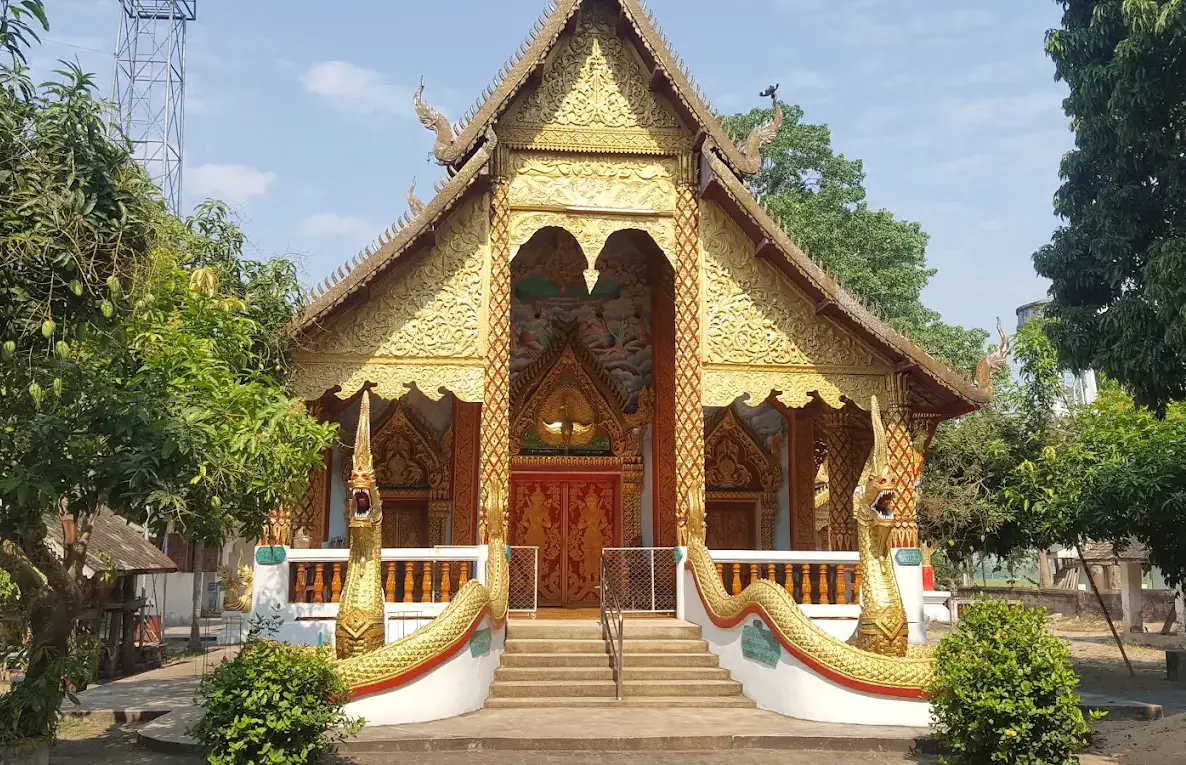
Wat Rong Meng is a local Buddhist temple under the Maha Nikaya order, located at 1 Moo 2, Ban Rong Meng, Nong Yaeng Subdistrict, San Sai District, Chiang Mai Province 50210. The temple covers 5 rai and 2 ngan. It was officially established in 1807 and received Wisungkham Sima on 23 June 1971. Wat Rong Meng is one of the old community temples of Nong Yaeng Subdistrict and is especially known for its role as an educational temple, a model temple for development, and the home of Rong Meng Temple Museum, one of the most important local cultural learning centers in the area.
The temple stands in Ban Rong Meng, Moo 2 of Nong Yaeng Subdistrict, in the eastern part of San Sai District. The surrounding area includes village communities, agricultural land, local roads, temples, and routes connecting San Sai with Mae Jo, Doi Saket, and Mae Kuang Dam. Wat Rong Meng therefore belongs to a living Lanna community landscape where temples are not only places for ceremonies but also spaces of learning, memory, and local identity.
The name Rong Meng is significant in local memory. Phra Khru Kovit Thammasophon explained that meng in northern Thai usage can refer to Mon people. The name appears in both the village name and the temple name, giving Wat Rong Meng a distinctive identity among the temples of Nong Yaeng. The name preserves linguistic, ethnic, and settlement memories within the religious landscape of the village.
The temple’s establishment in 1807 makes it one of the older temples of San Sai District. Across more than two centuries, the temple has witnessed the transformation of the local community from an agricultural village landscape into a wider semi-rural area connected with roads, schools, local administration, and cultural tourism. Wat Rong Meng therefore represents continuity between Buddhism, local culture, and community life in Nong Yaeng.
The granting of Wisungkham Sima on 23 June 1971 confirms the temple’s full status for formal Sangha acts within the Thai Buddhist monastic system. A Wisungkham Sima boundary is important for ordination and other formal monastic ceremonies. This status allows the temple to function fully as a community religious center for ordination, Kathin, Pa Pha offerings, Buddhist holy day observances, and annual ceremonies.
Wat Rong Meng has also been recognized as an educational park temple, a model development temple, and an outstanding development temple in 1999. These recognitions reflect the temple’s wider role beyond ordinary religious ceremonies. It has developed into a community learning space, a well-organized temple environment, and a place where local people and visitors can learn about Lanna culture through objects, stories, and Buddhist practice.
The temple’s most distinctive feature is Rong Meng Temple Museum, founded on 1 October 1984 by Phra Khru Sriphong Kovito, also known by his ecclesiastical title Phra Khru Kovit Thammasophon. He believed that a temple should not only teach morality and Buddhist practice, but also preserve old objects, farming tools, household utensils, religious objects, and everyday items that reveal how local people lived. This vision transformed Wat Rong Meng into a living repository of community memory.
The museum began simply but meaningfully. Its first important object was a curved wooden mold for making bricks used in well construction, known locally as pim pan din ki. Made from teak and more than 100 years old, it was originally given by the founder’s mother. When other old items such as bowls, dishes, tiles, and household objects were placed nearby, villagers became interested and began asking about their uses. The museum grew from this small beginning into a major local heritage collection.
As local residents and devotees learned about the founder’s purpose, they began donating old objects, Buddha images, traditional tools, household items, and artifacts to the temple. The museum was built on the principle of conservation rather than commerce. Objects were accepted as shared community heritage, not as things to be bought and sold. This gives Rong Meng Temple Museum its special character as a donation-based community museum rooted in faith and collective memory.
The museum collection grew from hundreds to thousands of objects. Today, it is displayed in two museum buildings within the temple. The collection includes Buddhist objects, ancient Buddha images, folk artifacts, agricultural tools, household utensils, carved wooden objects, old documents, religious items, and everyday objects from Lanna life. Together, these items allow visitors to understand local history not through abstract explanation, but through things that people once used in real daily life.
Some displayed objects carry strong social history value. Examples include a marriage registration document from 1937, lottery tickets from 1944, newspapers from the World War II era, an ox-cart driving license from 1926, a land sale agreement from 1929, agricultural tools, and household items. These objects show that history is not found only in royal chronicles or ancient city ruins. It is also preserved in ordinary documents, tools, and objects that record work, family, transport, economy, and village life.
Rong Meng Temple Museum is an important Lanna cultural learning center. Visitors can see Buddhist objects, folk tools, local wisdom, and artifacts that explain how communities in northern Thailand lived, worked, worshipped, and adapted over time. The museum is useful for students, researchers, cultural travelers, and anyone interested in understanding Chiang Mai beyond the old city and major tourist temples.
The museum has received wider recognition, and Phra Khru Kovit Thammasophon received an honor pin for Thai Heritage Conservation Day. The museum has also participated in national local museum events. This recognition shows that Rong Meng Temple Museum is not merely a storage room of old objects, but a meaningful model of how a rural temple can preserve cultural heritage and make it accessible to the public.
Phra Khru Kovit Thammasophon Kovito remains central to the identity of Wat Rong Meng. He is recognized as the founder of the museum and appears in recent Kathin records as the abbot of Wat Rong Meng. Recent public Kathin information also records five monks in residence in 2026, confirming that the temple remains active as a living Buddhist place with resident monks and annual religious activities.
Beyond the museum, Wat Rong Meng continues to function as a community temple. Its important areas include worship spaces, the viharn, temple courtyard, merit-making areas, two museum buildings, and community activity spaces. Local residents use the temple for Buddhist holy day merit-making, sermons, Kathin, Pa Pha offerings, memorial ceremonies, ordinations, and other annual activities.
Kathin is one of the temple’s important annual ceremonies. The 2026 Kathin record lists the ceremony for 22 November 2026 at 09.30, with five monks in residence. Kathin is held after Buddhist Lent and allows devotees to offer robes and requisites to the monastic community. At a temple like Wat Rong Meng, Kathin also helps sustain both the religious space and the museum-learning function of the temple.
Wat Rong Meng serves the community in multiple ways. Religiously, it is a place for worship, merit-making, sermons, and ceremonies. Culturally, it houses a museum that preserves Lanna artifacts and local objects. Educationally, it supports students, visitors, and community members who want to learn from physical heritage. Socially, it brings villagers together during annual events and community activities. For tourism, it offers a meaningful stop for visitors interested in local museums and village temples in San Sai.
Wat Rong Meng is suitable for visitors who want a temple visit with cultural depth. Important points to see include Rong Meng Temple Museum, the two exhibition buildings, the curved brick mold, old Buddha images, farming tools, household objects, carved wooden items, old documents, and the general atmosphere of a working community temple. Visitors should take time to look carefully because the value of this place lies in the details of each object and the local lives behind them.
A visit to Wat Rong Meng can be combined with nearby temples and places in Nong Yaeng Subdistrict, including Wat Buak Pao, Wat Nong Yaeng, Wat Thung Khao Tok, Wat Ban Dong Charoen Chai, Wat Phra Bat Tin Nok, and Wat Wiwek Wanaram. Visitors who want to continue toward Mae Jo can add Wat Thung Muen Noi, Wat Mae Jo, or Wat Huai Kiang. This makes a practical half-day or full-day cultural route through village temples and community heritage sites in San Sai.
Getting There is easiest by private car, rental car, or ride-hailing service. Set the destination as Wat Rong Meng or Rong Meng Temple Museum, 1 Moo 2, Ban Rong Meng, Nong Yaeng Subdistrict, San Sai District, Chiang Mai Province. From Chiang Mai city, travel toward San Sai District, then continue into Nong Yaeng Subdistrict and Ban Rong Meng. During rainy periods or temple festival days, extra travel time is useful because local roads and village traffic may be affected.
Because Wat Rong Meng is an active temple with a community museum inside, visitors should dress modestly, keep voices low, remove shoes where required, and avoid touching Buddha images, artifacts, display objects, or old documents without permission. Photography should follow the temple and museum rules. During Kathin, Pa Pha, or other temple ceremonies, visitors should respect local religious activities before viewing the museum or taking photographs.
| Name | Wat Rong Meng |
| Location | Ban Rong Meng, Moo 2, Nong Yaeng Subdistrict, San Sai District, Chiang Mai Province |
| Address | 1 Moo 2, Ban Rong Meng, Nong Yaeng Subdistrict, San Sai District, Chiang Mai 50210, Thailand |
| Temple Type | Local Buddhist Temple |
| Buddhist Order | Maha Nikaya |
| Land Area | 5 Rai, 2 Ngan |
| History | Established in 1807 and granted Wisungkham Sima on 23 June 1971 |
| Temple Recognition | Educational Park Temple, Model Development Temple, and Outstanding Development Temple in 1999 |
| Highlights | Old community temple of Nong Yaeng with Rong Meng Temple Museum, a major local learning center preserving Lanna artifacts, Buddhist objects, household tools, and folk heritage |
| Key Learning Site | Rong Meng Temple Museum, founded on 1 October 1984 by Phra Khru Sriphong Kovito, also known as Phra Khru Kovit Thammasophon |
| What To See | Rong Meng Temple Museum, curved brick mold, old Buddha images, Buddhist objects, Lanna household utensils, farming tools, old documents, and village-temple atmosphere |
| Main Areas / Zones | Worship areas, viharn, temple courtyard, merit-making areas, two museum buildings, and community activity spaces |
| Abbot / Caretaker | Phra Khru Kovit Thammasophon Kovito |
| Local Traditions / Activities | Kathin ceremony, Pa Pha offerings, Buddhist holy day merit-making, major Buddhist observances, and Lanna cultural learning activities |
| Travel Information | Accessible by private car, rental car, or ride-hailing service; set the destination as Wat Rong Meng or Rong Meng Temple Museum, 1 Moo 2, Nong Yaeng Subdistrict, San Sai District, Chiang Mai Province |
| Current Status | Open as an active community temple with resident monks and a local museum inside the temple |
| Open Days | Daily |
| Museum Opening Hours | 08.00 – 17.30 |
| Museum Admission Fee | Free Admission |
| Main Contact Number | Rong Meng Temple Museum Tel. 053-255-182, 081-960-3698 |
| Nearby Tourist Attractions | 1. Wat Buak Pao, about 2 km 2. Wat Nong Yaeng, about 3 km 3. Wat Thung Khao Tok, about 4 km 4. Wat Ban Dong Charoen Chai, about 5 km 5. Wat Phra Bat Tin Nok, about 9 km |
| Nearby Restaurants | 1. Som Tam Khon Ngam By Jessie Branch 02 San Sai, about 2 km, Tel. 096-070-9585, 096-389-8538 2. Saeb Nua Krua Nam Bistro & Drinks, about 4 km, Tel. 062-278-6836, 061-157-0647 3. JC Pizza, about 4 km, Tel. 061-793-2211 4. Farm Poo Na Cafe J Space San Sai, about 5 km, Tel. 065-614-6681 5. Chaliang Coffee, about 6 km, Tel. 090-979-5009 |
| Nearby Accommodations | 1. Nok Resort & Hotel, about 5 km, Tel. 080-679-9270 2. Lanna Saithong Resort, about 6 km, Tel. 053-255-371 3. The Sleep Resort Chiang Mai, about 9 km, Tel. 063-336-9641 4. MyRoom Boutique Home Mae Jo, about 13 km, Tel. 061-265-4555 5. The Loft House Sansai, about 14 km, Tel. 089-759-8666 |
Frequently Asked Questions (FAQ)
Q: Where is Wat Rong Meng located?
A: Wat Rong Meng is located at 1 Moo 2, Ban Rong Meng, Nong Yaeng Subdistrict, San Sai District, Chiang Mai 50210, Thailand.
Q: What is historically important about Wat Rong Meng?
A: Wat Rong Meng was established in 1807 and granted Wisungkham Sima on 23 June 1971. It is an old community temple of Nong Yaeng and is known for its local museum.
Q: What is the main highlight of Wat Rong Meng?
A: The main highlight is Rong Meng Temple Museum, which preserves Lanna artifacts, Buddhist objects, old Buddha images, farming tools, household utensils, old documents, and local heritage objects.
Q: When was Rong Meng Temple Museum founded?
A: Rong Meng Temple Museum was founded on 1 October 1984 by Phra Khru Sriphong Kovito, also known as Phra Khru Kovit Thammasophon.
Q: What are the opening hours of Wat Rong Meng?
A: Wat Rong Meng is open daily, and Rong Meng Temple Museum is open from 08.00 to 17.30. Visitors should dress modestly and respect the active temple environment.
Q: Is there an admission fee for Rong Meng Temple Museum?
A: Admission to Rong Meng Temple Museum is free. Visitors may make donations according to their faith and should follow the museum’s rules when viewing artifacts.
Q: Who is the abbot of Wat Rong Meng?
A: The abbot is Phra Khru Kovit Thammasophon Kovito, who is also the key figure behind the founding and development of Rong Meng Temple Museum.
Q: What nearby places can be combined with a visit to Wat Rong Meng?
A: Nearby places include Wat Buak Pao, Wat Nong Yaeng, Wat Thung Khao Tok, Wat Ban Dong Charoen Chai, and Wat Phra Bat Tin Nok.
 Category: ●Places of Worship
 Group: ●Temple
Last Update : 1 WeekAgo
 Last Update : 1 WeekAgo
 Click to Access the Navigation Map GPS
Wat Rong Meng Map
Recommend

 Muang Chiang Mai(121)Chom Thong(47)Mae Chaem(25)Chiang Dao(33)Doi Saket(68)Mae Taeng(85)Mae Rim(69)Samoeng(29)Fang(71)Mae Ai(59)Phrao(70)San Pa Tong(103)San Kamphaeng(66)San Sai(73)Hang Dong(73)Hot(32)Doi Tao(22)Omkoi(11)Saraphi(74)Wiang Haeng(15)Chai Prakan(28)Mae Wang(32)Mae On(22)Doi Lo(33)Galyani Vadhana(1)


