
lovethailand home >North Travel Attractions >Chiang Mai Travel Attractions >San Sai >Nong Yaeng > Wat Ban Dong Charoen Chai
TL;DR: Wat Ban Dong Charoen Chai is located at Ban Dong Charoen Chai, Moo 6, Nong Yaeng Subdistrict, San Sai District, Chiang Mai Province, open Daily, hours 08.00 – 17.00.

Wat Ban Dong Charoen Chai
Open Days: Daily
Opening Hours: 08.00 – 17.00
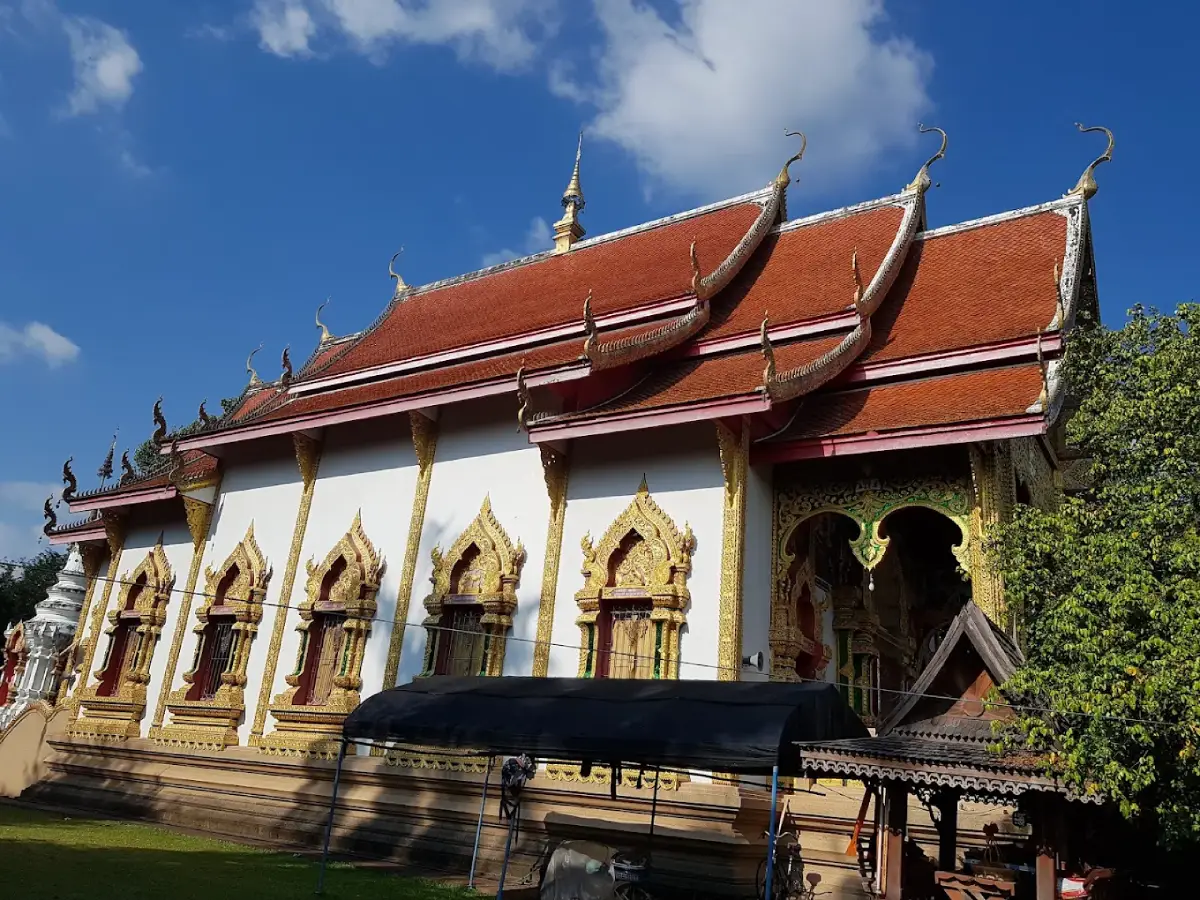
Wat Ban Dong Charoen Chai is a local Buddhist temple under the Maha Nikaya order, located at 89 Moo 6, Ban Dong Charoen Chai, on the San Sai–Doi Saket road in Nong Yaeng Subdistrict, San Sai District, Chiang Mai Province 50210. The temple covers 4 rai, 3 ngan, and 77 square wah. Permission to build the temple was granted on 20 September 1976, and the Ministry of Education officially announced the establishment of the temple on 20 December 1977. The temple was established through local devotion, with Nai Chue Boonpermphun applying for permission to create the temple on donated land from Nai Singkaew and Nang Buachum Charoensap, together with Nai Chaloemchai and Nang Lamchuai Chaimongkhon.
Ban Dong Charoen Chai is located in Nong Yaeng Subdistrict, a semi-rural agricultural area on the eastern side of San Sai District. The surrounding landscape includes longan orchards, houses, a local school, public roads, community spaces, and several village temples. Nearby temples in Nong Yaeng include Wat Thung Khao Tok, Wat Buak Pao, Wat Rong Meng, Wat Nong Yaeng, Wat Nong Bua Thian Siri, Wat Phra Bat Tin Nok, and Wat Mai Chonprathan. Wat Ban Dong Charoen Chai is therefore part of a wider network of community temples that support Buddhist life across Nong Yaeng.
The name Dong Charoen Chai reflects the identity of the village. Dong suggests a wooded or grove-like area, while Charoen Chai carries an auspicious meaning of prosperity and victory. The temple takes its name from the village, preserving the local identity of Ban Dong Charoen Chai within the religious landscape. It is not only a temple but also a place that represents the village, its road, its orchards, and its local community life.
The temple boundaries show its close relationship with the community. To the north and east are villagers’ longan orchards, to the west is Ban Dong Charoen Chai School, and to the south is a public road. This location places the temple between agricultural land, education, transport, and residential life. It functions as a religious space, a public community space, and a moral learning environment connected with the village school.
The connection between the temple and the nearby school is important. In Lanna village life, temples and schools often work together in moral education, Buddhist activities, youth events, and community ceremonies. Wat Ban Dong Charoen Chai can therefore serve as a place where young people learn respect, merit-making, chanting, meditation, and Buddhist values through direct participation in village activities.
The temple’s modern history is clear from the late 1970s. Permission to build the temple was granted on 20 September 1976, and official temple status was announced on 20 December 1977. This reflects the growth of the Ban Dong Charoen Chai community and its need for an official Buddhist temple of its own. The involvement of land donors and a formal applicant shows that the temple was established through collective local faith rather than by a single person alone.
The main figures associated with the establishment of the temple include Nai Chue Boonpermphun, who applied for permission to build and establish the temple, and the land donors: Nai Singkaew, Nang Buachum Charoensap, Nai Chaloemchai, and Nang Lamchuai Chaimongkhon. Donating land for a temple is a significant act of merit in Thai Buddhist communities because the land becomes a shared sacred space for worship, merit-making, funerals, ordinations, Kathin, Pa Pha offerings, and community activities for many generations.
The important structures at Wat Ban Dong Charoen Chai include the viharn, funeral and merit-making pavilion, kitchen, storage building, rest pavilion, bathrooms, and toilets. These structures allow the temple to serve as a fully functional community temple. The viharn is the main space for worship, Dhamma listening, and ceremonies. The merit-making pavilion supports funerals and community religious events. The kitchen supports large gatherings, while the rest pavilion and facilities make the temple practical for daily and annual use.
The viharn is the most important religious space of the temple. It is where local devotees pay respect to Buddha images, make merit, listen to sermons, and join Buddhist ceremonies. Wat Ban Dong Charoen Chai is not a large commercial tourist temple. Its value lies in its practical role as a living village temple used by the local community throughout the year.
The funeral and merit-making pavilion is another important structure because community temples support all stages of village life. Families use the temple for memorial ceremonies, merit-making, ordinations, Kathin, Pa Pha, and Buddhist holy day activities. A pavilion of this kind allows the temple to support both religious practice and social care within the village.
The kitchen and supporting structures also reveal how a village temple works in practice. Temple events often involve preparing food, offering meals to monks, welcoming guests, arranging ceremony spaces, and sharing labor among villagers. The kitchen is therefore not a minor facility. It is part of the social and devotional life of the temple.
Wat Ban Dong Charoen Chai has also played a role in subdistrict-level Dhamma activities. In 2023, the temple hosted a Dhamma travel program organized with Nong Yaeng Subdistrict Municipality, the local public training unit, the Nong Yaeng Sangha, village leaders, women’s groups, elderly groups, health volunteers, civil defense volunteers, youth groups, and local devotees. The activity included chanting, meditation, a Dhamma talk, and Dhamma question-and-answer activities by local youth.
This Dhamma program shows that the temple has a role beyond its own village. It is part of a network of eight temples and one hermitage in Nong Yaeng Subdistrict used for rotating Dhamma activities. Such programs strengthen moral education, intergenerational participation, and cooperation among monks, local government, community groups, and residents. Wat Ban Dong Charoen Chai therefore serves both Ban Dong Charoen Chai and the wider Nong Yaeng community.
The temple serves the community in several ways. Religiously, it is a place for worship, merit-making, sermon listening, observance, and Buddhist ceremonies. Socially, it is a gathering space for families during Kathin, Pa Pha, memorial ceremonies, and village activities. Educationally, it is linked with the nearby school and youth Dhamma activities. Spatially, it stands between longan orchards, a school, and a public road, making it accessible and useful for local residents.
Wat Ban Dong Charoen Chai is suitable for visitors who want to experience a quiet community temple in San Sai. Important things to observe include the viharn, merit-making pavilion, temple courtyard, the surrounding longan-orchard landscape, and the temple’s relationship with the nearby school and village road. Its value is not in grand tourist architecture but in its ongoing role as a living temple of Ban Dong Charoen Chai.
A visit to Wat Ban Dong Charoen Chai can be combined with nearby temples in Nong Yaeng Subdistrict, including Wat Thung Khao Tok, Wat Buak Pao, Wat Rong Meng, Wat Nong Yaeng, Wat Phra Bat Tin Nok, and Wat Wiwek Wanaram. Visitors can also continue toward the Mae Jo area to visit Wat Thung Muen Noi, Wat Mae Jo, or Wat Huai Kiang. This route is suitable for a half-day or full-day cultural trip focused on village temples and the semi-rural landscape of San Sai.
Getting There is easiest by private car, rental car, or ride-hailing service. Set the destination as Wat Ban Dong Charoen Chai, 89 Moo 6, Ban Dong Charoen Chai, San Sai–Doi Saket Road, Nong Yaeng Subdistrict, San Sai District, Chiang Mai Province. From Chiang Mai city, travel toward San Sai District, then continue into Nong Yaeng Subdistrict and Ban Dong Charoen Chai. During rainy periods or temple event days, allow extra travel time because local roads and village traffic may be affected.
Because Wat Ban Dong Charoen Chai is an active community temple, visitors should dress modestly, keep voices low, remove shoes where required, avoid touching Buddha images or sacred objects without permission, and give space to monks and local residents during ceremonies. If visiting during Kathin, Pa Pha, memorial ceremonies, or Dhamma activities, visitors should respect community use of the temple before taking photographs.
| Name | Wat Ban Dong Charoen Chai |
| Location | Ban Dong Charoen Chai, Moo 6, Nong Yaeng Subdistrict, San Sai District, Chiang Mai Province |
| Address | 89 Moo 6, Ban Dong Charoen Chai, San Sai–Doi Saket Road, Nong Yaeng Subdistrict, San Sai District, Chiang Mai 50210, Thailand |
| Coordinates | 18.88937, 99.11943 |
| Temple Type | Local Buddhist Temple |
| Buddhist Order | Maha Nikaya |
| Land Area | 4 Rai, 3 Ngan, 77 Square Wah |
| Boundaries | North: Villagers’ Longan Orchard; East: Villagers’ Longan Orchard; West: Ban Dong Charoen Chai School; South: Public Road |
| History | Permission to build the temple was granted on 20 September 1976, and the temple was officially announced on 20 December 1977 |
| Applicant For Temple Establishment | Nai Chue Boonpermphun |
| Land Donors | Nai Singkaew and Nang Buachum Charoensap; Nai Chaloemchai and Nang Lamchuai Chaimongkhon |
| Important Structures | Viharn, funeral and merit-making pavilion, kitchen, storage building, rest pavilion, bathrooms, and toilets |
| Highlights | Community temple created through local land donation and village faith, located near Ban Dong Charoen Chai School, longan orchards, and a public road |
| Local Activities | Buddhist holy day merit-making, Kathin ceremony, Pa Pha offerings, memorial ceremonies, Dhamma travel activities, chanting, meditation, and Dhamma Q&A |
| Travel Information | Accessible by private car, rental car, or ride-hailing service; set the destination as Wat Ban Dong Charoen Chai, 89 Moo 6, Ban Dong Charoen Chai, San Sai–Doi Saket Road, Nong Yaeng Subdistrict, San Sai District, Chiang Mai Province |
| Current Status | Open as an active community temple and religious space of Ban Dong Charoen Chai |
| Open Days | Daily |
| Opening Hours | 08.00 – 17.00 |
| Local Authority Contact | Nong Yaeng Subdistrict Municipality Tel. 053-255110, 053-255111, 053-255415 |
| Nearby Tourist Attractions | 1. Wat Thung Khao Tok, about 4 km 2. Wat Buak Pao, about 5 km 3. Wat Rong Meng, about 5 km 4. Wat Nong Yaeng, about 6 km 5. Wat Phra Bat Tin Nok, about 8 km |
| Nearby Restaurants | 1. Saeb Nua Krua Nam Bistro & Drinks, about 5 km, Tel. 062-278-6836, 061-157-0647 2. Farm Poo Na Cafe J Space San Sai, about 6 km, Tel. 065-614-6681 3. Chaliang Coffee, about 6 km, Tel. 090-979-5009 4. Rolls.space Chiang Mai, about 7 km, Tel. 095-759-6797 5. 8eggs.onthetable, about 8 km, Tel. 090-201-1614 |
| Nearby Accommodations | 1. Nok Resort & Hotel, about 5 km, Tel. 080-679-9270 2. Lanna Saithong Resort, about 6 km 3. The Sleep Resort Chiang Mai, about 9 km 4. Densathan Resort, about 10 km, Tel. 080-695-8107 5. MyRoom Boutique Home Mae Jo, about 13 km, Tel. 061-265-4555 |
Frequently Asked Questions (FAQ)
Q: Where is Wat Ban Dong Charoen Chai located?
A: Wat Ban Dong Charoen Chai is located at 89 Moo 6, Ban Dong Charoen Chai, San Sai–Doi Saket Road, Nong Yaeng Subdistrict, San Sai District, Chiang Mai 50210, Thailand.
Q: What is historically important about Wat Ban Dong Charoen Chai?
A: Permission to build the temple was granted on 20 September 1976, and the Ministry of Education officially announced the establishment of the temple on 20 December 1977. The temple was created through local land donation and community faith.
Q: What are the main highlights of Wat Ban Dong Charoen Chai?
A: Highlights include its role as a living community temple, its location near the village school and longan orchards, and its structures such as the viharn, merit-making pavilion, kitchen, rest pavilion, and basic visitor facilities.
Q: What important structures are found at the temple?
A: Important structures include the viharn, funeral and merit-making pavilion, kitchen, storage building, rest pavilion, bathrooms, and toilets.
Q: What are the opening hours of Wat Ban Dong Charoen Chai?
A: Wat Ban Dong Charoen Chai is open daily from 08.00 to 17.00. Visitors should dress modestly and respect the quiet atmosphere of the active community temple.
Q: What activities are associated with Wat Ban Dong Charoen Chai?
A: Activities include Buddhist holy day merit-making, Kathin, Pa Pha offerings, memorial ceremonies, and Dhamma travel activities such as chanting, meditation, Dhamma talks, and Dhamma Q&A.
Q: What nearby places can be combined with a visit to Wat Ban Dong Charoen Chai?
A: Nearby places include Wat Thung Khao Tok, Wat Buak Pao, Wat Rong Meng, Wat Nong Yaeng, and Wat Phra Bat Tin Nok.
Q: What is the easiest way to reach Wat Ban Dong Charoen Chai?
A: The easiest way is by private car, rental car, or ride-hailing service. Set the destination as Wat Ban Dong Charoen Chai, Nong Yaeng Subdistrict, San Sai District, Chiang Mai Province.
 Category: ●Places of Worship
 Group: ●Temple
Last Update : 6 DayAgo
 Last Update : 6 DayAgo
 Click to Access the Navigation Map GPS
Wat Ban Dong Charoen Chai Map
Recommend

 Muang Chiang Mai(121)Chom Thong(47)Mae Chaem(25)Chiang Dao(33)Doi Saket(68)Mae Taeng(85)Mae Rim(69)Samoeng(29)Fang(71)Mae Ai(59)Phrao(70)San Pa Tong(103)San Kamphaeng(66)San Sai(73)Hang Dong(73)Hot(32)Doi Tao(22)Omkoi(11)Saraphi(74)Wiang Haeng(15)Chai Prakan(28)Mae Wang(32)Mae On(22)Doi Lo(33)Galyani Vadhana(1)


