
lovethailand home >North Travel Attractions >Chiang Mai Travel Attractions >San Sai >Nong Han > Wat Wiwek Wanaram
TL;DR: Wat Wiwek Wanaram is located at Ban Wiwek, Moo 8, Nong Han Subdistrict, San Sai District, Chiang Mai Province.

Wat Wiwek Wanaram
Operating day: Daily
Operating time: 08.00 - 17.00
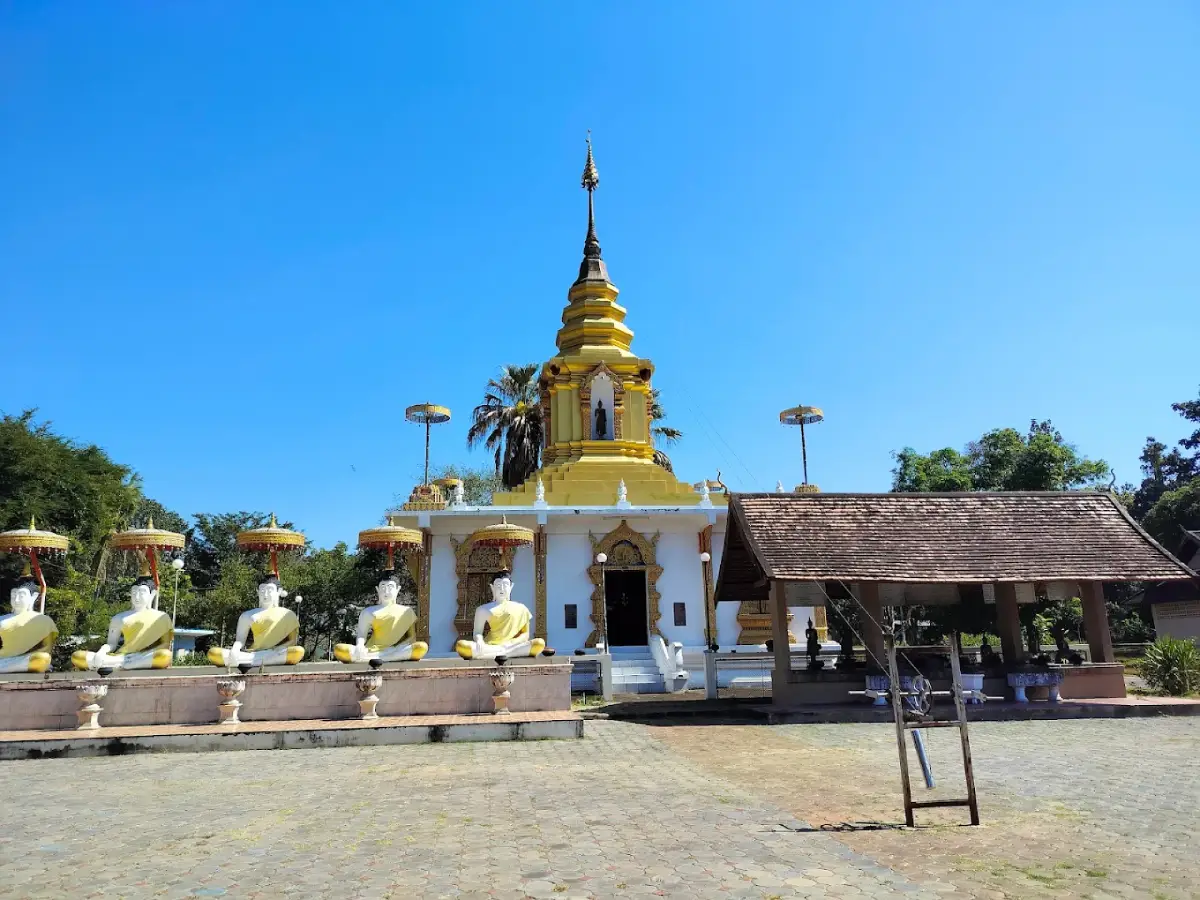
Wat Wiwek Wanaram is a local Buddhist temple under the Maha Nikaya order, located at 1 Moo 8, Ban Wiwek, Nong Han Subdistrict, San Sai District, Chiang Mai Province 50290. The temple has a distinctive history because it was revived from an old deserted temple site in a dense forest, where remains of an old ubosot boundary, bricks, and ancient roof tiles were found. It later developed into a temple, meditation center, monastic training site, and Buddhist education center connected with the training of monks and novices for the propagation of Buddhism in remote areas.
Wat Wiwek Wanaram is located in Ban Wiwek, Moo 8 of Nong Han Subdistrict. This area of San Sai District contains old village communities, former agricultural land, forested and upland zones, the Chiang Mai–Phrao route, Maejo University, schools, village temples, and communities that have expanded with the growth of northern Chiang Mai. The temple differs from many roadside or village-center temples because its history is tied to forest practice, monastic training, and the revival of a former deserted sacred site.
The word wiwek means solitude, quietness, and withdrawal from worldly distraction. This meaning fits the temple’s early setting. The original site was a dense forest with no nearby village and was about two kilometers from the nearest settlement. Such an environment was well suited to meditation and monastic discipline. Wat Wiwek Wanaram therefore carries the identity of a quiet practice temple and a place for mental training.
The temple’s story begins with Phra Khru Somboon Wutthisaro, also known as Khru Ba Somboon Wutthisaro, the first abbot of Wat Wiwek Wanaram. He had studied with Khru Ba Inthachak Raksa of Wat Nam Bo Luang in San Pa Tong District, Chiang Mai. Later, he traveled as a forest monk and stayed near Mon Rue Si, where he spent one rains retreat practicing monastic discipline. At that time, Phra Khru Mongkhon Khunathon of Wat San Sai Mun, who was the ecclesiastical district chief of San Sai, together with local leaders and devotees, considered building a temple near Mon Rue Si. However, that site was about seven to eight kilometers from villages and the main road, and travel was difficult because roads were limited to cart tracks.
Phra Khru Mongkhon Khunathon then inspected another site and found signs of an old deserted temple, including the base of an ubosot boundary and scattered ancient bricks and tiles. He considered this site more suitable for revival as a temple and meditation center. He therefore invited Phra Khru Somboon Wutthisaro to move from Mon Rue Si to this location on 17 December 1946. This move became the beginning of Wat Wiwek Wanaram as a revived temple and center of Buddhist practice.
In its earliest stage, the temple area was a dense forest without houses nearby and about two kilometers from the village. The site was quiet and suitable for meditation, but it required great effort from monks, novices, and devotees to clear, organize, and develop the land. Wat Wiwek Wanaram therefore grew from monastic perseverance and community support rather than from an already prepared settlement site.
The temple land originally covered about 256 rai. Phra Khru Mongkhon Khunathon, local leaders, and the temple committee chaired by Pho Mu Chantharangsi worked together to claim and preserve the land, obtaining Sor Khor 1 documentation as evidence. Later, when parts of the land were encroached upon, the temple committee and devotees dug boundary trenches and built roads around all four sides. This reduced the land area by more than 30 rai but helped protect the remaining temple land for Buddhist use.
The temple currently has 225 rai, 3 ngan, and 80 square wah of land, with land title deed number 10202 issued on 18 November 1985. This makes Wat Wiwek Wanaram unusually spacious compared with many village temples. The large area supports its functions as a meditation environment, residence for monks and novices, educational site, training center, and quiet religious space.
Wat Wiwek Wanaram has special importance in Buddhist education and propagation. Later, the Sangha and local devotees held a meeting chaired by Phra Khru Santi Yanusat, the ecclesiastical district chief of San Sai at that time. They resolved to place Wat Wiwek Wanaram under the patronage of Somdet Phra Phuttha Chinawong, the Northern Sangha Governor and abbot of Wat Benchamabophit, in order to develop the temple into a training center for monks and novices who would help propagate Buddhism in remote areas.
Following this direction, teaching for monks and novices began inside the temple in 1993. This role makes the temple more than a local place of worship. It became a training and educational center connected with the wider mission of Buddhist propagation, especially for monks and novices who would serve communities in distant and underserved areas.
The temple is also connected with the broader Phra Dhammacharika movement, which aimed to bring Buddhist teachings to hill-tribe communities in northern Thailand. The pilot program began in 1965 with monks traveling to hill-tribe villages in several northern provinces. The project encouraged Buddhist learning, faith, ordination, and monastic education among young people from remote communities. This background helps explain why Wat Wiwek Wanaram has such a strong role in monastic education and training.
Wat Wiwek Wanaram School is located within the temple at 1 Moo 8, San Sai–Phrao Road, Nong Han Subdistrict, San Sai District, Chiang Mai Province. It provides general education, Dhamma studies, and Pali studies for monks and novices. The school serves as a Phra Pariyatti Dhamma school for San Sai District, making the temple both a religious place and an educational institution within the Buddhist monastic system.
The current abbot is Phra Khru Si Panyawut Panyawutho. Public ecclesiastical records also list him as the ecclesiastical chief of Nong Han Subdistrict and a preceptor. His educational background includes Nak Tham Ek, Pali Grade 6, and a bachelor’s degree in religious studies. His role therefore extends across temple administration, monastic education, Buddhist practice, and ecclesiastical leadership in Nong Han Subdistrict.
Recent Kathin records show that Wat Wiwek Wanaram has five monks in residence and continues to hold Kathin ceremonies. This confirms that the temple remains active today, with resident monks, community participation, and ongoing Buddhist activities. It is not a deserted historical site but a living temple with religious, educational, and community functions.
The key areas of the temple should be understood through its role as a meditation and educational temple. Important areas include the old deserted temple site and former Sima base, worship areas, monks’ residences, meditation areas, Phra Pariyatti Dhamma education areas, temple courtyard, forested spaces, and quiet zones for practice. Public sources do not provide complete architectural details for every building, so the temple is best described through its verified history and functions.
The temple’s main appeal lies in its transformation from an old deserted forest temple into a meditation and monastic training center. Visitors should pay attention not only to buildings but also to the atmosphere. The essence of Wat Wiwek Wanaram is quietness, discipline, study, and mental cultivation rather than commercial tourism or large-scale architecture.
Wat Wiwek Wanaram is suitable for visitors who want to make merit, pay respect, learn about forest-based temple revival, and understand the role of Buddhism in education and outreach. Its story includes Khru Ba Somboon’s forest practice, the move from Mon Rue Si, the discovery of the old temple site, the protection of large temple land, the development under wider Sangha patronage, and the establishment of teaching for monks and novices.
The temple serves Ban Wiwek and Nong Han Subdistrict on several levels. Religiously, it is a place for merit-making, sermon listening, Buddhist observance, meditation, and ceremonies. Educationally, it supports monastic learning. Socially, it connects monks, villagers, students, and networks of devotees. Historically, it preserves the memory of a deserted temple, ancient bricks and tiles, forest practice, and the development of a Buddhist training center.
Wat Wiwek Wanaram can be combined with nearby places such as Lanna Dhutanka, Wat Huai Kiang, Wat Thung Muen Noi, Wat Mongkhon Setthi, Wat Thung Pa Ket, Wat Mae Jo, and Tweechol Botanic Garden. This route is suitable for visitors who want to explore local temples and Buddhist learning spaces in Nong Han and Mae Jo rather than only visiting major tourist temples in Chiang Mai city.
Getting There is easiest by private car, rental car, or ride-hailing service. Set the destination as Wat Wiwek Wanaram, 1 Moo 8, Nong Han Subdistrict, San Sai District, Chiang Mai Province. From Chiang Mai city, travel toward Mae Jo or along the Chiang Mai–Phrao route, then continue into Ban Wiwek. Extra travel time is useful during morning and evening traffic because Mae Jo and San Sai have schools, university traffic, shops, and local commuting routes.
Because Wat Wiwek Wanaram is an active religious and educational place, visitors should dress modestly, keep voices low, remove shoes where required, and avoid entering school areas, meditation areas, or monks’ residences without permission. If visiting during Kathin or other temple events, visitors should respect the ceremony before taking photographs. The most appropriate way to visit is to preserve the quietness that gives the temple its name.
| Name | Wat Wiwek Wanaram |
| Location | Ban Wiwek, Moo 8, Nong Han Subdistrict, San Sai District, Chiang Mai Province |
| Address | 1 Moo 8, Nong Han Subdistrict, San Sai District, Chiang Mai 50290, Thailand |
| Temple Type | Local Buddhist Temple |
| Buddhist Order | Maha Nikaya |
| Land Area | Originally about 256 Rai; currently 225 Rai, 3 Ngan, 80 Square Wah |
| Land Title Information | Title deed number 10202, issued on 18 November 1985 |
| Coordinates | Approximately 18.944, 99.01694 |
| Highlights | Meditation-oriented temple revived from a deserted forest temple site, with old Sima remains, ancient bricks and tiles, monastic training roles, and Phra Pariyatti Dhamma education |
| History | Phra Khru Somboon Wutthisaro moved from Mon Rue Si to the old deserted temple site on 17 December 1946; the temple later developed into a training center and began teaching monks and novices in 1993 |
| Name Meaning | The name reflects solitude and quietness, matching the temple’s forest-practice and meditation identity |
| Main Areas / Zones | Old deserted temple site and Sima base, worship areas, monks’ residences, meditation areas, Phra Pariyatti Dhamma education areas, temple courtyard, forested spaces, and quiet practice zones |
| Community Role | Community temple, meditation temple, monastic training center, and site of a Phra Pariyatti Dhamma school for San Sai District |
| Abbot / Caretaker | Phra Khru Si Panyawut Panyawutho |
| Ecclesiastical Roles | Abbot of Wat Wiwek Wanaram, ecclesiastical chief of Nong Han Subdistrict, and preceptor |
| Local Traditions / Activities | Kathin ceremony, Buddhist holy day merit-making, Phra Pariyatti Dhamma education, monastic training, and meditation-related activities |
| Travel Information | Accessible by private car, rental car, or ride-hailing service; set the destination as Wat Wiwek Wanaram, 1 Moo 8, Nong Han Subdistrict, San Sai District, Chiang Mai Province |
| Current Status | Open as an active community temple with resident monks and ongoing educational, meditation, and Buddhist activities |
| Opening Hours | 08.00 – 17.00 |
| Main Contact Number | Wat Wiwek Wanaram Tel. 053-498-995, 053-353-297 Nong Han Subdistrict Municipality Tel. 053-106-951 |
| Nearby Tourist Attractions | 1. Lanna Dhutanka, about 1 km 2. Wat Huai Kiang, about 3 km 3. Wat Thung Muen Noi, about 4 km 4. Wat Mongkhon Setthi, about 4 km 5. Wat Thung Pa Ket, about 5 km |
| Nearby Restaurants | 1. Bua Chicken Rice And Made-To-Order Food, about 3 km, Tel. 080-129-9388, 081-883-9504, 081-960-3114 2. Mee You Made-To-Order Food, about 4 km, Tel. 098-146-2362 3. Kuai Tiao Ban Mai, about 4 km, Tel. 086-198-1580 4. San Sai Korean Food, about 5 km, Tel. 096-192-0915 5. Pai-Yan Yai Restaurant & Drink, about 5 km, Tel. 090-893-3239 |
| Nearby Accommodations | 1. Densathan Resort, about 5 km, Tel. 080-695-8107 2. The Sleep Resort, about 6 km 3. Rung Nara Pool Villa, about 7 km, Tel. 064-946-6193 4. MyRoom Boutique Home Mae Jo, about 8 km, Tel. 061-265-4555 5. Thipthara Dormitory, about 8 km |
Frequently Asked Questions (FAQ)
Q: Where is Wat Wiwek Wanaram located?
A: Wat Wiwek Wanaram is located at 1 Moo 8, Ban Wiwek, Nong Han Subdistrict, San Sai District, Chiang Mai 50290, Thailand.
Q: What is historically important about Wat Wiwek Wanaram?
A: The temple was revived from an old deserted temple site where Sima remains, ancient bricks, and tiles were found. Phra Khru Somboon Wutthisaro moved to the site on 17 December 1946, and it later developed into a monastic training and education center.
Q: What are the main highlights of Wat Wiwek Wanaram?
A: Highlights include its quiet forest-practice atmosphere, large temple land, old deserted temple site, role in monastic training, and Phra Pariyatti Dhamma education for monks and novices.
Q: Who is the abbot of Wat Wiwek Wanaram?
A: The abbot is Phra Khru Si Panyawut Panyawutho, who also serves as ecclesiastical chief of Nong Han Subdistrict and as a preceptor.
Q: What are the opening hours of Wat Wiwek Wanaram?
A: Wat Wiwek Wanaram is open from 08.00 to 17.00. Visitors should dress modestly and preserve the quiet atmosphere of the active temple and school area.
Q: How is Wat Wiwek Wanaram connected with monastic education?
A: Teaching for monks and novices began at the temple in 1993, and the temple is home to a Phra Pariyatti Dhamma school offering general education, Dhamma studies, and Pali studies.
Q: What nearby places can be combined with a visit to Wat Wiwek Wanaram?
A: Nearby places include Lanna Dhutanka, Wat Huai Kiang, Wat Thung Muen Noi, Wat Mongkhon Setthi, and Wat Thung Pa Ket.
Q: What is the easiest way to reach Wat Wiwek Wanaram?
A: The easiest way is by private car, rental car, or ride-hailing service. Set the destination as Wat Wiwek Wanaram, 1 Moo 8, Nong Han Subdistrict, San Sai District, Chiang Mai Province.
 Category: ●Places of Worship
 Group: ●Temple
Last Update : 5 DayAgo
 Last Update : 5 DayAgo
 Click to Access the Navigation Map GPS
 Muang Chiang Mai(121)Chom Thong(47)Mae Chaem(25)Chiang Dao(33)Doi Saket(68)Mae Taeng(85)Mae Rim(69)Samoeng(29)Fang(71)Mae Ai(59)Phrao(70)San Pa Tong(103)San Kamphaeng(66)San Sai(73)Hang Dong(73)Hot(32)Doi Tao(22)Omkoi(11)Saraphi(74)Wiang Haeng(15)Chai Prakan(28)Mae Wang(32)Mae On(22)Doi Lo(34)Galyani Vadhana(1)


