
lovethailand home >North Travel Attractions >Chiang Mai Travel Attractions >San Sai >Nong Han > Wat Pa Bong
TL;DR: Wat Pa Bong is located at Ban Pa Bong, Moo 2, Nong Han Subdistrict, San Sai District, Chiang Mai Province, open Daily, hours 08.00 – 17.00.
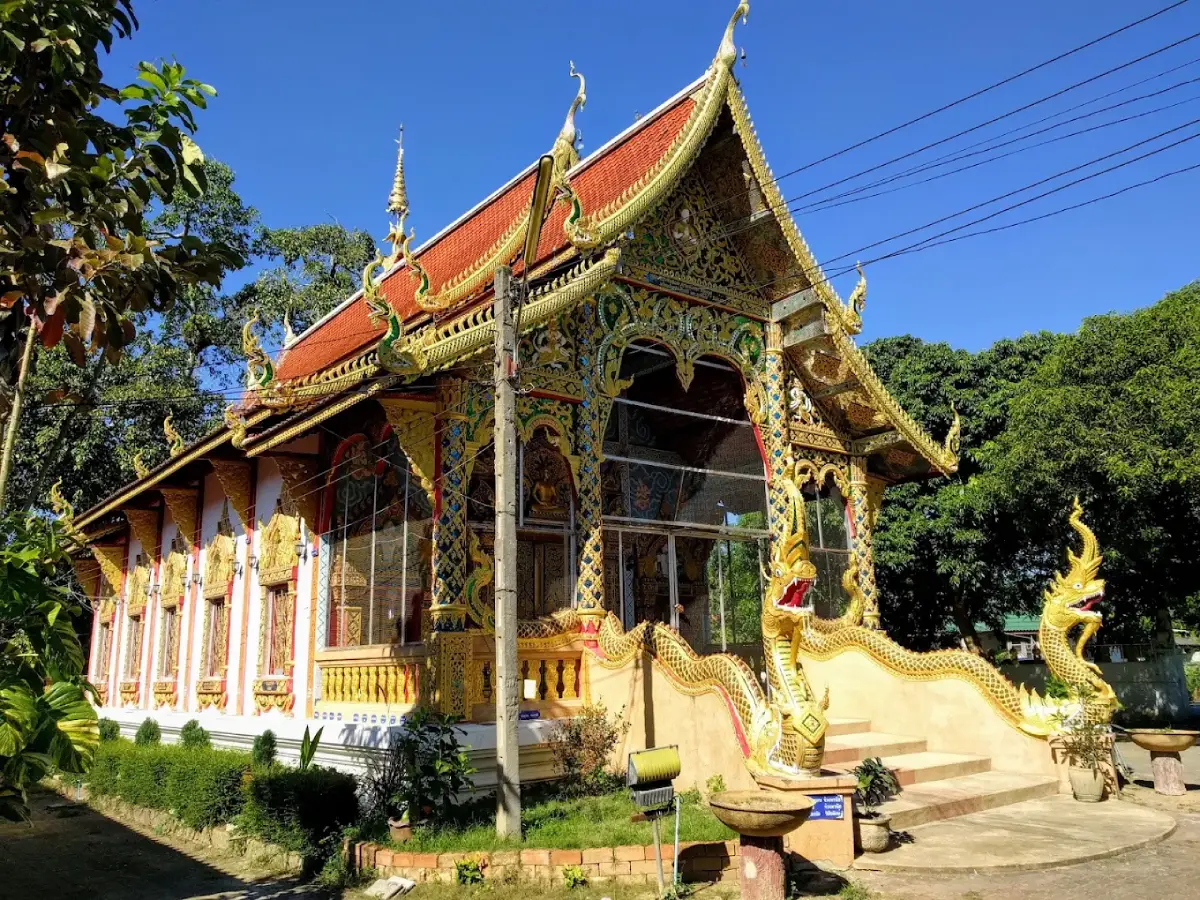
Wat Pa Bong
Open Days: Daily
Opening Hours: 08.00 – 17.00
Wat Pa Bong is a local Buddhist temple under the Maha Nikaya order, located at 3 Moo 2, Ban Pa Bong, Nong Han Subdistrict, San Sai District, Chiang Mai Province 50290. The temple was officially established in 1897 and received Wisungkham Sima in 1923. It is an old community temple with a meaningful history connected to an earlier temple site called Wat Nantharam, now deserted, which was located in a low-lying area affected by repeated flooding. The local community therefore decided to build a new temple on higher ground, creating Wat Pa Bong as a stable center of faith for Ban Pa Bong and nearby villages.
Wat Pa Bong stands in Nong Han Subdistrict, an important area of San Sai District and Mae Jo. The surrounding area includes old communities, agricultural land, main roads, educational institutions, residential neighborhoods, shops, and several village temples. Nearby temples include Wat Thung Muen Noi, Wat Thung Pa Ket, Wat Mae Jo, Wat Mae Tao Hai, Wat Wiwek Wanaram, Wat Huai Kiang, and Wat Sirimongkhon Bunyaram. Together, these temples reflect the Lanna pattern in which each village has its own temple as a spiritual and social center.
The name Pa Bong is connected with the village name and the older landscape of the area. The word bong is associated in local usage with bamboo or bamboo-like plants, suggesting a rural environment with vegetation, water, irrigation routes, and farmland. Although Nong Han and Mae Jo have changed considerably with urban expansion, the temple still preserves the memory of an older village landscape and the religious identity of Ban Pa Bong.
The key historical background of Wat Pa Bong begins with Wat Nantharam, the former temple site. Wat Nantharam was located in a low area and suffered from flooding many times until it could no longer function properly as a religious place. Villagers from Ban Pa Bong and nearby communities therefore held discussions and agreed to establish a new temple on higher ground. The decision was practical and spiritual at the same time: the community needed a temple that could remain stable, safe, and usable for monks, novices, and local devotees.
The relocation from Wat Nantharam to Wat Pa Bong shows the practical wisdom of a Lanna community in selecting a temple site. A temple in a flood-prone area is difficult to maintain, and religious activities become vulnerable to damage and disruption. By moving to higher ground, the community created a stronger religious center capable of supporting monastic residence, merit-making, ordination, and annual ceremonies. Wat Pa Bong therefore represents not only a new temple site but also the resilience of the community.
Wat Pa Bong became an important religious center for devotees from four communities: Ban Pa Bong, Ban Nong Hai, Ban Sahakon Soi Sip, and Ban Sahakon Ban Rai. This wider devotional base gives the temple a broader role than a single-village temple. It serves as a shared space where families and local residents from several communities come together for Buddhist ceremonies, ordinations, Kathin, Pa Pha, funerals, and other merit-making activities.
The year 1923 was important because Wat Pa Bong received Wisungkham Sima and became a complete temple under Thai Buddhist monastic law. A Wisungkham Sima boundary is essential for formal Sangha acts such as ordination and other monastic ceremonies. This confirmed Wat Pa Bong’s status as a full temple and allowed it to serve the local Buddhist community in a complete religious capacity.
The development of Wat Pa Bong can be seen through its permanent structures. In 1973, a new viharn was built to replace the old deteriorated one. The project was supported by a major benefactor, Dr. Satwakan, also known as Sa-ngiam Thatsanaphayak, together with the temple devotees. The viharn was completed in 1977 and celebrated with a Poi Luang ceremony. This construction reflects the continuing commitment of the community to keeping the temple active and suitable for religious use.
In 1982, a new monks’ residence was built to replace the old one, which was no longer sufficient for the increasing number of monks and novices. Phra Athikan Sum Achittathammo, also known as Wonghan, who was the abbot at that time, led the construction until it was completed in the early 1990s. The construction of monks’ residences shows that the temple supported regular monastic life and needed proper facilities for resident monks and novices.
The important areas of Wat Pa Bong follow the pattern of a living Lanna community temple. They include the viharn, ubosot or consecrated monastic area, chedi area, monks’ residences, temple courtyard, pavilions or community activity areas, and spaces used for merit-making. The viharn is the main worship hall. The ubosot is used for formal monastic rites. The monks’ residences support daily monastic life, while the temple courtyard and pavilions support village ceremonies and annual gatherings.
The main identity of Wat Pa Bong lies in its story of recovery from environmental difficulty. The temple was not established simply by constructing new buildings. It came from a collective decision by the community to preserve its sacred space and create a safer, more stable site for Buddhist practice. The move to higher ground can therefore be understood as both a practical solution and a spiritual renewal.
The chedi and sacred areas inside the temple should be approached respectfully. Wat Pa Bong remains an active temple with monks in residence and annual religious activities. Visitors should begin by paying respect in the viharn, then move quietly through the temple grounds and sacred areas. A community temple should be understood as a living place of faith rather than merely a photo location.
Recent public activity records show that Wat Pa Bong remains an active local temple with resident monks. The Kathin database for 2025 lists the temple as a local Buddhist temple with five monks in residence and a scheduled Kathin ceremony. This confirms that the temple continues to function in the religious life of the community.
The current abbot appearing in recent public records is Phra Khru Sangkarak Rungroj Chinwaro. Older local and tourism sources list Phra Athikan Thawat Thirachitto as abbot, but the latest public activity data identifies Phra Khru Sangkarak Rungroj Chinwaro. For this article, the table uses the latest public record while the older name is retained only in the separated reference context.
Kathin is one of the important annual activities at Wat Pa Bong. After Buddhist Lent, local devotees gather to offer robes and requisites to the monastic community. For a community temple, Kathin is not only a ritual offering. It is also a way of supporting the temple, strengthening relationships among devotees, and maintaining the cycle of Buddhist generosity.
Wat Pa Bong also appears in local municipal activities, including gratitude-making ceremonies dedicated to former abbots of Wat Pa Bong and former ecclesiastical leaders of Nong Han Subdistrict. The temple has also received municipal coordination for safety-related work inside the temple grounds. These activities show that the temple continues to have a relationship with Mae Jo Municipality and the surrounding community.
Wat Pa Bong serves the community in several ways. Religiously, it is a place for worship, merit-making, sermons, ordination, and Buddhist ceremonies. Socially, it is a gathering space for families and nearby villages. Culturally, it preserves Lanna merit-making traditions, Poi Luang, Kathin, Pa Pha, and the memory of the former Wat Nantharam site. Historically, it records the community’s response to flooding and the decision to rebuild its temple on safer ground.
Wat Pa Bong is suitable for visitors who want to experience a quiet community temple in the Mae Jo area. Important points to see include the viharn, chedi area, ubosot or consecrated monastic space, monks’ residences, courtyard, and the overall atmosphere of a working village temple. The value of the temple lies in continuity, community faith, and local history rather than grand tourist-scale architecture.
For visitors interested in the history of temples in San Sai District, Wat Pa Bong is particularly meaningful because of its connection with the former Wat Nantharam site. This history shows that temples in the past were deeply affected by natural conditions such as flooding, lowland geography, and water management. The establishment of Wat Pa Bong on higher ground reflects the intersection of local wisdom, Buddhist faith, and community planning.
Wat Pa Bong can be included in a wider temple route through Nong Han Subdistrict. Nearby temples include Wat Thung Muen Noi, Wat Thung Pa Ket, Wat Mae Jo, Wat Mae Tao Hai, Wat Huai Kiang, and Wat Wiwek Wanaram. This route is suitable for travelers who want to understand the village-temple network of Mae Jo and Nong Han. Each temple has its own story, while together they show the religious landscape of the San Sai side of Chiang Mai.
Visitors can also combine Wat Pa Bong with Tweechol Botanic Garden or restaurants and cafes in the Mae Jo area. A practical half-day route can begin at Wat Pa Bong, continue to nearby temples in Nong Han, and end with a meal or cafe stop near Mae Jo. The route is suitable for travelers who want a quieter cultural experience away from Chiang Mai’s old city and major tourist circuits.
Getting There is easiest by private car, rental car, or ride-hailing service. Set the destination as Wat Pa Bong, Nong Han Subdistrict, San Sai District, Chiang Mai Province. From Chiang Mai city, travel toward Mae Jo or along the Chiang Mai–Phrao route, then continue into the Ban Pa Bong area. Extra travel time is useful during morning and evening traffic because Mae Jo has schools, university traffic, shops, and local commuting routes.
Because Wat Pa Bong is an active religious place, visitors should dress modestly, keep voices low, remove shoes where required, avoid touching Buddha images, chedis, or sacred objects without permission, and give space to monks and local residents during ceremonies. If visiting during Kathin, Pa Pha, or other temple activities, visitors should respect the community ritual before taking photographs.
| Name | Wat Pa Bong |
| Location | Ban Pa Bong, Moo 2, Nong Han Subdistrict, San Sai District, Chiang Mai Province |
| Address | 3 Moo 2, Nong Han Subdistrict, San Sai District, Chiang Mai 50290, Thailand |
| Coordinates | 18.92849, 98.98453 |
| Temple Type | Local Buddhist Temple |
| Buddhist Order | Maha Nikaya |
| Highlights | Historic community temple established after relocating from the flood-prone former Wat Nantharam site; important for four nearby communities and active local merit-making traditions |
| History | Established in 1897 and granted Wisungkham Sima in 1923; founded after the former Wat Nantharam site became unsuitable because of repeated flooding |
| Former Temple Site | Wat Nantharam, now a deserted temple site in a low-lying flood-prone area |
| Main Devotional Communities | Ban Pa Bong, Ban Nong Hai, Ban Sahakon Soi Sip, and Ban Sahakon Ban Rai |
| Main Areas / Zones | Viharn, ubosot or consecrated monastic area, chedi area, monks’ residences, temple courtyard, pavilions or community activity spaces, and merit-making areas |
| Important Structures | New viharn begun in 1973 and celebrated with Poi Luang in 1977; monks’ residences begun in 1982 and completed in the early 1990s |
| Abbot / Caretaker | Phra Khru Sangkarak Rungroj Chinwaro |
| Local Traditions / Activities | Kathin ceremony, Pa Pha offerings, Buddhist holy day merit-making, ordination activities, and community merit-making ceremonies |
| Travel Information | Accessible by private car, rental car, or ride-hailing service; set the destination as Wat Pa Bong, Nong Han Subdistrict, San Sai District, Chiang Mai Province |
| Current Status | Open as an active community temple with monks in residence |
| Open Days | Daily |
| Opening Hours | 08.00 – 17.00 |
| Local Authority Contact | Mae Jo Municipality Tel. 053-498621 |
| Nearby Tourist Attractions | 1. Wat Mae Jo, about 4 km 2. Wat Thung Muen Noi, about 5 km 3. Wat Thung Pa Ket, about 6 km 4. Wat Mae Tao Hai, about 7 km 5. Tweechol Botanic Garden, about 12 km |
| Nearby Restaurants | 1. Cha Thai Putcha Pa Bong, about 1 km, Tel. 097-935-7926 2. Ran Diaw Im Mae Jo, about 2 km, Tel. 063-914-2923, 065-084-0445 3. Hong Larb Mae Jo, about 3 km, Tel. 065-258-2688 4. P. Pla Joom Mae Jo Branch, about 4 km, Tel. 083-918-2639 5. Three Brothers Restaurant, about 5 km, Tel. 094-751-1716 |
| Nearby Accommodations | 1. V House Mae Jo Dormitory, about 4 km, Tel. 093-626-9355 2. MyRoom Boutique Home Mae Jo, about 5 km, Tel. 061-265-4555 3. Surachai Dormitory Mae Jo, about 5 km, Tel. 080-125-7986, 098-658-1036 4. The Slipper Resort Maejo, about 6 km, Tel. 063-336-9641 5. Orawan Suites Chiangmai, about 10 km, Tel. 096-556-3914 |
Frequently Asked Questions (FAQ)
Q: Where is Wat Pa Bong located?
A: Wat Pa Bong is located at 3 Moo 2, Ban Pa Bong, Nong Han Subdistrict, San Sai District, Chiang Mai 50290, Thailand.
Q: What is historically important about Wat Pa Bong?
A: Wat Pa Bong was established in 1897 after the community moved from the flood-prone former Wat Nantharam site. It received Wisungkham Sima in 1923.
Q: What are the main highlights of Wat Pa Bong?
A: Highlights include its relocation history from Wat Nantharam, its role as a community temple for four nearby villages, the viharn, ubosot area, chedi area, monks’ residences, and active merit-making traditions.
Q: Who is the abbot of Wat Pa Bong?
A: The current abbot appearing in recent public activity records is Phra Khru Sangkarak Rungroj Chinwaro.
Q: What are the opening hours of Wat Pa Bong?
A: Wat Pa Bong is open daily from 08.00 to 17.00. Visitors should dress modestly and respect the quiet atmosphere of the active temple.
Q: How is Wat Pa Bong connected with Wat Nantharam?
A: Wat Nantharam was the former temple site. It is now deserted because the old site was low-lying and repeatedly affected by flooding, so the community established Wat Pa Bong on higher ground.
Q: What nearby places can be combined with a visit to Wat Pa Bong?
A: Nearby places include Wat Mae Jo, Wat Thung Muen Noi, Wat Thung Pa Ket, Wat Mae Tao Hai, and Tweechol Botanic Garden.
Q: What is the easiest way to reach Wat Pa Bong?
A: The easiest way is by private car, rental car, or ride-hailing service. Set the destination as Wat Pa Bong, Nong Han Subdistrict, San Sai District, Chiang Mai Province.
 Category: ●Places of Worship
 Group: ●Temple
Last Update : 5 DayAgo
 Last Update : 5 DayAgo
 Click to Access the Navigation Map GPS
 Muang Chiang Mai(121)Chom Thong(47)Mae Chaem(25)Chiang Dao(33)Doi Saket(68)Mae Taeng(85)Mae Rim(69)Samoeng(29)Fang(71)Mae Ai(59)Phrao(70)San Pa Tong(103)San Kamphaeng(66)San Sai(73)Hang Dong(73)Hot(32)Doi Tao(22)Omkoi(11)Saraphi(74)Wiang Haeng(15)Chai Prakan(28)Mae Wang(32)Mae On(22)Doi Lo(34)Galyani Vadhana(1)


