
lovethailand home >North Travel Attractions >Chiang Mai Travel Attractions >San Sai >Nong Chom > Wat Nong Khrai Luang
TL;DR: Wat Nong Khrai Luang is located at Ban Nong Khrai Luang, Moo 8, Nong Chom Subdistrict, San Sai District, Chiang Mai Province.
Wat Nong Khrai Luang
Operating day: Daily
Operating time: 08.00 - 17.00
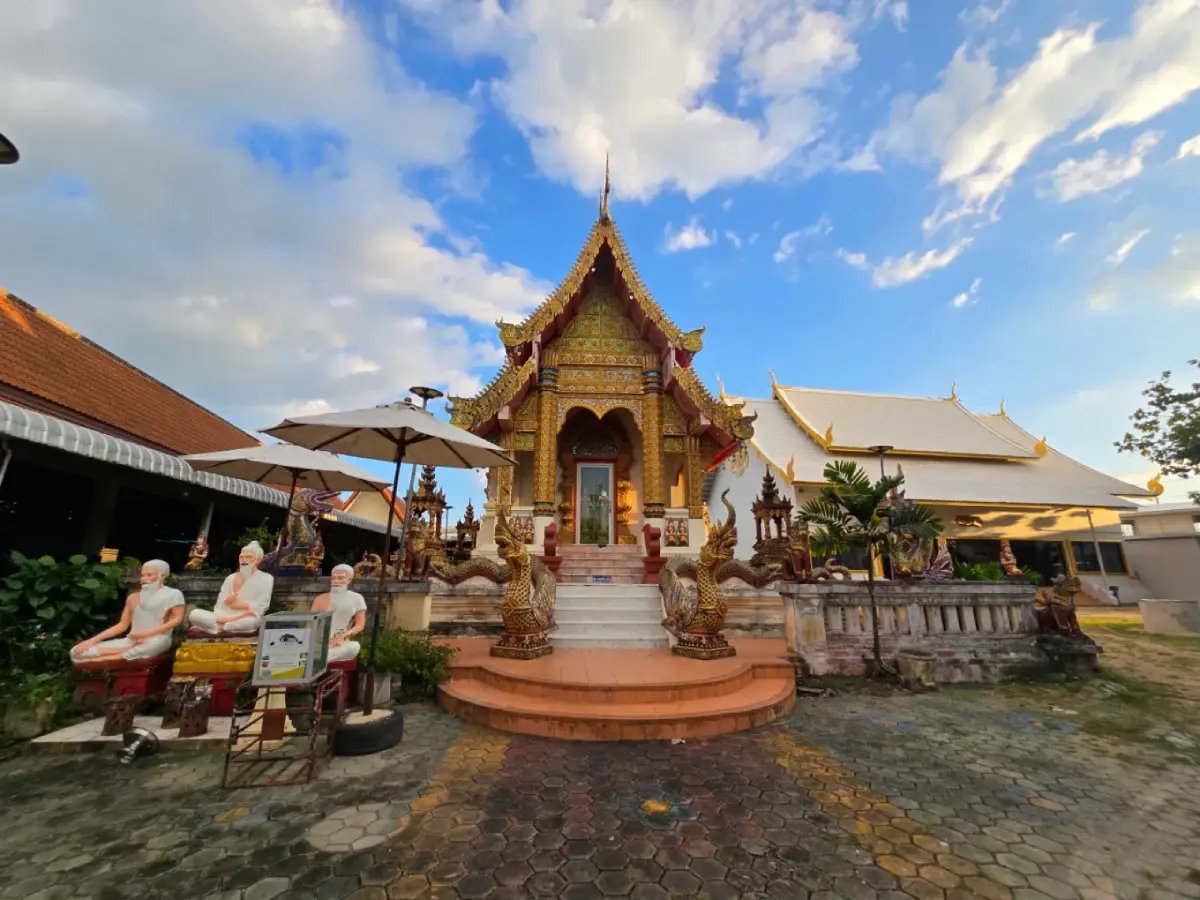
Wat Nong Khrai Luang is a local Buddhist temple under the Maha Nikaya order, located at 12 Moo 8, Ban Nong Khrai Luang, Nong Chom Subdistrict, San Sai District, Chiang Mai Province. The temple is an important community temple of Ban Nong Khrai Luang. Its history is linked to an earlier temple site that once stood in the middle of the village before the temple was moved eastward by more than half a kilometer after a fire. The present temple stands on raised ground in a former field landscape, with a large pond in the area, and continues to serve as a center of faith for the local community. Its key sacred features include Phra Phuttha Maherok Sophapmongkhon Bophit, the ubosot, viharn, crystal chedi, Buddha relics, Phra Chao Than Jai, and Phra Phuttha Chayanti Mahamuni, also revered as Phra Chao Than Jai.
Wat Nong Khrai Luang should be understood within the broader setting of Nong Chom Subdistrict. This area contains several village temples, including Wat Fa Mui, Wat Nang Liao, Wat San Pa Sak, Wat Tha Kwian, Wat Mae Kaet Luang, Wat Si Sai Mun, Wat Nong Khrai Luang, and Wat Ton Chan. These temples are not only places for Buddhist ceremonies. They function as centers of village faith, merit-making spaces, community gathering places, and custodians of Lanna local traditions. Wat Nong Khrai Luang therefore represents both Buddhist devotion and the history of the Ban Nong Khrai Luang community.
Ban Nong Khrai Luang is Moo 8 of Nong Chom Subdistrict in San Sai District, Chiang Mai Province. Nong Chom is now a semi-urban community with residential areas, shops, schools, and remaining agricultural zones. Waterways and irrigation routes remain part of the older landscape. The name Nong Khrai Luang reflects a local landscape associated with water and khrai vegetation, similar to many village names in Nong Chom that preserve memories of landforms, plants, or local events.
The temple’s history is especially meaningful because the original temple once stood in the middle of Ban Nong Khrai Luang. After a fire occurred at the temple, local Lanna belief regarded the event as an inauspicious sign. There was also a belief that when a temple stood too closely among houses, the shadow of the village could fall over the khuang kaeo, or temple courtyard, which was considered improper in local tradition. Khru Ba Chao Kitti, an important senior monk of the temple at that time, therefore selected a new site for the temple.
The new site was located more than half a kilometer east of the original temple. It was a raised area in the middle of fields, with an existing ubosot and a large pond nearby. This setting was considered suitable for a temple because it was more open, stood on higher ground, and was not overshadowed by nearby houses. The relocation was therefore not only a physical move. It was a rebalancing of the relationship between temple, village, sacred space, and local belief.
The present temple covers approximately 5 rai and 74 square wah. The former temple site is locally known as Wat Nong Khrai Fai Mai, or the burned Nong Khrai temple. It is now a deserted temple site with about 1 rai, 3 ngan, and 51 square wah remaining. This memory of the old site gives Wat Nong Khrai Luang a deeper historical dimension. The community remembers not only the present temple but also the earlier sacred ground, the fire, and the decision to establish a new temple on more suitable land.
Wat Nong Khrai Luang was officially established as a temple in 1852. It remains an active community temple with monks and novices in residence. This means that the temple is not a deserted ruin or a purely historical site. It continues to support Buddhist practice, merit-making, funerals, ordinations, holy day observances, and community activities for Ban Nong Khrai Luang and nearby areas.
The principal Buddha image of the temple is Phra Phuttha Maherok Sophapmongkhon Bophit. It is the central object of devotion for local residents. Visitors should begin their visit by paying respect to the principal Buddha image in the viharn and observing the temple quietly. In a community temple, the principal Buddha image is more than an artistic object. It is the spiritual focus of families, elders, monks, novices, and villagers across generations.
The main sacred structures and objects within Wat Nong Khrai Luang include the ubosot, viharn, principal Buddha image, dhamma seat, crystal chedi, Buddha relics, Phra Chao Than Jai, and Phra Phuttha Chayanti Mahamuni, also revered as Phra Chao Than Jai. The ubosot is the formal space for Sangha acts. The viharn is the primary devotional hall. The dhamma seat reflects the temple’s role in sermon delivery and religious instruction. The crystal chedi and Buddha relics provide a sacred focus for reverence, while the Than Jai Buddha images are important devotional points for worshippers.
The crystal chedi is one of the important points to observe in the temple. In Lanna Buddhist culture, a chedi often functions as a center of reverence, reflection, and ritual practice. When the chedi is associated with Buddha relics and Than Jai Buddha images, the temple becomes a layered sacred space where visitors can pay respect to the principal Buddha image, the relic shrine, and devotional Buddha images in one visit.
Phra Chao Than Jai and Phra Phuttha Chayanti Mahamuni are significant devotional images at the temple. The belief in Than Jai Buddha images is common in northern Thailand and is often associated with sincere prayer, firm intention, and hopes for timely fulfillment. Visitors should worship respectfully, keep their voices low, avoid obstructing local devotees, and remember that these areas are sacred spaces for the community.
The dhamma seat inside the temple reflects Wat Nong Khrai Luang’s role as a place for listening to sermons and cultivating the mind. Buddhist teaching is central to the function of a village temple. A temple is not only a place for offerings and ceremonies but also a space for moral learning, community instruction, and the transmission of Buddhist values to people of different generations.
The purpose of Wat Nong Khrai Luang is to serve as a community center for mental well-being, learning, religious activities, youth development, and environmental improvement. This makes the temple more than a worship site. It is a shared village space where faith, learning, solidarity, and community care come together.
A distinctive feature of Wat Nong Khrai Luang is its convenient access. The temple is located near Chiang Mai’s second ring road, Highway 121, making it easy to reach by private car or ride-hailing service. It is also an important village sacred site, a center of community faith, a place for Buddhist practice, and a place where local people come to make merit, observe precepts, meditate, and perform religious duties.
The line of abbots at Wat Nong Khrai Luang shows the continuity of monastic leadership over many generations. Recorded abbots include Khru Ba Chao Kitti, Khru Ba Chao Siriwichai, Khru Ba Chao Chino, Khru Ba Chao China, Khru Ba Yanwichai, Chao Athikan Chuen Intachoto, Phra Athikan Prawat Thitapanyo, Phra Athikan Somsak Thitapanyo, Phra Khru Baidika Somsak Piyawanno, and Phra Athikan Samran Chotithammo. This succession reflects the long process of caring for the temple, guiding the community, and preserving the memory of both the old and present temple sites.
Phra Athikan Samran Chotithammo was formerly known as Samran Lakdee. He was one of nine children of Mr. Dam and Mrs. In Lakdee. He was ordained as a novice on 6 July 2000 and received full ordination on the same day at Wat Sophanaram, with Phra Khru Mongkhon Siriwong, abbot of Wat Don Tan, as preceptor. He came to reside at Wat Nong Khrai Luang on 19 July 2004, was appointed acting abbot on 12 August 2006, and became abbot on 1 October 2007.
The role of the abbot in a community temple extends beyond ritual leadership. It includes caring for monks and novices, maintaining sacred buildings, coordinating religious activities, supporting local devotees, and preserving the temple as a peaceful place for merit-making, Buddhist observance, meditation, and community gatherings. Wat Nong Khrai Luang has remained meaningful because generations of monks and villagers have sustained it together.
Wat Nong Khrai Luang continues to be important for Ban Nong Khrai Luang as a center of faith and community activity. Local residents use the temple for Buddhist holy days, sermon listening, funerals, ordinations, Kathin, Pa Pha, and other merit-making occasions. Although the available official source does not list a detailed annual calendar month by month, the temple clearly functions in the pattern of a living Lanna community temple, where elders, families, young people, and local devotees return for important religious occasions.
The atmosphere of the temple is suitable for a calm visit. Important points to see include the viharn, Phra Phuttha Maherok Sophapmongkhon Bophit, the crystal chedi, Buddha relics, Phra Chao Than Jai, Phra Phuttha Chayanti Mahamuni, the dhamma seat, the ubosot, and the temple courtyard. The temple is especially meaningful for visitors interested in village temples, Lanna beliefs about sacred space, and the relationship between a temple and its community.
Wat Nong Khrai Luang is suitable for visitors who want to understand the quieter side of Chiang Mai outside the old city. Its significance lies not in grand scale but in its story: the old temple that burned, the relocation to a raised field area, the presence of a large pond, and the continuing role of the temple as the spiritual center of Ban Nong Khrai Luang. It is a good destination for cultural travelers, writers, students, and anyone interested in Lanna community temples.
Wat Nong Khrai Luang can be included in a wider route through Nong Chom Subdistrict. Nearby temples include Wat Ton Chan, Wat Si Sai Mun, Wat Fa Mui, Wat Nang Liao, Wat Tha Kwian, and Wat San Pa Sak. Tweechol Botanic Garden can also be added as a green stop. This route helps visitors understand Nong Chom as a subdistrict with a dense network of village temples, each with its own history and local identity.
Getting There is easiest by private car, rental car, or ride-hailing service. Set the destination as Wat Nong Khrai Luang, 12 Moo 8, Nong Chom Subdistrict, San Sai District, Chiang Mai Province. From Chiang Mai city, travelers can use the second ring road, Highway 121, and continue into Nong Chom and Ban Nong Khrai Luang. Extra time is useful during morning and evening traffic because San Sai and Nong Chom now contain many residential areas, schools, shops, and local roads.
Visitors should remember that Wat Nong Khrai Luang is an active religious place. Dress modestly, keep voices low, remove shoes where required, avoid touching Buddha images, relic shrines, chedis, or sacred objects without permission, and give space to monks, novices, and local residents during ceremonies. A visit to a community temple is most meaningful when the temple is respected as the spiritual home of local people, not only as a sightseeing stop.
| Name | Wat Nong Khrai Luang |
| Location | Ban Nong Khrai Luang, Moo 8, Nong Chom Subdistrict, San Sai District, Chiang Mai Province |
| Address | 12 Moo 8, Nong Chom Subdistrict, San Sai District, Chiang Mai 50210, Thailand |
| Temple Type | Local Buddhist Temple |
| Buddhist Order | Maha Nikaya |
| Land Area | Approximately 5 Rai And 74 Square Wah |
| Highlights | Historic community temple with Phra Phuttha Maherok Sophapmongkhon Bophit, crystal chedi, Buddha relics, Phra Chao Than Jai, and Phra Phuttha Chayanti Mahamuni |
| History | Officially established in 1852; the original temple stood in the middle of Ban Nong Khrai Luang before being moved more than half a kilometer eastward to raised field land after a fire |
| Present Site Origin | Khru Ba Chao Kitti selected a new site on raised ground in the fields, with an existing ubosot and a large pond in the same area |
| Former Temple Site | Locally known as Wat Nong Khrai Fai Mai, now a deserted temple site of about 1 Rai, 3 Ngan, and 51 Square Wah |
| Principal Buddha Image | Phra Phuttha Maherok Sophapmongkhon Bophit |
| Sacred Objects | Crystal chedi, Buddha relics, Phra Chao Than Jai, and Phra Phuttha Chayanti Mahamuni |
| Main Areas / Zones | Ubosot, viharn, principal Buddha image in the viharn, dhamma seat, crystal chedi, Buddha relics, Phra Chao Than Jai, and Phra Phuttha Chayanti Mahamuni |
| Distinctive Features | Located near Chiang Mai’s second ring road, Highway 121; an important village sacred site and spiritual center of Ban Nong Khrai Luang |
| Abbot / Caretaker | Phra Athikan Samran Chotithammo |
| Travel Information | Accessible by private car, rental car, or ride-hailing service; set the destination as Wat Nong Khrai Luang, 12 Moo 8, Nong Chom Subdistrict, San Sai District, Chiang Mai Province |
| Current Status | Open as an active community temple with monks in residence |
| Main Contact Number | Wat Nong Khrai Luang Tel. 053-491-789 Nong Chom Subdistrict Municipality Tel. 053-350326, 053-350328 |
| Official Website / Official Page | Wat Nong Khrai Luang Moo 8 information page by Nong Chom Subdistrict Municipality |
| Nearby Tourist Attractions | 1. Wat Ton Chan, about 2 km 2. Wat Si Sai Mun, about 2 km 3. Wat Fa Mui, about 3 km 4. Wat Nang Liao, about 4 km 5. Tweechol Botanic Garden, about 11 km |
| Nearby Restaurants | 1. Nong Chom Chicken Rice, about 1 km, Tel. 064-991-4818 2. I am Pizza' POON HOUSE Nong Chom Branch, about 2 km, Tel. 084-485-7023 3. Stuffed Omelette Nong Chom, about 2 km, Tel. 093-228-3745 4. Krua Im Aroi Nong Chom, about 2 km, Tel. 065-343-7549 5. My Wine My Somtum, about 5 km, Tel. 081-139-4516 |
| Nearby Accommodations | 1. Si Sai Mun Dormitory, about 2 km, Tel. 089-952-4063 2. Khun Nai Apartment, about 3 km, Tel. 089-701-8283 3. Subtaweechok Apartment, about 3 km, Tel. 081-765-2748 4. The Loft House Sansai, about 5 km, Tel. 089-759-8666 5. Tamruethai House, about 6 km |
Frequently Asked Questions (FAQ)
Q: Where is Wat Nong Khrai Luang located?
A: Wat Nong Khrai Luang is located at 12 Moo 8, Ban Nong Khrai Luang, Nong Chom Subdistrict, San Sai District, Chiang Mai 50210, Thailand.
Q: What is historically important about Wat Nong Khrai Luang?
A: Wat Nong Khrai Luang was officially established in 1852. The original temple once stood in the middle of the village before it was moved eastward to raised field land after a fire.
Q: What are the main highlights of Wat Nong Khrai Luang?
A: Highlights include Phra Phuttha Maherok Sophapmongkhon Bophit, the ubosot, viharn, crystal chedi, Buddha relics, Phra Chao Than Jai, and Phra Phuttha Chayanti Mahamuni.
Q: Who is the abbot of Wat Nong Khrai Luang?
A: The abbot listed by Nong Chom Subdistrict Municipality’s temple information page is Phra Athikan Samran Chotithammo.
Q: Does Wat Nong Khrai Luang have an older temple site?
A: Yes. The former site is locally known as Wat Nong Khrai Fai Mai, or the burned Nong Khrai temple. It is now a deserted temple site.
Q: What should visitors see inside Wat Nong Khrai Luang?
A: Visitors should see the principal Buddha image, ubosot, viharn, crystal chedi, Buddha relics, Phra Chao Than Jai, Phra Phuttha Chayanti Mahamuni, dhamma seat, and temple courtyard.
Q: What nearby places can be combined with a visit to Wat Nong Khrai Luang?
A: Nearby places include Wat Ton Chan, Wat Si Sai Mun, Wat Fa Mui, Wat Nang Liao, and Tweechol Botanic Garden.
Q: What is the easiest way to reach Wat Nong Khrai Luang?
A: The easiest way is by private car, rental car, or ride-hailing service. Set the destination as Wat Nong Khrai Luang, 12 Moo 8, Nong Chom Subdistrict, San Sai District, Chiang Mai Province.
 Category: ●Places of Worship
 Group: ●Temple
Last Update : 2 DayAgo
 Last Update : 2 DayAgo
 Click to Access the Navigation Map GPS
Wat Nong Khrai Luang Map
Recommend

 Muang Chiang Mai(121)Chom Thong(47)Mae Chaem(25)Chiang Dao(33)Doi Saket(68)Mae Taeng(85)Mae Rim(69)Samoeng(29)Fang(71)Mae Ai(59)Phrao(70)San Pa Tong(103)San Kamphaeng(66)San Sai(73)Hang Dong(73)Hot(32)Doi Tao(22)Omkoi(11)Saraphi(74)Wiang Haeng(15)Chai Prakan(28)Mae Wang(32)Mae On(22)Doi Lo(34)Galyani Vadhana(1)


