
lovethailand home >North Travel Attractions >Chiang Mai Travel Attractions >San Sai >Nong Chom > Wat Fa Mui
TL;DR: Wat Fa Mui is located at Ban Fa Mui, Moo 1, Nong Chom Subdistrict, San Sai District, Chiang Mai Province, open Daily, hours 08.00 – 17.00.
Wat Fa Mui
Open Days: Daily
Opening Hours: 08.00 – 17.00
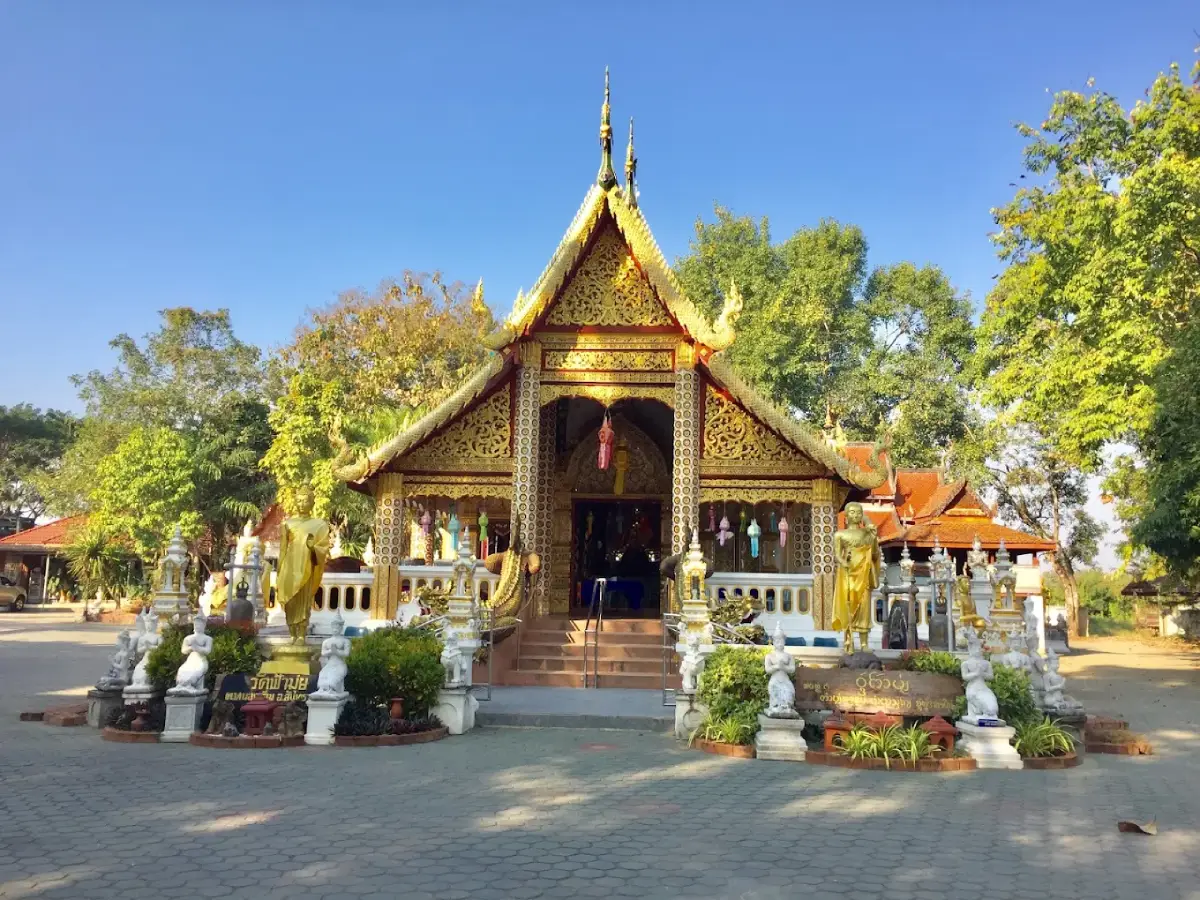
Wat Fa Mui is a local Buddhist temple under the Maha Nikaya order, located at 80 Ban Fa Mui, Moo 1, Nong Chom Subdistrict, San Sai District, Chiang Mai Province. The temple was built in 1782 and received Wisungkham Sima on 10 December 1872. Its principal Buddha image is a stucco Buddha image in the meditation posture, and its important sacred objects include a square-based chedi, Buddha images, and Wihan Phra Chao Than Jai. Wat Fa Mui is best understood as a historic community temple that continues to serve as a spiritual center for Ban Fa Mui and the wider Nong Chom area.
Wat Fa Mui stands in Nong Chom Subdistrict, an old community area in San Sai District where village temples, farmland, local roads, and residential neighborhoods remain closely connected. Ban Fa Mui is Moo 1 of Nong Chom Subdistrict, and Wat Fa Mui is the main temple of the village. Its role is directly tied to everyday community life, including merit-making, Buddhist holy day observances, annual ceremonies, village activities, and the preservation of Lanna Buddhist traditions.
Historically, Wat Fa Mui has existed for more than 200 years. Its establishment in 1782 places it among the long-standing community temples of the Nong Chom area. The temple was created to provide a nearby center of worship and merit-making for local residents, especially elderly villagers and devotees who found it difficult to travel far. This origin is important because it shows that the temple was not built merely as an architectural landmark. It was created from the religious and social needs of the village.
The original temple land covered 3 rai, 2 ngan, and 83 square wah. Later, the temple acquired additional land of 3 rai, 5 ngan, and 7 square wah, bringing the present total to approximately 8 rai and 80 square wah. This area supports the temple’s religious buildings, monks’ quarters, community-use spaces, and service areas. The temple boundary reflects its old rural setting: the north, west, and east sides adjoin rice fields, while the south side adjoins a local residence. This setting illustrates the close relationship between temple, village, agriculture, and local life in a Lanna community.
The connection between the temple and surrounding fields is part of Wat Fa Mui’s character. The temple is not isolated from its community. It stands within a landscape shaped by farming, seasonal rhythms, village roads, and Buddhist practice. During important religious days and annual ceremonies, local residents gather at the temple, keeping the temple active as both a sacred place and a community center.
The main structures inside Wat Fa Mui include the viharn, monks’ residences, ubosot, scripture hall, Wihan Phra Chao Than Jai, multipurpose pavilion, sermon hall, kitchen, restrooms, and storage pavilion. These structures show that the temple serves several functions. The viharn is the primary space for worship and ceremonies. The ubosot is used for formal monastic rites. The scripture hall represents the preservation of Buddhist teachings. The sermon hall, multipurpose pavilion, and kitchen support village merit-making events and annual community ceremonies.
The principal Buddha image is a stucco Buddha image in the meditation posture. This posture represents stillness, inner stability, and meditative concentration. Visitors should approach this area quietly and respectfully, using the space for reflection and worship rather than treating it only as a photo spot. For local residents, the principal Buddha image is the central object of devotion during merit-making, Buddhist holy days, and temple ceremonies.
Important sacred objects at Wat Fa Mui include a square-based chedi, Buddha images, and Wihan Phra Chao Than Jai. The chedi adds a strong sense of sacred presence to the temple grounds. In Lanna Buddhist culture, chedis are often focal points of reverence, reflection, and ritual practice. Wihan Phra Chao Than Jai is another significant devotional area where visitors may pay respect and make wishes with a focused and respectful mind.
Phra Chao Than Jai devotion is widely known in northern Thailand and is often associated with sincere prayer, firm intention, and hopes for swift fulfillment. Visitors to Wat Fa Mui may pay respect to Phra Chao Than Jai together with the principal Buddha image and the chedi. As this is an active religious site, visitors should keep their voices low, avoid obstructing local worshippers, and refrain from touching sacred objects without permission.
The scripture hall is another meaningful structure within the temple. It represents the preservation of Buddhist teachings and reflects the traditional role of northern Thai temples as centers of learning. In the past, temples were not only places for rituals but also places where monks, novices, and villagers encountered religious knowledge. The bell tower also contributes to the atmosphere of a functioning community temple, marking time and religious activities within the temple grounds.
The purpose of establishing Wat Fa Mui was to create a center of faith for the village and a spiritual home for local devotees. It also made merit-making more convenient for elderly residents who could not easily travel far. This role remains important in understanding the temple. Wat Fa Mui is a place where people of different generations can participate in Buddhist practice, listen to sermons, join ceremonies, and maintain a connection with the village.
The distinctive character of Wat Fa Mui lies in its sacred buildings and its role as a place of refuge for the community. The viharn, ubosot, chedi, and Wihan Phra Chao Than Jai all provide devotional spaces for worshippers. Visitors can walk through the temple respectfully, beginning with the viharn and principal Buddha image before continuing to the chedi, Wihan Phra Chao Than Jai, scripture hall, and community pavilions.
The line of abbots at Wat Fa Mui shows the continuity of monastic care over many generations. Recorded abbots include Phra Athikan Boonmi Phasukathammo, who served from 1935 to 1953; Phra Athikan Chuen Intachoto, who served from 1956 to 1960; Phra Athikan Phrom Phrompanyo, who served from 1962 to 1975; Phra Athikan Thawin Theerapanyo, who served from 1976 to 1984; and Phra Khru Adunworapanya, the present abbot. This succession reflects the continuing responsibility of monks in maintaining the temple, guiding the community, and preserving religious practice.
The current abbot, Phra Khru Adunworapanya Techapanyo, has a close connection with Ban Fa Mui. His former name was Somphon Khrueathong. He was born on 4 June 1967 and is originally from Moo 1, Nong Chom Subdistrict, San Sai District, Chiang Mai Province. He was ordained as a novice on 20 June 1981 and received full ordination on 21 January 1990 at Wat Fa Mui. His ordination involved senior monks from nearby temples, including Wat Ton Chan, Wat Nong Khrai Luang, and Wat San Pa Sak, showing the strong relationship among temples in Nong Chom.
This monastic connection is significant because it shows that Wat Fa Mui belongs to a wider network of local temples. Temples in Nong Chom are linked through ordination, community activities, ecclesiastical relationships, and shared cultural practice. Wat Fa Mui, Wat Ton Chan, Wat Nong Khrai Luang, and Wat San Pa Sak are therefore not isolated religious sites. They form part of a living Buddhist and community network in San Sai District.
Wat Fa Mui has a full calendar of annual Buddhist and Lanna community activities. On 1 January, the temple holds New Year almsgiving. On 15 April, residents join Songkran or Pi Mai Mueang merit-making. Other annual observances include Makha Bucha, Visakha Bucha, Asalha Bucha, Buddhist Lent, Mother’s Day almsgiving and community service, Duan Sip Song Peng merit-making for departed relatives, Ok Phansa, Yi Peng, Father’s Day almsgiving and community service, and year-end chanting.
These ceremonies keep the temple active throughout the year. Pi Mai Mueang connects the temple with Lanna New Year traditions. Duan Sip Song Peng reflects the practice of making merit for departed relatives. Yi Peng brings together light, devotion, and community gathering. Community service activities on Mother’s Day and Father’s Day show how the temple connects Buddhist practice with care for the village and public space.
Wat Fa Mui is suitable for visitors who want to understand a real Lanna community temple rather than a highly commercial tourist attraction. Important points to see include the viharn, the principal Buddha image in meditation posture, the square-based chedi, Wihan Phra Chao Than Jai, the scripture hall, the ubosot, the bell tower, the sermon hall, and the temple courtyard. Visitors should move slowly, observe respectfully, and remember that this is an active temple used by local residents.
Wat Fa Mui can be included in a wider cultural route through Nong Chom Subdistrict. Nearby temples include Wat San Pa Sak, Wat Nang Liao, Wat Tha Kwian, Wat Mae Kaet Luang, Wat Si Sai Mun, Wat Nong Khrai Luang, and Wat Ton Chan. Visiting several temples in this area gives travelers a clearer understanding of Nong Chom as a community shaped by village temples, Lanna traditions, and local Buddhist life.
Getting There is easiest by private car, rental car, or ride-hailing service. Set the destination as Wat Fa Mui, Ban Fa Mui, Moo 1, Nong Chom Subdistrict, San Sai District, Chiang Mai Province. From Chiang Mai city, travel toward San Sai or Mae Jo, then continue into the Nong Chom and Ban Fa Mui area. It is useful to allow extra time during morning and evening traffic because San Sai has many residential communities, local businesses, and village roads.
For a more complete itinerary, begin at Wat Fa Mui and continue to Wat San Pa Sak, Wat Si Sai Mun, Wat Tha Kwian, or Wat Ton Chan before stopping at local restaurants in the Nong Chom, Fa Mui, or Mae Jo area. If you want to add a green stop, Tweechol Botanic Garden can also be included in the route. This itinerary is suitable for travelers who want to see Chiang Mai beyond the old city, Nimmanhaemin, and Doi Suthep, focusing instead on community temples and local life.
Because Wat Fa Mui is an active temple, visitors should dress modestly, keep voices low, remove shoes where required, avoid touching sacred objects without permission, and give space to monks and local residents during ceremonies. A visit to a community temple is most meaningful when the temple is understood as a spiritual home of the local people, not merely a sightseeing stop.
| Name | Wat Fa Mui |
| Location | Ban Fa Mui, Moo 1, Nong Chom Subdistrict, San Sai District, Chiang Mai Province |
| Address | 80 Moo 1, Nong Chom Subdistrict, San Sai District, Chiang Mai 50210, Thailand |
| Temple Type | Local Buddhist Temple |
| Buddhist Order | Maha Nikaya |
| Land Area | Approximately 8 Rai And 80 Square Wah |
| Highlights | Historic community temple with a meditation-posture principal Buddha image, square-based chedi, Wihan Phra Chao Than Jai, scripture hall, and annual Lanna Buddhist activities |
| History | Built in 1782 and granted Wisungkham Sima on 10 December 1872; the Sima boundary measures 5 meters wide and 8 meters long |
| Principal Buddha Image | Stucco Buddha image in the meditation posture |
| Sacred Objects | Square-based chedi, Buddha images, and Wihan Phra Chao Than Jai |
| Main Areas / Zones | Viharn, monks’ residences, ubosot, scripture hall, Wihan Phra Chao Than Jai, multipurpose pavilion, sermon hall, kitchen, restrooms, and storage pavilion |
| Abbot / Caretaker | Phra Khru Adunworapanya Techapanyo |
| Local Traditions / Activities | New Year almsgiving, Songkran or Pi Mai Mueang merit-making, Makha Bucha, Visakha Bucha, Asalha Bucha, Buddhist Lent, Mother’s Day almsgiving, Duan Sip Song Peng, Ok Phansa, Yi Peng, Father’s Day almsgiving, and year-end chanting |
| Travel Information | Accessible by private car, rental car, or ride-hailing service; set the destination as Wat Fa Mui, Ban Fa Mui, Moo 1, Nong Chom Subdistrict, San Sai District, Chiang Mai Province |
| Current Status | Open as an active community temple and legally recognized Buddhist temple in Nong Chom Subdistrict |
| Open Days | Daily |
| Opening Hours | 08.00 – 17.00 |
| Local Authority Contact | Nong Chom Subdistrict Municipality Tel. 053-350326, 053-350328 |
| Official Website / Official Page | Wat Fa Mui information page by Nong Chom Subdistrict Municipality |
| Nearby Tourist Attractions | 1. Wat San Pa Sak, about 2 km 2. Wat Si Sai Mun, about 2 km 3. Wat Ton Chan, about 3 km 4. Wat Tha Kwian, about 4 km 5. Tweechol Botanic Garden, about 11 km |
| Nearby Restaurants | 1. Banana Story, about 1 km, Tel. 088-547-5954 2. La Mei Mala, about 1 km, Tel. 081-561-7828 3. Bomb San Sai, about 2 km, Tel. 089-142-7272 4. Krua Rim Bo Mae Jo, about 3 km, Tel. 093-339-1543 5. Nawaree Cafe & Restaurant, about 4 km, Tel. 098-751-1908 |
| Nearby Accommodations | 1. Khun Nai Apartment, about 1 km, Tel. 089-701-8283 2. Subtaweechok Apartment, about 1 km, Tel. 081-765-2748 3. The Loft House Sansai, about 3 km, Tel. 089-759-8666 4. Si Sai Mun Dormitory, about 3 km, Tel. 089-952-4063 5. Tamruethai House, about 5 km, Tel. 081-516-5535 |
Frequently Asked Questions (FAQ)
Q: Where is Wat Fa Mui located?
A: Wat Fa Mui is located at 80 Moo 1, Ban Fa Mui, Nong Chom Subdistrict, San Sai District, Chiang Mai 50210, Thailand.
Q: What is historically important about Wat Fa Mui?
A: Wat Fa Mui is a Maha Nikaya community temple built in 1782 and granted Wisungkham Sima on 10 December 1872.
Q: What are the main highlights of Wat Fa Mui?
A: The highlights include the principal Buddha image in the meditation posture, a square-based chedi, Wihan Phra Chao Than Jai, scripture hall, and its role as a historic Lanna community temple.
Q: Who is the abbot of Wat Fa Mui?
A: The current abbot is Phra Khru Adunworapanya Techapanyo.
Q: What are the opening hours of Wat Fa Mui?
A: Wat Fa Mui is open daily from 08.00 to 17.00. Visitors should dress modestly and respect the quiet atmosphere of the active temple.
Q: What annual ceremonies are held at Wat Fa Mui?
A: Annual activities include New Year almsgiving, Songkran or Pi Mai Mueang, Makha Bucha, Visakha Bucha, Asalha Bucha, Buddhist Lent, Duan Sip Song Peng, Ok Phansa, Yi Peng, Father’s Day, Mother’s Day, and year-end chanting.
Q: What nearby places can be combined with a visit to Wat Fa Mui?
A: Nearby places include Wat San Pa Sak, Wat Si Sai Mun, Wat Ton Chan, Wat Tha Kwian, and Tweechol Botanic Garden.
Q: What is the easiest way to reach Wat Fa Mui?
A: The easiest way is by private car, rental car, or ride-hailing service. Set the destination as Wat Fa Mui, Ban Fa Mui, Moo 1, Nong Chom Subdistrict, San Sai District, Chiang Mai Province.
 Category: ●Places of Worship
 Group: ●Temple
Last Update : 1 DayAgo
 Last Update : 1 DayAgo
 Click to Access the Navigation Map GPS
 Muang Chiang Mai(121)Chom Thong(47)Mae Chaem(25)Chiang Dao(33)Doi Saket(68)Mae Taeng(85)Mae Rim(69)Samoeng(29)Fang(71)Mae Ai(59)Phrao(70)San Pa Tong(103)San Kamphaeng(66)San Sai(73)Hang Dong(73)Hot(32)Doi Tao(22)Omkoi(11)Saraphi(74)Wiang Haeng(15)Chai Prakan(28)Mae Wang(32)Mae On(22)Doi Lo(34)Galyani Vadhana(1)


