
lovethailand home >North Travel Attractions >Chiang Mai Travel Attractions >San Sai >San Na Meng > Wat San Na Meng (San Sai)
TL;DR: Wat San Na Meng (San Sai) is located at Ban San Na Meng, Mu 3, San Na Meng Subdistrict, San Sai District, Chiang Mai Province, open Daily, hours 08.00 – 17.00.
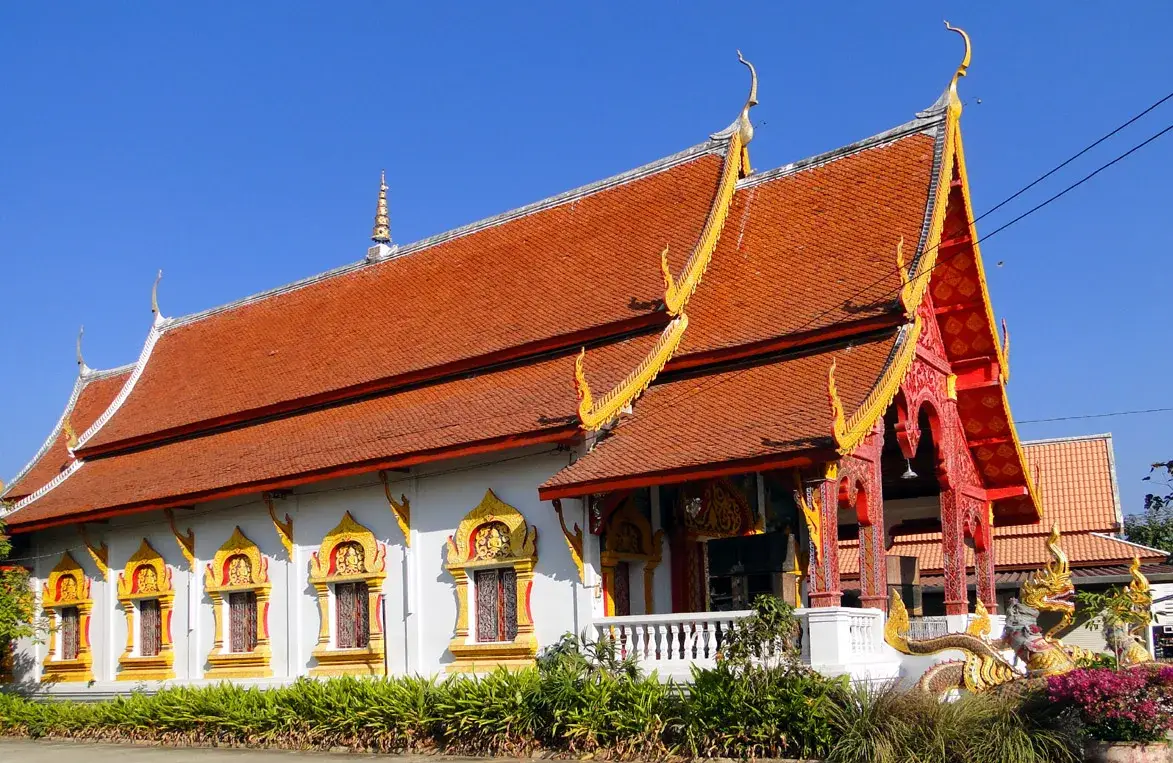
Wat San Na Meng (San Sai)
Open Days: Daily
Opening Hours: 08.00 – 17.00
Wat San Na Meng (San Sai) is a local Buddhist temple under the Mahanikaya monastic order, located at 197 Mu 3, Chiang Mai–Doi Saket Road, San Na Meng Subdistrict, San Sai District, Chiang Mai Province 50210. Established in 1856 and granted its royal consecrated boundary in 1905, it is one of the important historic community temples of San Na Meng.
The temple stands within Ban San Na Meng, a community east of Chiang Mai city. The surrounding area includes local roads, residential neighborhoods, agricultural land, and irrigation waterways. This setting gives the temple a strong village identity. Wat San Na Meng is not only a religious site but also a cultural and social center that has grown alongside the community for generations.
Wat San Na Meng is suitable for visitors who want to experience a quiet local temple near Chiang Mai city. It is not a large tourist temple, but it has deep historical and community value. The temple remains active as a place for worship, Buddhist holy day merit-making, Dharma listening, Kathin, Pha Pa offerings, Buddhist Lent activities, Lanna New Year traditions, and community gatherings.
The temple is located along the Chiang Mai–Doi Saket road corridor, one of the main routes connecting Chiang Mai city with San Sai and Doi Saket. Its accessible location makes it convenient for travelers using private cars, rental cars, or local transport. It can also be combined with other temples in San Na Meng Subdistrict for a half-day temple route.
The temple land is recorded under Nor Sor 3 document No. 108. Its boundaries show the close connection between the temple and its village landscape: the north borders a road, the south borders villagers’ rice fields, the east borders an irrigation area, and the west borders a road. This layout reflects a traditional Lanna community setting in which temples, roads, fields, and waterways form part of the same living landscape.
Important temple structures include the ordination hall, viharn, monks’ residences, sermon hall, merit-making pavilion, chedi, bell tower, kitchen, drum hall, and restrooms. This complete set of structures allows the temple to support monastic ceremonies, public worship, Dharma listening, community events, monk residence, food preparation during merit-making events, and regular village religious activities.
The ordination hall is one of the most important sacred spaces of Wat San Na Meng. It is connected with the temple’s consecrated boundary and formal monastic acts. The temple received its royal consecrated boundary in 1905, confirming its status as a fully functioning Buddhist temple. Visitors should treat the ordination hall with respect, dress modestly, speak softly, and avoid entering restricted areas.
The viharn is the main worship space where local residents and visitors can pay respect, chant, listen to Dharma, and join ceremonies on important Buddhist occasions. In a village temple, the viharn is closely tied to everyday religious life. It is where villagers gather on Buddhist holy days, during Lent, after Lent, during Lanna New Year, and at annual merit-making events.
The chedi is one of the temple’s key devotional points. In Lanna Buddhist culture, a chedi often serves as a spiritual landmark where people make merit, pay respect, and reflect on Buddhist teachings. Visitors should approach the chedi respectfully, avoid touching or climbing on the structure, and preserve the quiet atmosphere of the temple grounds.
The sermon hall and merit-making pavilion support the social role of the temple. These spaces are used for Dharma listening, meetings, preparation for ceremonies, and merit-making events that bring villagers together. The monks’ residences support daily monastic life, while the bell tower and drum hall connect temple rhythm with village life. The kitchen is especially important during Kathin, Pha Pa, and other major events involving food preparation and hospitality.
Phra Khru Niphat Sangwonkhun Thirasivaro is the abbot of Wat San Na Meng. In a community temple, the abbot plays a central role in maintaining religious activities, supporting merit-making events, guiding the temple community, and preserving the relationship between monks and local residents. This role remains important as San Na Meng continues to develop as a suburban community near Chiang Mai city.
San Na Meng Subdistrict is a suburban area with many residential communities, fertile land, and several waterways. It is suitable for living, agriculture, trade, and community activity. Within this changing environment, Wat San Na Meng helps preserve local Buddhist identity by connecting long-established village culture with newer residents through religious and community events.
Religious activities associated with Wat San Na Meng include Buddhist holy day merit-making, Dharma listening, Buddhist Lent, candle offerings, end-of-Lent activities, Kathin, Pha Pa offerings, Lanna New Year, and ceremonies on important Buddhist dates. Kathin, held after Buddhist Lent, is one of the most important annual merit-making events. Pha Pa offerings can be organized on different occasions to support temple maintenance and Buddhist activities.
During Lanna New Year or Songkran, local temples in Chiang Mai become centers for merit-making, water-pouring ceremonies, offerings for ancestors, and community gatherings. Wat San Na Meng, as the main temple of Ban San Na Meng, helps connect families, local residents, and Buddhist practice through these annual traditions.
The atmosphere of Wat San Na Meng is calm, practical, and local. It is best suited to visitors who appreciate quiet temples, old community temples, and authentic Lanna Buddhist culture near Chiang Mai city. The temple does not rely on grand tourist architecture. Its value lies in its age, complete temple structures, village setting, and continuing role in community life.
Visitors can respectfully observe the ordination hall, viharn, chedi, bell tower, drum hall, sermon hall, merit-making pavilion, monks’ residences, kitchen, and temple courtyard. A visit should be quiet and respectful, allowing time to understand the relationship between the temple, surrounding roads, irrigation waterways, and the local community.
Visitors should dress modestly, speak quietly, remove shoes before entering religious buildings, avoid disturbing monks or worshippers, and refrain from entering private monastic areas without permission. If visiting during a ceremony or merit-making event, visitors should give priority to the local ritual and observe respectfully before taking photographs.
Getting There is most convenient by private car, rental car, or local transport. From Chiang Mai city, travel toward San Sai District via Chiang Mai–Doi Saket Road and continue into Ban San Na Meng, Mu 3. The temple is close to San Na Meng Municipality and can be combined with other nearby community temples in the same subdistrict.
A meaningful half-day route can begin at Wat San Na Meng, then continue to Wat Mae Kuang to see its Lanna-style viharn and chedi, Wat Khok Mu Pa for its distinctive local legend, Wat Rong Sak for another historic community temple, and Wat Lak Pan or Wat San Luang for a broader view of San Sai’s local temple network.
In summary, Wat San Na Meng is a historically important community temple in San Sai District. Established in 1856, granted its royal consecrated boundary in 1905, and led by Phra Khru Niphat Sangwonkhun Thirasivaro, the temple preserves the Buddhist identity of Ban San Na Meng and offers visitors a quiet way to understand Chiang Mai’s local Lanna temple culture beyond the main tourist routes.
| Name | Wat San Na Meng (San Sai) |
| Type | Local Buddhist Temple Under The Mahanikaya Order |
| Location | Ban San Na Meng, Mu 3, San Na Meng Subdistrict, San Sai District, Chiang Mai Province |
| Address | 197 Mu 3, Chiang Mai–Doi Saket Road, San Na Meng Subdistrict, San Sai District, Chiang Mai 50210, Thailand |
| Main Contact Number | 053-492-088 |
| Highlights | Historic village temple with an ordination hall, viharn, chedi, sermon hall, merit-making pavilion, bell tower, drum hall, and active community role |
| History | Established in 1856 and received its royal consecrated boundary on 3 May 1905 |
| Distinctive Features | Lanna community temple connected with Chiang Mai–Doi Saket Road, local roads, irrigation waterways, villagers’ rice fields, and Ban San Na Meng community life |
| Land Document | Nor Sor 3 No. 108 |
| Boundaries | North: road; South: villagers’ rice fields; East: irrigation area; West: road |
| Important Structures | Ordination hall, viharn, monks’ residences, sermon hall, merit-making pavilion, chedi, bell tower, kitchen, drum hall, and restrooms |
| Sacred Objects / Worship Points | Chedi and worship area inside the viharn |
| Main Areas / Zones | Ordination hall area, viharn, chedi area, sermon hall, merit-making pavilion, monks’ residences, bell tower, drum hall, kitchen, and temple courtyard |
| Abbot | Phra Khru Niphat Sangwonkhun Thirasivaro |
| Traditions / Merit-Making Events | Buddhist holy day merit-making, Dharma listening, Buddhist Lent, candle offerings, end-of-Lent activities, Kathin, Pha Pa offerings, Lanna New Year, and ceremonies on important Buddhist dates |
| Current Status | Listed as a temple in San Na Meng Municipality and open for worship, merit-making, and Buddhist community activities |
| Open Days | Daily |
| Opening Hours | 08.00 – 17.00 |
| Travel Information | Best reached by private car, rental car, or local transport from Chiang Mai city toward San Sai District via Chiang Mai–Doi Saket Road and Ban San Na Meng, Mu 3 |
| Nearby Tourist Attractions | 1. Wat Mae Kuang, about 3 km 2. Wat Khok Mu Pa, about 3 km 3. Wat Rong Sak, about 3 km 4. Wat Lak Pan, about 4 km 5. Wat San Luang, about 4 km |
| Nearby Restaurants | 1. San Na Meng Chicken Rice, about 1 km, Tel. 097-918-0229 2. Krua Ban Suan San Na Meng, about 2 km, Tel. 063-104-3759 3. Sansai Sansai, about 2 km, Tel. 086-366-5262 4. Five Star PTT Doi Saket San Na Meng, about 2 km, Tel. 083-945-6496 5. BOKRAK, about 3 km, Tel. 080-461-6636 |
| Nearby Accommodations | 1. Sannameng Place, about 2 km, Tel. 081-343-8181 2. Palm Villa - Modern Luxury & Exclusive Villa Resort, about 3 km, Tel. 064-597-6494 3. Fern Paradise Hotel, about 5 km, Tel. 084-687-2474 4. The Forest Hill Cafe Restaurant & Massage, about 5 km, Tel. 081-362-6258 5. D-Sabai Residence, about 7 km, Tel. 053-351-419 |
Frequently Asked Questions (FAQ)
Q: Where is Wat San Na Meng located?
A: Wat San Na Meng is located at 197 Mu 3, Chiang Mai–Doi Saket Road, San Na Meng Subdistrict, San Sai District, Chiang Mai 50210, Thailand.
Q: Is Wat San Na Meng open daily?
A: Yes. The temple is listed as open daily from 08.00 to 17.00.
Q: Why is Wat San Na Meng historically important?
A: Wat San Na Meng was established in 1856 and received its royal consecrated boundary on 3 May 1905, making it one of the historic community temples of San Na Meng.
Q: What important structures can visitors see at Wat San Na Meng?
A: Visitors can see the ordination hall, viharn, monks’ residences, sermon hall, merit-making pavilion, chedi, bell tower, kitchen, drum hall, and temple courtyard.
Q: Who is the abbot of Wat San Na Meng?
A: The abbot is Phra Khru Niphat Sangwonkhun Thirasivaro.
Q: What type of traveler is Wat San Na Meng suitable for?
A: It is suitable for travelers who enjoy quiet local temples, historic community temples, and authentic Lanna Buddhist culture near Chiang Mai city.
Q: What religious events are associated with Wat San Na Meng?
A: The temple is associated with Buddhist holy day merit-making, Dharma listening, Buddhist Lent, candle offerings, end-of-Lent activities, Kathin, Pha Pa offerings, Lanna New Year, and ceremonies on important Buddhist dates.
Q: What nearby temples can be visited with Wat San Na Meng?
A: Nearby temples include Wat Mae Kuang, Wat Khok Mu Pa, Wat Rong Sak, Wat Lak Pan, and Wat San Luang.
 Category: ●Places of Worship
 Group: ●Temple
Last Update : 6 DayAgo
 Last Update : 6 DayAgo
 Click to Access the Navigation Map GPS
Wat San Na Meng (San Sai) Map
Recommend

 Muang Chiang Mai(121)Chom Thong(47)Mae Chaem(25)Chiang Dao(33)Doi Saket(68)Mae Taeng(85)Mae Rim(69)Samoeng(29)Fang(71)Mae Ai(59)Phrao(70)San Pa Tong(103)San Kamphaeng(66)San Sai(73)Hang Dong(73)Hot(32)Doi Tao(22)Omkoi(11)Saraphi(74)Wiang Haeng(15)Chai Prakan(28)Mae Wang(32)Mae On(22)Doi Lo(34)Galyani Vadhana(1)


