
lovethailand home >North Travel Attractions >Chiang Mai Travel Attractions >San Sai >San Sai Luang > Wat Rong Sak
TL;DR: Wat Rong Sak is located at Ban Rong Sak, Mu 1, San Na Meng Subdistrict, San Sai District, Chiang Mai Province, open Daily, hours 08.00 – 17.00.

Wat Rong Sak
Open Days: Daily
Opening Hours: 08.00 – 17.00
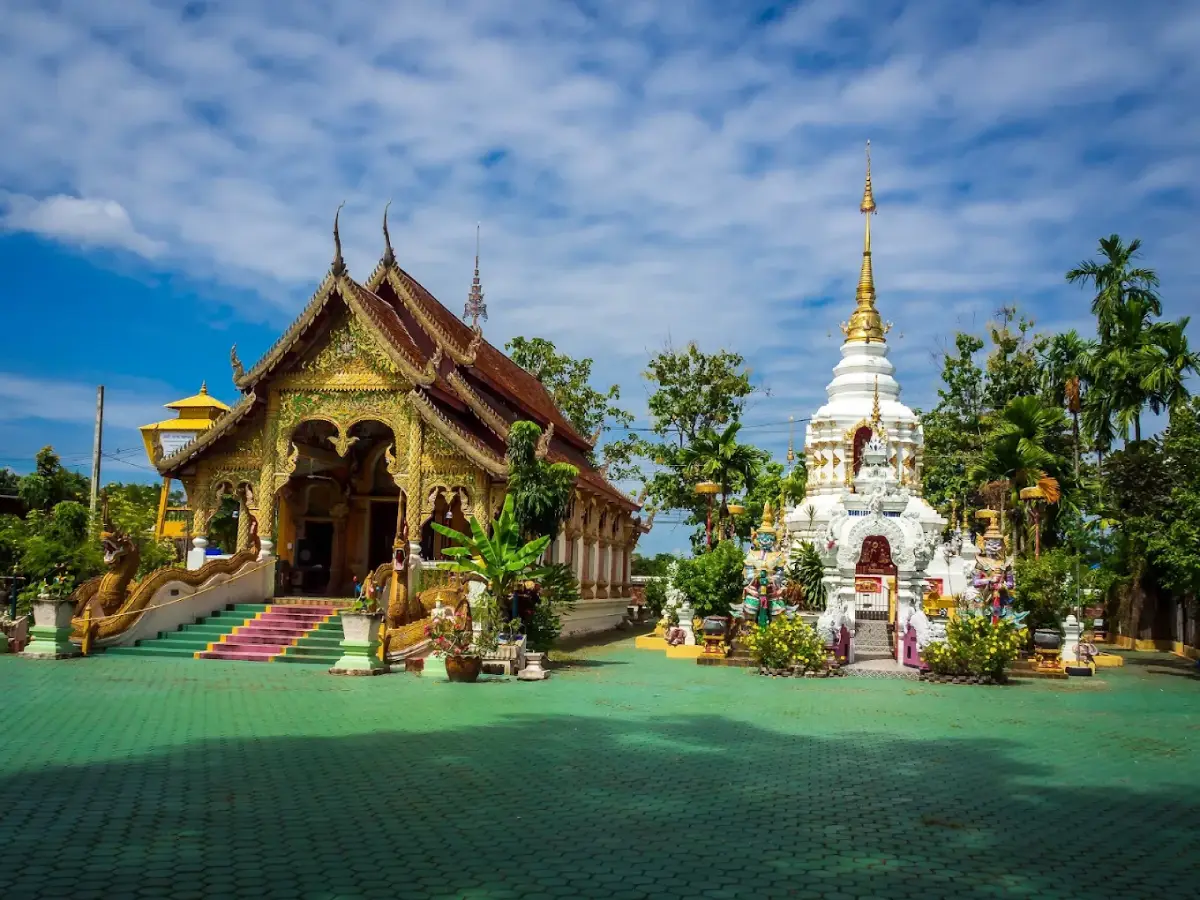
Wat Rong Sak is a local Buddhist temple under the Mahanikaya monastic order, located at 36 Mu 1, Ban Rong Sak, San Na Meng Subdistrict, San Sai District, Chiang Mai Province 50210. It is an old community temple connected with the village landscape of San Na Meng, where temples, rice fields, irrigation channels, and village houses have long shaped local life. The temple covers 3 rai, 1 ngan, and 17 square wah.
Wat Rong Sak is suitable for travelers who want to visit a quiet local temple near Chiang Mai city rather than a crowded tourist site. Its distinctive identity comes from its name. The original temple site was once an area with teak trees, and the temple was named after that landscape. This makes Wat Rong Sak a place where local geography, village memory, and Buddhist faith come together.
The temple was established in 1842 and received its royal consecrated boundary in 1937. In Thai Buddhist practice, a royal consecrated boundary is important because it marks the formal area for monastic acts, especially ceremonies connected with the ordination hall. This confirms the temple’s religious status as a functioning community temple.
Ban Rong Sak is part of San Na Meng Subdistrict, an area with several village temples including Wat Mae Kuang, Wat Khok Mu Pa, Wat San Na Meng, Wat San Luang, Wat Lak Pan, and Wat Rong Sak. This pattern reflects a traditional northern Thai community structure in which each village has its own temple as a religious, social, and cultural center.
The known boundaries of Wat Rong Sak show the temple’s close connection with village land and agriculture. The north borders villagers’ land, the south borders villagers’ rice fields, and the west borders a public irrigation channel. This setting places the temple within a traditional village environment of homes, fields, pathways, and water systems.
Important temple structures include the ordination hall, ritual pavilion, sermon hall, and monks’ residences. The ordination hall supports formal monastic ceremonies. The sermon hall serves Dharma listening, meetings, and community gatherings. The ritual pavilion supports lay Buddhist activities, while the monks’ residences allow the monastic community to remain active within the temple.
The ordination hall is one of the most important religious areas of Wat Rong Sak because it is connected with the temple’s consecrated boundary. Visitors should treat this area respectfully, dress modestly, speak softly, and avoid entering restricted areas. In a village temple, the ordination hall represents not only architecture but also the continuity of Buddhist practice in the community.
The sermon hall and ritual pavilion reflect the social role of the temple. They provide space for villagers to listen to Dharma, prepare merit-making events, gather during Buddhist holy days, and support ceremonies such as Kathin, Pha Pa, Buddhist Lent, and Lanna New Year activities. These buildings help make the temple a practical center of village life.
Phra Athikan Prasit Aphiwatthano is the abbot of Wat Rong Sak. In a community temple, the abbot plays an important role in maintaining religious activities, caring for the temple, supporting local merit-making events, and keeping the relationship between monks and villagers active.
Wat Rong Sak remains important to Ban Rong Sak as a place for Buddhist holy day merit-making, family ceremonies, annual religious events, and community gatherings. It is not simply a historic site. It is a living temple used by local residents for worship, merit-making, and shared village activities.
Religious activities associated with Wat Rong Sak include Buddhist holy day merit-making, Dharma listening, Buddhist Lent, end-of-Lent activities, Kathin, Pha Pa offerings, Lanna New Year, and ceremonies on important Buddhist dates. These activities keep the temple connected with local families and help preserve the rhythm of Lanna Buddhist life.
During Lanna New Year or Songkran, village temples in Chiang Mai often become centers for merit-making, water-pouring ceremonies, offerings for ancestors, and community gatherings. Wat Rong Sak, as the village temple of Ban Rong Sak, is well suited for visitors who want to observe the quiet local atmosphere of a northern Thai Buddhist community.
The atmosphere of Wat Rong Sak is calm, modest, and local. It is best suited to visitors who appreciate community temples, village Buddhist culture, and less crowded religious sites near Chiang Mai city. Its value lies in its age, its name connected with the former teak landscape, and its continuing role as a spiritual center for Ban Rong Sak.
Visitors can respectfully observe the ordination hall, sermon hall, ritual pavilion, monks’ residences, and temple courtyard. A visit should begin with worship in the public area of the temple, followed by a quiet walk around the grounds to understand the relationship between the temple, the village, and the surrounding irrigation landscape.
Visitors should dress modestly, speak quietly, remove shoes before entering religious buildings, avoid disturbing monks or worshippers, and refrain from entering private monastic areas without permission. If visiting during a ceremony or merit-making event, visitors should observe respectfully and give priority to local residents participating in the ritual.
Getting There is most convenient by private car, rental car, or local transport. From Chiang Mai city, travel toward San Sai District and continue into San Na Meng Subdistrict and Ban Rong Sak, Mu 1. The temple can be combined with other community temples in San Na Meng for a half-day or full-day temple route.
A meaningful route can begin at Wat Rong Sak, then continue to Wat San Na Meng, Wat Mae Kuang, Wat Khok Mu Pa, Wat Lak Pan, and Wat San Luang. This route helps visitors understand the network of village temples in San Sai District and the way Buddhism remains closely linked with local community life.
In summary, Wat Rong Sak is a historic community temple in San Na Meng. Established in 1842, granted its royal consecrated boundary in 1937, and named after the former teak landscape of its site, the temple remains a meaningful place for worship, merit-making, and understanding Lanna village temple culture near Chiang Mai city.
| Name | Wat Rong Sak |
| Type | Local Buddhist Temple Under The Mahanikaya Order |
| Location | Ban Rong Sak, Mu 1, San Na Meng Subdistrict, San Sai District, Chiang Mai Province |
| Address | 36 Mu 1, San Na Meng Subdistrict, San Sai District, Chiang Mai 50210, Thailand |
| Map Code | V32C+WVX, San Na Meng, San Sai District, Chiang Mai 50210 |
| Main Contact Number | 053-868-347 |
| Highlights | Historic village temple named after the former teak forest site, with an ordination hall, ritual pavilion, sermon hall, and monks’ residences |
| History | Established in 1842 and received its royal consecrated boundary in 1937 |
| Name Origin | The original temple site was once a teak forest area, giving rise to the name Wat Rong Sak |
| Distinctive Features | Lanna community temple connected with Ban Rong Sak, villagers’ land, rice fields, public irrigation channels, and local Buddhist traditions |
| Temple Area | 3 rai, 1 ngan, and 17 square wah, Nor Sor 3 No. 45 |
| Boundaries | North: villagers’ land; South: villagers’ rice fields; West: public irrigation channel |
| Important Structures | Ordination hall, ritual pavilion, sermon hall, and monks’ residences |
| Main Areas / Zones | Ordination hall area, ritual pavilion, sermon hall, monks’ residences, and temple courtyard for community activities |
| Abbot | Phra Athikan Prasit Aphiwatthano |
| Traditions / Merit-Making Events | Buddhist holy day merit-making, Dharma listening, Buddhist Lent, end-of-Lent activities, Kathin, Pha Pa offerings, Lanna New Year, and ceremonies on important Buddhist dates |
| Current Status | Listed as a temple in San Na Meng Municipality and open for worship, merit-making, and Buddhist community activities |
| Open Days | Daily |
| Opening Hours | 08.00 – 17.00 |
| Travel Information | Best reached by private car, rental car, or local transport from Chiang Mai city toward San Sai District, San Na Meng Subdistrict, and Ban Rong Sak |
| Nearby Tourist Attractions | 1. Wat San Na Meng, about 3 km 2. Wat Mae Kuang, about 4 km 3. Wat Khok Mu Pa, about 5 km 4. Wat Lak Pan, about 5 km 5. Wat San Luang, about 6 km |
| Nearby Restaurants | 1. Our Coffee House, about 0.5 km, Tel. 091-071-6548, 087-126-4344 2. Hom Cha Coffee, about 1 km, Tel. 084-045-6093 3. BOKRAK, about 2 km, Tel. 080-461-6636 4. San Na Meng Chicken Rice, about 2 km, Tel. 097-918-0229 5. Naracha Chak San Na Meng Branch, about 3 km, Tel. 081-467-4857 |
| Nearby Accommodations | 1. The Forest Hill Cafe Restaurant & Massage, about 0.4 km, Tel. 081-362-6258 2. Safe House Sirintara, about 1 km, Tel. 087-445-2941 3. Sannameng Place, about 3 km, Tel. 081-343-8181 4. Fern Paradise Hotel, about 5 km, Tel. 084-687-2474 5. D-Sabai Residence, about 7 km, Tel. 053-351-419 |
Frequently Asked Questions (FAQ)
Q: Where is Wat Rong Sak located?
A: Wat Rong Sak is located at 36 Mu 1, Ban Rong Sak, San Na Meng Subdistrict, San Sai District, Chiang Mai 50210, Thailand.
Q: Is Wat Rong Sak open daily?
A: Yes. The temple is listed as open daily from 08.00 to 17.00.
Q: Why is Wat Rong Sak historically important?
A: Wat Rong Sak was established in 1842 and received its royal consecrated boundary in 1937, making it one of the older community temples of San Na Meng.
Q: What is the origin of the name Wat Rong Sak?
A: The name comes from the original temple site, which was once an area of teak trees.
Q: What important structures can visitors see at Wat Rong Sak?
A: Visitors can see the ordination hall, ritual pavilion, sermon hall, monks’ residences, and temple courtyard.
Q: Who is the abbot of Wat Rong Sak?
A: The abbot is Phra Athikan Prasit Aphiwatthano.
Q: What type of traveler is Wat Rong Sak suitable for?
A: It is suitable for travelers who enjoy quiet local temples, Lanna village culture, and peaceful Buddhist sites near Chiang Mai city.
Q: What nearby temples can be visited with Wat Rong Sak?
A: Nearby temples include Wat San Na Meng, Wat Mae Kuang, Wat Khok Mu Pa, Wat Lak Pan, and Wat San Luang.
 Category: ●Places of Worship
 Group: ●Temple
Last Update : 5 DayAgo
 Last Update : 5 DayAgo
 Click to Access the Navigation Map GPS
 Muang Chiang Mai(121)Chom Thong(47)Mae Chaem(25)Chiang Dao(33)Doi Saket(68)Mae Taeng(85)Mae Rim(69)Samoeng(29)Fang(71)Mae Ai(59)Phrao(70)San Pa Tong(103)San Kamphaeng(66)San Sai(73)Hang Dong(73)Hot(32)Doi Tao(22)Omkoi(11)Saraphi(74)Wiang Haeng(15)Chai Prakan(28)Mae Wang(32)Mae On(22)Doi Lo(34)Galyani Vadhana(1)


