
lovethailand home >North Travel Attractions >Chiang Mai Travel Attractions >San Sai >San Na Meng > Wat Khok Mu Pa
TL;DR: Wat Khok Mu Pa is located at Ban Khok Mu Pa, Mu 7, San Na Meng Subdistrict, San Sai District, Chiang Mai Province, open Daily, hours 08.00 – 17.00.
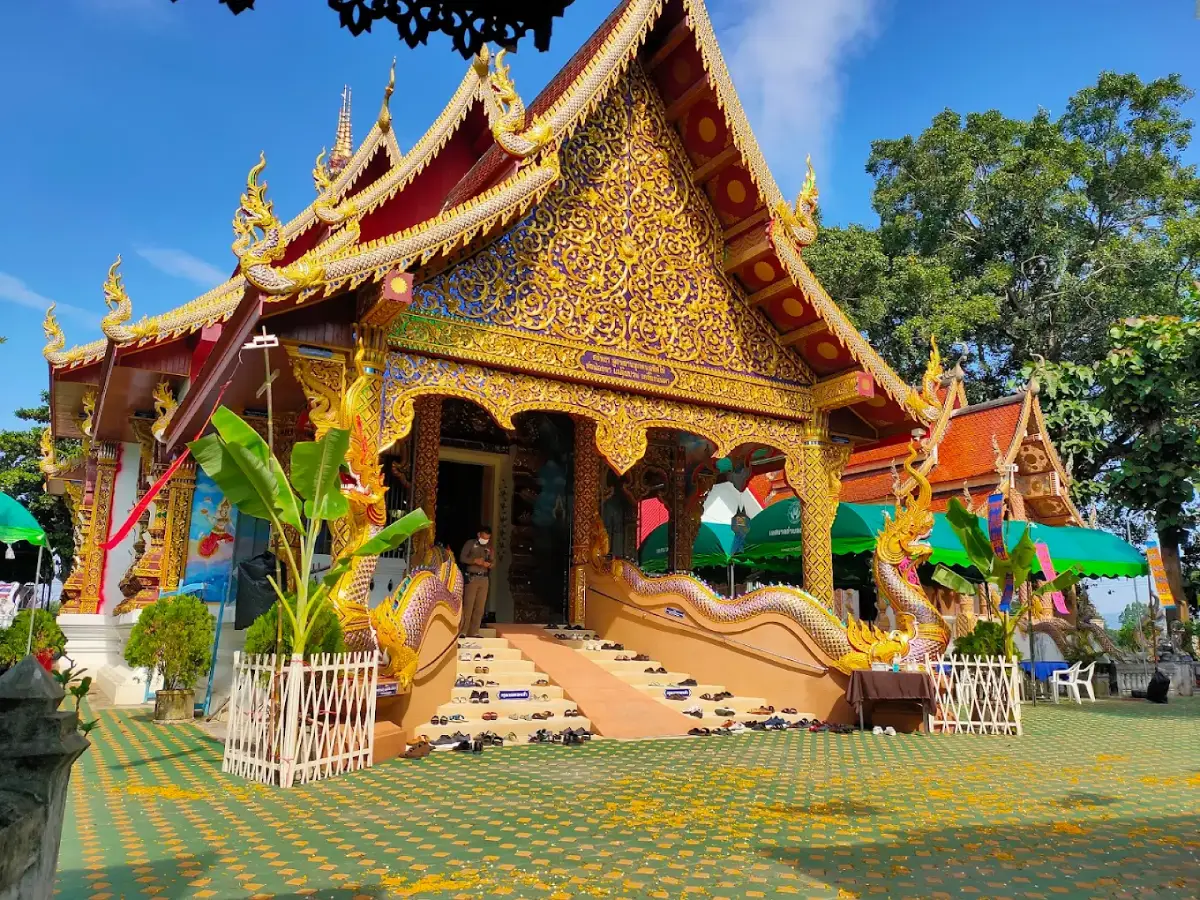
Wat Khok Mu Pa
Open Days: Daily
Opening Hours: 08.00 – 17.00
Wat Khok Mu Pa is a local Buddhist temple under the Mahanikaya monastic order, located in Mu 7, Ban Khok Mu Pa, San Na Meng Subdistrict, San Sai District, Chiang Mai Province 50210. The temple stands within a village landscape shaped by irrigation channels, rice fields, and the Mae Kuang River. It covers 3 rai, 1 ngan, and 23 square wah, with the north and west sides bordering irrigation waterways, the east side bordering the Mae Kuang River, and the south side adjoining villagers’ rice fields.
Wat Khok Mu Pa is suitable for visitors who want to explore a quiet local temple rather than a crowded tourist site. Its most distinctive feature is the local legend behind its name, involving ten wild boars, a young woman, her elderly grandmother, and a former city ruler. This story gives the temple a strong sense of place and makes it different from ordinary village temples. The temple is also important as a community Buddhist site where local residents make merit, join ceremonies, and maintain the religious life of Ban Khok Mu Pa.
The temple is said to have begun construction around 1868, based on the oral accounts of village elders, and it received its royal consecrated boundary in 2000. In Thai Buddhist practice, a royal consecrated boundary is important because it formally marks the area for monastic acts, especially ceremonies that must take place within a consecrated boundary. This confirms the temple’s status as a functioning Buddhist temple for the local community.
The setting of Wat Khok Mu Pa is closely tied to water and agriculture. The temple was established in a lowland area where bamboo once grew thickly, close to the Mae Kuang River and local irrigation channels. This landscape shows how the temple is embedded in the everyday life of the village. It is not isolated from the community; it grew within a settlement shaped by farming, waterways, and local religious devotion.
The legend of Wat Khok Mu Pa tells of a young woman who lived with her elderly grandmother in the area. A city ruler saw the young woman and wanted to take her as a consort. Concerned for her grandmother, the woman set a condition: the ruler had to find ten wild boars for her before she would agree to go with him. The ruler and his soldiers then captured the boars and placed them in an enclosure until the requested number was complete.
After the young woman went to live in the city, her grandmother was left alone and eventually died of grief at the site. Later, the ruler and the young woman returned and built a temple as a memorial. The temple was therefore named Wat Khok Mu Pa, meaning a temple associated with an enclosure for wild boars. This legend gives the temple its emotional and cultural identity, linking the place with memory, loss, devotion, and local storytelling.
The temple’s story reflects several themes in local Lanna culture: gratitude toward elders, the relationship between rulers and villagers, the use of temple construction as an act of remembrance, and the role of oral tradition in explaining village names. For visitors, the legend helps make the temple more meaningful. A visit to Wat Khok Mu Pa is therefore not only a religious visit but also an opportunity to understand how local communities preserve memory through place names and temple stories.
After the temple was established, monks came to reside there over time, although there were periods when no monks stayed and the temple became abandoned. Later, Princess Dara Rasmi presided over restoration work, helping the temple develop and continue its religious role to the present day. This connection adds historical depth to the temple because Princess Dara Rasmi is one of the important figures associated with Chiang Mai and Lanna history.
Important temple structures include the ordination hall, viharn, monks’ residences, and pavilion. The ordination hall is used for formal monastic ceremonies, while the viharn serves as a place for worship and community religious activities. The monks’ residences support monastic life, and the pavilion provides space for laypeople during merit-making events, Buddhist holy days, Kathin, Pha Pa offerings, and village gatherings.
The temple’s important sacred object is the chedi. In a Lanna community temple, a chedi is a spiritual landmark where devotees pay respect, make merit, and reflect on Buddhist teachings. Visitors should approach the chedi with respect, avoid touching or climbing on the structure, and preserve the peaceful atmosphere of the temple grounds.
Wat Khok Mu Pa is part of a network of temples in San Na Meng Subdistrict, along with Wat Rong Sak, Wat Lak Pan, Wat San Luang, Wat Mae Kuang, Wat San Na Meng, and Wat Pa Kluai Tha Kunchon. This pattern shows how northern Thai villages are closely connected with their local temples. Each village temple serves as a religious and social center for its own community, and Wat Khok Mu Pa plays that role for Ban Khok Mu Pa.
The temple remains important to the local community as a place for Buddhist holy day merit-making, family ceremonies, village gatherings, and annual religious events. Community temples like Wat Khok Mu Pa help preserve the relationship between older and younger generations by keeping Buddhist practice active in everyday village life.
Religious activities associated with the temple include Buddhist holy day merit-making, Kathin, Pha Pa offerings, Buddhist Lent, end-of-Lent activities, Lanna New Year, and ceremonies on important Buddhist dates. Kathin, which takes place after Buddhist Lent, is especially important because villagers and supporters join together to offer robes and necessities to monks. Pha Pa offerings can be organized on different occasions to support temple maintenance and religious activities.
During Lanna New Year or Songkran, local temples in Chiang Mai often become centers for merit-making, water-pouring ceremonies, offerings for departed relatives, and community gatherings. Wat Khok Mu Pa, as the village temple of Ban Khok Mu Pa, is well suited for visitors who want to experience the quiet local atmosphere of a Lanna Buddhist community during important religious periods.
The atmosphere of Wat Khok Mu Pa is calm, modest, and local. It is best suited to visitors who appreciate quiet temples, community history, local legends, and Buddhist sites that remain connected with village life. The temple does not rely on grand tourist architecture. Its value comes from its legend, its riverside and irrigation landscape, its chedi, and its historical association with the restoration supported by Princess Dara Rasmi.
Visitors can respectfully observe the ordination hall, viharn, chedi, monks’ residences, pavilion, and temple grounds. A visit should begin with worship in the public area of the viharn, followed by a quiet walk around the temple grounds. The site is also meaningful for those interested in the relationship between village legends and Buddhist temples in northern Thailand.
Visitors should dress modestly, speak quietly, remove shoes before entering religious buildings, avoid disturbing monks or worshippers, and refrain from entering private monastic areas without permission. If visiting during a ceremony or merit-making event, visitors should observe respectfully and give priority to local residents participating in the ritual.
Getting There is most convenient by private car, rental car, or local transport. From Chiang Mai city, travel toward San Sai District and continue into San Na Meng Subdistrict and Ban Khok Mu Pa, Mu 7. Because public sources list slightly different house numbers for the temple, visitors should use the temple name and GPS navigation rather than relying only on a street number.
A meaningful temple route can begin at Wat Khok Mu Pa, then continue to Wat San Na Meng, Wat Mae Kuang, Wat San Luang, Wat Lak Pan, and Wat Rong Sak within San Na Meng Subdistrict. Travelers with more time can extend the route to nearby temples in San Sai Luang, such as Wat San Sai Luang, Wat Khao Thaen Luang, Wat Khao Thaen Noi, and Wat Ban Tho. This route provides a deeper view of community temples in San Sai District.
In summary, Wat Khok Mu Pa is a historically and culturally meaningful community temple in San Na Meng. It is associated with a distinctive local legend, began construction around 1868, received its royal consecrated boundary in 2000, and has a chedi as its important sacred object. Its location near irrigation channels and the Mae Kuang River, together with its connection to Princess Dara Rasmi’s restoration work, makes it a valuable stop for travelers who want to understand Chiang Mai’s local Lanna temple culture beyond the main tourist routes.
| Name | Wat Khok Mu Pa |
| Type | Local Buddhist Temple Under The Mahanikaya Order |
| Location | Ban Khok Mu Pa, Mu 7, San Na Meng Subdistrict, San Sai District, Chiang Mai Province |
| Address | Mu 7, San Na Meng Subdistrict, San Sai District, Chiang Mai 50210, Thailand |
| Coordinates | 18.85195, 99.06072 |
| Highlights | Historic riverside community temple with a local legend about ten wild boars and a chedi as its important sacred object |
| History | Construction began around 1868 according to local oral accounts, and the temple received its royal consecrated boundary in 2000 |
| Name Origin | Linked to the legend of a ruler capturing ten wild boars for a young woman before a temple was later built as a memorial at the site |
| Distinctive Features | Lanna community temple connected with the Mae Kuang River, irrigation channels, rice fields, and the local memory of Ban Khok Mu Pa |
| Temple Area | 3 rai, 1 ngan, and 23 square wah |
| Boundaries | North: irrigation waterway; South: villagers’ rice fields; East: Mae Kuang River; West: irrigation waterway |
| Important Structures | Ordination hall, viharn, monks’ residences, and pavilion |
| Sacred Object | Chedi |
| Main Areas / Zones | Ordination hall area, viharn, monks’ residences, pavilion, chedi area, and temple courtyard for community activities |
| Traditions / Merit-Making Events | Buddhist holy day merit-making, Kathin, Pha Pa offerings, Buddhist Lent, end-of-Lent activities, Lanna New Year, and ceremonies on important Buddhist dates |
| Current Status | Listed as a temple in San Na Meng Municipality and open for worship, merit-making, and Buddhist community activities |
| Open Days | Daily |
| Opening Hours | 08.00 – 17.00 |
| Travel Information | Best reached by private car, rental car, or local transport from Chiang Mai city toward San Sai District, San Na Meng Subdistrict, and Ban Khok Mu Pa |
| Nearby Tourist Attractions | 1. Wat San Na Meng, about 1 km 2. Wat Mae Kuang, about 2 km 3. Wat San Luang, about 3 km 4. Wat Lak Pan, about 4 km 5. Wat Rong Sak, about 5 km |
| Nearby Restaurants | 1. Omtang Yum Zaap, about 2 km, Tel. 088-252-2432 2. San Na Meng Chicken Rice, about 2 km, Tel. 097-918-0229 3. BOKRAK, about 2 km, Tel. 080-461-6636 4. Somtam Kham Phaeng, near 7-Eleven San Na Meng, about 2 km, Tel. 084-228-7493 5. Cha Anchalee San Na Meng, about 3 km, Tel. 094-636-1609 |
| Nearby Accommodations | 1. Sannameng Place, about 1 km, Tel. 081-343-8181 2. Kalaka Homestay, about 3 km, Tel. 087-788-6900 3. Palm Villa - Modern Luxury & Exclusive Villa Resort, about 4 km, Tel. 064-597-6494 4. The Forest Hill Cafe Restaurant & Massage, about 5 km, Tel. 081-362-6258 5. D-Sabai Residence, about 7 km, Tel. 053-351-419 |
Frequently Asked Questions (FAQ)
Q: Where is Wat Khok Mu Pa located?
A: Wat Khok Mu Pa is located in Mu 7, Ban Khok Mu Pa, San Na Meng Subdistrict, San Sai District, Chiang Mai 50210, Thailand.
Q: Is Wat Khok Mu Pa open daily?
A: Yes. The temple is listed as open daily from 08.00 to 17.00.
Q: Why is Wat Khok Mu Pa historically important?
A: The temple is said to have begun construction around 1868 and received its royal consecrated boundary in 2000. It is also connected with a distinctive local legend and Princess Dara Rasmi’s restoration work.
Q: What is the origin of the name Wat Khok Mu Pa?
A: The name comes from a local legend in which a ruler had ten wild boars captured and placed in an enclosure before a temple was later built as a memorial at the site.
Q: What important structures can visitors see at Wat Khok Mu Pa?
A: Visitors can see the ordination hall, viharn, monks’ residences, pavilion, chedi, and temple courtyard.
Q: How is Wat Khok Mu Pa connected with Princess Dara Rasmi?
A: Local temple history states that Princess Dara Rasmi presided over restoration work, helping the temple develop and continue its religious role.
Q: What type of traveler is Wat Khok Mu Pa suitable for?
A: It is suitable for travelers who enjoy quiet local temples, Lanna village culture, local legends, and community Buddhist sites near Chiang Mai city.
Q: What nearby temples can be visited with Wat Khok Mu Pa?
A: Nearby temples include Wat San Na Meng, Wat Mae Kuang, Wat San Luang, Wat Lak Pan, and Wat Rong Sak.
 Category: ●Places of Worship
 Group: ●Temple
Last Update : 5 HourAgo
 Last Update : 5 HourAgo
 Click to Access the Navigation Map GPS
 Muang Chiang Mai(121)Chom Thong(47)Mae Chaem(25)Chiang Dao(33)Doi Saket(68)Mae Taeng(85)Mae Rim(69)Samoeng(29)Fang(71)Mae Ai(59)Phrao(70)San Pa Tong(103)San Kamphaeng(66)San Sai(73)Hang Dong(74)Hot(32)Doi Tao(22)Omkoi(11)Saraphi(74)Wiang Haeng(15)Chai Prakan(28)Mae Wang(32)Mae On(22)Doi Lo(34)Galyani Vadhana(1)


