
lovethailand home >North Travel Attractions >Chiang Mai Travel Attractions >San Sai >Paphai > Wat Pa Daet (Pa Phai)
TL;DR: Wat Pa Daet (Pa Phai) is located at Moo 3, Ban Pa Phai, Pa Phai Subdistrict, San Sai District, Chiang Mai Province, open Daily, hours 08.00 – 17.00.

Wat Pa Daet (Pa Phai)
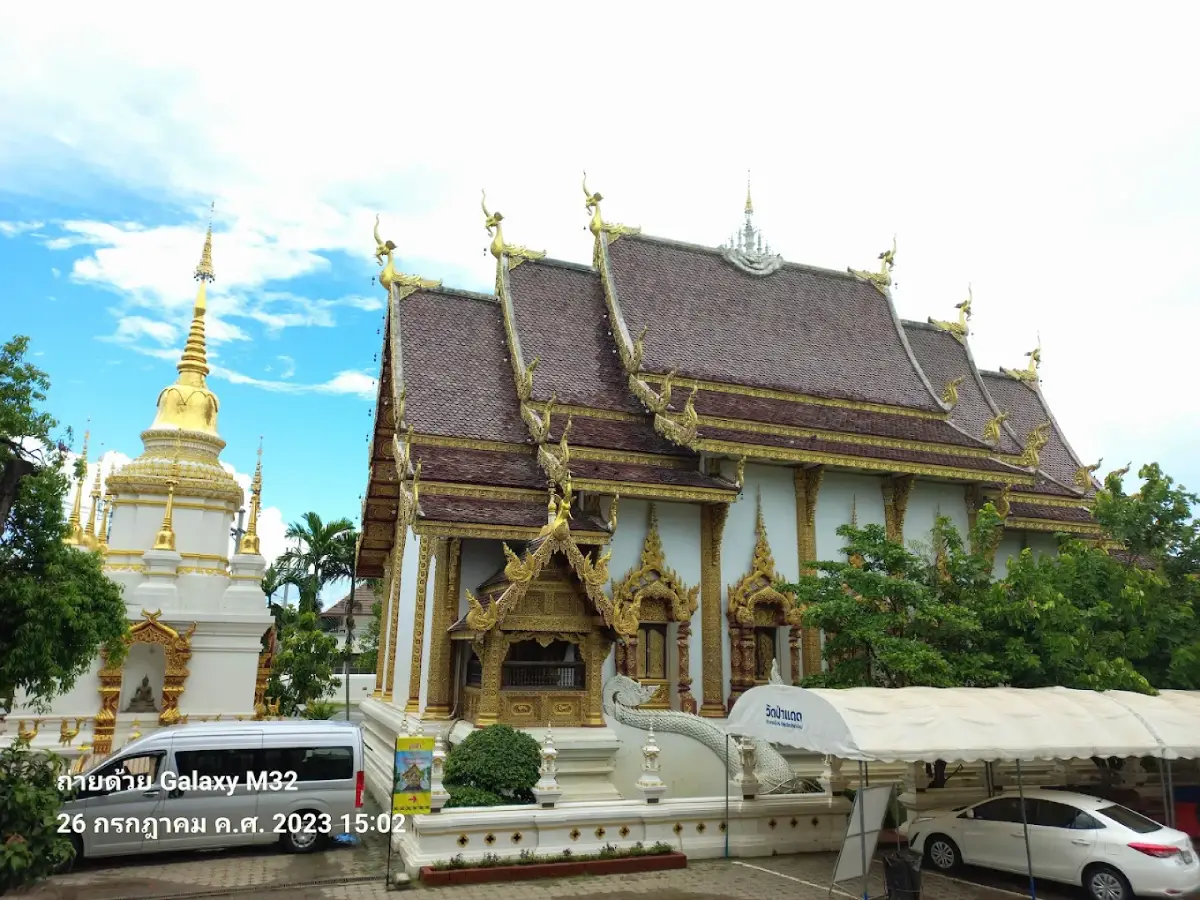
Open Days: Daily
Opening Hours: 08.00 – 17.00
Wat Pa Daet (Pa Phai) is a local Buddhist temple under the Mahanikaya order, located in Moo 3, Ban Pa Phai, along the Chiang Mai–Phrao road in Pa Phai Subdistrict, San Sai District, Chiang Mai Province. The temple was officially permitted to be established in 1809 and received its Wisungkham Sima in 1918. With this long history, Wat Pa Daet is one of the old community temples of Pa Phai and an important spiritual landmark in northern San Sai.
Pa Phai Subdistrict has a strong community background linked with foothill plains, agricultural settlement, and the presence of bamboo that gave the area its name. The name Pa Phai reflects both the natural landscape and the memory of early settlement. Within this setting, Wat Pa Daet stands as part of a village landscape where temples, homes, fields, local roads, and Buddhist practice remain closely connected.
The temple is located along the Chiang Mai–Phrao route, a key road corridor connecting Chiang Mai city, Mae Jo, San Sai, Pa Phai, Mae Faek, and the northern part of Chiang Mai Province. This makes Wat Pa Daet convenient for travelers who want to explore local temples beyond the main tourist areas of Chiang Mai. It can be combined with nearby temples and local places in Pa Phai Subdistrict, including Wat Pa Mueat, Wat Mueang Khon, Wat Mae Kaet Noi, Wat Nong Tao Kham, Wat Nong Ubosot, and Pa Mueat Market.
The temple’s establishment in 1809 shows that Wat Pa Daet has been part of local Buddhist life for more than 200 years. In a Lanna village context, a temple was never only a ritual building. It was where villagers made merit, listened to sermons, gathered on Buddhist holy days, organized annual ceremonies, and created a shared moral and social space for the community.
Wat Pa Daet received Wisungkham Sima in 1918. A consecrated boundary is significant because it allows important monastic rites to be performed according to Buddhist discipline. The granting of Wisungkham Sima confirms the temple’s formal role within the Thai monastic system and its stable position within the local community.
Phra Kittiphum is listed as the abbot of Wat Pa Daet in the temple information used for this article. In a community temple, the abbot plays an important role beyond monastic administration. He helps maintain temple activities, care for the temple grounds, coordinate merit-making events, guide villagers in religious practice, and preserve the relationship between monks and the local community.
The main value of Wat Pa Daet lies in its identity as an old village temple in Pa Phai. Visitors will not find the scale and crowds of large city temples here. Instead, the temple offers a quieter and more local atmosphere. Its importance comes from community faith, long-term continuity, and its role as a Buddhist center for people living in and around Ban Pa Phai.
The name Wat Pa Daet also carries a sense of place. Pa suggests a forested or natural landscape, while daet evokes sunlight and openness. Within Pa Phai Subdistrict, the temple name becomes part of a wider local identity shaped by nature, settlement, agriculture, and Buddhist faith. The temple should therefore be understood not only as a place of worship but also as part of the cultural landscape of the village.
Wat Pa Daet plays several roles for the community. First, it is a spiritual center where villagers pay respect, make merit, and listen to Buddhist teachings. Second, it is a social space for ordinations, funerals, Kathin, robe-offering activities, and village ceremonies. Third, it is a historical marker that helps preserve the memory of Pa Phai as a long-standing Buddhist community in San Sai District.
In Lanna culture, a village temple helps shape community values. Children and young people grow up visiting the temple with their families. Elders use the temple as a place for merit-making and listening to sermons. Families return to the temple for important life events. In this way, Wat Pa Daet functions as a moral and social anchor for the village.
Publicly available information about specific named sacred objects or individual architectural structures at Wat Pa Daet is limited, so the temple is best appreciated through its overall role as an old community temple. Visitors should pay respect quietly, walk through the temple grounds, observe the village atmosphere, and understand that this temple remains meaningful because it continues to serve local people.
Religious activities at Wat Pa Daet follow the Buddhist calendar and local Lanna community practice. Important occasions include Buddhist holy days, Makha Bucha, Visakha Bucha, Asalha Bucha, Buddhist Lent, the end of Buddhist Lent, Kathin, robe-offering activities, and local community merit-making events. These activities keep the relationship between temple and village active throughout the year.
Kathin is especially important for a local temple. During Kathin, villagers and devotees offer robes and support the maintenance of the temple and monastic community. Kathin is not only a religious ceremony but also an annual gathering that strengthens the bond between villagers, former residents, supporters, and the temple itself.
Robe-offering activities and other merit-making events also help sustain the temple. Maintaining an old temple such as Wat Pa Daet requires the faith of many generations, including the care of temple grounds, support for religious activities, and the passing down of temple memory to younger people in the community.
Wat Pa Daet is best visited as part of a Pa Phai community-temple route. Nearby temples such as Wat Pa Mueat, Wat Mueang Khon, Wat Mae Kaet Noi, Wat Nong Tao Kham, and Wat Nong Ubosot show how Pa Phai Subdistrict contains a network of village temples, each serving its own local community. Visiting several of these temples together gives a clearer picture of local Buddhist life in San Sai.
A meaningful itinerary can begin at Wat Pa Daet, continue to Pa Mueat Market for local food and community atmosphere, and then connect with nearby temples in Pa Phai. This type of route is suitable for travelers who prefer quiet cultural travel, local communities, and authentic village temples rather than crowded tourist landmarks.
Getting There is convenient by private car or motorcycle. From Chiang Mai city, travel toward San Sai and Mae Jo, then continue into Pa Phai Subdistrict along the Chiang Mai–Phrao route or local San Sai–Pa Mueat roads. The temple is located in Moo 3, Ban Pa Phai, and can be visited as part of a half-day route through Pa Phai Subdistrict.
Visitors should dress modestly, keep their voices low, avoid entering monks’ private areas without permission, and photograph sacred areas respectfully. Wat Pa Daet remains a local Buddhist temple used by the community, so it should be treated first as a place of worship and village faith rather than a purely touristic site.
Overall, Wat Pa Daet (Pa Phai) is an old and meaningful local temple in San Sai District. Its strongest value lies in its establishment in 1809, Wisungkham Sima granted in 1918, its role as a spiritual center of the Pa Phai community, and its connection with the local temple network of northern San Sai. It is a worthwhile stop for travelers who want to understand a quieter and more authentic side of Chiang Mai’s Lanna village temple culture.
| Name | Wat Pa Daet (Pa Phai) |
| Location | Moo 3, Ban Pa Phai, Pa Phai Subdistrict, San Sai District, Chiang Mai Province |
| Address | Moo 3, Pa Phai, Chiang Mai–Phrao Road, Pa Phai Subdistrict, San Sai District, Chiang Mai 50210, Thailand |
| Type | Local Buddhist temple under the Mahanikaya order |
| Abbot / Caretaker | Phra Kittiphum |
| Highlights | Old community temple of Pa Phai, established in 1809, serving as a spiritual center and part of the San Sai local temple route |
| History | Officially permitted to be established as a temple in 1809, making it one of the old community temples of Pa Phai Subdistrict |
| Wisungkham Sima | Granted in 1918 |
| Community Context | Pa Phai developed in a foothill-plain agricultural landscape, with the name of the area connected to the presence of bamboo and early local settlement |
| Main Areas / Zones | Worship area, temple courtyard, Buddhist activity area, and community merit-making space for Ban Pa Phai |
| Community Role | Spiritual center of Pa Phai community, used for merit-making, sermons, Kathin, robe-offering activities, and local Buddhist ceremonies |
| Traditions / Merit-Making | Buddhist holy days, major Buddhist festivals, Buddhist Lent, the end of Buddhist Lent, Kathin, robe-offering activities, and Pa Phai community merit-making events |
| Travel Information | From Chiang Mai city, travel toward San Sai and Mae Jo, then continue into Pa Phai Subdistrict along the Chiang Mai–Phrao route or local San Sai–Pa Mueat roads. |
| Current Status | Open as a local Buddhist temple and community sacred site of Pa Phai Subdistrict, San Sai District, Chiang Mai |
| Open Days | Daily |
| Opening Hours | 08.00 – 17.00 |
| Main Contact Number | 053-397-743 |
| Facilities | Worship area, temple courtyard, religious activity space, and parking area within the temple community |
| Nearby Tourist Attractions | 1. Pa Mueat Market, about 1–2 km 2. Wat Pa Mueat, Pa Phai Subdistrict, about 2 km 3. Wat Mueang Khon, Pa Phai Subdistrict, about 3 km 4. Wat Mae Kaet Noi, Pa Phai Subdistrict, about 4 km 5. Wat Nong Tao Kham, Pa Phai Subdistrict, about 5 km 6. Wat Nong Ubosot, Pa Phai Subdistrict, about 5–6 km |
| Nearby Restaurants | 1. Witsawa Hainanese Chicken Rice Pa Mueat, about 1–2 km, Tel. 099-190-6778 2. Khao Man Kai Suk Jai Pa Mueat, about 1–2 km, Tel. 088-415-2421 3. Sai Krok Moo Wun Sen Ta Yai at Pa Mueat Market, about 2 km, Tel. 097-352-8375 4. Coffee Tale Pa Mueat Market, about 2 km, Tel. 061-375-4335, 094-607-2020 5. A Place On Earth Pa Phai, about 3–4 km, Tel. 088-251-1044 6. Pa Maem Cooked-To-Order Restaurant, about 4 km, Tel. 061-075-3985 |
| Nearby Accommodations | 1. Baan View Na, about 3–5 km, Tel. 089-844-9675 2. MonMin Farmstay, about 5–7 km, Tel. 084-656-0009 3. Mj House Stay With Guest And Host, about 6–8 km 4. Maejo Resort, about 8–10 km, Tel. 081-429-9935 5. Boonthavon Maejo Hotel, about 10 km 6. Preme House Boutique, about 10–12 km |
Frequently Asked Questions (FAQ)
Q: Where is Wat Pa Daet (Pa Phai) located?
A: Wat Pa Daet is located in Moo 3, Ban Pa Phai, along the Chiang Mai–Phrao road in Pa Phai Subdistrict, San Sai District, Chiang Mai 50210, Thailand.
Q: When is Wat Pa Daet open?
A: Wat Pa Daet is open daily from 08.00 to 17.00.
Q: What type of temple is Wat Pa Daet?
A: Wat Pa Daet is a local Buddhist temple under the Mahanikaya order and serves as a sacred community site for Pa Phai.
Q: When was Wat Pa Daet established?
A: Wat Pa Daet was officially permitted to be established as a temple in 1809.
Q: When did Wat Pa Daet receive Wisungkham Sima?
A: Wat Pa Daet received Wisungkham Sima in 1918.
Q: Who is the abbot of Wat Pa Daet?
A: The abbot of Wat Pa Daet is Phra Kittiphum.
Q: Who should visit Wat Pa Daet?
A: The temple is suitable for travelers interested in Lanna community temples, old temples in San Sai, quiet village atmospheres, and local cultural routes in Pa Phai Subdistrict.
Q: What nearby places can be visited on the same trip?
A: Nearby places include Pa Mueat Market, Wat Pa Mueat, Wat Mueang Khon, Wat Mae Kaet Noi, Wat Nong Tao Kham, and Wat Nong Ubosot.
 Category: ●Places of Worship
 Group: ●Temple
Last Update : 5 DayAgo
 Last Update : 5 DayAgo
 Click to Access the Navigation Map GPS
Wat Pa Daet (Pa Phai) Map
Recommend

 Muang Chiang Mai(121)Chom Thong(47)Mae Chaem(25)Chiang Dao(33)Doi Saket(68)Mae Taeng(85)Mae Rim(69)Samoeng(29)Fang(71)Mae Ai(59)Phrao(70)San Pa Tong(103)San Kamphaeng(66)San Sai(73)Hang Dong(73)Hot(32)Doi Tao(22)Omkoi(11)Saraphi(74)Wiang Haeng(15)Chai Prakan(28)Mae Wang(32)Mae On(22)Doi Lo(34)Galyani Vadhana(1)


