
lovethailand home >North Travel Attractions >Chiang Mai Travel Attractions >San Sai >Mae Faek > Wat Nong Sae (Mae Faek)
TL;DR: Wat Nong Sae (Mae Faek) is located at Ban Nong Sae, Moo 8, Mae Faek Subdistrict, San Sai District, Chiang Mai Province.
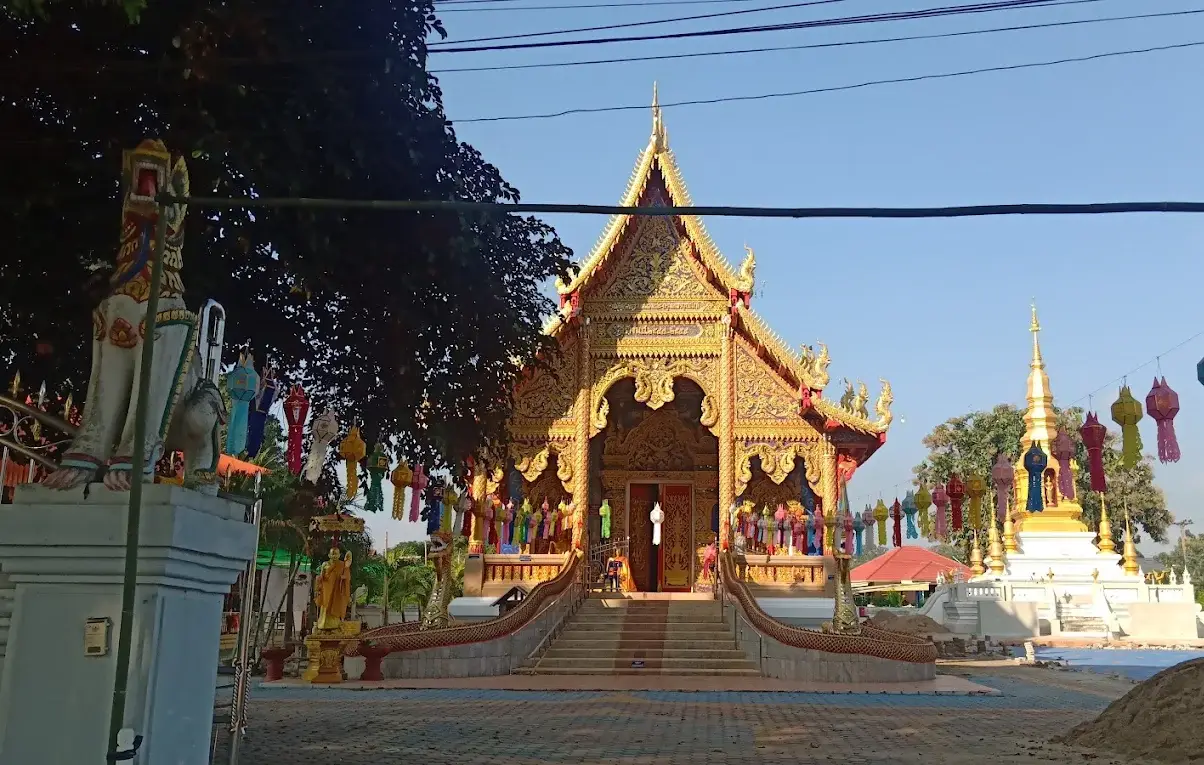
Wat Nong Sae (Mae Faek)
Operating day: Daily
Operating time: 08.00 - 17.00
Wat Nong Sae (Mae Faek) in Ban Nong Sae, Moo 8, Mae Faek Subdistrict, San Sai District, Chiang Mai Province, is an old local Buddhist temple under the Mahanikaya order. Established in 1861, the temple is one of the older community temples in Mae Faek. It is located in a village landscape connected with the Chiang Mai–Phrao road, irrigation canals, agricultural land, and the rural Buddhist way of life in northern Chiang Mai. Wat Nong Sae is not a major tourist landmark, but it is meaningful as a living village temple that reflects local faith, settlement history, and Lanna community identity.
The name Nong Sae links the temple directly with the surrounding village. In Thai, nong refers to a pond, wetland, or water-related landscape. As a temple name, Wat Nong Sae preserves the identity of Ban Nong Sae and reflects the connection between temple, water, settlement, and local memory. This relationship between place-name and temple name is common in northern Thai communities, where temples often serve as living records of the village landscape.
Wat Nong Sae is located in Moo 8, Mae Faek Subdistrict, San Sai District, Chiang Mai 50290, Thailand. Ban Nong Sae is part of Mae Faek Municipality and lies near the Chiang Mai–Phrao road, also known as Highway 1001. The village area is connected with the Mae Faek–Mae Ngat irrigation canal system, which has long supported agriculture and settlement in this part of San Sai District.
The temple was officially permitted to be established in 1861. Its temple land covers 3 rai, 2 ngan, and 1 square wah. This makes Wat Nong Sae one of the old temples of Mae Faek Subdistrict, with a history of more than 160 years. When considered together with other old temples in Mae Faek, such as Wat Rom Luang, Wat Si Ngam, Wat Si Sai Mun, Wat Nong Ma Chap, and Wat Ban Pong, the temple forms part of a wider network of community temples that have supported local Buddhist life for generations.
The broader context of Mae Faek is important for understanding Wat Nong Sae. Mae Faek is a foothill plain with irrigation canals, the Ping River, agricultural areas, and the Chiang Mai–Phrao road running through it. Villages in this area developed around water, farmland, transport routes, and temples. Wat Nong Sae should therefore be understood not as an isolated religious building, but as part of the village system that shaped local life.
In Lanna society, a village temple is more than a ritual space. It is a place for making merit, listening to sermons, gathering for Buddhist holy days, organizing Kathin, robe-offering activities, funerals, ordinations, meetings, and other community events. Wat Nong Sae plays this role for Ban Nong Sae. It serves as both a spiritual center and a shared social space for local people.
Phra Khru Uthai Chayadhammo is associated with Wat Nong Sae as the abbot in the information used for this article. In a local community temple, an abbot plays an important role beyond monastic administration. He helps maintain temple life, guide religious activities, coordinate merit-making, and support the relationship between monks and villagers. This role is essential for keeping a village temple active across generations.
The temple contains worship and religious activity areas used by the local community. Publicly available architectural details about specific structures such as the vihara, ubosot, chedi, or sermon hall are limited, so the strongest value of Wat Nong Sae should be understood through its age, community role, and relationship with Ban Nong Sae rather than through a detailed architectural inventory. Its meaning lies in continuity, local devotion, and everyday Buddhist life.
Although Wat Nong Sae is not widely promoted as a major tourist site, it offers a quiet and authentic village-temple atmosphere. Visitors will not find the scale or crowds of famous city temples here. Instead, they can experience a calm local temple that remains connected with the real community around it. This makes the temple suitable for travelers interested in rural Lanna culture, community Buddhism, and less crowded cultural routes in San Sai District.
The Ban Nong Sae village area is located at approximately 19.016386707031067, 98.9683011174202. The village is only a short distance from the Chiang Mai–Phrao road, making it accessible by private car or motorcycle. This location allows travelers to include Wat Nong Sae in a wider temple route through Mae Faek without needing to travel deep into remote mountain areas.
Mae Faek Subdistrict has a landscape shaped by irrigation, agriculture, and riverside settlement. The Mae Faek–Mae Ngat irrigation canal is an important water resource for Ban Nong Sae, while the broader Mae Faek area is connected with the Ping River system. This environmental context helps explain why temples, villages, and farming life are closely linked in the area.
The temple’s role in Ban Nong Sae has several layers. First, it is a place of worship where villagers make merit, listen to sermons, and observe Buddhist holy days. Second, it is a community gathering place for annual ceremonies and local activities. Third, it is a historical marker that shows Ban Nong Sae has maintained a Buddhist community identity since at least the temple’s establishment in 1861.
Religious activities at Wat Nong Sae follow the Buddhist calendar and local Lanna practice. Important occasions include Buddhist holy days, major Buddhist festivals, Buddhist Lent, the end of Buddhist Lent, Kathin, robe-offering activities, and community merit-making events. Recent Kathin activity listings include Wat Nong Sae in Mae Faek Subdistrict, San Sai District, showing that the temple remains part of the living merit-making cycle of the community.
Kathin is especially important for a local temple. It allows villagers, devotees, and people connected with the community to support the monks, maintain temple facilities, and strengthen their bond with the village temple. In this sense, Kathin is not only a robe-offering ceremony; it is also a social mechanism that keeps the temple and community closely connected.
Robe-offering activities and other merit-making events also support the temple throughout the year. At a village temple such as Wat Nong Sae, the temple is preserved by the shared faith of monks and villagers. The continuing presence of religious activities helps maintain both the physical site and the community memory attached to it.
For cultural travelers, Wat Nong Sae is best visited as part of a Mae Faek community temple route. Nearby temples and places include Wat Nong Ma Chap, Wat Si Sai Mun, Wat Si Ngam, Wat Rom Luang, Wat Phra That Chom Kitti, and Wat Ban Pong. Each site has a different story, and together they show the religious and community landscape of Mae Faek in greater depth.
A meaningful route can begin at Wat Nong Sae, then continue to Wat Nong Ma Chap and the Ban Nong Ma Chap OTOP community tourism area, followed by Wat Si Sai Mun, Wat Si Ngam, Wat Rom Luang, and Wat Phra That Chom Kitti. This route combines village temples, community tourism, agriculture, hilltop sacred sites, and local history in one area.
Getting There is convenient by private car or motorcycle. From Chiang Mai city, take Highway 1001 or the Chiang Mai–Phrao road toward San Sai, passing Mae Jo and Mae Faek. Continue to Ban Nong Sae, Moo 8, Mae Faek Subdistrict. The temple is located within the local community and can be visited as part of a half-day or full-day cultural trip in northern San Sai.
Visitors should allow around 30–60 minutes to pay respect, walk around the temple grounds, and understand the temple’s role in the village. Those who want a deeper cultural route should allow more time for nearby temples and Ban Nong Ma Chap community tourism, where agriculture, local products, community markets, and village life are part of the travel experience.
Visitors should dress modestly, keep their voices low, avoid entering monks’ private areas without permission, and photograph sacred areas respectfully. Wat Nong Sae is an active local Buddhist temple, so visitors should treat it first as a place of worship and community faith rather than a purely touristic site.
Overall, Wat Nong Sae (Mae Faek) is an old and meaningful community temple of Ban Nong Sae. Its main value lies in its establishment in 1861, its status as a local Buddhist temple under the Mahanikaya order, its setting within Mae Faek’s agricultural and irrigation landscape, and its role as the spiritual center of Ban Nong Sae. It is a worthwhile stop for travelers who want to understand a quieter, deeper, and more authentic side of Chiang Mai’s village temple culture.
| Name | Wat Nong Sae (Mae Faek) |
| Location | Ban Nong Sae, Moo 8, Mae Faek Subdistrict, San Sai District, Chiang Mai Province |
| Address | Moo 8, Mae Faek Subdistrict, San Sai District, Chiang Mai 50290, Thailand |
| Ban Nong Sae Area Coordinates | 19.016386707031067, 98.9683011174202 |
| Type | Local Buddhist temple under the Mahanikaya order |
| Abbot / Caretaker | Phra Khru Uthai Chayadhammo |
| Highlights | Old community temple of Ban Nong Sae, established in 1861, and a spiritual center of an agricultural village in Mae Faek Subdistrict |
| History | Officially established as a temple in 1861, making it one of the older community temples in Mae Faek Subdistrict, San Sai District, Chiang Mai Province |
| Temple Land Area | 3 rai, 2 ngan, and 1 square wah |
| Name Origin | The name comes from Ban Nong Sae, Moo 8, Mae Faek Subdistrict. The word Nong reflects a water-related village landscape. |
| Distinctive Features | A Lanna community temple connected with the Chiang Mai–Phrao route, the Mae Faek–Mae Ngat irrigation canal, and the agricultural way of life in Mae Faek |
| Main Areas / Zones | Worship area, temple courtyard, Buddhist activity area, and community merit-making space for Ban Nong Sae |
| Traditions / Merit-Making | Buddhist holy days, major Buddhist festivals, Buddhist Lent, the end of Buddhist Lent, Kathin, robe-offering activities, and Ban Nong Sae community merit-making events |
| Travel Information | From Chiang Mai city, take Highway 1001 or the Chiang Mai–Phrao road toward San Sai, passing Mae Jo and Mae Faek, then enter Ban Nong Sae, Moo 8. |
| Current Status | Open as a local Buddhist temple and community sacred site of Ban Nong Sae, Mae Faek Subdistrict, San Sai District, Chiang Mai |
| Facilities | Worship area, temple courtyard, religious activity space, and parking area within the temple community |
| Nearby Tourist Attractions | 1. Ban Nong Sae and Mae Faek Community Area, about 0.5 km 2. Wat Nong Ma Chap and Ban Nong Ma Chap Community Tourism Area, about 3 km 3. Wat Si Sai Mun (Mae Tae), about 4 km 4. Wat Si Ngam, Mae Faek Subdistrict, about 5 km 5. Wat Rom Luang, Mae Faek Subdistrict, about 6 km 6. Wat Phra That Chom Kitti, about 10 km |
| Nearby Restaurants | 1. CHA 168 Mae Faek Mai, about 5 km, Tel. 081-749-1549, 080-052-9538 2. Enjoy Healthy Food Mae Faek Mai, about 6 km, Tel. 085-082-3953, 099-218-9339 3. Moonshine Cafe, about 7 km, Tel. 092-365-1178 4. M&M Cha, about 8 km, Tel. 093-032-2321 5. Memory Coffee House Nong Han San Sai, about 8 km, Tel. 094-602-3773 6. Mum Aroi Food Court, about 8 km, Tel. 052-014-190 |
| Nearby Accommodations | 1. The Royal Chiang Mai Golf Resort, about 6 km, Tel. 083-568-9797, 083-578-2727, 083-576-4747 2. Innbox Chiangmai Hotel, about 7 km, Tel. 081-171-0247 3. Mae Faek Villas, about 8 km, Tel. 081-287-9011 4. Dream Villa Resort @ Chiang Mai, about 9 km, Tel. 099-291-6447 5. Holiday Resort Rimping, about 10 km 6. Tao Garden Health Spa & Resort, about 18 km, Tel. 084-028-0230 |
Frequently Asked Questions (FAQ)
Q: Where is Wat Nong Sae (Mae Faek) located?
A: Wat Nong Sae is located in Ban Nong Sae, Moo 8, Mae Faek Subdistrict, San Sai District, Chiang Mai Province, along the Chiang Mai–Phrao travel corridor.
Q: When was Wat Nong Sae established?
A: Wat Nong Sae was officially established as a temple in 1861, making it one of the older community temples in Mae Faek Subdistrict.
Q: What type of temple is Wat Nong Sae?
A: Wat Nong Sae is a local Buddhist temple under the Mahanikaya order and serves as a sacred community site for Ban Nong Sae.
Q: What is Wat Nong Sae known for?
A: The temple is known as an old Ban Nong Sae community temple connected with Mae Faek’s agricultural landscape, irrigation canals, and village Buddhist life.
Q: Who is the abbot of Wat Nong Sae?
A: The abbot of Wat Nong Sae is Phra Khru Uthai Chayadhammo.
Q: How do visitors get to Wat Nong Sae?
A: From Chiang Mai city, take Highway 1001 or the Chiang Mai–Phrao road toward San Sai, passing Mae Jo and Mae Faek, then enter Ban Nong Sae, Moo 8.
Q: Who should visit Wat Nong Sae?
A: The temple is suitable for travelers interested in Lanna community temples, village history, agricultural landscapes, and cultural routes in San Sai District.
Q: What nearby places can be visited on the same trip?
A: Nearby places include Wat Nong Ma Chap, Wat Si Sai Mun, Wat Si Ngam, Wat Rom Luang, Wat Phra That Chom Kitti, and Ban Nong Ma Chap community tourism area.
 Category: ●Places of Worship
 Group: ●Temple
Last Update : 1 WeekAgo
 Last Update : 1 WeekAgo
 Click to Access the Navigation Map GPS
Wat Nong Sae (Mae Faek) Map
Recommend

 Muang Chiang Mai(121)Chom Thong(47)Mae Chaem(25)Chiang Dao(33)Doi Saket(68)Mae Taeng(85)Mae Rim(69)Samoeng(29)Fang(71)Mae Ai(59)Phrao(70)San Pa Tong(103)San Kamphaeng(66)San Sai(73)Hang Dong(73)Hot(32)Doi Tao(22)Omkoi(11)Saraphi(74)Wiang Haeng(15)Chai Prakan(28)Mae Wang(32)Mae On(22)Doi Lo(33)Galyani Vadhana(1)


