
lovethailand home >North Travel Attractions >Chiang Mai Travel Attractions >San Sai >Mae Faek > Wat Phra That Chom Kitti
TL;DR: Wat Phra That Chom Kitti is located at Ban Phra That, Moo 9, Mae Faek Subdistrict, San Sai District, Chiang Mai Province, open Daily, hours 08.00 – 17.00.

Wat Phra That Chom Kitti
Open Days: Daily
Opening Hours: 08.00 – 17.00
Wat Phra That Chom Kitti is a hilltop Buddhist temple located in Ban Phra That, Moo 9, Mae Faek Subdistrict, San Sai District, Chiang Mai Province. The temple is known for its golden castle-shaped Lanna stupa enshrining relics of the Buddha, its peaceful meditation atmosphere, its reclining Buddha image, and its panoramic viewpoint over the Mae Faek area. It is one of the most meaningful local temples in northern San Sai for travelers who want to visit a quiet sacred site outside central Chiang Mai.
The temple was officially permitted to be established in 1935 and received its Wisungkham Sima in 2007. This consecrated boundary allows the temple to perform important monastic rites according to Buddhist discipline. Wat Phra That Chom Kitti is located in Moo 9, Mae Faek Subdistrict, San Sai District, Chiang Mai 50290. Its location connects naturally with the Mae Jo, Mae Faek, Mae Faek Mai, and Chiang Mai–Phrao travel route.
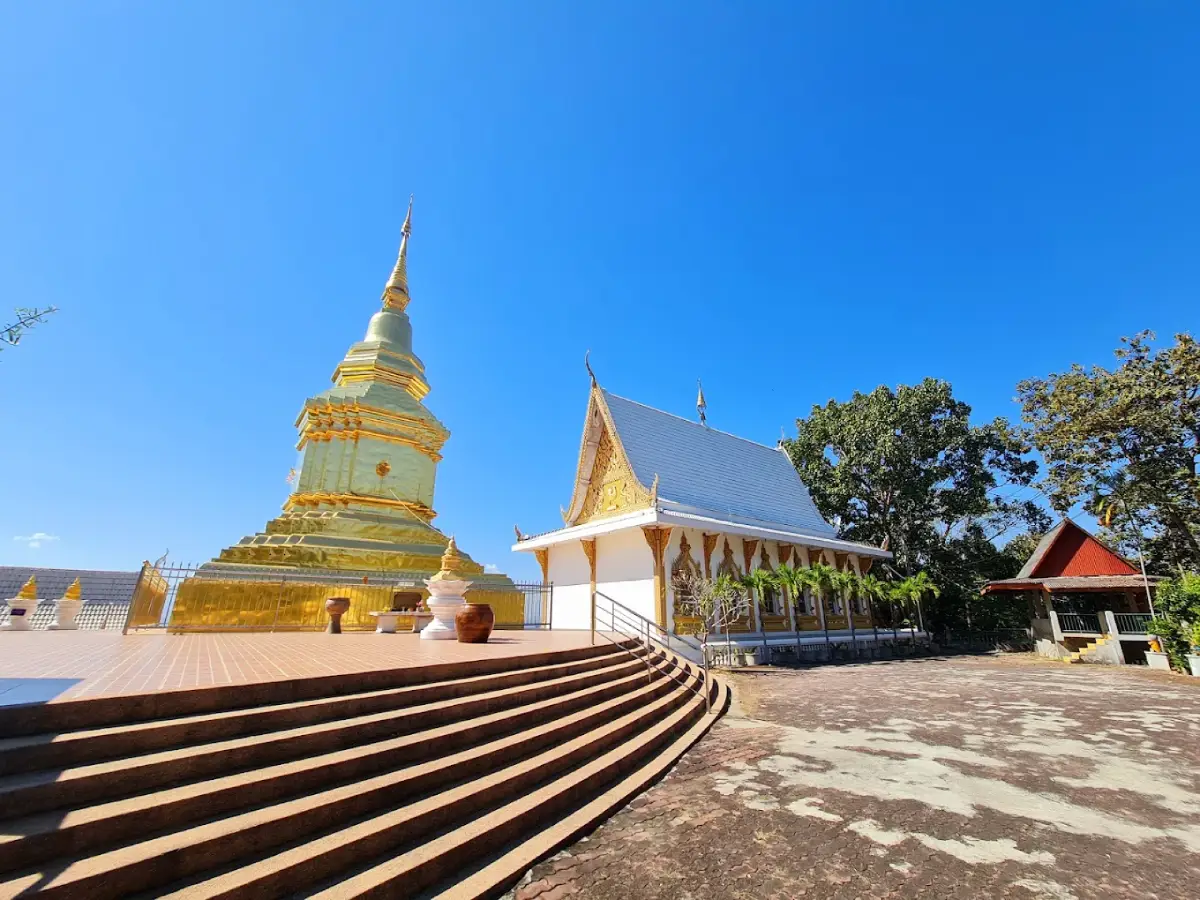
The main sacred focus of the temple is Phra That Chom Kitti, a golden castle-shaped stupa built in Lanna style with brick and mortar. The stupa enshrines relics of the Buddha and stands on a small hilltop, making it both a place of worship and a scenic viewpoint. Local tradition holds that the stupa is about 800 years old, which would place its origin around the 17th Buddhist century, before the founding of Chiang Mai city in 1296. This local belief gives the temple a strong cultural identity as an ancient sacred site of Mae Faek.
According to local accounts, the hill where the temple now stands was once an abandoned and overgrown area. Villagers saw mysterious light appearing on the hill at night, and several people in nearby communities described the same phenomenon. Later, a wandering monk understood through spiritual insight that relics of the Buddha were enshrined on the hill. He then wished to establish a temple there. Local villagers, led by village headmen and community leaders, helped clear the area and improve access to the hill so that people could reach the sacred site more easily.
The temple is also associated with the older names Wat Phra That Doi Kitchi and Wat Doi Phra That Chom Kitti. Local legend connects the temple with Luang Pu Chum Photiko, a close disciple of Khru Ba Siwichai, the revered Lanna monk. The story says that Khru Ba Siwichai was once invited by villagers to build a temple on this hill, but he declined and said the place had to wait for its true builder, who would be one of his disciples. Luang Pu Chum Photiko later became closely connected with the establishment and restoration of the temple.
The golden castle-shaped stupa is the heart of Wat Phra That Chom Kitti. Its Lanna architectural form, brick-and-mortar structure, and hilltop setting make it the most important feature of the temple. Visitors usually begin by paying respect to the stupa, making a wish, and walking calmly around the sacred area. The stupa is important not only for its visual appearance but also because it functions as a spiritual center for Mae Faek villagers and devotees from nearby communities.
The temple compound includes a vihara, an ubosot, a bell tower, a reclining Buddha image, a viewpoint courtyard, a stairway leading up to the temple area, and a meditation hall. The vihara is used for worship and religious activities, while the ubosot is important for monastic rites. The bell tower symbolizes the traditional rhythm of temple life. The reclining Buddha image is another major sacred object, and the viewpoint courtyard gives the temple a peaceful scenic character.
Wat Phra That Chom Kitti is distinctive because it stands on a hill that is not too difficult to access, yet high enough to create a strong sense of separation from the busy lowland area. Once visitors reach the temple, they find a quiet, open, and shaded atmosphere suitable for prayer, meditation, walking, and contemplation. On clear days, the temple offers views across fields, villages, and surrounding hills.
The reclining Buddha image has a special connection with the temple’s founding legend. The story says that Luang Pu Chum Photiko built a reclining Buddha 12 sok long to accompany the stupa, following a vision that the Buddha relics were buried 12 sok beneath the base of the chedi. The reclining Buddha therefore adds another layer of meaning to the temple, linking relic worship, meditation, and local Lanna devotion.
Statues of Khru Ba Waen, also known as Phra Khru Winit Khunakon, and Khru Ba Chum Photiko are also important points to see. These two revered monks are associated with the care and restoration of Phra That Chom Kitti. Their presence reflects the Lanna tradition of honoring monks who devoted their effort to reviving and maintaining sacred Buddhist places.
Wat Phra That Chom Kitti also serves as a meditation and spiritual practice site. Its hilltop setting, forested surroundings, and quiet environment make it suitable for people seeking a calm place for reflection. Visitors can spend time walking slowly through the temple grounds, starting from the stairway, the stupa courtyard, the vihara, the reclining Buddha, the bell tower, and the viewpoint before resting in the peaceful temple area.
Current temple activity records list Phra Thep Mangkhalachan as the abbot. Older temple and festival records also mention Phra Athikan Niran Thanadhammo in connection with Wat Phra That Chom Kitti and its annual relic-bathing ceremony. This continuity of monastic care shows that the temple remains active and continues to serve as a center of faith for the Mae Faek community.
The most important annual tradition is the relic-bathing ceremony of Phra That Chom Kitti, locally associated with walking up the hill, offering flowers, and making merit. This event reflects a strong Lanna pattern of worship: sacred relics, hilltop pilgrimage, flower offerings, and community merit-making. The temple also holds Kathin, robe-offering activities, and Buddhist holy day events.
The Kathin ceremony remains an important part of temple life. Current activity records for the 2025 Kathin project list Wat Phra That Chom Kitti as a local temple with 5 resident monks, with the Kathin ceremony scheduled for October 28, 2025 at 14.00. Such ceremonies allow villagers and devotees to support the temple, maintain the monastic community, and strengthen the bond between the temple and local residents.
The temple plays several roles in Mae Faek community life. It is a sacred place for worshipping the relics, a quiet place for meditation, a venue for annual Buddhist traditions, and a local learning site about Lanna belief, revered monks, and the cultural landscape of San Sai. This gives Wat Phra That Chom Kitti more depth than a standard scenic viewpoint or roadside temple.
The main places to see inside the temple are the stairway, the golden castle-shaped stupa, the vihara, the ubosot, the reclining Buddha image, the statues of Khru Ba Waen and Khru Ba Chum Photiko, the bell tower, and the viewpoint courtyard. Visiting in the morning or late afternoon is especially pleasant because the light is softer and the hilltop atmosphere is cooler.
Visitors should dress modestly, keep their voices low, avoid touching the stupa or sacred objects improperly, and help keep the temple clean. The hilltop paths and stairs should be used carefully, especially after rain when the ground may be slippery. Because the temple is also a meditation site, visitors should respect people who come for prayer or practice.
Getting There is convenient by private car or motorcycle. From Chiang Mai city, take Highway 1001 or the Chiang Mai–Phrao road toward San Sai and Maejo University, then continue to Mae Faek Subdistrict and Ban Phra That. From the village, a concrete road leads up the small hill to the temple. Parking is available near the upper temple area, making the temple suitable for a half-day cultural trip from Chiang Mai.
Wat Phra That Chom Kitti can be combined with nearby temples and attractions such as Wat Ban Pong, Wat Rom Luang, Wat Si Ngam, Wat Si Sai Mun, Wat Nong Ma Chap, Ban Nong Ma Chap community tourism area, The Royal Chiang Mai Golf Resort, and Mae Jo–San Sai attractions. This makes the temple a useful anchor for a cultural route through Mae Faek and northern San Sai.
Overall, Wat Phra That Chom Kitti is a meaningful destination for travelers interested in Lanna temples, sacred relics, meditation, peaceful viewpoints, and local Buddhist traditions. Its golden stupa, relic legend, reclining Buddha, revered monk statues, annual relic-bathing ceremony, and hilltop setting make it one of the most distinctive temples in Mae Faek Subdistrict.
| Name | Wat Phra That Chom Kitti |
| Location | Ban Phra That, Moo 9, Mae Faek Subdistrict, San Sai District, Chiang Mai Province |
| Address | Moo 9, Mae Faek Subdistrict, San Sai District, Chiang Mai 50290, Thailand |
| Coordinates | 19.03543, 98.99499 |
| Type | Local Buddhist temple, hilltop temple, and meditation practice site |
| Abbot / Caretaker | Phra Thep Mangkhalachan |
| Highlights | Golden castle-shaped stupa enshrining Buddha relics, reclining Buddha image, hilltop stairway, viewpoint courtyard, and statues of Khru Ba Waen and Khru Ba Chum Photiko |
| History | Established as a temple in 1935 and granted Wisungkham Sima in 2007. Local tradition says the stupa may be about 800 years old, dating to the 17th Buddhist century before Chiang Mai city. |
| Name Origin | Connected with the sacred hill known as Doi Kitchi or Doi Chom Kitti, where local belief holds that Buddha relics were enshrined |
| Distinctive Features | Lanna-style castle-shaped stupa built with brick and mortar on a small hilltop, creating a peaceful setting for worship, meditation, and scenic views |
| Main Areas / Zones | Golden stupa, vihara, ubosot, bell tower, reclining Buddha image, stairway, viewpoint courtyard, and meditation hall |
| Important Sacred Objects | Buddha relics enshrined inside the stupa and the reclining Buddha image built in connection with the temple legend |
| Important Traditions | Relic-bathing ceremony, walking up the hill with flower offerings, Kathin, robe-offering activities, and Buddhist holy day events |
| Travel Information | From Chiang Mai city, take Highway 1001 or the Chiang Mai–Phrao road past Maejo University, continue to Mae Faek Subdistrict and Ban Phra That, then drive up the concrete road to the hilltop temple |
| Current Status | Open as a Buddhist temple and meditation site for the Mae Faek community, San Sai District, Chiang Mai |
| Open Days | Daily |
| Opening Hours | 08.00 – 17.00 |
| Fees | No admission fee |
| Facilities | Parking area, temple access road, worship areas, viewpoint courtyard, and meditation space |
| Nearby Tourist Attractions | 1. The Royal Chiang Mai Golf Resort, about 1.6 km 2. Wat Ban Pong, Mae Faek Subdistrict, about 8 km 3. Wat Rom Luang, Mae Faek Subdistrict, about 8 km 4. Wat Si Ngam, Mae Faek Subdistrict, about 9 km 5. Wat Si Sai Mun, Mae Faek Subdistrict, about 10 km 6. Wat Nong Ma Chap and Ban Nong Ma Chap Community Tourism Area, about 12 km |
| Nearby Restaurants | 1. CHA 168 Mae Faek Mai, about 8 km, Tel. 081-749-1549, 080-052-9538 2. Enjoy Healthy Food Mae Faek Mai, about 9 km, Tel. 085-082-3953, 099-218-9339 3. The North Cafe Chiang Mai, about 10 km, Tel. 065-956-4865 4. Moonshine Cafe, about 11 km, Tel. 092-365-1178 5. Thai Taste Cafe, about 12 km, Tel. 098-762-0888 6. M&M Cha, about 12 km, Tel. 093-032-2321 |
| Nearby Accommodations | 1. The Royal Chiang Mai Golf Resort, about 1.6 km 2. Mae Faek Villas, about 9 km, Tel. 081-287-9011 3. Dream Villa Resort @ Chiang Mai, about 10 km, Tel. 099-291-6447 4. Yoo Sabai Home, about 10 km, Tel. 092-578-1136 5. Tao Garden Health Spa & Resort, about 18 km, Tel. 084-028-0230 6. Golden Cupids Hotel, about 22 km |
Frequently Asked Questions (FAQ)
Q: Where is Wat Phra That Chom Kitti located?
A: Wat Phra That Chom Kitti is located in Ban Phra That, Moo 9, Mae Faek Subdistrict, San Sai District, Chiang Mai Province, on a small hilltop in the Mae Faek area.
Q: What is Wat Phra That Chom Kitti known for?
A: The temple is known for its golden Lanna-style castle-shaped stupa enshrining Buddha relics, its reclining Buddha image, meditation atmosphere, stairway, and scenic viewpoint.
Q: How old is Phra That Chom Kitti?
A: Local tradition says the stupa is about 800 years old, placing it around the 17th Buddhist century, before the founding of Chiang Mai city.
Q: Is there an admission fee?
A: No. Visitors can enter the temple without an admission fee, but donations for temple maintenance are welcomed according to personal faith.
Q: How do visitors get to Wat Phra That Chom Kitti?
A: From Chiang Mai city, take Highway 1001 or the Chiang Mai–Phrao road past Maejo University, continue to Mae Faek and Ban Phra That, then drive up the concrete road to the hilltop temple.
Q: What annual tradition is important at the temple?
A: The most important annual tradition is the relic-bathing ceremony, when devotees walk up the hill, offer flowers, make merit, and pay respect to Phra That Chom Kitti.
Q: Who should visit Wat Phra That Chom Kitti?
A: The temple is suitable for travelers interested in Lanna temples, sacred relics, quiet meditation places, scenic viewpoints, and less crowded cultural routes in San Sai District.
Q: What nearby places can be visited on the same trip?
A: Nearby places include The Royal Chiang Mai Golf Resort, Wat Ban Pong, Wat Rom Luang, Wat Si Ngam, Wat Si Sai Mun, Wat Nong Ma Chap, and the Mae Jo–San Sai travel area.
 Category: ●Places of Worship
 Group: ●Temple
Last Update : 2 DayAgo
 Last Update : 2 DayAgo
 Click to Access the Navigation Map GPS
Wat Phra That Chom Kitti Map
Recommend

 Muang Chiang Mai(121)Chom Thong(47)Mae Chaem(25)Chiang Dao(33)Doi Saket(68)Mae Taeng(85)Mae Rim(69)Samoeng(29)Fang(71)Mae Ai(59)Phrao(70)San Pa Tong(103)San Kamphaeng(66)San Sai(73)Hang Dong(73)Hot(32)Doi Tao(22)Omkoi(11)Saraphi(74)Wiang Haeng(15)Chai Prakan(28)Mae Wang(32)Mae On(22)Doi Lo(34)Galyani Vadhana(1)


