
lovethailand home >North Travel Attractions >Chiang Mai Travel Attractions >San Kamphaeng >Huai Sai > Wat Pa Tueng (Huai Sai)
TL;DR: Wat Pa Tueng (Huai Sai) is located at Moo 7, Ban Pa Tueng, Huai Sai Subdistrict, San Kamphaeng District, Chiang Mai Province, open Daily, hours 08.00 – 17.00.

Wat Pa Tueng (Huai Sai)
Open Days: Daily
Opening Hours: 08.00 – 17.00
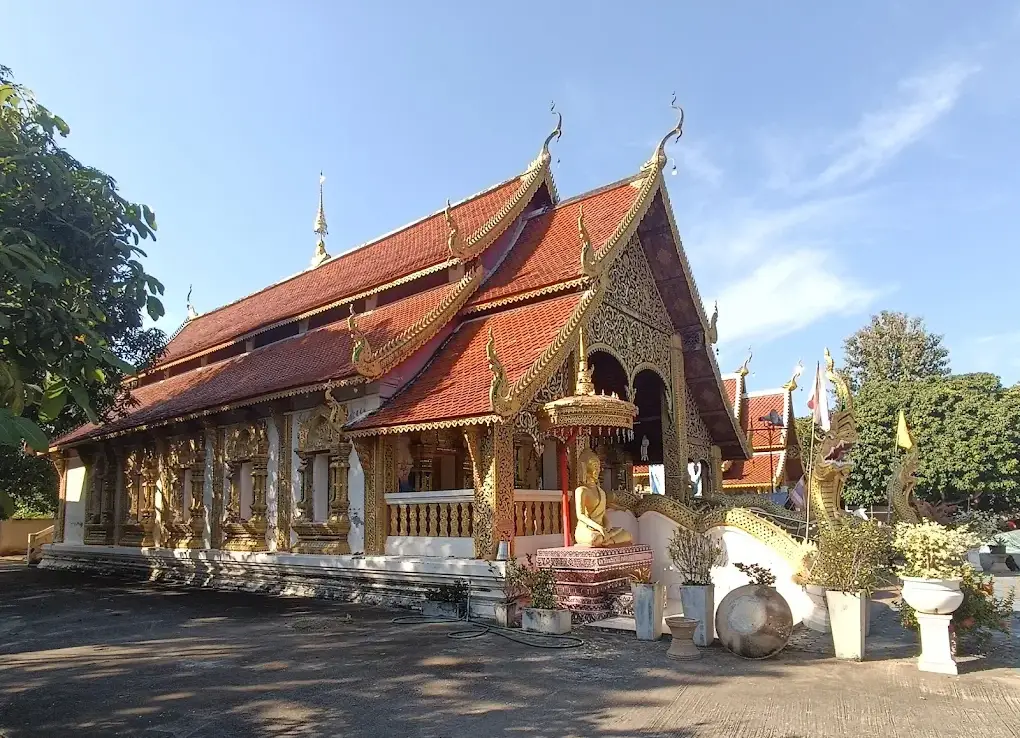
Wat Pa Tueng (Huai Sai) is located at 44 Ban Pa Tueng, Soi 2, Moo 7, Huai Sai Subdistrict, San Kamphaeng District, Chiang Mai Province. It is a private Buddhist temple under the Mahanikaya order and an important community temple of Ban Pa Tueng. The temple was officially established in 1871 and received its royal Wisungkhamsima in 1997. Its temple land covers approximately 4 rai, 2 ngan, and 45 square wah. The temple stands within a village landscape connected with public roads, rice fields, and an irrigation canal, reflecting the relationship between Buddhist faith and local agricultural life in Huai Sai.
The importance of Wat Pa Tueng lies in its long role as a village temple of Huai Sai for more than 150 years. Its official establishment in 1871 shows that Ban Pa Tueng had a settled Buddhist community and local lay supporters from an early period of modern Lanna village life. In northern Thai society, a temple was not only a place for religious ceremonies. It was also a center for Dhamma listening, ordination, merit-making, community gatherings, and the preservation of local memory.
The name “Pa Tueng” is closely connected with the local landscape and community identity. In northern Thai usage, “tueng” is associated with the tueng or tong tueng tree, a familiar local tree in the region, while “pa” refers to a wooded area or forested setting. The name therefore preserves a sense of the older natural environment and the identity of Ban Pa Tueng. Wat Pa Tueng is not only a place name; it also reflects the relationship between landscape, village memory, and Buddhist faith.
Huai Sai Subdistrict contains several village temples, including Wat Mae Tat, Wat Nong Sae, Wat Lan Tong, Wat San Khao Khaep Klang, Wat Ban Mo or Wat Thung Tom, Wat Doi Siw, Wat Pa Tueng, and Doi Noi Monastic Residence. This pattern reflects Lanna community life, where each village has its own temple as a spiritual and social center. Wat Pa Tueng should therefore be understood as part of the wider Buddhist and cultural landscape of Huai Sai and San Kamphaeng.
The setting of Wat Pa Tueng is especially meaningful because the temple is surrounded by village roads, rice fields, and irrigation features. This shows that the temple is part of everyday village life rather than a site separated from the community. In Lanna agricultural society, temples often stood near village routes and water systems because they were connected with movement, gathering, and seasonal religious ceremonies. Wat Pa Tueng clearly reflects this village-temple relationship.
The royal Wisungkhamsima granted in 1997 was an important milestone in the temple’s formal Buddhist status. Wisungkhamsima is the consecrated boundary used for important monastic acts. Receiving this royal grant strengthened the temple’s role in the Sangha system and marked its development from a village religious site into a more formally recognized Buddhist institution. This is one of the most important points in the temple’s historical profile.
The main structures of Wat Pa Tueng include the viharn, monks’ residences, and sala bat. The viharn is the central space for worship, merit-making, Dhamma listening, and community ceremonies. The monks’ residences support monastic life within the temple. The sala bat is connected with merit-making, food offerings, and village participation in Buddhist practice. Together, these structures show that Wat Pa Tueng is a functioning community temple rather than merely a historical site.
The viharn is the most important area for visitors. In a village temple, the viharn is not only a ceremonial building. It is also a place where generations of residents have gathered for Buddhist holy days, Kathin, robe offerings, sermons, and village merit-making. The value of the viharn lies not only in architecture but also in its continued use as a shared sacred space for Ban Pa Tueng community.
The monks’ residences show that the temple supports resident monastic life. A functioning temple depends on monks who maintain daily routines, care for religious practice, and support community ceremonies. The presence of monks allows the temple to remain active throughout the year, supporting Buddhist holy days, chanting, merit-making, and religious guidance for local residents.
The sala bat reflects the everyday merit-making culture of a village temple. It is connected with food offerings and shared Buddhist activities between monks and lay supporters. In a local temple, this type of space reveals the close relationship between generosity, community participation, and the maintenance of Buddhism at the village level.
Phra Yutthaphong Chatamethi is the abbot of Wat Pa Tueng, and the temple has 5 resident monks. His role includes caring for monastic life, temple buildings, merit-making activities, and relationships with local lay supporters. In a community temple, the abbot is central to keeping the temple orderly, active, and connected with the village.
Phra Khru Rattanawiboon Jiratthiko is an important former abbot of Wat Pa Tueng and a former ecclesiastical head of Huai Sai Subdistrict. His name remains connected with the temple’s local memory and the Buddhist life of Ban Pa Tueng. Former abbots often played an important role in maintaining religious buildings, supporting merit-making activities, guiding lay supporters, and strengthening the temple’s relationship with the community.
Wat Pa Tueng remains an active temple in Huai Sai Subdistrict. It appears in local temple listings and in Kathin information for San Kamphaeng District, confirming its continuing role in Buddhist merit-making and local religious life. The temple is not an abandoned site; it continues to serve monks, lay supporters, and the surrounding community.
Wat Pa Tueng is connected with regular Buddhist village activities such as Kathin, robe offerings, Buddhist Lent, End of Buddhist Lent, Buddhist holy days, and local merit-making events. These activities bring together elders, families, young people, monks, and lay supporters. They keep the temple active as a living center of faith and social connection within Ban Pa Tueng.
The role of Wat Pa Tueng can be understood on several levels. Religiously, it is a place for worship, Dhamma listening, merit-making, and Buddhist ceremonies. Socially, it is a meeting place for villagers during merit-making and community events. Culturally, it preserves the name, memory, and identity of Ban Pa Tueng. Spatially, it is a landmark in Moo 7 and part of the temple route of Huai Sai and San Kamphaeng.
The atmosphere of Wat Pa Tueng is calm, local, and community-oriented. It is not a large mainstream tourist attraction, and that is part of its value. Visitors can pay respect, make merit, observe the viharn, sala bat, monks’ residences, and temple grounds, and experience a working village temple in Huai Sai. It is suitable for travelers interested in quiet Buddhist spaces and cultural routes around San Kamphaeng.
Key points to notice at Wat Pa Tueng include the viharn, sala bat, monks’ residences, temple courtyard, and the surrounding village landscape. Visitors interested in local history should note the temple’s establishment in 1871 and royal Wisungkhamsima in 1997. Visitors interested in community culture should observe the relationship between the temple, rice fields, irrigation canal, village roads, and Ban Pa Tueng community.
Wat Pa Tueng can be included in a connected cultural route around Huai Sai. Nearby places include Wat Thung Tom or Wat Ban Mo, Wat Doi Siw, Wat Mae Tat, Wat Lan Tong, Huai Nam Phrik Reservoir, and Pong Wai forest area. This route is suitable for a half-day or full-day trip combining old temples, local community life, agricultural landscapes, and quiet natural attractions in Huai Sai.
Huai Sai has a landscape of temples, villages, fields, irrigation canals, reservoirs, and forest areas. A visit to Wat Pa Tueng is therefore not only a visit to a single temple, but also an opportunity to understand how a local temple sits within the broader rhythm of village life. The temple is well suited to travelers who prefer quiet places and want to see Buddhist faith in its local community setting.
Visitors should observe proper temple etiquette. Dress modestly, speak quietly, respect the viharn, sala bat, and monks’ residences, avoid disturbing monks or local residents, and park without blocking village entrances or local roads. During Buddhist holy days or merit-making events, visitors should follow the guidance of the temple committee and local residents. Community temples remain living sacred spaces, so respectful behavior helps preserve both the religious atmosphere and the local rhythm of life.
Getting There is convenient by private car, rental car, or hired local transport from Chiang Mai city. Take the Chiang Mai–San Kamphaeng route toward Huai Sai Subdistrict, then continue to Ban Pa Tueng in Moo 7. The temple connects with local routes to Wat Thung Tom, Wat Doi Siw, Wat Mae Tat, Wat Lan Tong, Huai Nam Phrik Reservoir, and the San Kamphaeng–Mae On travel corridor. Travelers using navigation apps should search for “Wat Pa Tueng Huai Sai San Kamphaeng” to avoid confusion with another Wat Pa Tueng in On Tai Subdistrict.
Wat Pa Tueng is suitable for visitors interested in old village temples, Huai Sai community history, quiet Buddhist spaces, and cultural routes around San Kamphaeng. Its value lies in its establishment in 1871, its royal Wisungkhamsima in 1997, its viharn, monks’ residences, sala bat, and continuing role as the spiritual center of Ban Pa Tueng. For travelers who want to understand Chiang Mai beyond major landmarks, Wat Pa Tueng offers a grounded view of local Buddhist faith and Lanna village life.
| Name | Wat Pa Tueng (Huai Sai) |
| Location | Moo 7, Ban Pa Tueng, Huai Sai Subdistrict, San Kamphaeng District, Chiang Mai Province |
| Address | 44 Ban Pa Tueng, Soi 2, Moo 7, Huai Sai Subdistrict, San Kamphaeng District, Chiang Mai 50130, Thailand |
| Highlights | An old Ban Pa Tueng community temple with a viharn, monks’ residences, sala bat, and a village setting connected with rice fields and irrigation canals |
| History | Officially established as a temple in 1871 and granted royal Wisungkhamsima in 1997 |
| Name Origin | The name Pa Tueng is connected with Ban Pa Tueng and the local northern Thai landscape associated with tueng or tong tueng trees |
| Distinctive Features | A Mahanikaya community temple in Moo 7, Huai Sai, connected with Ban Pa Tueng faith, village merit-making, and the temple route of San Kamphaeng |
| Travel Information | Travel from Chiang Mai city via the Chiang Mai–San Kamphaeng route, then continue to Huai Sai Subdistrict and Ban Pa Tueng in Moo 7. Search for “Wat Pa Tueng Huai Sai San Kamphaeng” in navigation apps. |
| Current Status | Active community Buddhist temple and religious activity space of Ban Pa Tueng |
| Temple Type | Private Buddhist temple under the Mahanikaya order |
| Temple Area | 4 rai, 2 ngan, and 45 square wah |
| Abbot / Caretaker | Phra Yutthaphong Chatamethi |
| Important Former Abbot | Phra Khru Rattanawiboon Jiratthiko, former abbot of Wat Pa Tueng and former ecclesiastical head of Huai Sai Subdistrict |
| Resident Monks | 5 monks |
| Open Days | Daily |
| Opening Hours | 08.00 – 17.00 |
| Main Areas / Structures | Viharn, monks’ residences, sala bat, temple courtyard, and community religious activity areas |
| Related Traditions / Activities | Kathin, robe offerings, Buddhist Lent, End of Buddhist Lent, Buddhist holy days, and local community merit-making |
| Nearby Tourist Attractions | 1. Wat Thung Tom or Wat Ban Mo, about 3 km 2. Wat Doi Siw, about 4 km 3. Wat Mae Tat, about 4 km 4. Huai Nam Phrik Reservoir, about 5 km 5. Wat Lan Tong, about 5 km |
| Nearby Restaurants | 1. Mala Thai Soi, about 5 km, Tel. 094-759-7087 2. San Kamphaeng Beef Noodle, about 7 km, Tel. 082-685-2863 3. San Kamphaeng Restaurant, about 8 km, Tel. 053-332-935, 053-395-389 4. Huen Jai Yong, about 10 km, Tel. 086-671-8710 5. Satesinlp Restaurant, about 12 km, Tel. 053-338-388, 081-881-4121, 089-992-3434 |
| Nearby Accommodations | 1. Baan Pingkan Wellness Resort, about 3 km 2. 102 Residence, about 7 km 3. LaMoon Cottage SanKampang, about 9 km, Tel. 094-723-5395 4. San Kamphaeng Lake View Resort, about 11 km, Tel. 053-381-039 5. The Vet Boutique Hotel, about 12 km, Tel. 052-011-179, 091-852-5507 |
Frequently Asked Questions (FAQ)
Q: Where is Wat Pa Tueng (Huai Sai) located?
A: Wat Pa Tueng (Huai Sai) is located at 44 Ban Pa Tueng, Soi 2, Moo 7, Huai Sai Subdistrict, San Kamphaeng District, Chiang Mai 50130, Thailand.
Q: What are the open days and opening hours of Wat Pa Tueng (Huai Sai)?
A: Wat Pa Tueng (Huai Sai) is open daily from 08.00 to 17.00.
Q: What is the history of Wat Pa Tueng (Huai Sai)?
A: Wat Pa Tueng was officially established as a temple in 1871 and received royal Wisungkhamsima in 1997. It is an old community temple of Ban Pa Tueng in Huai Sai Subdistrict.
Q: What type of temple is Wat Pa Tueng?
A: Wat Pa Tueng is a private Buddhist temple under the Mahanikaya order.
Q: Who is the abbot of Wat Pa Tueng?
A: The abbot is Phra Yutthaphong Chatamethi.
Q: What are the important structures at Wat Pa Tueng?
A: Important structures include the viharn, monks’ residences, sala bat, temple courtyard, and community religious activity areas.
Q: Is Wat Pa Tueng suitable for cultural travelers?
A: Yes. It is suitable for visitors interested in old community temples, quiet Buddhist spaces, and cultural routes in Huai Sai and San Kamphaeng.
Q: What nearby places can visitors combine with Wat Pa Tueng?
A: Visitors can combine the trip with Wat Thung Tom, Wat Doi Siw, Wat Mae Tat, Huai Nam Phrik Reservoir, and Wat Lan Tong.
 Category: ●Places of Worship
 Group: ●Temple
Last Update : 3 HourAgo
 Last Update : 3 HourAgo
 Click to Access the Navigation Map GPS
Wat Pa Tueng (Huai Sai) Map
Recommend

 Muang Chiang Mai(121)Chom Thong(47)Mae Chaem(25)Chiang Dao(33)Doi Saket(68)Mae Taeng(85)Mae Rim(69)Samoeng(29)Fang(71)Mae Ai(59)Phrao(70)San Pa Tong(103)San Kamphaeng(66)San Sai(73)Hang Dong(74)Hot(32)Doi Tao(22)Omkoi(11)Saraphi(74)Wiang Haeng(15)Chai Prakan(28)Mae Wang(32)Mae On(22)Doi Lo(34)Galyani Vadhana(1)


