
lovethailand home >North Travel Attractions >Chiang Mai Travel Attractions >San Kamphaeng >Rong Wuadaeng > Wat Nam Cham
TL;DR: Wat Nam Cham is located at Ban Nam Cham, Moo 6, Rong Wua Daeng Subdistrict, San Kamphaeng District, Chiang Mai Province, open Daily, hours 08.00 – 17.00.
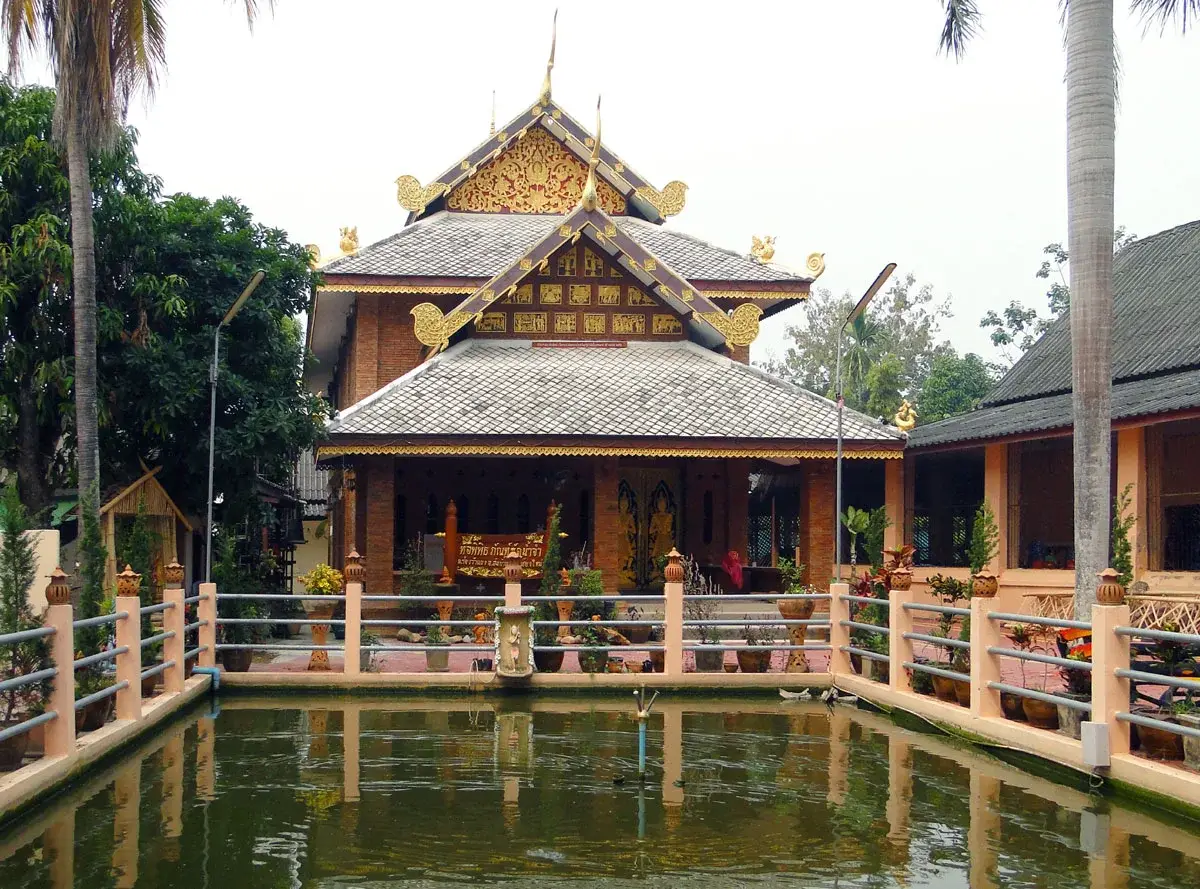
Wat Nam Cham
Open Days: Daily
Opening Hours: 08.00 – 17.00
Wat Nam Cham is located at 123 Moo 6, Ban Nam Cham, Muang Ma-Nam Cham Road, Rong Wua Daeng Subdistrict, San Kamphaeng District, Chiang Mai Province. It is a local Buddhist temple under the Mahanikaya order with a long and meaningful history in the Ban Nam Cham community. The temple was officially established in B.E. 2170, or 1627, received its Wisungkham Sima royal boundary in B.E. 2499, or 1956, and was recognized as an outstanding developed temple in B.E. 2551, or 2008. Wat Nam Cham is therefore more than a village temple. It is a religious center, a cultural memory site, and a local learning space connected with Lanna community life.
The charm of Wat Nam Cham lies in its direct relationship with Ban Nam Cham. The name of the village is linked to a shallow well east of the settlement. This well held water throughout the year and once served as an important source of drinking water for local residents and domestic animals. Because of this water source, the community became known as Ban Nam Cham. The temple name therefore carries the memory of the land, water, village life, and the shared history of the local people.
The temple grounds cover 7 rai, 3 ngan, and 72 square wah. Wat Nam Cham stands within an agricultural landscape in Rong Wua Daeng, a subdistrict of San Kamphaeng where village roads, irrigation canals, farmland, and Buddhist temples remain closely connected. Many local residents are engaged in agriculture, including rice farming, field crops, and gardening. In this setting, the temple functions not only as a place of worship but also as a central community space for merit-making, ceremonies, social gatherings, and the preservation of local knowledge.
Wat Nam Cham’s history extends for almost 400 years from its establishment in B.E. 2170. The temple has been maintained by generations of monks and local devotees. Luang Pho Teja served as the first abbot and built the temple’s first viharn. Luang Pho Khun later became the second abbot, but when he left to travel elsewhere, the temple lacked resident monks and novices. The local community then invited Luang Pu Phra Khru Kaeo Chayaseno, who was studying Buddhist discipline at Wat Chai Sathan San Ton Du in San Pu Loei Subdistrict, Doi Saket District, to return and care for the temple.
Luang Pu Phra Khru Kaeo Chayaseno became one of the most important figures in the revival of Wat Nam Cham. He looked after the temple for several rainy-season retreats, taught the local community, and restored stability to the temple. In B.E. 2446, Chao Khun Aphaisaratha, the Chiang Mai provincial ecclesiastical head from Wat Fai Hin in Mueang Chiang Mai District, appointed him as abbot of Wat Nam Cham. After that, Luang Pu Phra Khru Kaeo guided the community in building lasting Buddhist structures and strengthening the temple’s role as the spiritual center of Ban Nam Cham.
Luang Pu Phra Khru Kaeo Chayaseno is remembered with deep respect by local devotees. He did not only maintain the physical temple grounds but also taught Buddhist values and helped establish the temple as a durable center of village faith. The temple relic stupa is connected with the area where he practiced meditation in the later years of his life. He passed away on July 16, B.E. 2508, at 17.55, at the age of 73 rainy-season retreats. His story remains an important part of Wat Nam Cham’s identity.
Phra Khru Phisan Chediyarak Mongkhalathammo later became a key figure in the modern development of Wat Nam Cham. He served as acting abbot in B.E. 2529 and was officially appointed abbot in B.E. 2532. His work has been important in developing the temple grounds, preserving local objects, building community learning resources, and connecting the temple with cultural education. He was also royally appointed as a second-class Phra Khru Sanyabat, reflecting his role in Buddhist service and temple administration.
One of the most distinctive features of Wat Nam Cham is the Wat Nam Cham Museum, a local temple-and-community museum shaped by the faith of villagers, supporters, and Phra Khru Phisan Chediyarak. The museum was created as a learning center for both local people and outside visitors. It displays objects that reflect local wisdom, everyday tools from the past, woven items, pottery, traditional art objects, old photographs, models of past ways of life, local clothing, and antique objects donated by members of the community.
The Wat Nam Cham Museum is important as a place that preserves community memory. One part of the display reflects everyday village life, while another connects with Lanna Buddhism through manuscripts, palm-leaf texts, ritual objects, and items related to monks and religious ceremonies. For this reason, Wat Nam Cham is not only a place for merit-making. It is also a cultural learning site where visitors can understand the relationship between homes, temples, local wisdom, and Buddhist practice in Lanna society.
The important areas of the temple include the viharn, temple courtyard, relic stupa, ceremonial areas, community activity spaces, and the Wat Nam Cham Museum. The viharn connects with the early phase of the temple’s history. The relic stupa is tied to the memory of Luang Pu Phra Khru Kaeo Chayaseno. The museum expands the temple’s role from a place of worship into a center of local knowledge. Visitors should allow enough time to experience both the spiritual and cultural dimensions of the temple.
The atmosphere of Wat Nam Cham is peaceful and local. It is not a large tourist complex, but its value lies in its long history, its bond with Ban Nam Cham, and its role in preserving local heritage. Visitors can make merit, walk respectfully around the temple grounds, pay respect at the sacred areas, and learn from the museum. The temple is especially suitable for travelers interested in old community temples, Lanna culture, local museums, and cultural routes that move beyond Chiang Mai’s main tourist areas.
Wat Nam Cham is connected with the northern Thai Buddhist calendar. Important occasions include Songkran, relic bathing traditions, Buddhist Lent, the end of Buddhist Lent, Kathin, Pha Pa offerings, Tan Kuai Salak, and Buddhist holy day activities. These events are not only religious ceremonies. They bring villagers together, support the monastic community, maintain the temple, and pass Buddhist and cultural values from one generation to the next.
Kathin is one of the important community events associated with Wat Nam Cham. After the end of Buddhist Lent, local devotees gather to offer robes and support to the monks. At a village temple, Kathin is also a social and cultural event. People help prepare the temple grounds, cook food, welcome relatives, join processions, and make offerings according to their faith. This event clearly reflects the relationship between the temple and the community.
Wat Nam Cham plays an important role in Ban Nam Cham as a religious, social, and educational center. Local residents use the temple for merit-making, Dhamma listening, ceremonies, and annual festivals. Children and young people learn temple manners and local customs through participation in temple events. Elderly residents use the temple as a place for spiritual practice and community connection. The museum adds an educational role by preserving local objects and making community knowledge visible.
Rong Wua Daeng Subdistrict contains several Buddhist temples, including Wat Wang Than, Wat Ban Mai, Wat Rong Wua Daeng, Wat Muang Khiao, Wat Nam Cham, Wat Muang Ma Nuea, and Wat Muang Ma Tai. This network of temples reflects the traditional Lanna village pattern in which each community has its own religious center. Wat Nam Cham is therefore part of a wider religious landscape connected by merit-making, kinship, local roads, and shared faith.
Wat Nam Cham can be included in a meaningful cultural route around San Kamphaeng. Nearby temples and places include Wat Muang Ma Nuea, Wat Pa Tueng, Wat Rong Wua Daeng, and Wat Muang Ma Tai. Travelers who want to add handicraft culture can continue to Bo Sang Umbrella Village and the Bo Sang Handicraft Centre. Those interested in local food and accommodation can connect the route with cafés, restaurants, and farm-stay style lodging in Rong Wua Daeng, Mae Pu Kha, and San Kamphaeng.
Getting There is most convenient by private car, rental car, or local hired transport. From Chiang Mai city, travel toward San Kamphaeng District, continue into Rong Wua Daeng Subdistrict, and head to Ban Nam Cham, Moo 6. The local roads connect villages, temples, farmland, and routes toward nearby districts. Visitors using hired vehicles or ride-hailing services should arrange the return trip in advance because the temple is located in a village community rather than a dense public transport zone.
The best time to visit is in the morning or late afternoon when the weather is more comfortable. Visitors should dress modestly, speak quietly, and respect monastic and community areas. If you wish to visit the museum, contacting the temple in advance is recommended for convenience because the museum contains valuable local objects and may require proper supervision or guidance during visits.
Wat Nam Cham is a worthwhile destination for travelers who want to understand Chiang Mai at the community level. Its early establishment date, the story behind the name Ban Nam Cham, the legacy of Luang Pu Phra Khru Kaeo Chayaseno, the relic stupa, the viharn, the local museum, and its continuing role in community merit-making give the temple depth and identity. A visit to Wat Nam Cham reveals how Buddhism, Lanna culture, water sources, local wisdom, and village life remain closely connected in San Kamphaeng.
| Name | Wat Nam Cham |
| Location | Ban Nam Cham, Moo 6, Rong Wua Daeng Subdistrict, San Kamphaeng District, Chiang Mai Province |
| Address | 123 Moo 6, Ban Nam Cham, Muang Ma-Nam Cham Road, Rong Wua Daeng Subdistrict, San Kamphaeng District, Chiang Mai 50130, Thailand |
| Temple Type | Local Buddhist temple under the Mahanikaya order |
| Temple Area | 7 rai, 3 ngan, 72 square wah |
| Highlights | Old village temple of Ban Nam Cham with a long history, viharn, relic stupa, and Wat Nam Cham Museum |
| History | Officially established as a temple in B.E. 2170, received Wisungkham Sima in B.E. 2499, and recognized as an outstanding developed temple in B.E. 2551 |
| Name Origin | The name Ban Nam Cham is linked to a shallow well east of the village that held water throughout the year and served as an important community water source. |
| Important Monks | Luang Pho Teja, Luang Pho Khun, Luang Pu Phra Khru Kaeo Chayaseno, and Phra Khru Phisan Chediyarak Mongkhalathammo |
| Abbot | Phra Khru Phisan Chediyarak Mongkhalathammo |
| Important Areas / Structures | Viharn, relic stupa, temple courtyard, ceremonial areas, community activity spaces, and Wat Nam Cham Museum |
| Wat Nam Cham Museum | A local museum displaying community wisdom, antique tools, woven items, pottery, traditional art objects, old photographs, palm-leaf texts, and Lanna Buddhist objects |
| Local Importance | A spiritual center of Ban Nam Cham, Moo 6, and a local learning place for religion, culture, and community heritage in Rong Wua Daeng |
| Traditions / Temple Events | Songkran, relic bathing traditions, Buddhist Lent, the end of Buddhist Lent, Kathin, Pha Pa offerings, Tan Kuai Salak, and local Buddhist merit-making events |
| Travel Information | From Chiang Mai city, travel toward San Kamphaeng District, continue into Rong Wua Daeng Subdistrict, and head to Ban Nam Cham, Moo 6. Private car, rental car, or local hired transport is recommended. |
| Current Status | An active Buddhist temple in Rong Wua Daeng Subdistrict, San Kamphaeng District, Chiang Mai Province |
| Open Days | Daily |
| Opening Hours | 08.00 – 17.00 |
| Main Contact Number | 053-881-592 |
| Nearby Tourist Attractions | 1. Wat Muang Ma Nuea, about 2 km 2. Wat Pa Tueng, about 2 km 3. Wat Rong Wua Daeng, about 4 km 4. Vichit Studio, about 4 km 5. Bo Sang Umbrella Village / Bo Sang Handicraft Centre, about 8 km 6. San Kamphaeng Hot Springs, about 17 km |
| Nearby Restaurants | 1. Mu Kratha Rong Wua Daeng, about 4 km, Tel. 092-352-2881 2. Sher ga Shaw Farmstay Cafe & Hostel, about 5 km, Tel. 088-268-7446 3. G&M German Sausage, about 6 km, Tel. 053-840-531, 094-708-3737 4. Khao Soi Pu Kha Nuea, about 7 km, Tel. 065-995-6998 5. Puka Cafe, about 7 km, Tel. 052-011-460 6. Satesinlp Restaurant, about 9 km, Tel. 053-338-388, 081-881-4121, 089-992-3434 |
| Nearby Accommodations | 1. Oon Valley Farm Stay, about 6 km 2. LPL Resort, about 6 km 3. Phu Mi Lum Nao House, about 7 km 4. Viewdoi Art and Resort, about 8 km, Tel. 088-866-2562 5. Baan Rai Plai Na San Kamphaeng, about 8 km, Tel. 065-349-4403 6. Sher ga Shaw Farmstay Cafe & Hostel, about 5 km, Tel. 088-268-7446 |
Frequently Asked Questions (FAQ)
Q: Where is Wat Nam Cham located?
A: Wat Nam Cham is located at 123 Moo 6, Ban Nam Cham, Muang Ma-Nam Cham Road, Rong Wua Daeng Subdistrict, San Kamphaeng District, Chiang Mai 50130, Thailand.
Q: What is the history of Wat Nam Cham?
A: Wat Nam Cham was officially established as a temple in B.E. 2170, received Wisungkham Sima in B.E. 2499, and was recognized as an outstanding developed temple in B.E. 2551.
Q: What is the origin of the name Ban Nam Cham?
A: The name comes from a shallow well east of the village that held water throughout the year and served as an important water source for villagers and domestic animals.
Q: Who is the abbot of Wat Nam Cham?
A: The abbot of Wat Nam Cham is Phra Khru Phisan Chediyarak Mongkhalathammo.
Q: What are the main highlights of Wat Nam Cham?
A: The main highlights include its long history, viharn, relic stupa, Wat Nam Cham Museum, and the story of Luang Pu Phra Khru Kaeo Chayaseno.
Q: What is interesting about Wat Nam Cham Museum?
A: The museum displays local wisdom objects, antique tools, woven items, pottery, traditional art, old photographs, palm-leaf texts, and Lanna Buddhist objects.
Q: What are the opening days and hours of Wat Nam Cham?
A: Wat Nam Cham is open daily from 08.00 to 17.00.
Q: What nearby places can be combined with Wat Nam Cham?
A: Nearby places include Wat Muang Ma Nuea, Wat Pa Tueng, Wat Rong Wua Daeng, Vichit Studio, Bo Sang Umbrella Village, and San Kamphaeng Hot Springs.
 Category: ●Places of Worship
 Group: ●Temple
Last Update : 1 WeekAgo
 Last Update : 1 WeekAgo
 Click to Access the Navigation Map GPS
Wat Nam Cham Map
Recommend

 Muang Chiang Mai(121)Chom Thong(47)Mae Chaem(25)Chiang Dao(33)Doi Saket(68)Mae Taeng(85)Mae Rim(69)Samoeng(29)Fang(71)Mae Ai(59)Phrao(70)San Pa Tong(103)San Kamphaeng(66)San Sai(73)Hang Dong(73)Hot(32)Doi Tao(22)Omkoi(11)Saraphi(74)Wiang Haeng(15)Chai Prakan(28)Mae Wang(32)Mae On(22)Doi Lo(33)Galyani Vadhana(1)


