
lovethailand home >North Travel Attractions >Chiang Mai Travel Attractions >San Kamphaeng >Buak Khang > Wat Buak Khang
TL;DR: Wat Buak Khang is located at Ban Buak Khang, Village No. 1, Buak Khang Subdistrict, San Kamphaeng District, Chiang Mai Province.

Wat Buak Khang
Operating day: Daily
Operating time: 08.00 - 17.00
Wat Buak Khang is a local Buddhist temple under the Mahanikaya sect, located in Ban Buak Khang, Village No. 1, Buak Khang Subdistrict, San Kamphaeng District, Chiang Mai Province. The temple was officially established in 1467 and received Wisungkhamasima in 1821. Its abbot is Phra Khru Adun Chanthachot Chandasaro. Wat Buak Khang is one of the most important temples of Buak Khang Subdistrict, serving as a spiritual center of the local Yong community and as a cultural site closely connected with the revival of Chiang Mai under Phaya Kawila.
Buak Khang Subdistrict is a culturally significant area of San Kamphaeng District. The community has strong historical roots connected with Yong people who resettled in Chiang Mai during the city’s revival period. The Yong community in Buak Khang continues to preserve its language, religious customs, merit-making traditions, local identity, and temple patronage. Wat Buak Khang is therefore not only a place of worship, but also a living center of community history and cultural memory.
The name “Buak Khang” is connected with the older local name “Buak Khang” or “Bo Khang.” According to local tradition, monkeys once dug a pond or “buak” in the area to collect rainwater for drinking. The place was therefore called Buak Khang or Bo Khang, and the name gradually became Wat Buak Khang. This origin story links the temple name with animals, water sources, landscape, and early community memory.
Wat Buak Khang has several layers of historical background. Official temple data records that it was established in 1467, while local history describes earlier Buddhist activity around 1369–1371 during the reign of King Kue Na of the Lanna Kingdom. That period was important for the spread of Lanka-style Buddhism in Lanna. The temple’s history therefore reaches beyond ordinary village-temple history and connects with the wider Buddhist development of northern Thailand.
The temple also went through a period of decline during times of war and political upheaval in Lanna. When Chiang Mai lost independence to Burmese power, many communities were disrupted and some temples became abandoned. Later, during the revival of Chiang Mai under Phaya Kawila, people from Yong and nearby regions were resettled in Chiang Mai. Buak Khang became a significant Yong community, and Wat Buak Khang was revived as a religious and cultural center.
A key historical figure connected with Wat Buak Khang is Chao Kramom Suriyawongsa, the 34th ruler of Yong. After settling in the Buak Khang area, he invited Khru Ba Chao Yan Siri from Wat Buak Khang Saem Luang in Yong to become the abbot and restore the temple. This restoration included important sacred and historical features such as Ku Dam, the chedi, and Phra Non La. The revival of the temple helped strengthen the Yong community in Buak Khang.
Ku Dam is one of the most important sacred and historical features of Wat Buak Khang. It is an old Lanna-style sacred structure associated with the Mangrai dynasty period. Ku Dam is valuable as a religious object, a historical remnant, and an artistic feature preserved within the temple. Its presence makes Wat Buak Khang significant not only as a community temple, but also as a cultural heritage site of San Kamphaeng.
Phra Non La, also known as Phra Chao Non La, is another major highlight. This reclining Buddha image was created as a spiritual center for the Yong community that settled in Buak Khang. It is a symbol of Buddhist devotion and community identity. Visitors should pay respect to Phra Non La with a calm and respectful attitude, as the image is closely connected with the spiritual life of local devotees.
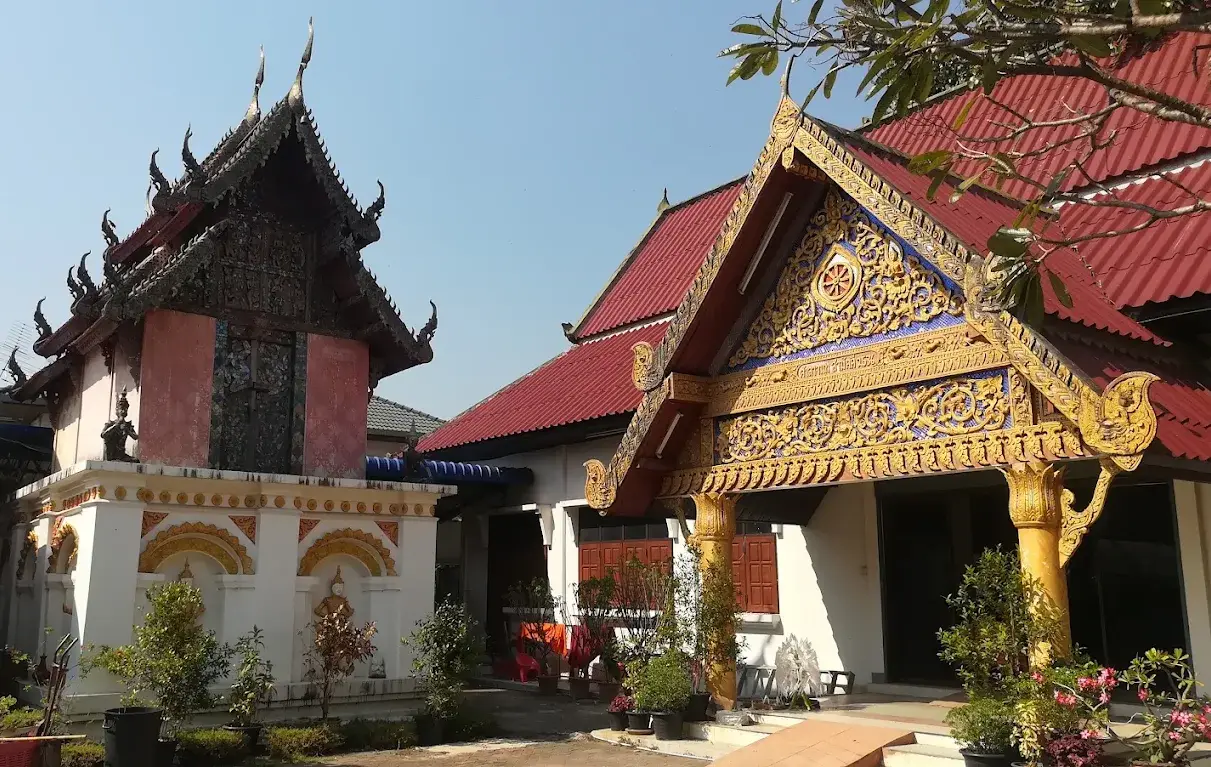
The twin-roofed viharn is the most distinctive architectural feature of Wat Buak Khang. It was built to enshrine both Phra Non La and Ku Dam, combining older sacred remains with later community restoration. Architecturally, the twin-roofed viharn is rare and strongly associated with Buak Khang’s identity. It reflects the community’s effort to preserve sacred objects while adapting the temple space for continued worship.
Other important features of the temple include the ubosot, Ho Trai or scripture hall, chedi, Bo Dang, ceremonial Dhamma procession objects, temple courtyard, and community merit-making spaces. The ubosot supports formal monastic acts, the Ho Trai represents respect for Buddhist scripture, and the ceremonial objects reflect Lanna and Yong Buddhist traditions connected with Dhamma learning and community ceremonies.
Receiving Wisungkhamasima in 1821 was an important religious milestone for Wat Buak Khang. Wisungkhamasima is the consecrated boundary used for formal monastic acts. This status confirms the temple’s recognized role within the Buddhist monastic system and its importance as a complete religious institution for the local community.
Phra Khru Adun Chanthachot Chandasaro is the abbot of Wat Buak Khang. In a community temple, the abbot plays an important role in caring for monks, maintaining temple buildings, leading ceremonies, supporting annual merit-making, and preserving the relationship between the temple and local villagers. Wat Buak Khang continues through cooperation between monks and lay devotees.
Wat Buak Khang plays a strong role as the spiritual center of the Yong community in Buak Khang. Villagers use the temple for merit-making, Dhamma listening, food offerings, Kathin, forest robe offerings, Buddhist holy days, Buddhist Lent, the end of Buddhist Lent, and major Buddhist observances. During temple events, villagers help prepare the grounds, support offerings, and participate in ceremonies, keeping the temple active as a living religious space.
The importance of Wat Buak Khang also lies in its role in preserving Yong identity. The Yong community continues to maintain language, foodways, ritual practice, clothing traditions, and local religious customs. The temple is the place where these cultural elements remain visible through annual ceremonies, community gatherings, and intergenerational transmission of local knowledge.
Key things to see and worship at Wat Buak Khang include Phra Non La, Ku Dam, the twin-roofed viharn, the chedi, the ubosot, the Ho Trai, Bo Dang, ceremonial Dhamma objects, the temple courtyard, and the surrounding Yong community atmosphere. The temple’s value lies in the way it brings together Lanna history, Yong migration history, sacred objects, unusual architecture, and active community religious life.
Wat Buak Khang is suitable for visitors interested in old Lanna temples, Yong cultural history, Buddhist art, San Kamphaeng cultural routes, and community-based tourism. It is best experienced slowly and respectfully. Visitors should pay respect to Phra Non La and Ku Dam, observe the viharn’s structure, and understand the temple as a living place of faith rather than only a sightseeing stop.
Religious activities at Wat Buak Khang follow the Buddhist calendar and local Lanna practice. These include Kathin, forest robe offerings, Buddhist holy days, Makha Bucha, Visakha Bucha, Asalha Bucha, Buddhist Lent, the end of Buddhist Lent, and annual community merit-making. Through these events, the temple continues to strengthen the relationship between monks, villagers, and the wider Yong community.
Wat Buak Khang can be linked with several nearby cultural sites in Buak Khang Subdistrict, including Wat Pa Tan, Wat Ko Saliam, Wat Long Ko Kham, Wat Rong Kong Khao, Wat Pong Chang Khot, and local Yong cultural learning points. A broader San Kamphaeng route can continue to Bo Sang Umbrella Village, Ban Ton Pao, and cultural attractions in nearby Ton Pao. This route gives visitors a deeper view of San Kamphaeng through temples, community history, food, crafts, and living culture.
Getting There from Chiang Mai city is convenient by private car, rental car, or local hired transport. Take the Chiang Mai–San Kamphaeng route toward San Kamphaeng District, then continue to Buak Khang Subdistrict and Ban Buak Khang, Village No. 1. The temple is located within the local community and can be combined with Wat Pa Tan, Wat Ko Saliam, and Yong cultural learning sites in the same route.
A half-day itinerary can begin at Wat Buak Khang to pay respect to Phra Non La, see Ku Dam, and observe the twin-roofed viharn. Visitors can then stop for local food in Buak Khang and continue to Wat Pa Tan or Wat Ko Saliam. With more time, the route can include weaving activities, Yong cultural learning, Bo Sang Umbrella Village, or contemporary art attractions in Ton Pao.
Visitors should dress modestly, keep noise low, avoid disturbing monks or local devotees, and behave respectfully in the temple grounds. If a ceremony, merit-making event, or community activity is taking place, visitors should give space to participants. Photography should be discreet and should not disturb rituals or private monastic areas.
Wat Buak Khang deserves a place in San Kamphaeng’s cultural travel routes because it combines deep Lanna history, official temple establishment in 1467, Wisungkhamasima in 1821, sacred objects such as Phra Non La and Ku Dam, rare twin-roofed viharn architecture, and a living connection with the Yong community of Buak Khang. For travelers who want to understand San Kamphaeng through faith, community, and northern Thai cultural history, this temple offers a calm and meaningful village-temple experience.
| Name | Wat Buak Khang |
| Location | Ban Buak Khang, Village No. 1, Buak Khang Subdistrict, San Kamphaeng District, Chiang Mai Province |
| Address | 125 Moo 1, Buak Khang Subdistrict, San Kamphaeng District, Chiang Mai 50130, Thailand |
| Type | Local Buddhist temple under the Mahanikaya sect |
| Highlights | Phra Non La, Ku Dam, twin-roofed viharn, chedi, Bo Dang, ceremonial Dhamma objects, and its role as a spiritual center of the Yong community |
| History | Officially established as a temple in 1467 and received Wisungkhamasima in 1821; local history also connects the temple with an earlier origin around 1369–1371 and a major revival during Phaya Kawila’s period |
| Former / Related Names | Wat Bo Khang, Wat Buak Khang, Wat Buak Khang Luang |
| Name Origin | Linked with a local story of monkeys digging a pond or buak to collect rainwater, leading to the old name Bo Khang or Buak Khang |
| Abbot / Caretaker | Phra Khru Adun Chanthachot Chandasaro |
| Important Historical Figures | Chao Kramom Suriyawongsa, the 34th ruler of Yong, and Khru Ba Chao Yan Siri from Yong |
| What To See / Worship | Phra Non La, Ku Dam, twin-roofed viharn, chedi, ubosot, Ho Trai, Bo Dang, ceremonial Dhamma objects, and the Yong community atmosphere |
| Main Areas / Structures | Twin-roofed viharn, ubosot, Ho Trai, chedi, temple courtyard, worship area, and community merit-making space |
| Sacred / Historical Features | Phra Non La, Ku Dam, chedi, Bo Dang, and ceremonial Dhamma objects |
| Community Context | Buak Khang is a major Yong cultural community of San Kamphaeng, where local language, customs, Buddhist traditions, and temple patronage remain important |
| Religious Activities | Kathin, forest robe offerings, Buddhist holy days, Buddhist Lent, the end of Buddhist Lent, Makha Bucha, Visakha Bucha, Asalha Bucha, and annual community merit-making |
| Community Importance | Spiritual center of Ban Buak Khang and the Yong community, used for Buddhist ceremonies, Dhamma listening, merit-making, and community gatherings throughout the year |
| Travel Information | From Chiang Mai city, take the Chiang Mai–San Kamphaeng route toward San Kamphaeng District, then continue to Buak Khang Subdistrict and Ban Buak Khang, Village No. 1; best accessed by private car, rental car, or local hired transport |
| Current Status | Active community Buddhist temple used for local religious ceremonies |
| Main Contact Number | 053-446896 |
| Main Areas / Zones | 1. Twin-roofed viharn and Phra Non La 2. Ku Dam and chedi 3. Ubosot and monastic ritual area 4. Ho Trai and ceremonial Dhamma objects 5. Temple courtyard and community merit-making area |
| Nearby Tourist Attractions | 1. Wat Pa Tan, about 2 km 2. Wat Ko Saliam, about 3 km 3. Wat Long Ko Kham, about 3 km 4. Wat Rong Kong Khao, about 4 km 5. Bo Sang Umbrella Village, about 9 km |
| Nearby Restaurants | 1. Bar Buak Khang @ San Kamphaeng, about 100 m 2. Huen Jai Yong, about 2 km, Tel. 086-671-8710, 086-730-2673 3. Aroi Ploen Phung, about 2 km, Tel. 085-151-5409 4. Huen Chao Khun, about 3 km, Tel. 090-317-3521 5. To Lao San Kamphaeng, about 5 km, Tel. 062-396-5653 |
| Nearby Accommodations | 1. Boon Homestay, about 2 km, Tel. 093-494-8000 2. Huanmaisakngam Resort, about 4 km, Tel. 065-495-5365 3. 749 Baan Suan Resort, about 6 km 4. LaMoon Cottage SanKampang, about 9 km, Tel. 094-723-5395 5. The Vet Boutique Hotel, about 11 km, Tel. 052-011-179 |
Frequently Asked Questions (FAQ)
Q: Where is Wat Buak Khang located?
A: Wat Buak Khang is located in Ban Buak Khang, Village No. 1, Buak Khang Subdistrict, San Kamphaeng District, Chiang Mai Province 50130.
Q: What type of temple is Wat Buak Khang?
A: Wat Buak Khang is a local Buddhist temple under the Mahanikaya sect and an important temple of the Yong community in Buak Khang.
Q: When was Wat Buak Khang officially established?
A: Wat Buak Khang was officially established as a temple in 1467 and received Wisungkhamasima in 1821.
Q: What are the main highlights of Wat Buak Khang?
A: Highlights include Phra Non La, Ku Dam, the twin-roofed viharn, the chedi, ubosot, Ho Trai, Bo Dang, and ceremonial Dhamma objects.
Q: What is the origin of the name Wat Buak Khang?
A: The name is linked with a local story of monkeys digging a pond or buak to collect rainwater, leading to the old name Bo Khang or Buak Khang.
Q: Who is the abbot of Wat Buak Khang?
A: The abbot of Wat Buak Khang is Phra Khru Adun Chanthachot Chandasaro.
Q: What nearby places can be visited with Wat Buak Khang?
A: Nearby places include Wat Pa Tan, Wat Ko Saliam, Wat Long Ko Kham, Wat Rong Kong Khao, and Bo Sang Umbrella Village.
 Category: ●Places of Worship
 Group: ●Temple
Last Update : 1 WeekAgo
 Last Update : 1 WeekAgo
 Click to Access the Navigation Map GPS
Wat Buak Khang Map
Recommend

 Muang Chiang Mai(121)Chom Thong(47)Mae Chaem(25)Chiang Dao(33)Doi Saket(68)Mae Taeng(85)Mae Rim(69)Samoeng(29)Fang(71)Mae Ai(59)Phrao(70)San Pa Tong(103)San Kamphaeng(66)San Sai(73)Hang Dong(73)Hot(32)Doi Tao(22)Omkoi(11)Saraphi(74)Wiang Haeng(15)Chai Prakan(28)Mae Wang(32)Mae On(22)Doi Lo(33)Galyani Vadhana(1)


