
lovethailand home >North Travel Attractions >Chiang Mai Travel Attractions >San Kamphaeng >Ton Pao > Wat Phra Pan (Wat Phranon Mae Pu Kha)
TL;DR: Wat Phra Pan (Wat Phranon Mae Pu Kha) is located at Ban San Phra Chao Ngam, Village No. 5, Ton Pao Subdistrict, San Kamphaeng District, Chiang Mai Province, open Daily, hours 06.00 – 18.00.
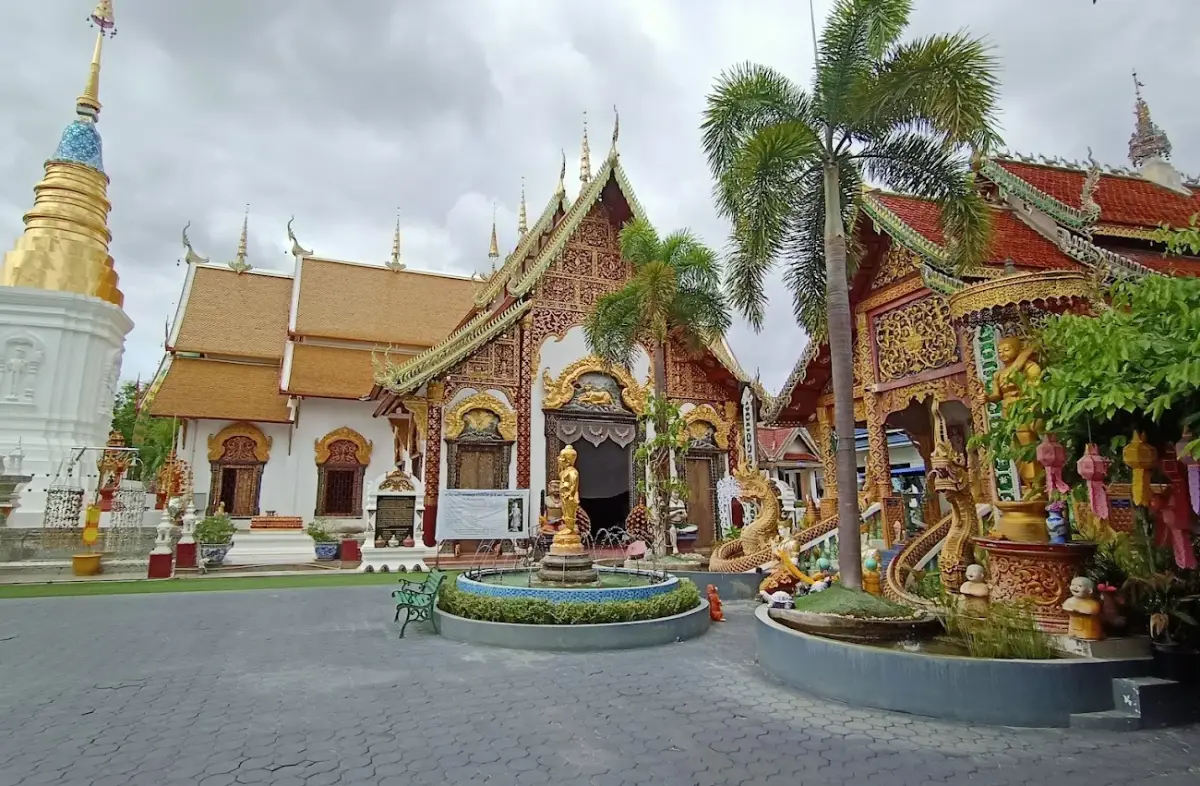
Wat Phra Pan (Wat Phranon Mae Pu Kha)
Open Days: Daily
Opening Hours: 06.00 – 18.00
Wat Phra Pan, widely known as Wat Phranon Mae Pu Kha, is a local Buddhist temple under the Mahanikaya sect, located at 64 Moo 5, Ban San Phra Chao Ngam, Ton Pao Subdistrict, San Kamphaeng District, Chiang Mai Province 50130. The temple was officially established in 1660 and received Wisungkhamasima in 1662. Its abbot is Phra Athikan Uthena Utheno. Wat Phra Pan is one of the most culturally significant temples in Ton Pao and San Kamphaeng because it combines old Lanna legends, a sacred reclining Buddha image, a relic chedi, the spiritual memory of Khru Ba Siwichai, and the colorful atmosphere of Lanna umbrellas.
The temple stands in Ton Pao Subdistrict, an important cultural and craft area of San Kamphaeng District. Ton Pao is associated with mulberry paper, Bo Sang umbrellas, and local craft communities, while also preserving a network of old village temples. Wat Phra Pan therefore belongs to a landscape where Buddhist faith, craft heritage, and Lanna community life meet. A visit to the temple offers more than a religious stop; it gives travelers a deeper view of San Kamphaeng’s living culture.
The name “Wat Phra Pan” is connected with the Lanna legend of Phra Pan and the story of the Buddha’s journey through the region. In the local tale, the Buddha arrived at this place and saw a farmer working on a rice-field ridge. In the northern Thai language, the ridge of a rice field is called “pan,” which became part of the temple’s name. The temple later became widely known as Wat Phranon Mae Pu Kha because of the important reclining Buddha image enshrined inside the main viharn.
The legend of Phra Pan is culturally important because it links the temple with rice fields, local language, sacred geography, and the belief in the Buddha’s presence in Lanna. The story also mentions the Buddha giving a hair relic, which became part of the sacred memory associated with the temple’s chedi. This type of legend shows how Lanna communities preserved religious meaning through landscape, oral tradition, and temple identity.
The main highlight of Wat Phra Pan is Luang Pho Phranon Mae Pu Kha, the sacred reclining Buddha image enshrined in the main viharn. A reclining Buddha represents peace, release, and the final stage of the Buddha’s earthly life. For local devotees, the image is not only an object of worship but also the spiritual heart of the temple. Visitors come to pay respect, make merit, and experience the calm atmosphere surrounding the image.
The main viharn housing the reclining Buddha is also historically significant. Local history connects its reconstruction with Khru Ba Siwichai, the revered Lanna monk known for restoring many temples across northern Thailand. In 1928, a new viharn was built to cover the reclining Buddha, with Khru Ba Khao Pi supervising construction. The work took several years and was later celebrated with a major temple ceremony. This links Wat Phra Pan with the broader legacy of Lanna Buddhist restoration.
Important areas and structures in the temple include the main viharn, ubosot, monks’ quarters, small pavilions, dining hall, relic chedi, Khru Ba Siwichai memorial area, temple courtyard, and the umbrella-decorated zone. The relic chedi is associated with the temple legend of the Buddha’s hair relics. Some traditions mention one hair relic, while others mention three. This variation reflects the way local sacred narratives were transmitted through different versions over time.
The Khru Ba Siwichai memorial area adds another meaningful layer to the temple. Khru Ba Siwichai is deeply respected across northern Thailand as a monk who restored temples, roads, and religious sites. Having a space dedicated to him at Wat Phra Pan connects the temple with one of the most important figures in modern Lanna Buddhist history and gives devotees another point of worship within the temple grounds.
Wat Phra Pan is also visually distinctive because of its Lanna umbrellas, known locally as “chong.” These umbrellas are closely associated with San Kamphaeng and Bo Sang craft culture. When used in the temple setting, they are more than decoration. They connect Buddhist devotion with local craftsmanship, turning the temple courtyard into a space where faith and craft identity meet. The colorful umbrellas make the temple one of the most memorable cultural stops in San Kamphaeng.
An important annual tradition at the temple is the Mae Pu Kha reclining Buddha bathing ceremony held during the sixth northern lunar month. This event brings together local devotees, the temple, and Ton Pao community organizations. The temple is also associated with the Mahatsachan Chong Lanna festival, an umbrella-themed cultural event that highlights Lanna craft identity and Buddhist devotion. These activities make Wat Phra Pan a living cultural site, not only an old temple.
Wat Phra Pan functions as a spiritual center for the Ton Pao and San Kamphaeng communities. It supports Buddhist holy days, Kathin, forest robe offerings, Buddhist Lent, the end of Buddhist Lent, merit-making ceremonies, and local religious gatherings. Through the reclining Buddha tradition and Lanna umbrella culture, the temple also helps preserve local identity and community memory.
Key things to see and respect at Wat Phra Pan include Luang Pho Phranon Mae Pu Kha, the relic chedi, the Khru Ba Siwichai memorial area, Phra Chao Than Chai, the main viharn, the umbrella-decorated courtyard, and the temple grounds. Visitors interested in Lanna legends should pay attention to the Phra Pan story, as it gives the reclining Buddha and the temple name deeper meaning.
The atmosphere of Wat Phra Pan changes with the season. On ordinary days, the temple is calm and suitable for worship, merit-making, and quiet walking. During festivals, the temple becomes lively with colorful Lanna umbrellas, local devotees, and cultural activities. This makes it suitable for many types of visitors, including Buddhist pilgrims, cultural travelers, photographers, and those exploring the San Kamphaeng craft route.
Getting There from Chiang Mai city is convenient by private car, rental car, or local hired transport. Take the old Chiang Mai–San Kamphaeng road toward Ton Pao Subdistrict, then follow the temple sign into the local community road. The temple is in Ban San Phra Chao Ngam, Village No. 5. It is around 9–12 kilometers from Chiang Mai city depending on the route. Travelers already visiting Bo Sang or Ton Pao can easily add Wat Phra Pan to the same itinerary.
Wat Phra Pan can be combined with several nearby cultural stops. A temple-focused route can include Wat Bo Sang, Wat Ton Phueng, Wat Buak Pet, Wat Ton Pao, and Wat Phra That Doi Ngu. A craft-and-culture route can include Bo Sang Umbrella Village, Ban Ton Pao’s mulberry paper community, MAIIAM Contemporary Art Museum, and Baan Jang Nak. This combination shows San Kamphaeng through temples, craft traditions, art, and Lanna community identity.
The temple is suitable for travelers interested in old Lanna temples, reclining Buddha images, local legends, community festivals, and the visual culture of Bo Sang umbrellas. It adds a strong spiritual dimension to a San Kamphaeng trip, especially for visitors who want to see more than handicraft shops and souvenir routes.
Visitors should dress modestly, keep noise low, and behave respectfully in worship areas. Shoes should be removed before entering sacred spaces. Photography should be done with discretion, especially around devotees, monks, and active rituals. During festivals, visitors should allow extra time because the temple may be crowded and should follow temple or community guidance.
Wat Phra Pan deserves a place in San Kamphaeng’s cultural travel routes because it combines a long history since 1660, the Phra Pan legend, the sacred reclining Buddha of Mae Pu Kha, the relic chedi, the memory of Khru Ba Siwichai, the annual reclining Buddha bathing tradition, and the colorful Lanna umbrella culture of Ton Pao and Bo Sang. For travelers who want to understand San Kamphaeng more deeply, this temple offers one of the richest combinations of faith, history, craft, and community life.
| Name | Wat Phra Pan / Wat Phranon Mae Pu Kha |
| Location | Ban San Phra Chao Ngam, Village No. 5, Ton Pao Subdistrict, San Kamphaeng District, Chiang Mai Province |
| Address | 64 Moo 5, Ton Pao Subdistrict, San Kamphaeng District, Chiang Mai 50130, Thailand |
| Type | Local Buddhist temple under the Mahanikaya sect |
| Highlights | Luang Pho Phranon Mae Pu Kha, main viharn, relic chedi, Khru Ba Siwichai memorial area, Phra Chao Than Chai, Lanna umbrella courtyard, and annual Mae Pu Kha reclining Buddha bathing tradition |
| History | Officially established as a temple in 1660 and received Wisungkhamasima in 1662 |
| Name Origin | Linked with the Phra Pan legend and the northern Thai word “pan,” meaning a rice-field ridge; the temple later became widely known through its sacred reclining Buddha image |
| Abbot / Caretaker | Phra Athikan Uthena Utheno |
| What To See / Worship | Luang Pho Phranon Mae Pu Kha, relic chedi, Khru Ba Siwichai memorial area, Phra Chao Than Chai, main viharn, and Lanna umbrella courtyard |
| Main Areas / Structures | Main viharn, ubosot, monks’ quarters, small pavilions, dining hall, relic chedi, Khru Ba Siwichai memorial area, temple courtyard, and Lanna umbrella area |
| Temple Land | 3 rai |
| Religious Activities | Mae Pu Kha reclining Buddha bathing ceremony in the sixth northern lunar month, Mahatsachan Chong Lanna festival, Kathin, forest robe offerings, Buddhist holy days, Buddhist Lent, and major Buddhist observances |
| Community Importance | Spiritual center of the Ton Pao and San Kamphaeng communities, connecting the Mae Pu Kha reclining Buddha tradition, Lanna legends, and local umbrella craft culture |
| Travel Information | From Chiang Mai city, take the old Chiang Mai–San Kamphaeng road toward Ton Pao, then follow the temple sign into the local community road; best accessed by private car, rental car, or local hired transport |
| Current Status | Active community Buddhist temple used for ceremonies, merit-making, and annual traditions |
| Open Days | Daily |
| Opening Hours | 06.00 – 18.00 |
| Main Contact Number | 053-332-862 |
| Main Areas / Zones | 1. Main viharn and Mae Pu Kha reclining Buddha 2. Relic chedi 3. Khru Ba Siwichai memorial area 4. Lanna umbrella courtyard 5. Ubosot, pavilions, dining hall, monks’ quarters, and temple courtyard |
| Nearby Tourist Attractions | 1. Bo Sang Umbrella Village, about 5 km 2. Ban Ton Pao / Mulberry Paper Craft Area, about 5 km 3. Wat Bo Sang, about 5 km 4. MAIIAM Contemporary Art Museum, about 6 km 5. Baan Jang Nak, about 7 km |
| Nearby Restaurants | 1. Creative Coffee Bo Sang, about 6 km, Tel. 052-005-213 2. Bo Sang Kang Jong, about 6 km, Tel. 082-459-7779 3. Baan Din San Kamphaeng Restaurant, about 9 km, Tel. 053-286-539, 081-952-3130 4. San Kamphaeng Phochana, about 10 km, Tel. 053-332-935, 062-657-6288, 053-395-389 5. Big Phochana, about 11 km, Tel. 097-967-1636 |
| Nearby Accommodations | 1. Viewdoi Art and Resort, about 6 km, Tel. 088-866-2562 2. Baan Rai Plai Na San Kamphaeng, about 7 km, Tel. 065-349-4403 3. The Vet Boutique Hotel, about 8 km, Tel. 052-011-179 4. Chiangmai Lanna Modern Loft Hotel, about 8 km, Tel. 062-181-9696, 063-465-7785, 082-347-2527 5. Doltara Chiang Mai Boutique Resort, about 9 km, Tel. 086-348-0692 |
Frequently Asked Questions (FAQ)
Q: Where is Wat Phra Pan located?
A: Wat Phra Pan is located at 64 Moo 5, Ban San Phra Chao Ngam, Ton Pao Subdistrict, San Kamphaeng District, Chiang Mai Province 50130.
Q: Are Wat Phra Pan and Wat Phranon Mae Pu Kha the same temple?
A: Yes. Wat Phra Pan is the original and registered name, while Wat Phranon Mae Pu Kha is the widely known name associated with the temple’s sacred reclining Buddha image.
Q: When was Wat Phra Pan established?
A: Wat Phra Pan was officially established as a temple in 1660 and received Wisungkhamasima in 1662.
Q: Who is the abbot of Wat Phra Pan?
A: The abbot of Wat Phra Pan is Phra Athikan Uthena Utheno.
Q: What are the highlights of Wat Phra Pan?
A: Highlights include Luang Pho Phranon Mae Pu Kha, the relic chedi, Khru Ba Siwichai memorial area, the Phra Pan legend, and the colorful Lanna umbrella courtyard.
Q: What important tradition is held at Wat Phra Pan?
A: Important traditions include the Mae Pu Kha reclining Buddha bathing ceremony in the sixth northern lunar month and the Mahatsachan Chong Lanna umbrella festival.
Q: What nearby places can be visited with Wat Phra Pan?
A: Nearby places include Bo Sang Umbrella Village, Ban Ton Pao, Wat Bo Sang, MAIIAM Contemporary Art Museum, and Baan Jang Nak.
 Category: ●Places of Worship
 Group: ●Temple
Last Update : 3 DayAgo
 Last Update : 3 DayAgo
 Click to Access the Navigation Map GPS
Wat Phra Pan (Wat Phranon Mae Pu Kha) Map
Recommend

 Muang Chiang Mai(121)Chom Thong(47)Mae Chaem(25)Chiang Dao(33)Doi Saket(68)Mae Taeng(85)Mae Rim(69)Samoeng(29)Fang(71)Mae Ai(59)Phrao(70)San Pa Tong(103)San Kamphaeng(66)San Sai(73)Hang Dong(73)Hot(32)Doi Tao(22)Omkoi(11)Saraphi(74)Wiang Haeng(15)Chai Prakan(28)Mae Wang(32)Mae On(22)Doi Lo(34)Galyani Vadhana(1)


