
lovethailand home >North Travel Attractions >Chiang Mai Travel Attractions >Samoeng >Samoeng Nuea > Wat Ban Phok (Ban Pok)
TL;DR: Wat Ban Phok (Ban Pok) is located at 125 Moo 5, Ban Pok, Samoeng Nuea Subdistrict, Samoeng District, Chiang Mai Province 50250, open Daily, hours 08.00 - 17.00.

Wat Ban Phok (Ban Pok)
Open Days: Daily
Opening Hours: 08.00 - 17.00
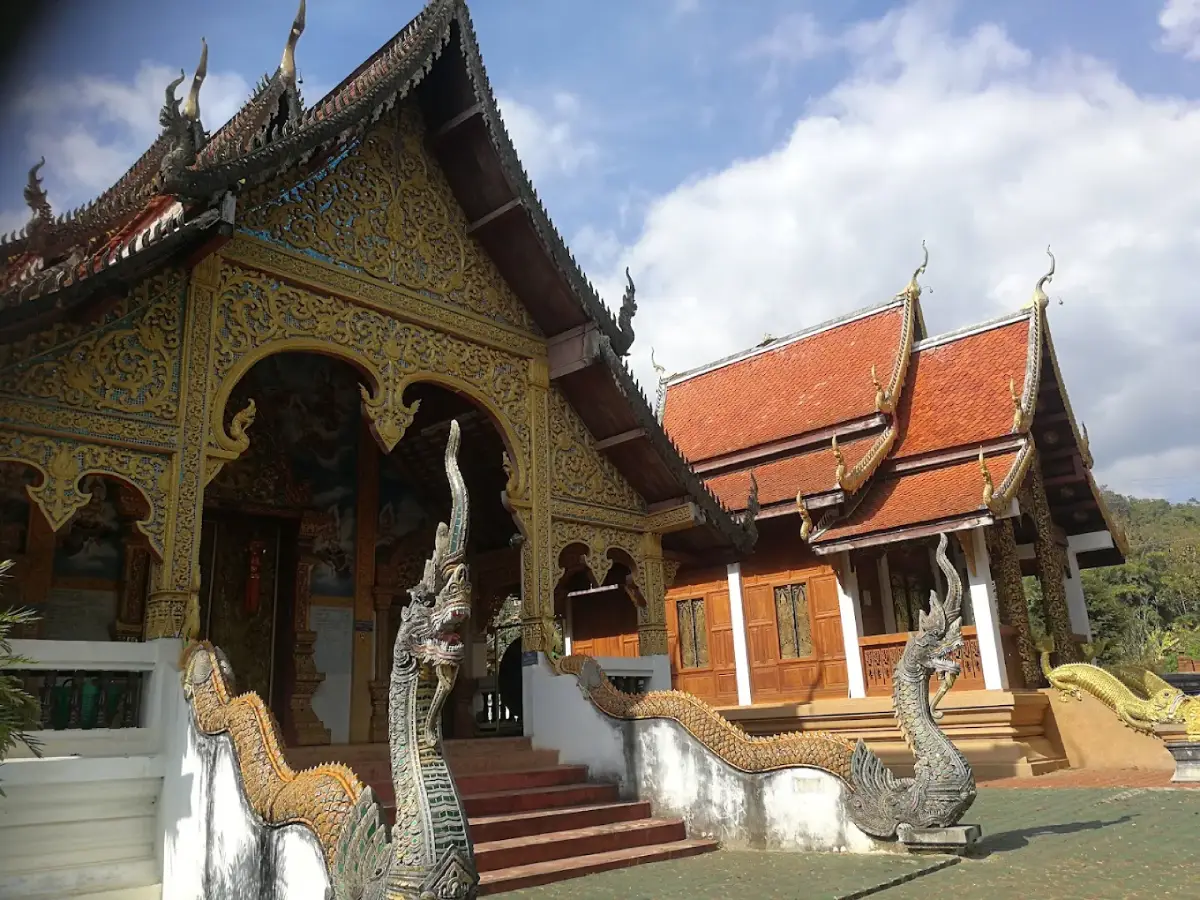
Wat Ban Phok (Ban Pok) is a local Buddhist temple under the Maha Nikaya order, located at 125 Moo 5, Ban Pok, Samoeng Nuea Subdistrict, Samoeng District, Chiang Mai Province. The temple was established in B.E. 2448 and received its royal consecrated boundary on January 17, B.E. 2534. The consecrated boundary measures 16 meters wide and 25 meters long. The abbot is Phra Khru Kowit Chakhratham, monastic name Chakharo, who also serves as the Ecclesiastical Chief of Yang Moen Subdistrict. The temple is an important moral and ethical development center for Samoeng Nuea and a spiritual center for Ban Pok.
Wat Ban Phok (Ban Pok) is a community temple with historical, religious, linguistic, and local-cultural value. Its importance lies not in being a large tourist attraction, but in being the temple of Ban Pok village, where local residents make merit, worship, listen to Dhamma teachings, join annual merit-making activities, and maintain the relationship between the village and Buddhism. Visitors can experience a quiet mountain-community temple that reflects the everyday religious life of Samoeng Nuea.
The temple was established in B.E. 2448, giving it more than a century of history. In the context of Samoeng Nuea, a village temple was essential for merit-making, sermons, ceremonies, moral learning, and community gatherings. Wat Ban Phok (Ban Pok) therefore developed as a religious and social center for the local village, supporting Buddhist activities and community relationships across generations.
The temple’s name has a distinctive local story. The original name known by villagers was “Wat Ban Pok,” after the village name. During a period when the temple had no abbot and not even a novice residing there, the temple name was written incorrectly as “Wat Ban Phok.” Later, the abbot initiated a request to change the temple name back to match the village name. In the Lanna language, “pok” means “to return” or “to come back.” This name story gives the temple a strong connection with local language, village identity, and community memory.
The effort to restore the temple name to match Ban Pok is more than a spelling correction. It represents the restoration of the relationship between the temple and the village. In Lanna communities, a temple is often part of the village identity, memory, and shared sense of belonging. When the temple name is connected again with Ban Pok, it confirms the temple’s role as the spiritual center of the community.
The temple land covers 2 rai, 3 ngan, and 73 square wah, with Sangha land totaling 4 rai, 2 ngan, and 184 square wah. The temple compound includes an ordination hall, viharn, multi-purpose pavilion, monk’s residence, temple grounds, worship area, and community Buddhist activity space. These structures support formal Sangha ceremonies, worship, sermons, merit-making events, and the daily religious life of the village.
Wat Ban Phok (Ban Pok) received its royal consecrated boundary on January 17, B.E. 2534. This is an important religious milestone because a consecrated boundary provides an officially recognized area for formal Sangha ceremonies according to Buddhist discipline. The boundary measures 16 meters wide and 25 meters long, confirming the temple’s role as a complete Buddhist institution serving monks and laypeople.
The ordination hall measures 5 meters wide and 10 meters long and was built in B.E. 2552. It is one of the most important religious spaces of the temple because it supports formal monastic ceremonies. In a community temple, the ordination hall is more than a building. It is a sacred space connected with Buddhist discipline and the temple’s religious completeness.
The viharn measures 9 meters wide and 23 meters long. It is the main worship area where local residents pay respect, chant, listen to Dhamma teachings, make merit, and participate in Buddhist activities. In a northern Thai village temple, the viharn is often the spiritual heart of the temple and the most accessible religious space for laypeople.
The multi-purpose pavilion measures 9 meters wide and 20 meters long and was built in B.E. 2547. It supports various temple and community activities, including merit-making, community meetings, ceremony preparation, and public gatherings. The pavilion reflects the temple’s role as a shared village space used for both religious and community purposes.
The temple has one monk’s residence, built as a half-masonry and half-wooden structure. It serves as the living quarters for resident monks and supports the daily monastic life of the temple. A resident monk’s area is essential for maintaining regular Buddhist activities, temple care, and the relationship between monks and villagers.
Phra Khru Kowit Chakhratham, Chakharo, is the abbot of Wat Ban Phok (Ban Pok) and also serves as the Ecclesiastical Chief of Yang Moen Subdistrict. His role connects the temple with broader monastic administration as well as the daily religious life of the local community. In a village temple, the abbot serves as a Dhamma leader, caretaker, and link between the Sangha and laypeople.
The temple is important as a moral and ethical development center for Samoeng Nuea. It is a place where villagers cultivate the mind, observe precepts, make merit, listen to Dhamma teachings, and participate in Buddhist activities. The temple supports children, youth, adults, and elders in different ways, making it both a sacred place and a community learning space.
Ban Pok is one of the villages of Samoeng Nuea, a mountainous subdistrict with several community temples, including Wat Mae Loei, Wat Mae Phae, Wat Ban Pok, Wat Pong Pa, Wat Ton Lan, Wat Thung Lom, Wat Sala Pong Kwao, and Wat Sukhawadee Anamwanaram. Together, these temples form a network of local faith that gives Samoeng Nuea its identity as a district of village temples, Lanna traditions, agriculture, and mountain landscapes.
Wat Ban Phok (Ban Pok) is also connected with Wat Ban Pok School, a primary school in Samoeng Nuea. The relationship between temple, school, and community is an important feature of rural Thailand. In mountain areas, temples and schools often function as central spaces for education, moral formation, and community development.
Religious activities at Wat Ban Phok (Ban Pok) follow the rhythm of northern Thai community temples. These include Buddhist holy day observances, Kathin ceremonies, forest robe offerings, Buddhist Lent activities, end-of-Lent merit-making, major Buddhist holy days, and Northern Thai New Year traditions. During these occasions, villagers gather to make offerings, listen to Dhamma teachings, prepare the temple grounds, and maintain local Buddhist culture.
In the Lanna cultural context, Wat Ban Phok (Ban Pok) connects religion, community participation, and local identity. Merit-making events are not only rituals. They are also moments when villagers gather, cooperate, and pass on local practices from older generations to younger ones. The temple therefore keeps Lanna culture alive through repeated participation in real community life.
For visitors, the main points of interest are the ordination hall, viharn, multi-purpose pavilion, temple grounds, and the local story of the temple name. The name story—moving from Ban Pok to Ban Phok and the request to restore the correct village-linked name—gives the temple a distinctive cultural identity. Visitors should take time to appreciate this local history along with the temple’s religious role.
The atmosphere of Wat Ban Phok (Ban Pok) is calm and modest, typical of a mountain village temple. It is suitable for travelers who want to make merit while exploring Samoeng Nuea, learn about local temples, or understand Lanna community life outside Chiang Mai city. Visitors should dress modestly, speak quietly, and respect the ordination hall, viharn, monk’s residence, and ceremony areas.
Getting There is most convenient by private car or rental car. From Chiang Mai city, travelers can drive toward Samoeng District via the Mae Rim–Samoeng route or the Hang Dong–Samoeng route, then continue to Samoeng Nuea Subdistrict and Ban Pok, Moo 5. The route includes mountain roads and rural village roads, so careful driving is recommended, especially during the rainy season or late afternoon.
A visit to Wat Ban Phok (Ban Pok) can be combined with nearby places in Samoeng Nuea, including Wat Ton Lan, Wat Thung Lom, Wat Pong Pa, Wat Mae Phae, Wat Mae Loei, Wat Sala Pong Kwao, and Pong Kwao Hot Spring. This route is suitable for travelers who want to experience community temples, the story of Ban Pok, agricultural villages, nature, cafés, restaurants, and mountain accommodation in western Chiang Mai.
| Name | Wat Ban Phok (Ban Pok) |
| Type | Local Buddhist temple under the Maha Nikaya order |
| Location | 125 Moo 5, Ban Pok, Samoeng Nuea Subdistrict, Samoeng District, Chiang Mai Province 50250 |
| Highlights | A community temple of Ban Pok, established in B.E. 2448, with a distinctive name history involving the spelling shift from Wat Ban Pok to Wat Ban Phok and a request to restore the name to match the village name |
| History | Established in B.E. 2448 and granted a royal consecrated boundary on January 17, B.E. 2534 |
| Temple Area | Temple land: 2 rai, 3 ngan, and 73 square wah; Sangha land: 4 rai, 2 ngan, and 184 square wah |
| Consecrated Boundary | Granted on January 17, B.E. 2534; 16 meters wide and 25 meters long |
| Name Origin | Originally known as Wat Ban Pok after the village name. The name was later written as Wat Ban Phok, and the abbot initiated a request to restore the temple name to match the village name. “Pok” means “to return” in the Lanna language. |
| Distinctive Features | A Lanna community temple in the mountain landscape of Samoeng Nuea, with religious, moral, and village-identity roles |
| Main Areas / Zones | Ordination hall, viharn, multi-purpose pavilion, monk’s residence, temple grounds, worship area, and community Buddhist activity space |
| Important Structures | Ordination hall: 5 by 10 meters, built in B.E. 2552 Viharn: 9 by 23 meters Multi-purpose pavilion: 9 by 20 meters, built in B.E. 2547 One half-masonry and half-wooden monk’s residence |
| Abbot / Caretaker | Phra Khru Kowit Chakhratham, Chakharo, Ecclesiastical Chief of Yang Moen Subdistrict |
| Traditions / Religious Activities | Kathin ceremonies, forest robe offerings, Buddhist holy day observances, Buddhist Lent activities, end-of-Lent merit-making, major Buddhist holy days, and Northern Thai New Year traditions |
| Community Role | A center for moral and ethical development in Samoeng Nuea, a spiritual center of Ban Pok, and a community space for merit-making, sermons, Buddhist activities, and village gatherings |
| Travel Information | Best reached by private car or rental car from Chiang Mai city to Samoeng District, then onward to Samoeng Nuea Subdistrict and Ban Pok, Moo 5. The route includes mountain and rural roads. |
| Current Status | A Maha Nikaya community temple of Ban Pok, used for worship, merit-making, sermons, and Buddhist community activities |
| Open Days | Daily |
| Opening Hours | 08.00 - 17.00 |
| Facilities | Ordination hall, viharn, multi-purpose pavilion, monk’s residence, temple grounds, worship area, and community Buddhist activity space |
| Nearby Tourist Attractions | 1. Wat Ton Lan, about 3 km 2. Wat Thung Lom, about 5 km 3. Wat Pong Pa, about 7 km 4. Wat Mae Phae, about 10 km 5. Pong Kwao Hot Spring, about 12 km 6. Wat Mae Loei, about 15 km 7. Wat Sala Pong Kwao, about 13 km |
| Nearby Restaurants | 1. Food service area at Pong Kwao Hot Spring, about 12 km 2. Ice Cream Café At Samoeng, about 18 km, Tel. 081-751-2191 3. Baan Coffee Samoeng, about 19 km, Tel. 082-763-3400 4. Cafe De Mountain, about 20 km, Tel. 098-506-5306 5. Coffee By Aitsara, about 22 km, Tel. 084-378-0821 |
| Nearby Accommodations | 1. Baan Amphor Hotel, Pong Kwao Hot Spring, about 12 km, Tel. 097-429-1453 2. Pong Kwao Community Homestay, about 13 km 3. Forest Guesthouse, about 20 km, Tel. 084-371-5055 4. Lhongkhao Samoeng, about 22 km 5. Rai Nap-Phupha, about 25 km, Tel. 088-404-2553, 081-603-9800, 053-378-414 |
Frequently Asked Questions (FAQ)
Q: Where is Wat Ban Phok (Ban Pok) located?
A: Wat Ban Phok (Ban Pok) is located at 125 Moo 5, Ban Pok, Samoeng Nuea Subdistrict, Samoeng District, Chiang Mai Province 50250.
Q: Are Wat Ban Phok and Wat Ban Pok the same temple?
A: Yes. The temple was originally known by villagers as Wat Ban Pok, after the village name. The name was later written as Wat Ban Phok, and a request was made to restore the name to match the village name.
Q: What is the history of Wat Ban Phok (Ban Pok)?
A: Wat Ban Phok (Ban Pok) was established in B.E. 2448 and received its royal consecrated boundary on January 17, B.E. 2534. It is a Maha Nikaya community temple of Ban Pok in Samoeng Nuea.
Q: What does the word “Pok” mean?
A: In the Lanna language, “pok” means “to return” or “to come back.” It is also the name of the village where the temple is located.
Q: What important structures are inside Wat Ban Phok (Ban Pok)?
A: The temple has an ordination hall, viharn, multi-purpose pavilion, monk’s residence, temple grounds, worship area, and community Buddhist activity space.
Q: Who is the abbot of Wat Ban Phok (Ban Pok)?
A: The abbot is Phra Khru Kowit Chakhratham, Chakharo, Ecclesiastical Chief of Yang Moen Subdistrict.
Q: Why is Wat Ban Phok (Ban Pok) important to the local community?
A: The temple is a center for moral and ethical development in Samoeng Nuea, a spiritual center of Ban Pok, and a community space for merit-making, sermons, Buddhist activities, and village gatherings.
Q: What nearby places can travelers visit with Wat Ban Phok (Ban Pok)?
A: Travelers can combine the visit with Wat Ton Lan, Wat Thung Lom, Wat Pong Pa, Wat Mae Phae, Pong Kwao Hot Spring, Wat Mae Loei, and Wat Sala Pong Kwao.
 Category: ●Places of Worship
 Group: ●Temple
Last Update : 7 DayAgo
 Last Update : 7 DayAgo
 Click to Access the Navigation Map GPS
Wat Ban Phok (Ban Pok) Map
Recommend

 Muang Chiang Mai(121)Chom Thong(47)Mae Chaem(25)Chiang Dao(33)Doi Saket(68)Mae Taeng(85)Mae Rim(69)Samoeng(29)Fang(71)Mae Ai(59)Phrao(70)San Pa Tong(103)San Kamphaeng(66)San Sai(73)Hang Dong(73)Hot(32)Doi Tao(22)Omkoi(11)Saraphi(74)Wiang Haeng(15)Chai Prakan(28)Mae Wang(32)Mae On(22)Doi Lo(34)Galyani Vadhana(1)


