
lovethailand home >North Travel Attractions >Chiang Mai Travel Attractions >Samoeng >Samoeng Tai > Wat Samoeng
TL;DR: Wat Samoeng is located at 22 Moo 3, Ban Huai Khok, Samoeng Tai Subdistrict, Samoeng District, Chiang Mai Province 50250.
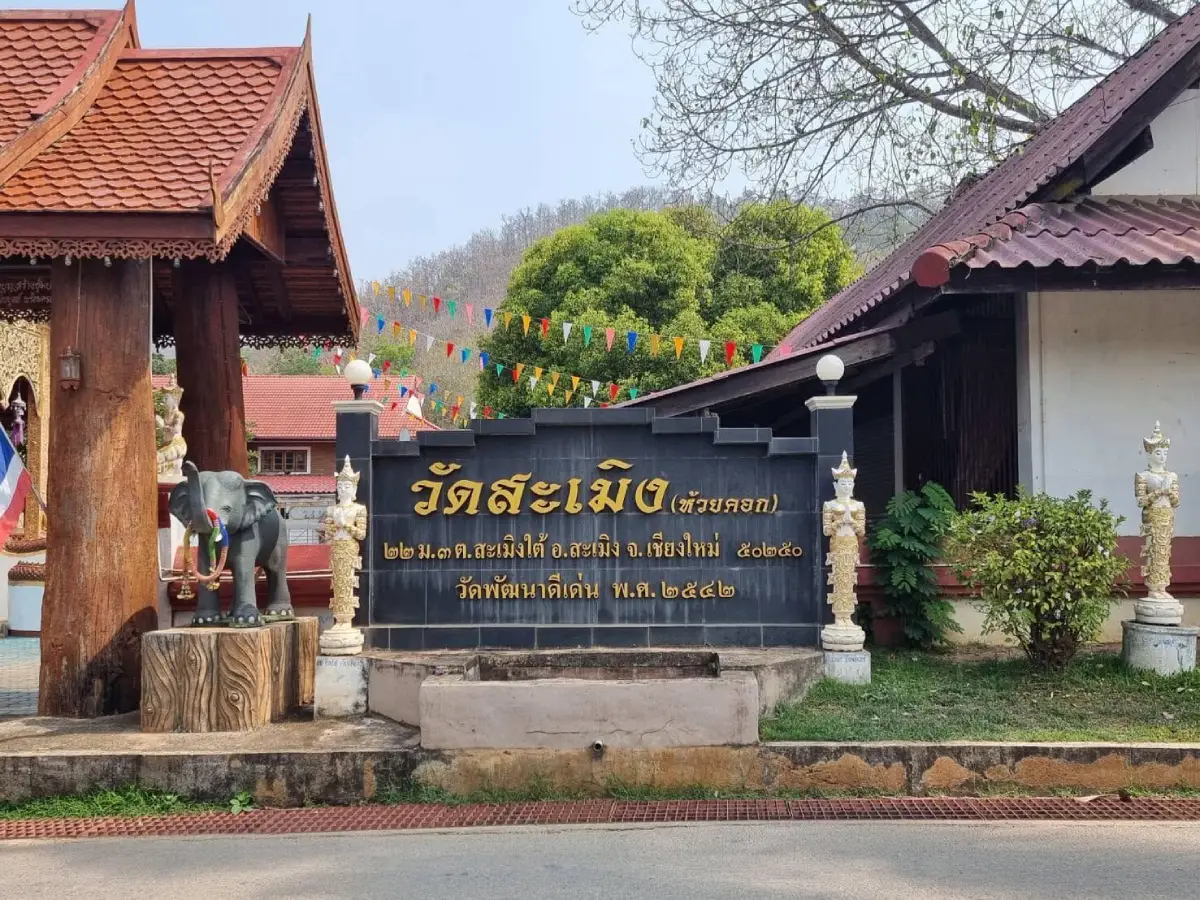
Wat Samoeng
Operating day: Daily
Operating time: 08.00 - 17.00
Wat Samoeng, also known locally as Wat Huai Khok, is a local Buddhist temple under the Maha Nikaya order. It is located at 22 Moo 3, Ban Huai Khok, Samoeng Tai Subdistrict, Samoeng District, Chiang Mai Province 50250. The temple is an important religious and community space for Ban Huai Khok and the wider Samoeng Tai area. Phra Khru Thirathammaphisut, formerly known as Phra Baidika Saokham Thirathammo, is closely associated with Wat Samoeng and Buddhist education in the area. The temple therefore functions not only as a village temple, but also as a space for religion, learning, and community activities in Samoeng.
Wat Samoeng has the character of a community temple in a mountain district of Chiang Mai. Its value lies in its role as a spiritual center for Ban Huai Khok. Local residents use the temple for worship, merit-making, Dhamma listening, annual Buddhist activities, community ceremonies, and public events. Visitors can experience the quiet atmosphere of a functioning local temple that remains closely connected with the everyday life of people in Samoeng District.
Ban Huai Khok is located in Samoeng Tai Subdistrict, an area shaped by mountains, valleys, waterways, and agricultural communities. Samoeng is known for its natural scenery, cool climate, farming culture, and network of local temples. Wat Samoeng belongs to this cultural landscape where village life, Buddhism, community identity, and nature remain closely connected. The temple should therefore be understood both as a religious place and as a shared community space for Ban Huai Khok.
The name “Wat Samoeng” gives the temple a district-level identity because it carries the name of Samoeng itself. At the same time, the local name “Wat Huai Khok” connects the temple directly with Ban Huai Khok, the Moo 3 community where it is located. These two names show the temple’s role at two levels: as a temple of the local village and as a temple linked with the broader identity of Samoeng District.
Publicly available information about the early history and specific temple buildings of Wat Samoeng is limited. However, the temple appears in temple directories as a Maha Nikaya temple in Samoeng Tai Subdistrict, Samoeng District, Chiang Mai Province, associated with Moo 3, Ban Huai Khok. The temple also appears in local public events held at Wat Samoeng, or Wat Huai Khok, showing that it continues to function as an active religious and community place.
Phra Khru Thirathammaphisut, formerly Phra Baidika Saokham Thirathammo, plays an important role connected with Wat Samoeng. He is also associated with Wat Samoeng Wittaya, a Buddhist scripture school located at Wat Samoeng. In a community temple, a monk’s role extends beyond leading ceremonies. It includes guiding laypeople, supporting Buddhist education, maintaining temple activities, and preserving the continuity of Buddhism in the local community.
One of the important dimensions of Wat Samoeng is its educational role. Wat Samoeng Wittaya appears in information on Buddhist scripture schools in Chiang Mai Province and is linked with Wat Samoeng in Samoeng Tai Subdistrict. This gives the temple a broader function beyond ritual practice. It is also a learning space for monks and novices, supporting both Buddhist knowledge and general education.
The presence of Buddhist education gives Wat Samoeng deeper community value. The temple is not only a place where villagers make merit on Buddhist holy days. It is also a place where discipline, moral cultivation, Dhamma learning, and educational development are supported. A Buddhist scripture school within the temple helps keep the temple active as a learning environment and contributes to the future of Buddhist practice in Samoeng.
Wat Samoeng serves as a spiritual center for Ban Huai Khok. Local residents come to the temple for worship, merit-making, sermons, annual ceremonies, and community participation. It brings people of different generations together through Buddhist practice and local traditions, including Kathin ceremonies, forest robe offerings, Buddhist holy days, Buddhist Lent activities, end-of-Lent merit-making, major Buddhist holidays, and Northern Thai New Year traditions.
The temple also serves as a venue for local public ceremonies. It has been used for merit-making, alms-giving, and Buddhist chanting ceremonies held by local authorities on important national occasions. This public role shows that Wat Samoeng is not only a neighborhood temple, but also a central community space where monks, government officials, villagers, and participants gather for formal religious and civic activities.
For visitors, the appeal of Wat Samoeng lies in its calm village-temple atmosphere, its connection with Ban Huai Khok, and its role in Buddhist education. The temple is suitable for travelers who want to make merit while visiting Samoeng, learn about community temples in mountain areas, or understand the district through religion, education, and local life rather than only cafés, viewpoints, or seasonal farms.
The atmosphere of Wat Samoeng is modest and local. Visitors should value the quietness of the temple and behave respectfully because the compound is used by monks, novices, villagers, and learners. If visiting during chanting, classes, temple activities, or merit-making events, travelers should avoid disturbing religious and educational areas.
Religious activities at Wat Samoeng follow the rhythm of northern Thai community temples. These include Buddhist holy day observances, Kathin ceremonies, forest robe offerings, Buddhist Lent activities, end-of-Lent merit-making, major Buddhist holy days, and Northern Thai New Year traditions. During these occasions, the temple becomes a gathering place where villagers make offerings, listen to Dhamma teachings, help prepare the temple grounds, and maintain local Buddhist culture.
The role of Wat Samoeng can be seen in several dimensions. Religiously, it is a place for worship, merit-making, and Dhamma listening. Socially, it is a shared space for village and public activities. Educationally, it is connected with Wat Samoeng Wittaya and Buddhist scripture education. Culturally, it helps preserve the Lanna relationship between temple, village, and community life in Samoeng Tai.
Visitors should dress modestly, speak quietly, and respect the worship areas, community spaces, and educational areas inside the temple. If visitors would like to make merit or ask about activities, it is best to contact the temple or temple representatives at an appropriate time. A respectful visit helps preserve the calm character of this active community temple.
Getting There is most convenient by private car or rental car. From Chiang Mai city, travelers can drive toward Samoeng District via the Mae Rim–Samoeng route or the Hang Dong–Samoeng route, then continue to Samoeng Tai Subdistrict and Ban Huai Khok, Moo 3. The route includes mountain roads and rural village roads, so careful driving is recommended, especially during the rainy season or late afternoon.
A visit to Wat Samoeng can be combined with nearby temples and community destinations in Samoeng Tai, including Wat Mae Sap Nuea, Wat Mae Sap Tai, Wat Nam Rin, Wat Sai Mun, Wat Tha Sala, Wat Pa Kluai, Sop Samoeng, Samoeng Forest Viewpoint in Khun Khan National Park, and Phra That Doi Nok. This route is suitable for travelers who want to connect community temples, Buddhist education, Lanna local life, nature, cafés, restaurants, and mountain accommodation in western Chiang Mai.
| Name | Wat Samoeng, Also Known As Wat Huai Khok |
| Type | Local Buddhist temple under the Maha Nikaya order |
| Location | 22 Moo 3, Ban Huai Khok, Samoeng Tai Subdistrict, Samoeng District, Chiang Mai Province 50250 |
| Contact Number | 087-274-2688 |
| Highlights | A community temple of Ban Huai Khok in Samoeng Tai, used for worship, merit-making, community events, and connected with Wat Samoeng Wittaya, a Buddhist scripture school in Samoeng District |
| History / Community Context | A Maha Nikaya temple of Ban Huai Khok, Moo 3, Samoeng Tai Subdistrict, Samoeng District, Chiang Mai, serving as a religious and community space for worship, Buddhist ceremonies, and public activities |
| Name Origin | The name Wat Samoeng connects the temple with Samoeng District, while the local name Wat Huai Khok connects it with Ban Huai Khok, the Moo 3 village where the temple is located |
| Distinctive Features | A community temple in the mountain landscape of Samoeng, with religious, community, and Buddhist educational roles |
| Main Areas / Zones | Worship area, temple grounds, ceremony area, community activity space, and Buddhist education area |
| Abbot / Caretaker | Phra Khru Thirathammaphisut, formerly Phra Baidika Saokham Thirathammo |
| Educational Role | Connected with Wat Samoeng Wittaya, a Buddhist scripture school, general education section, in Samoeng District |
| Traditions / Religious Activities | Kathin ceremonies, forest robe offerings, Buddhist holy day observances, Buddhist Lent activities, end-of-Lent merit-making, major Buddhist holy days, and Northern Thai New Year traditions |
| Community Role | A spiritual center for Ban Huai Khok, supporting merit-making, Dhamma listening, public ceremonies, and Buddhist education |
| Travel Information | Best reached by private car or rental car from Chiang Mai city to Samoeng District, then onward to Samoeng Tai Subdistrict and Ban Huai Khok, Moo 3. The route includes mountain and rural roads. |
| Current Status | A Maha Nikaya community temple of Ban Huai Khok, used for worship, merit-making, sermons, Buddhist education, community activities, and public ceremonies in Samoeng Tai |
| Facilities | Temple grounds, worship area, ceremony area, and community activity space |
| Nearby Tourist Attractions | 1. Wat Mae Sap Nuea, about 2 km 2. Wat Mae Sap Tai, about 2 km 3. Wat Nam Rin, about 3 km 4. Wat Sai Mun, about 4 km 5. Wat Tha Sala, about 6 km 6. Sop Samoeng, about 7 km 7. Samoeng Forest Viewpoint, Khun Khan National Park, about 18 km 8. Phra That Doi Nok, about 20 km |
| Nearby Restaurants | 1. Cafe De Mountain, about 1 km, Tel. 098-506-5306 2. Ice Cream Café At Samoeng, about 2 km, Tel. 081-751-2191 3. Baan Coffee Samoeng, about 3 km, Tel. 082-763-3400 4. Coffee By Aitsara, about 5 km, Tel. 084-378-0821 5. Khwamsukh Cafe, about 12 km, Tel. 064-339-2582 |
| Nearby Accommodations | 1. Baan Suan View Thung, about 1 km, Tel. 062-605-6556 2. Forest Guesthouse, about 1 km, Tel. 084-371-5055 3. Lhongkhao Samoeng, about 3 km, Tel. 089-504-8108 4. Wongwan Strawberry Farm, about 8 km 5. Rai Nap-Phupha, about 10 km, Tel. 088-404-2553, 081-603-9800, 053-378-414 |
Frequently Asked Questions (FAQ)
Q: Where is Wat Samoeng located?
A: Wat Samoeng is located at 22 Moo 3, Ban Huai Khok, Samoeng Tai Subdistrict, Samoeng District, Chiang Mai Province 50250.
Q: Are Wat Samoeng and Wat Huai Khok the same temple?
A: Yes. Wat Samoeng is also known locally as Wat Huai Khok, a name connected with Ban Huai Khok, the Moo 3 community where the temple is located.
Q: Why is Wat Samoeng important to the local community?
A: Wat Samoeng is a spiritual center for Ban Huai Khok, supporting merit-making, Dhamma listening, public ceremonies, community activities, and Buddhist education.
Q: Who is associated with the care of Wat Samoeng?
A: Wat Samoeng is associated with Phra Khru Thirathammaphisut, formerly Phra Baidika Saokham Thirathammo, who plays an important role in religion and Buddhist education in the area.
Q: What educational role does Wat Samoeng have?
A: The temple is connected with Wat Samoeng Wittaya, a Buddhist scripture school, general education section, in Samoeng District. This gives the temple an important role in supporting Buddhist education for monks and novices.
Q: What kind of travelers is Wat Samoeng suitable for?
A: It is suitable for travelers who want to make merit in Samoeng, visit a local community temple, and understand the district through Buddhism, community life, and Buddhist education.
Q: How can travelers get to Wat Samoeng?
A: The most convenient way is by private car or rental car from Chiang Mai city to Samoeng District, then onward to Samoeng Tai Subdistrict and Ban Huai Khok, Moo 3. The route includes mountain and rural roads.
Q: What nearby places can travelers visit with Wat Samoeng?
A: Travelers can combine the visit with Wat Mae Sap Nuea, Wat Mae Sap Tai, Wat Nam Rin, Wat Sai Mun, Wat Tha Sala, Sop Samoeng, Samoeng Forest Viewpoint, and Phra That Doi Nok.
 Category: ●Places of Worship
 Group: ●Temple
Last Update : 4 DayAgo
 Last Update : 4 DayAgo
 Click to Access the Navigation Map GPS
 Muang Chiang Mai(121)Chom Thong(47)Mae Chaem(25)Chiang Dao(33)Doi Saket(68)Mae Taeng(85)Mae Rim(69)Samoeng(29)Fang(71)Mae Ai(59)Phrao(70)San Pa Tong(105)San Kamphaeng(66)San Sai(73)Hang Dong(74)Hot(32)Doi Tao(22)Omkoi(11)Saraphi(74)Wiang Haeng(15)Chai Prakan(28)Mae Wang(32)Mae On(22)Doi Lo(34)Galyani Vadhana(1)


