
lovethailand home >North Travel Attractions >Chiang Mai Travel Attractions >Samoeng >Samoeng Tai > Wat Tha Sala
TL;DR: Wat Tha Sala is located at Moo 4, Samoeng Tai Subdistrict, Samoeng District, Chiang Mai Province, open Daily, hours 08.00 - 17.00.
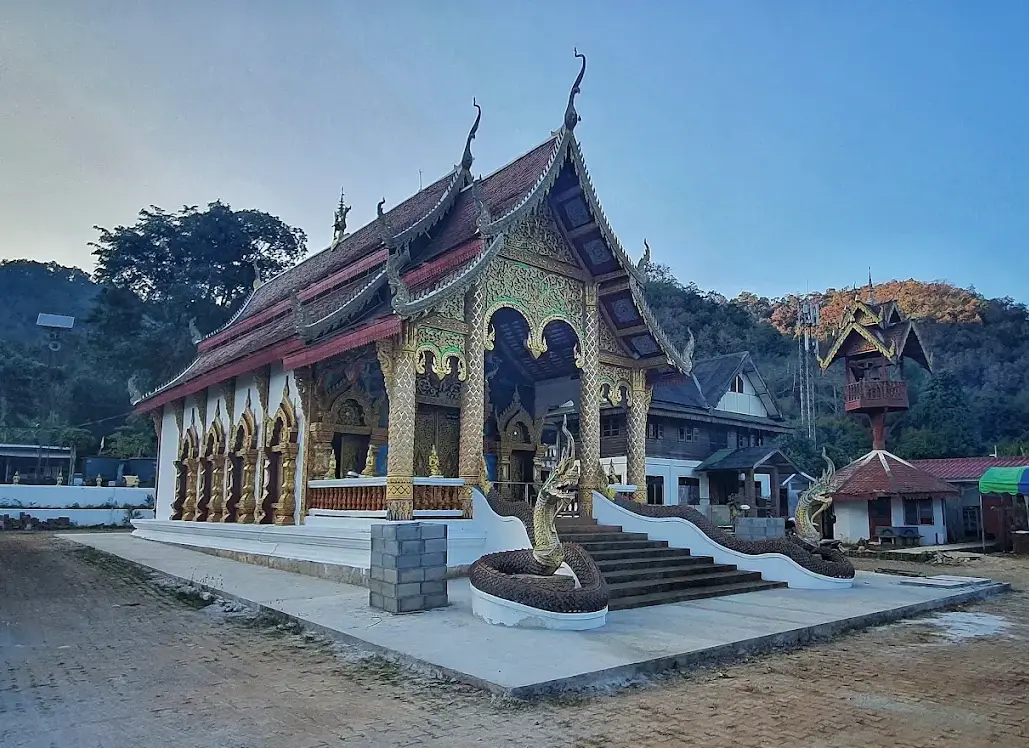
Wat Tha Sala
Open Days: Daily
Opening Hours: 08.00 - 17.00
Wat Tha Sala is a local Buddhist temple under the Maha Nikaya order, located in Moo 4, Samoeng Tai Subdistrict, Samoeng District, Chiang Mai Province. The temple was officially permitted to be established in B.E. 2360, making it one of the older community temples in the Samoeng area. The abbot is Phra Khru Suphat Pramot, monastic name Suphattho. Wat Tha Sala remains an important spiritual center for the local community, serving as a place for worship, merit-making, Dhamma listening, and Buddhist activities throughout the year.
Wat Tha Sala is best understood as a living village temple rather than a large tourist attraction. Its value lies in its role as a community temple where local residents continue to make merit, gather for religious events, observe Buddhist traditions, and maintain the relationship between temple and village. For travelers, the temple offers a quiet and authentic view of Buddhist life in Samoeng Tai.
The temple’s documented history begins with its official establishment in B.E. 2360. With more than two centuries of history, Wat Tha Sala reflects the long-standing settlement and Buddhist faith of the community in Moo 4 of Samoeng Tai. In rural northern Thailand, a village temple is more than a place of worship. It is a center for ceremonies, moral education, community gatherings, and the transmission of local traditions across generations.
The name “Tha Sala” is closely associated with the local community in Moo 4. Publicly available sources do not provide a detailed confirmed origin of the name, so the temple is best presented as a temple named after its local area. This connection makes Wat Tha Sala inseparable from the identity of the village. The temple is a place where community memory, Buddhist practice, and annual traditions meet.
Samoeng Tai provides the broader context for understanding Wat Tha Sala. The subdistrict is part of Samoeng District in Chiang Mai and has a mountain and valley landscape shaped by rural communities, agriculture, local temples, and nature-based travel routes. Wat Tha Sala belongs to this cultural landscape, where the temple, village life, farming, and the surrounding environment remain closely connected.
Phra Khru Suphat Pramot, Suphattho, is the abbot of Wat Tha Sala. His role includes caring for the temple, guiding lay devotees, leading religious activities, and maintaining the continuity of Buddhist practice in the local community. In a village temple, the abbot is not only a ritual leader but also a spiritual figure who helps connect monks, villagers, and community traditions.
Publicly available details about the individual buildings of Wat Tha Sala are limited, so the temple should be described only through confirmed information. As a Maha Nikaya local temple that continues to serve its community, Wat Tha Sala provides space for worship, merit-making, ceremonies, Dhamma listening, and Buddhist community activities. These functions are central to the temple’s identity and to its role in everyday village life.
One of the important traditions connected with Wat Tha Sala is the Song Nam Phra ceremony held in April. This tradition is associated with the Northern Thai New Year period, when communities make merit, bathe Buddha images, pay respect, and begin the new year with purification and auspiciousness. For the Tha Sala community, the ceremony is not only a religious activity but also a community gathering that helps preserve local Lanna culture.
The Song Nam Phra tradition has deep meaning in northern Thai Buddhist life. Bathing Buddha images symbolizes respect, cleansing, renewal, and spiritual blessing. At Wat Tha Sala, the April ceremony helps connect younger generations with local customs and gives villagers a shared space to participate in Buddhist practice and cultural continuity.
Other religious activities at Wat Tha Sala follow the rhythm of northern Thai village temples. These include Buddhist holy day observances, Kathin ceremonies, forest robe offerings, Buddhist Lent activities, end-of-Lent merit-making, and Northern Thai New Year traditions. These occasions bring villagers together to make offerings, listen to Dhamma teachings, prepare the temple grounds, and strengthen community relationships.
The role of Wat Tha Sala can be understood in several dimensions. Religiously, it is a place for worship, merit-making, Dhamma listening, and Buddhist ceremonies. Socially, it is a gathering place for local residents during merit-making events. Culturally, it helps preserve the Song Nam Phra tradition, Lanna Buddhist customs, and the close relationship between temple and village in Samoeng Tai.
For visitors, the appeal of Wat Tha Sala is its quiet local atmosphere and long history. It is suitable for travelers who prefer community temples, local culture, and a slower travel route in Samoeng. A visit to the temple can offer a deeper understanding of Samoeng beyond farms, cafés, and viewpoints, showing the spiritual and cultural life of the local community.
Wat Tha Sala is also well placed for a route connecting nearby temples and attractions in Samoeng Tai. Visitors can combine the temple with Wat Pa Kluai, Wat Nam Rin, Wat Sai Mun, Sop Samoeng, Samoeng Forest Viewpoint, and Phra That Doi Nok. This route gives travelers a wider view of Samoeng Tai through old temples, local villages, mountain roads, nature, cafés, and small accommodation options.
Visitors should dress modestly, speak quietly, and behave respectfully inside the temple compound. Because Wat Tha Sala is an active community temple, travelers should avoid disturbing monks or villagers during religious activities. Visiting during April may offer a chance to see the temple’s role in the Song Nam Phra tradition, when local Buddhist culture becomes especially visible.
Getting There is most convenient by private car or rental car. From Chiang Mai city, travelers can drive toward Samoeng District via the Mae Rim–Samoeng route or the Hang Dong–Samoeng route, then continue to Samoeng Tai Subdistrict and Moo 4. The route includes mountain roads and rural village roads, so careful driving is recommended, especially during the rainy season or late afternoon.
A visit to Wat Tha Sala can be part of a broader Samoeng Tai route. Travelers can begin with a temple visit, continue to nearby community temples or viewpoints, stop at cafés or local restaurants in Samoeng, and stay overnight in accommodation around Samoeng Tai or the district center. This route is suitable for those who want to connect Buddhist culture, village life, mountain scenery, and rural Chiang Mai in one trip.
| Name | Wat Tha Sala |
| Type | Local Buddhist temple under the Maha Nikaya order |
| Location | Moo 4, Samoeng Tai Subdistrict, Samoeng District, Chiang Mai Province |
| Highlights | An old community temple in Samoeng Tai, established in B.E. 2360, and associated with the April Song Nam Phra tradition |
| History | Permitted to be established as a temple in B.E. 2360 and preserved as a Maha Nikaya village temple in Samoeng Tai |
| Name Origin | Named after the local Tha Sala area in Moo 4 of Samoeng Tai Subdistrict |
| Distinctive Features | A rural Lanna community temple connected with merit-making, village life, and the April Song Nam Phra tradition |
| Main Areas / Zones | Worship area, ceremony area, temple grounds, and community Buddhist activity space |
| Abbot / Caretaker | Phra Khru Suphat Pramot, Suphattho |
| Traditions / Religious Activities | Song Nam Phra ceremony in April, Kathin ceremonies, forest robe offerings, Buddhist holy day observances, Buddhist Lent activities, end-of-Lent merit-making, and Northern Thai New Year traditions |
| Community Role | A spiritual center for the Moo 4 community in Samoeng Tai, supporting worship, merit-making, Dhamma listening, and local cultural continuity |
| Travel Information | Best reached by private car or rental car from Chiang Mai city to Samoeng District, then onward to Samoeng Tai Subdistrict and Moo 4. The route includes mountain and rural roads. |
| Current Status | Open as a local community temple for worship, merit-making, and Buddhist activities |
| Open Days | Daily |
| Opening Hours | 08.00 - 17.00 |
| Facilities | Worship area, temple grounds, and community Buddhist activity space |
| Nearby Tourist Attractions | 1. Wat Pa Kluai, about 2 km 2. Wat Nam Rin, about 4 km 3. Wat Sai Mun, about 5 km 4. Sop Samoeng, about 7 km 5. Samoeng Forest Viewpoint, Khun Khan National Park, about 18 km 6. Phra That Doi Nok, about 20 km |
| Nearby Restaurants | 1. Cafe De Mountain, about 4 km, Tel. 098-506-5306 2. Ice Cream Café At Samoeng, about 6 km, Tel. 081-751-2191 3. Baan Coffee Samoeng, about 7 km, Tel. 082-763-3400 4. Khwamsukh Cafe, about 9 km, Tel. 064-339-2582 5. Coffee By Aitsara, about 11 km, Tel. 084-378-0821 |
| Nearby Accommodations | 1. Forest Guesthouse, about 4 km, Tel. 084-371-5055 2. Lhongkhao Samoeng, about 6 km, Tel. 089-504-8108 3. Khum Samoeng - Samoeng Center, about 7 km 4. Wongwan Strawberry Farm, about 8 km 5. Rai Nap-Phupha, about 10 km |
Frequently Asked Questions (FAQ)
Q: Where is Wat Tha Sala located?
A: Wat Tha Sala is located in Moo 4, Samoeng Tai Subdistrict, Samoeng District, Chiang Mai Province.
Q: What are the open days and opening hours of Wat Tha Sala?
A: Wat Tha Sala is open daily from 08.00 to 17.00.
Q: What is the history of Wat Tha Sala?
A: Wat Tha Sala was permitted to be established as a temple in B.E. 2360, making it one of the older Maha Nikaya community temples in Samoeng Tai.
Q: Who is the abbot of Wat Tha Sala?
A: The abbot of Wat Tha Sala is Phra Khru Suphat Pramot, Suphattho.
Q: What important tradition is associated with Wat Tha Sala?
A: Wat Tha Sala is associated with the Song Nam Phra ceremony in April, a Northern Thai New Year period tradition involving merit-making and the bathing of Buddha images.
Q: Why is Wat Tha Sala important to the local community?
A: Wat Tha Sala is a spiritual center for the Moo 4 community in Samoeng Tai, supporting worship, merit-making, Dhamma listening, and local cultural continuity.
Q: What kind of travelers is Wat Tha Sala suitable for?
A: It is suitable for travelers interested in old village temples, Lanna Buddhist traditions, quiet local culture, and a slower travel route in Samoeng Tai.
Q: What nearby places can travelers visit with Wat Tha Sala?
A: Travelers can combine the visit with Wat Pa Kluai, Wat Nam Rin, Wat Sai Mun, Sop Samoeng, Samoeng Forest Viewpoint, and Phra That Doi Nok.
 Category: ●Places of Worship
 Group: ●Temple
Last Update : 2 WeekAgo
 Last Update : 2 WeekAgo
 Click to Access the Navigation Map GPS
 Muang Chiang Mai(121)Chom Thong(47)Mae Chaem(25)Chiang Dao(33)Doi Saket(68)Mae Taeng(85)Mae Rim(69)Samoeng(29)Fang(71)Mae Ai(59)Phrao(70)San Pa Tong(103)San Kamphaeng(66)San Sai(73)Hang Dong(73)Hot(32)Doi Tao(22)Omkoi(11)Saraphi(74)Wiang Haeng(15)Chai Prakan(28)Mae Wang(32)Mae On(22)Doi Lo(34)Galyani Vadhana(1)


