
lovethailand home >North Travel Attractions >Chiang Mai Travel Attractions >Wiang Haeng >Muang Haeng > Wat Kamphaeng Mai
TL;DR: Wat Kamphaeng Mai is located at 82 Ban Pa Phai, Moo 3, Mueang Haeng Subdistrict, Wiang Haeng District, Chiang Mai Province 50350, Thailand, open Daily, hours 08.00 – 17.00.

Wat Kamphaeng Mai
Open Days: Daily
Opening Hours: 08.00 – 17.00
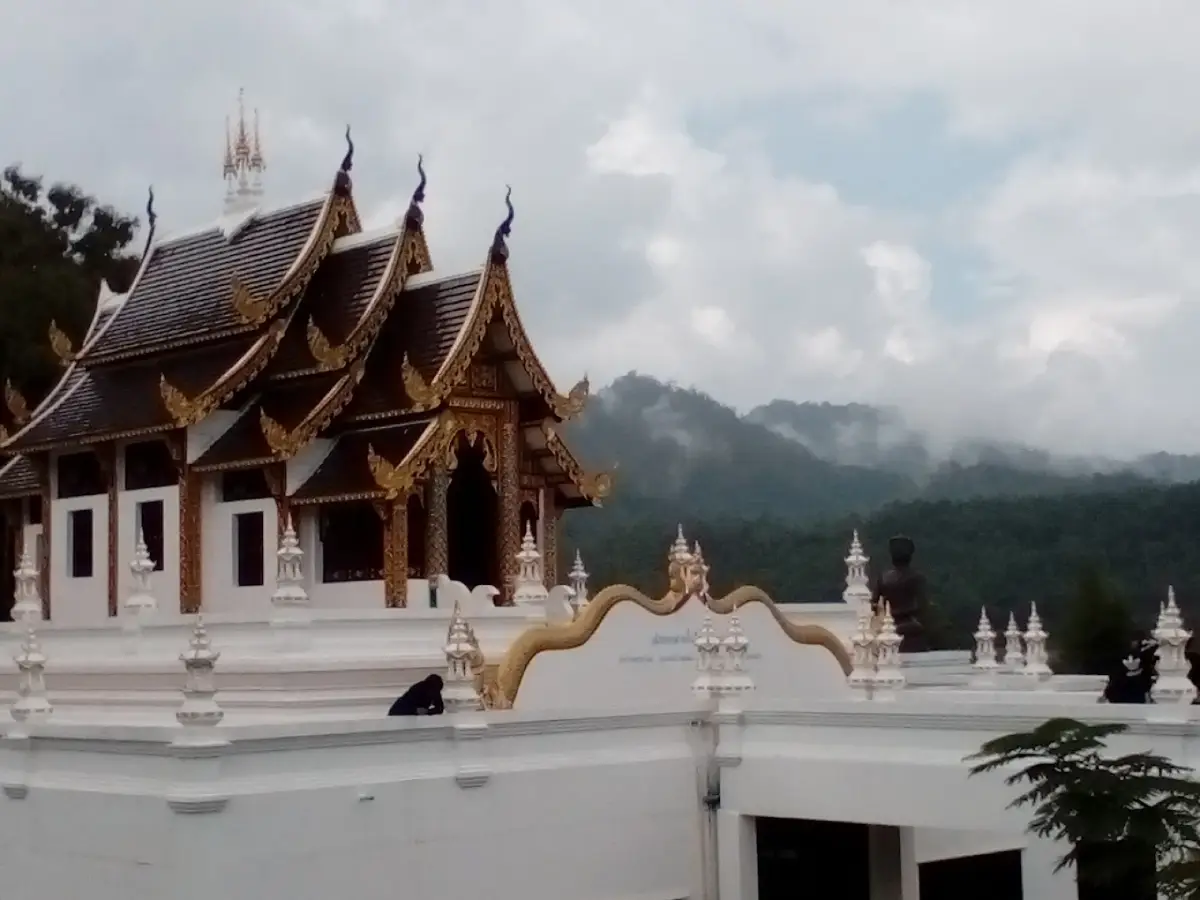
Wat Kamphaeng Mai is a historic community Buddhist temple at No. 82, Ban Pa Phai, Moo 3, Mueang Haeng Subdistrict, Wiang Haeng District, Chiang Mai Province. The monastery traces its foundation to around B.E. 2456, equivalent to 1913, giving it a history of more than 110 years. Its former name was Wat Kamphaeng Ngam, a name that remains closely connected with the historical memory and archaeological landscape of Ban Pa Phai. Today, Wat Kamphaeng Mai remains an active Maha Nikaya monastery, with monks and novices affiliated with the temple, continuing Buddhist educational activity, and an established role in community and district-level ceremonies. The most recently confirmed abbot is Phrakhru Prakan Worasat, who also serves as the ecclesiastical head of Mueang Haeng Subdistrict and remains involved in Buddhist education in Wiang Haeng.
The temple stands in Ban Pa Phai, Moo 3, within the broad mountain basin of Wiang Haeng. Its approximate coordinates are 19.55970, 98.63297, at an elevation of about 732 metres above sea level. Homes, agricultural fields, village roads, forest areas, and mountains surround the community, giving Wat Kamphaeng Mai a distinctly rural highland atmosphere rather than the urban character associated with the famous temples of Chiang Mai city.
Wat Kamphaeng Mai is officially registered under temple code 350200102 as a Maha Nikaya temple in Mueang Haeng Subdistrict. Its continued appearance in the contemporary temple registry, together with Buddhist examination records and ceremonies held at the temple in 2025 and 2026, confirms that it remains a functioning religious institution rather than an abandoned monastery or archaeological monument.
The temple grounds historically cover approximately 6 rai under Nor Sor 3 Kor land document No. 142. The northern boundary extended roughly 50 wa toward village homes, while the southern boundary bordered a cemetery. The eastern and western sides extended approximately 120 wa toward pathways. This layout demonstrates how closely the temple was integrated into the social structure of Ban Pa Phai, with homes, paths, and spaces associated with the community life cycle located directly around the monastery.
The monastery is believed to have been established around 1913 and was originally known as Wat Kamphaeng Ngam. The older name continues to appear in local use. In 2025, for example, a major ceremony honoring Phrakhru Prakan Worasat was publicly described as taking place at Wat Kamphaeng Ngam even though he was officially identified as abbot of Wat Kamphaeng Mai. The parallel use of the historical and modern names has therefore become part of the temple's local identity.
The period in which the temple was founded is significant. In the early twentieth century, Wiang Haeng remained a remote mountain valley with limited transportation links to Chiang Mai. A village monastery provided far more than a sacred place. It served as a center for Buddhist teaching, moral education, community gatherings, funerary ceremonies, merit-making, and the social organization of rural families.
Ban Pa Phai remains an important community within Mueang Haeng Subdistrict. The village lies on the flat land of the Wiang Haeng basin and is supported by local water systems associated with the Mae Taeng and Mae Paem rivers. Agriculture has long formed a major part of local livelihoods, including rice farming, garlic cultivation, livestock raising, and the use of forest resources.
The community is also known for its community forest management. Ban Pa Phai lies within the upper Mae Taeng watershed and has developed conservation and resource-use zones. Local activities include forest-fire prevention, watershed protection, and the controlled use of natural resources. Wat Kamphaeng Mai therefore stands within a community where Buddhist life, agriculture, and environmental stewardship remain closely connected.
Another major reason the temple is significant is its location within the archaeological landscape of ancient Wiang Haeng. Archaeological research has identified human occupation in the wider basin extending back thousands of years, while the historical settlement flourished particularly during the Lanna period. More than 50 ruined sites have been identified throughout the basin, demonstrating that Wiang Haeng was once a substantial religious and settlement landscape.
The Ban Pa Phai area has direct archaeological importance. Research on ancient Wiang Haeng included excavation at the abandoned Wat Kamphaeng Ngam and Pa Sak temple sites. Phrakhru Prakan Worasat, abbot of Wat Kamphaeng Mai, assisted archaeological work in these areas. This connects the living monastery not only with the historical name Kamphaeng Ngam but also with formal archaeological research into the settlement history of the valley.
Wat Kamphaeng Mai and the abandoned archaeological site known as Wat Kamphaeng Ngam should nevertheless be distinguished physically. Wat Kamphaeng Mai is the functioning monastery in Ban Pa Phai today, while the abandoned Wat Kamphaeng Ngam represents an archaeological site within the wider historical landscape. Their names and histories are interconnected, but visitors should not automatically treat every ruin associated with Kamphaeng Ngam as part of the present temple compound.
The historically recorded monastic structures include a viharn, a salabat hall, and monks' residences. At the time the earlier temple history was compiled, the viharn was still under construction. This reflects the normal development of a community monastery, where buildings are constructed, renovated, enlarged, and replaced according to the resources and religious support available in each generation.
The viharn is the principal devotional space. It is used for worship, chanting, sermons, and ceremonies involving both monks and laypeople. In a northern Thai community temple, the viharn is not simply an architectural monument but the main place where daily Buddhist practice and communal merit-making take place.
The salabat reflects the practical organization of traditional monastery life. It is associated with food offerings, alms, and other activities through which lay Buddhists support the monastic community. Although such a structure may attract less tourist attention than a viharn or stupa, it reveals the everyday relationship between monks and villagers.
The monks' residences are private living and study areas for monks and novices. Because Wat Kamphaeng Mai continues to have monastics affiliated with it, these areas should be respected as residential spaces. Visitors should remain in public temple areas unless specifically invited into monastic quarters.
The succession of abbots preserves an important institutional history. The first recorded abbot was Phra Paeng Attagutto, who served from B.E. 2456 to 2477. He was followed by Phra Peng Silasuttho from B.E. 2477 to 2500 and Phra Bunsong Attadantho from B.E. 2500 to 2506.
Later leadership included Phra Athikan Pan Kambhirapanyo, Phra Maha Sombun Chantangkaro from B.E. 2513 to 2514, Phra Athikan Kasem Sumedho from B.E. 2514 to 2516, Phra Baidika Bunchuai Kantacharo from B.E. 2516 to 2521, Phra Kaeng Katapunyo from B.E. 2521 to 2522, Phra Athikan Buntha Abhijoto from B.E. 2522 to 2524, and Phra Puan Dipadhammo from B.E. 2524 according to the historical temple record.
The most recently confirmed abbot is Phrakhru Prakan Worasat, also identified as Phra Nopphadon. In 2025, he was officially identified as abbot of Wat Kamphaeng Mai, ecclesiastical head of Mueang Haeng Subdistrict, and director of Wiang Haeng Pariyatti Suksa School at Wat Kong Lom. He also received a new royal ecclesiastical title and ceremonial fan, with schools and community organizations participating in the celebration.
His responsibilities extend well beyond Wat Kamphaeng Mai. As the ecclesiastical head of Mueang Haeng, he contributes to local Sangha administration, while his role in the Buddhist school links him directly with religious education. In 2026, he continued to appear publicly as director of the Pariyatti school and presided over an education network meeting involving school administrators and educational personnel in Wiang Haeng.
Wat Kamphaeng Mai itself continues to play an active role in Buddhist education. The 2025 national Dhamma examination list included several novices affiliated with the monastery, including Saendee Saenli, Nattawut Fa-in, Sawang Saengchan, Chunwu Nakprat, and Jaijom Nakprat. Their participation demonstrates that the temple remains a place of novice ordination and formal religious learning.
This educational role is not new. Earlier Dhamma examination records also contain monks and novices from Wat Kamphaeng Mai. In a remote mountain and border district, monastic education has historically provided young people with religious training, discipline, literacy, and access to a wider Buddhist educational network.
The connection with Wiang Haeng Pariyatti Suksa School further strengthens this educational role. Although the school operates from Wat Kong Lom, its director is the abbot of Wat Kamphaeng Mai. The Buddhist educational system of the district therefore links multiple temples rather than functioning as separate isolated institutions.
One of the clearest contemporary confirmations of the temple's active status occurred on July 30, 2026, when Wiang Haeng District held an official Buddhist merit-making ceremony at Wat Kamphaeng Mai. The event was attended by the district chief, government officials, local administrators, police officers, village leaders, and residents.
Phrakhru Kantasilanuyut, ecclesiastical head of Wiang Haeng District and abbot of Wat Kong Lom, presided over the monastic side of the ceremony together with other senior monks. This illustrates how Wat Kamphaeng Mai functions within the broader Sangha network of the district, serving both Ban Pa Phai and wider public religious activities.
The monastery has also hosted Kathin ceremonies involving young people and local schools. Kathin, held after the end of the Buddhist rains retreat, combines the offering of robes and necessities to monks with strong community participation. Such events reinforce relationships between families, schools, monks, and the wider village.
Buddhist Lent, the end of the rains retreat, Kathin, community robe offerings, Songkran, and other major Buddhist occasions continue to shape the annual rhythm of temples in Mueang Haeng. Wat Kamphaeng Mai's continuing educational and ceremonial activity places it firmly within this living Buddhist cycle.
The relationship between home, temple, and education is particularly visible here. Ban Pa Phai provides the residential and agricultural community, the temple acts as the spiritual center, and local schools together with Buddhist education provide learning opportunities. This traditional relationship remains an important element of rural northern Thai social structure.
The village's community forest adds another dimension. Forest areas support food, water, local livelihoods, and watershed stability, while residents participate in fire prevention and conservation. Visiting Wat Kamphaeng Mai can therefore lead to a wider understanding of how religious life exists alongside agricultural and environmental management.
The archaeological context further distinguishes the temple from many ordinary community monasteries. Ancient Wiang Haeng contained more than 50 ruined sites and once formed an important Lanna settlement. Archaeological evidence from temples such as Wat Huai Hok and Wat Wiang Haeng demonstrates the depth of Buddhist art and settlement in the basin.
A visit to Wat Kamphaeng Mai is consequently most rewarding for travelers interested in both living Buddhism and local history. The viharn should be visited first, followed by the salabat hall, monks' residential structures viewed from appropriate public areas, and the overall courtyard. The surrounding village and mountains are equally important parts of the experience.
The temple remains a community monastery rather than a commercial tourist attraction. There are no large shopping zones within the grounds. Its appeal comes from the quiet atmosphere, the continuity of Buddhist practice, and the opportunity to observe how a monastery still functions naturally within village life.
Visitors should dress modestly, covering shoulders and knees, remove shoes before entering designated religious buildings, and avoid climbing onto Buddha platforms. Monks' residences and educational areas should be treated as private spaces. Permission should be requested before photographing monks, novices, or community ceremonies.
Wat Nai Yang is one of the most interesting nearby temples because it is located in Ban Pa Phai as well. Once an abandoned monastery, it was officially restored to active monastic status by the Sangha authorities in 2012. Visiting Wat Kamphaeng Mai and Wat Nai Yang together shows two different patterns of temple continuity within the same village.
Wat Phra That Kamphaeng Ngam is another nearby religious landmark whose name preserves the old Kamphaeng Ngam place-name. Travelers interested in the archaeological landscape can combine these locations while remaining careful around ruined structures and never moving or collecting archaeological material.
Wat Kong Lom is only a few kilometres away and serves as an important center of district-level Buddhist administration. Its abbot, Phrakhru Kantasilanuyut, is the ecclesiastical head of Wiang Haeng. Combining Wat Kamphaeng Mai with Wat Kong Lom therefore helps explain the contemporary monastic structure of the district.
Wat Wiang Haeng and Wat Huai Hok add a deeper historical dimension. Archaeological research has identified important Lanna Buddhist material from these temple areas, making them useful stops for travelers interested in understanding the broader religious history of the Wiang Haeng basin.
Mae Hat Waterfall can be added for travelers who want to combine cultural exploration with nature. Located within Mueang Haeng Subdistrict, it provides a forest environment that contrasts with the temples and village landscape. Seasonal conditions should be checked before visiting.
Food options in central Mueang Haeng include local northern cuisine, cafes, and casual restaurants. Pa Khin Restaurant is known for dishes such as northern-style larb and kaeng khae, while Wiang Haeng Coffee provides drinks and cafe food. Chapter four, Sukjai Cafe, and other small local businesses give travelers additional choices within a short drive of the temple.
Accommodation is available in and around Mueang Haeng. Muang Haeng Resort & Spa is located in Moo 3, the same village zone as Wat Kamphaeng Mai. Nong Pleng Room and Kru Ae Homestay are near Wiang Haeng Witthayakhom School, Baan Somwang Resort is near the district center, and Chiang Tung Apartment is located in Ban Wiang Haeng.
Staying overnight is generally preferable for travelers arriving from Chiang Mai city. The mountain road into Wiang Haeng contains numerous bends and elevation changes. An overnight stay allows the first day to focus on Mueang Haeng and Ban Pa Phai, with Saen Hai or Piang Luang explored on the following day.
The cool season is the most comfortable period for visiting. At more than 700 metres above sea level, Wiang Haeng is cooler than central Chiang Mai, especially in the morning and at night. The rainy season offers lush forest and agricultural scenery but can bring wet roads, fog, and reduced mountain visibility.
Getting There from Chiang Mai city is easiest by private car or rental vehicle. Follow Highway 107 toward Chiang Dao and then take the route into Wiang Haeng District. Continue into Mueang Haeng and Ban Pa Phai, Moo 3. The temple can be found using the name Wat Kamphaeng Mai or the approximate coordinates 19.55970, 98.63297.
Vehicles should be checked carefully before the journey, particularly brakes, tyres, fuel, and lights. While Mueang Haeng itself lies within a relatively flat valley, the approach to the district involves extended mountain sections. Daytime travel is recommended for drivers unfamiliar with the route.
A half-day cultural route can combine Wat Kamphaeng Mai, Wat Nai Yang, Wat Phra That Kamphaeng Ngam, Wat Kong Lom, and Wat Wiang Haeng. A full-day itinerary can add Wat Huai Hok and Mae Hat Waterfall, creating a balanced combination of archaeology, living Buddhist culture, village history, and nature.
With two days and one night, travelers can spend the first day exploring Ban Pa Phai and central Mueang Haeng, then continue on the second day to Wat Phra That Saen Hai and the Shan-influenced communities of Piang Luang. This reveals the distinct cultural character of all three major areas of Wiang Haeng District.
Wat Kamphaeng Mai is particularly suitable for travelers interested in historic community temples, archaeology, Lanna history, and Buddhist education. Its value lies in continuity rather than monumental scale: foundation around 1913, the historical name Wat Kamphaeng Ngam, successive generations of abbots, continuing novice education, and the contemporary leadership of Phrakhru Prakan Worasat.
The temple is also unusual because its story connects directly with an archaeological landscape that is much older than the present monastery. Ancient Wiang Haeng preserves evidence of a substantial Lanna settlement, while excavations at abandoned religious sites around Ban Pa Phai add historical depth to the modern village.
At community level, Wat Kamphaeng Mai exists alongside Ban Pa Phai's agricultural land, water resources, and community forest. Religion, farming, education, and environmental stewardship remain interconnected rather than separate aspects of local life.
For visitors seeking to understand Wiang Haeng beyond its reputation as a remote border district, Wat Kamphaeng Mai provides an unusually rich starting point. Its history leads naturally into the story of Ban Pa Phai, ancient Wiang Haeng, Buddhist education, community forestry, and the network of temples across the valley. It remains simultaneously a living monastery, a community institution, and a gateway to one of northern Chiang Mai's lesser-known historical landscapes.
| Name | Wat Kamphaeng Mai |
| Former Name | Wat Kamphaeng Ngam |
| Temple Type | Public Buddhist Temple, Maha Nikaya Order |
| Temple Registry Code | 350200102 |
| Address | 82 Ban Pa Phai, Moo 3, Mueang Haeng Subdistrict, Wiang Haeng District, Chiang Mai Province 50350, Thailand |
| Coordinates | 19.55970, 98.63297 |
| Elevation | Approximately 732 Metres Above Sea Level |
| Established | Around B.E. 2456 / 1913 |
| Temple Area | Approximately 6 Rai, Nor Sor 3 Kor No. 142 |
| Historical Boundaries | Village homes to the north, cemetery to the south, and pathways to the east and west |
| Important Structures | Viharn, Salabat Hall, And Monks' Residences |
| Highlights | Historic Ban Pa Phai temple with more than 110 years of history, direct connections to the archaeology of ancient Wiang Haeng, and an active role in Buddhist education |
| Most Recently Confirmed Abbot | Phrakhru Prakan Worasat (Nopphadon) |
| Ecclesiastical And Educational Roles | Ecclesiastical Head Of Mueang Haeng Subdistrict And Director Of Wiang Haeng Pariyatti Suksa School At Wat Kong Lom |
| Historical Abbots | 1. Phra Paeng Attagutto, B.E. 2456-2477 2. Phra Peng Silasuttho, B.E. 2477-2500 3. Phra Bunsong Attadantho, B.E. 2500-2506 4. Phra Athikan Pan Kambhirapanyo 5. Phra Maha Sombun Chantangkaro, B.E. 2513-2514 6. Phra Athikan Kasem Sumedho, B.E. 2514-2516 7. Phra Baidika Bunchuai Kantacharo, B.E. 2516-2521 8. Phra Kaeng Katapunyo, B.E. 2521-2522 9. Phra Athikan Buntha Abhijoto, B.E. 2522-2524 10. Phra Puan Dipadhammo, From B.E. 2524 According To The Historical Temple Record |
| Educational Role | Monks and novices remain connected with formal Buddhist education; several novices from Wat Kamphaeng Mai entered the 2025 national Dhamma examinations |
| Current Status | Active registered Maha Nikaya temple and venue for district-level Buddhist ceremonies in 2026 |
| Open Days | Daily |
| Opening Hours | 08.00 – 17.00 |
| Travel Information | Travel from Chiang Mai via Highway 107 toward Chiang Dao and continue into Wiang Haeng District, Mueang Haeng, and Ban Pa Phai. Private car or rental vehicle is recommended. |
| Nearby Tourist Attractions | 1. Wat Nai Yang, About 1 km 2. Wat Phra That Kamphaeng Ngam, About 2 km 3. Wat Kong Lom, About 3 km 4. Wat Wiang Haeng, About 4 km 5. Wat Huai Hok, About 5 km 6. Mae Hat Waterfall, About 8 km |
| Nearby Restaurants & Cafes | 1. Wiang Haeng Coffee, About 3 km, Tel. 087-496-5932 2. Chapter four, About 3 km, Tel. 090-742-4044 3. Pa Khin Restaurant, About 4 km, Tel. 089-854-9071 4. Sukjai Cafe, About 4 km, Tel. 098-981-1177 5. Chamuk Jab Dood Sushi Kham To, About 4 km, Tel. 084-117-0101 |
| Nearby Accommodations | 1. Muang Haeng Resort & Spa, About 1 km, Tel. 088-430-5658 2. Nong Pleng Room, About 2 km 3. Kru Ae Homestay, About 2 km, Tel. 087-179-4631 4. Baan Somwang Resort, About 3 km 5. Chiang Tung Apartment / Chiang Tung Rooms, About 4 km, Tel. 053-477-251, 089-835-4932, 082-895-6271 |
Frequently Asked Questions (FAQ)
Q: Where is Wat Kamphaeng Mai located?
A: Wat Kamphaeng Mai is located at No. 82, Ban Pa Phai, Moo 3, Mueang Haeng Subdistrict, Wiang Haeng District, Chiang Mai Province 50350, at approximately 19.55970, 98.63297.
Q: When was Wat Kamphaeng Mai established?
A: The temple dates to around B.E. 2456, equivalent to 1913, giving it more than 110 years of history. Its former name was Wat Kamphaeng Ngam.
Q: What is the relationship between Wat Kamphaeng Mai and Wat Kamphaeng Ngam?
A: The historical record of Wat Kamphaeng Mai identifies Wat Kamphaeng Ngam as its earlier name. Ban Pa Phai also contains an abandoned archaeological site known as Wat Kamphaeng Ngam, so the functioning modern monastery and the abandoned archaeological remains should be distinguished physically.
Q: Who is the abbot of Wat Kamphaeng Mai?
A: The most recently confirmed abbot is Phrakhru Prakan Worasat, also known as Phra Nopphadon. He also serves as ecclesiastical head of Mueang Haeng Subdistrict and remains active in Buddhist education in Wiang Haeng.
Q: Is Wat Kamphaeng Mai still active?
A: Yes. The temple remains registered under the Maha Nikaya order, had several novices entered in the 2025 national Dhamma examinations, and hosted a major Wiang Haeng district Buddhist ceremony in July 2026.
Q: What can visitors see at Wat Kamphaeng Mai?
A: Important temple elements include the viharn, salabat hall, monks' residences, and the atmosphere of a historic working community monastery. The temple is also closely connected with the archaeological landscape of ancient Wiang Haeng.
Q: What nearby attractions can be combined with Wat Kamphaeng Mai?
A: Nearby places include Wat Nai Yang, Wat Phra That Kamphaeng Ngam, Wat Kong Lom, Wat Wiang Haeng, Wat Huai Hok, and Mae Hat Waterfall.
Q: What type of traveler will appreciate Wat Kamphaeng Mai?
A: It is especially suitable for travelers interested in historic temples, Lanna archaeology, local communities, Buddhist education, and quieter cultural destinations beyond Chiang Mai's mainstream tourism areas.
 Category: ●Places of Worship
 Group: ●Temple
Last Update : 6 DayAgo
 Last Update : 6 DayAgo
 Click to Access the Navigation Map GPS
 Muang Chiang Mai(121)Chom Thong(47)Mae Chaem(25)Chiang Dao(33)Doi Saket(68)Mae Taeng(85)Mae Rim(69)Samoeng(29)Fang(71)Mae Ai(59)Phrao(70)San Pa Tong(103)San Kamphaeng(66)San Sai(73)Hang Dong(73)Hot(32)Doi Tao(22)Omkoi(11)Saraphi(74)Wiang Haeng(15)Chai Prakan(28)Mae Wang(32)Mae On(22)Doi Lo(33)Galyani Vadhana(1)


