
lovethailand home >North Travel Attractions >Chiang Mai Travel Attractions >Wiang Haeng >Piang Luang > Wat Huai Khrai
TL;DR: Wat Huai Khrai is located at Ban Huai Khrai, Piang Luang Subdistrict, Wiang Haeng District, Chiang Mai Province 50350, Thailand, open Daily, hours 08.00 – 17.00.

Wat Huai Khrai
Open Days: Daily
Opening Hours: 08.00 – 17.00
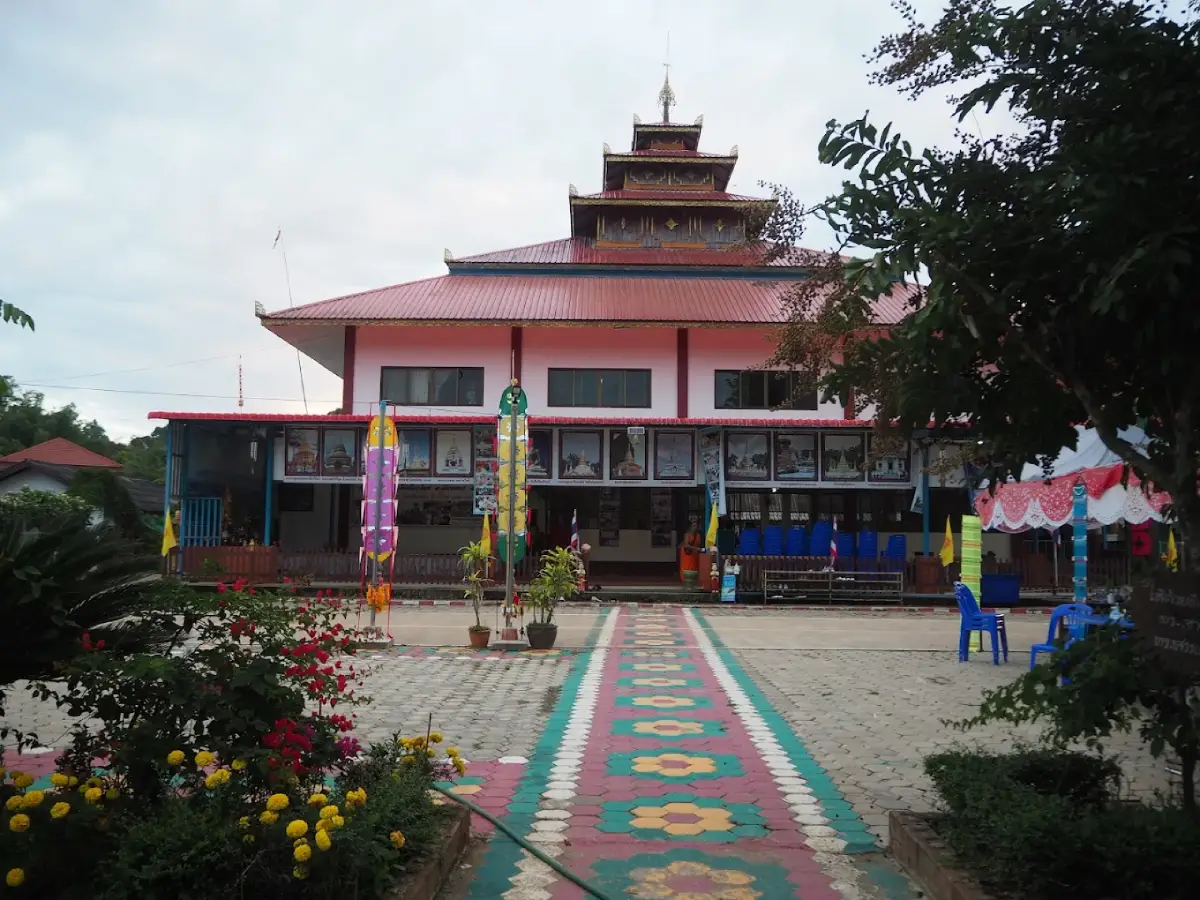
Wat Huai Khrai is a historic Buddhist community temple in Ban Huai Khrai, Piang Luang Subdistrict, Wiang Haeng District, Chiang Mai Province. Established in B.E. 2472, equivalent to 1929, the temple remains an active religious institution within the Maha Nikaya order. Its most distinctive historically recorded features include a Shan-style monks' residence, a sermon hall, and a viharn. The temple remains closely connected with Ban Huai Khrai and the wider multicultural landscape of Piang Luang, where Northern Thai, Shan, Yunnanese Chinese, and other communities have lived along the Thai–Myanmar border for generations.
Wat Huai Khrai lies within the mountainous northern part of Chiang Mai Province. Wiang Haeng is characterized by valleys surrounded by forested mountains, agricultural areas, streams, and small settlements connected by winding roads. Traveling to the temple therefore offers a very different experience from visiting the major temples of Chiang Mai city. Here, Buddhist architecture exists within a living highland village rather than an urban heritage district.
Older temple records place Wat Huai Khrai in Ban Huai Khrai, Moo 3, Piang Luang Subdistrict. Later administrative records identify Ban Huai Khrai under a different village number following changes in local administrative boundaries. For present-day travel, the most reliable location description is Ban Huai Khrai, Piang Luang Subdistrict, Wiang Haeng District, Chiang Mai 50350.
The temple was founded in 1929 during the late reign of King Prajadhipok. At that time, Wiang Haeng was considerably more isolated from Chiang Mai city than today. Mountain roads were difficult, and local communities depended heavily on temples for religious ceremonies, education, community gatherings, and social support. Establishing a temple was therefore an essential part of creating a stable village community.
Historical information records an original temple area of 4 rai, 2 ngan, and 40 square wah. The northern boundary extended approximately 180 wa toward a road and village, while the southern boundary met a road. The eastern side also bordered a road and village, and the western side met a stream and forest. This arrangement clearly demonstrates the temple's original position between settlement and nature.
The name Huai Khrai is directly connected with Ban Huai Khrai and the local landscape. In Thai, “huai” refers to a stream, and historical boundary descriptions confirm the presence of a stream along the western side of the temple property. Like many northern Thai settlements, the place name therefore reflects a natural feature that shaped community life long before modern roads and mapping systems were established.
Wat Huai Khrai should also be understood as part of a network of temples across Piang Luang. Neighboring communities such as Ban Muang Khruea, Ban Chong, Ban Piang Luang, and Ban Paek Saem developed their own Buddhist institutions. Together, these temples form a religious landscape distributed across the valley, linking villages through ceremonies, monastic administration, Buddhist education, and seasonal merit-making.
Piang Luang is culturally distinctive because of its proximity to Shan State in Myanmar. Shan, Northern Thai, Yunnanese Chinese, and other communities have contributed to the area's cultural identity. Language, food, religious architecture, festivals, and settlement patterns therefore reveal influences that are less visible in central Chiang Mai. Wat Huai Khrai reflects this borderland character most clearly through its Shan-style monastic architecture.
The Shan-style monks' residence is the temple's most distinctive historically recorded architectural feature. Shan Buddhist architecture developed through cultural connections with Shan State and Myanmar and often differs from mainstream Lanna architecture in roof form, proportions, and decorative details. The presence of a Shan-style residence at Wat Huai Khrai provides tangible evidence of the community's cultural connections across the northern borderlands.
A monks' residence is not merely an architectural object. It is the living space where monks study, rest, chant, and carry out everyday monastic routines. In a community temple, residential buildings are fundamental to the continuity of Buddhist life because they allow monks to remain in the village throughout the year, including during the annual rains retreat.
The sermon hall is another important structure recorded in the temple's history. It provides space for sermons, merit-making ceremonies, community meetings, and larger gatherings of lay Buddhists. In rural northern Thailand, sermon halls often serve a broader social function because they are among the few community buildings capable of accommodating many people at the same time.
The viharn forms the devotional heart of the temple. Historical records indicate that a new viharn was under construction during an earlier period of the temple's development, demonstrating that the community continued to invest in and renew its religious buildings. A viharn is normally used for worship, chanting, sermons, and ceremonies centered on the principal Buddha image.
Visitors who want to understand Wat Huai Khrai should observe the relationship between the viharn, sermon hall, monks' residence, temple courtyard, surrounding village, and nearby natural landscape. The temple's value lies less in monumental scale than in the fact that its buildings have supported community Buddhist life for generations.
Ban Huai Khrai also has an active local school. Ban Huai Khrai School continues to provide early childhood and primary education under Chiang Mai Primary Educational Service Area Office 3. The presence of both a functioning school and an active temple illustrates the basic social structure of the village: families, education, religion, and community remain physically and socially connected.
Historical temple records preserve a long succession of abbots. Phra Tong Dhammavaro served from B.E. 2492 to 2499. He was followed by Phra Kumala Dipako from B.E. 2499 to 2508, Phra Bunpeng Dullabho from B.E. 2508 to 2511, Phra Ti Dantakayo from B.E. 2511 to 2515, Phra Nanta Dhammadharo from B.E. 2515 to 2522, Phra Chanthun Vijayo from B.E. 2522 to 2524, Phra Naling Vijittadhammo from B.E. 2524 to 2525, and Phra Kralingta Kiccasaro from B.E. 2525 according to the earlier temple record.
These names are culturally significant because several reflect naming patterns associated with Shan Buddhist communities. The uninterrupted succession of monastic leadership from the post-war period onward also demonstrates that Wat Huai Khrai developed into a stable religious institution despite its remote mountain location.
Contemporary records from Thailand's National Office of Buddhism identify Phrakhru Thirakit Koson, Suthiro with Wat Huai Khrai in Piang Luang, Wiang Haeng. He appears in Chiang Mai monastic administrative records, and the publicly listed contact number associated with the temple is 089-455-4577. This provides a contemporary link between the temple's historical line of abbots and its continuing role in the modern Sangha administration.
The presence of a senior monastic administrator means the temple participates in responsibilities extending beyond local ritual life. Thai Sangha administrators contribute to monastic governance, Buddhist education, religious propagation, and community support. Wat Huai Khrai therefore functions within a wider district and provincial Buddhist network.
Buddhist education remains important in remote communities such as Wiang Haeng. Monks study Buddhist doctrine and discipline through the national ecclesiastical education system, while villagers attend sermons and religious activities on Buddhist observance days. The village school provides secular education, while the temple continues the religious dimension of learning.
Piang Luang's annual cultural calendar contains many Buddhist traditions. Shan communities are particularly associated with Poy Sang Long novice ordination, while Songkran, Buddhist Lent, the end of Buddhist Lent, Kathin robe offerings, and community merit-making remain important throughout northern Thailand. Local temples provide the religious spaces that allow these traditions to continue.
Poy Sang Long is one of the best-known Shan Buddhist traditions. Boys preparing for novice ordination are dressed elaborately as “crystal sons” before entering monastic life. The ceremony brings together families, monks, relatives, musicians, and local residents, transforming novice ordination into an important expression of community identity and religious merit.
Songkran, or the northern New Year period, also demonstrates the close relationship between temples and local communities. Residents make merit, pay respect to Buddha images, ask blessings from elders, and participate in traditional water rituals. In culturally mixed areas such as Piang Luang, local practices can include both Lanna and Shan elements.
During Buddhist Lent, monks remain in residence and villagers regularly bring food and other offerings. After the rains retreat ends, Kathin and other merit-making ceremonies help support temples financially and socially. Contributions from villagers often fund maintenance, renovations, and new buildings. The historical construction of a new viharn at Wat Huai Khrai fits naturally within this tradition of collective temple support.
Wat Huai Khrai is particularly suitable for travelers interested in living community culture rather than major tourist monuments. The temple does not depend on large commercial tourism facilities. Its atmosphere remains quiet and closely tied to local religious life. Visitors can worship, observe Shan-influenced architecture, and experience the rhythm of a genuine mountain community.
Architecture enthusiasts should compare the Shan-style monks' residence with structures at Wat Makayon, Wat Piang Luang, and other Shan-influenced temples across the subdistrict. Doing so reveals that Buddhist architecture in Wiang Haeng is not uniform. Lanna, Shan, and Burmese influences overlap in ways that reflect the long history of movement across the northern border.
Wat Muang Khruea and Wat Makayon are particularly useful companion visits. Wat Muang Khruea traces its history to 1905, while Wat Makayon was founded in 1927 and is known for Shan-style architecture. Wat Huai Khrai followed in 1929. Visiting these temples together helps illustrate how Buddhist institutions expanded alongside communities in Piang Luang during the early twentieth century.
Ban Piang Luang is another natural extension of the route. As the main community center in the subdistrict, it has restaurants, cafes, accommodation, schools, and a strong Shan and Yunnanese Chinese cultural presence. Travelers can use Piang Luang as a base for exploring the surrounding temples and mountain landscape.
Xinglongshan Viewpoint adds a scenic component to a cultural itinerary. Morning and late afternoon are particularly suitable for viewing the surrounding mountains and valleys. A practical route is to visit Wat Huai Khrai and neighboring temples during the morning and midday before continuing to Ban Piang Luang and the viewpoint later in the day.
Wat Fa Wiang In is another important temple associated with Shan culture and the border region. Travelers spending two days in Wiang Haeng can explore Wat Huai Khrai and southern Piang Luang communities on the first day before continuing farther toward the border area on the second. Access regulations near the international border should always be respected.
Food options have expanded in Piang Luang in recent years. Krua Piang Luang Restaurant is an established local restaurant, while Chomview Cafe, Long Oei Cafe, Pang Luang Cafe, Little Happiness, and Boonpan Coffee provide additional options for drinks, desserts, and light meals. Because small businesses in mountain communities often close earlier than city restaurants, planning meals before late evening is advisable.
Accommodation is available in the wider Piang Luang area. Baan Suan Chomview Resort, Baan Rabiang Mai Resort, and Huean Mok Kham Resort are among the available options. Staying overnight is particularly useful for travelers who want to visit several temples without rushing or driving mountain roads after dark.
The cool season from late year into early year is generally the most comfortable time to visit. Wiang Haeng's elevation creates cooler temperatures than central Chiang Mai, and mist is common on some mornings. The rainy season brings lush green scenery but also wet roads and reduced visibility on mountain sections.
Visitors should dress modestly and remember that Wat Huai Khrai is an active religious site. Shoes should be removed where required, noise should be kept low, and monks' residential areas should be respected. Permission should be requested before taking close photographs of monks or community ceremonies.
Photography is most rewarding when the temple is shown within its surrounding landscape. Village roads, forest, streams, mountain backdrops, and temple buildings together explain Wat Huai Khrai's character better than isolated architectural details alone.
From a historical perspective, Wat Huai Khrai provides evidence of the growth of Ban Huai Khrai before the Second World War. Founded in 1929, the temple has a documented sequence of abbots from the late 1940s and remains connected to contemporary Sangha administration today. This continuity is one of its most important characteristics.
The natural environment is equally significant. Historical boundaries identify a stream and forest along the western side of the temple land. This shows how closely the monastery was integrated into the ecological system that supported village life through water, forest resources, and agriculture.
The continued operation of Ban Huai Khrai School provides further evidence that this is a living community rather than a heritage settlement frozen in the past. Families and children continue to reside in the village, while the temple and school maintain complementary roles in community life.
A practical first-time itinerary can begin at Wat Huai Khrai in the morning, continue to Wat Muang Khruea and Wat Makayon, and then proceed to Ban Piang Luang for lunch. In the afternoon, travelers can explore the community or visit Xinglongshan Viewpoint. Those staying overnight can continue to Wat Fa Wiang In and other Wiang Haeng attractions the following day.
Wat Huai Khrai is best suited to travelers who value local history, Shan culture, vernacular Buddhist architecture, and community-based travel. Its simplicity is part of its appeal. Rather than functioning as a major tourist landmark, it allows visitors to see how a temple continues to serve a mountain village in everyday life.
A visit also reveals the cultural diversity of Chiang Mai Province. Beyond the Lanna traditions most commonly associated with the old city, Wiang Haeng contains Shan, Yunnanese Chinese, and other cultural influences created by generations of movement across the northern borderlands.
Responsible travel is particularly important in small communities. Using local restaurants and accommodation helps distribute tourism income, while respecting temple rules, keeping the area clean, and avoiding disruption of religious ceremonies protects the community atmosphere that makes the destination valuable.
Getting There from Chiang Mai city is easiest by private car or rental vehicle. Travel north toward Chiang Dao before taking the mountain route into Wiang Haeng District, then continue toward Piang Luang along Provincial Highway 1178. The temple appears on mapping systems as Wat Huai Khrai. The route includes extensive mountain curves, so brakes, tyres, fuel, and general vehicle condition should be checked before departure. Daytime travel is preferable.
For travelers coming from Chiang Mai city, staying at least one night in Piang Luang or Wiang Haeng is generally more comfortable than attempting a rushed same-day return. An overnight stay also allows visitors to experience the cooler morning atmosphere of the valley and explore additional temples and viewpoints.
Wat Huai Khrai can ultimately be understood as both a historical record and a living Buddhist institution. Founded in 1929 on land traditionally recorded as 4 rai, 2 ngan, and 40 square wah, it preserves Shan-influenced architecture, a sermon hall, a viharn, a long succession of abbots, and contemporary monastic administration. Together, these elements make it a meaningful cultural stop for anyone seeking a deeper understanding of Piang Luang and Wiang Haeng.
| Name | Wat Huai Khrai |
| Temple Type | Public Buddhist Temple, Maha Nikaya Order |
| Location | Ban Huai Khrai, Piang Luang Subdistrict, Wiang Haeng District, Chiang Mai Province 50350, Thailand |
| Main Access Road | Provincial Highway 1178, Piang Luang, Wiang Haeng, Chiang Mai |
| Established | B.E. 2472 / 1929 |
| Historical Temple Area | 4 rai, 2 ngan, and 40 square wah |
| Historical Boundaries | Roads and village to the north and east, road to the south, and stream and forest to the west |
| Highlights | Historic Piang Luang community temple distinguished by Shan-style monastic architecture and its long connection with Ban Huai Khrai |
| Important Structures | Shan-style Monks' Residence, Sermon Hall, and Viharn |
| Historical Abbots | 1. Phra Tong Dhammavaro, B.E. 2492-2499 2. Phra Kumala Dipako, B.E. 2499-2508 3. Phra Bunpeng Dullabho, B.E. 2508-2511 4. Phra Ti Dantakayo, B.E. 2511-2515 5. Phra Nanta Dhammadharo, B.E. 2515-2522 6. Phra Chanthun Vijayo, B.E. 2522-2524 7. Phra Naling Vijittadhammo, B.E. 2524-2525 8. Phra Kralingta Kiccasaro, from B.E. 2525 according to the historical temple record |
| Current Abbot / Sangha Administrator | Phrakhru Thirakit Koson, Suthiro |
| Main Contact Number | 089-455-4577 |
| Open Days | Daily |
| Opening Hours | 08.00 – 17.00 |
| Current Status | Active Buddhist temple within the contemporary Sangha administration |
| Travel Information | Travel from Chiang Mai via Chiang Dao and Wiang Haeng, then continue along Provincial Highway 1178 toward Piang Luang. Private car or rental vehicle is recommended, preferably during daylight. |
| Nearby Tourist Attractions | 1. Wat Muang Khruea, about 2 km 2. Wat Makayon, about 3 km 3. Ban Piang Luang, about 4 km 4. Xinglongshan Viewpoint, about 5 km 5. Wat Piang Luang, about 5 km 6. Wat Fa Wiang In, about 8 km |
| Nearby Restaurants & Cafes | 1. Chomview Cafe, about 1 km, Tel. 093-278-7501 2. Long Oei Cafe, about 2 km, Tel. 085-033-8198 3. Krua Piang Luang Restaurant, about 4 km, Tel. 086-665-6607 4. Little Happiness, about 4 km, Tel. 085-998-2426 5. Pang Luang Cafe, about 4 km, Tel. 088-267-3365 6. Boonpan Coffee, about 5 km, Tel. 084-165-4109 |
| Nearby Accommodations | 1. Baan Suan Chomview Resort, about 2 km, Tel. 084-487-5399 2. Baan Rabiang Mai Resort, about 3 km 3. Huean Mok Kham Resort, about 4 km, Tel. 083-260-5222 4. Local Accommodation in Ban Piang Luang, about 4 km 5. Guesthouses in Central Ban Piang Luang, about 4-5 km |
Frequently Asked Questions (FAQ)
Q: Where is Wat Huai Khrai located?
A: Wat Huai Khrai is located in Ban Huai Khrai, Piang Luang Subdistrict, Wiang Haeng District, Chiang Mai Province 50350, near Provincial Highway 1178.
Q: When was Wat Huai Khrai established?
A: Wat Huai Khrai was established in B.E. 2472, equivalent to 1929, and has served the Ban Huai Khrai community for nearly a century.
Q: What is special about Wat Huai Khrai?
A: Its distinctive features include a Shan-style monks' residence, a sermon hall, a viharn, and its long connection with the multicultural border communities of Wiang Haeng.
Q: Who is the current abbot or temple administrator?
A: Contemporary National Office of Buddhism records identify Phrakhru Thirakit Koson, Suthiro, with Wat Huai Khrai. The publicly listed contact number is 089-455-4577.
Q: What are the opening hours of Wat Huai Khrai?
A: The temple is open daily from 08.00 to 17.00. Visitors should respect ongoing religious and community activities.
Q: What attractions can be combined with Wat Huai Khrai?
A: Nearby destinations include Wat Muang Khruea, Wat Makayon, Ban Piang Luang, Wat Piang Luang, Xinglongshan Viewpoint, and Wat Fa Wiang In.
Q: What type of traveler will appreciate Wat Huai Khrai?
A: It is particularly suitable for travelers interested in historic temples, Shan architecture, border communities, ethnic culture, and quieter parts of Chiang Mai Province.
Q: Is an overnight stay recommended?
A: Yes. Travelers coming from Chiang Mai city will have more time to explore Piang Luang and avoid mountain driving after dark by staying at least one night in the area.
 Category: ●Places of Worship
 Group: ●Temple
Last Update : 2 DayAgo
 Last Update : 2 DayAgo
 Click to Access the Navigation Map GPS
Wat Huai Khrai Map
Recommend

 Muang Chiang Mai(121)Chom Thong(47)Mae Chaem(25)Chiang Dao(33)Doi Saket(68)Mae Taeng(85)Mae Rim(69)Samoeng(29)Fang(71)Mae Ai(59)Phrao(70)San Pa Tong(103)San Kamphaeng(66)San Sai(73)Hang Dong(73)Hot(32)Doi Tao(22)Omkoi(11)Saraphi(74)Wiang Haeng(15)Chai Prakan(28)Mae Wang(32)Mae On(22)Doi Lo(34)Galyani Vadhana(1)


