
lovethailand home >North Travel Attractions >Chiang Mai Travel Attractions >Mae Ai >Mae Ai > Wat Niwas Sathan (Ban Hong)
TL;DR: Wat Niwas Sathan (Ban Hong) is located at 300 Moo 8, Mae Ai Subdistrict, Mae Ai District, Chiang Mai Province, open Daily, hours 08.00 – 17.00.
Wat Niwas Sathan (Ban Hong)
Open Days: Daily
Opening Hours: 08.00 – 17.00
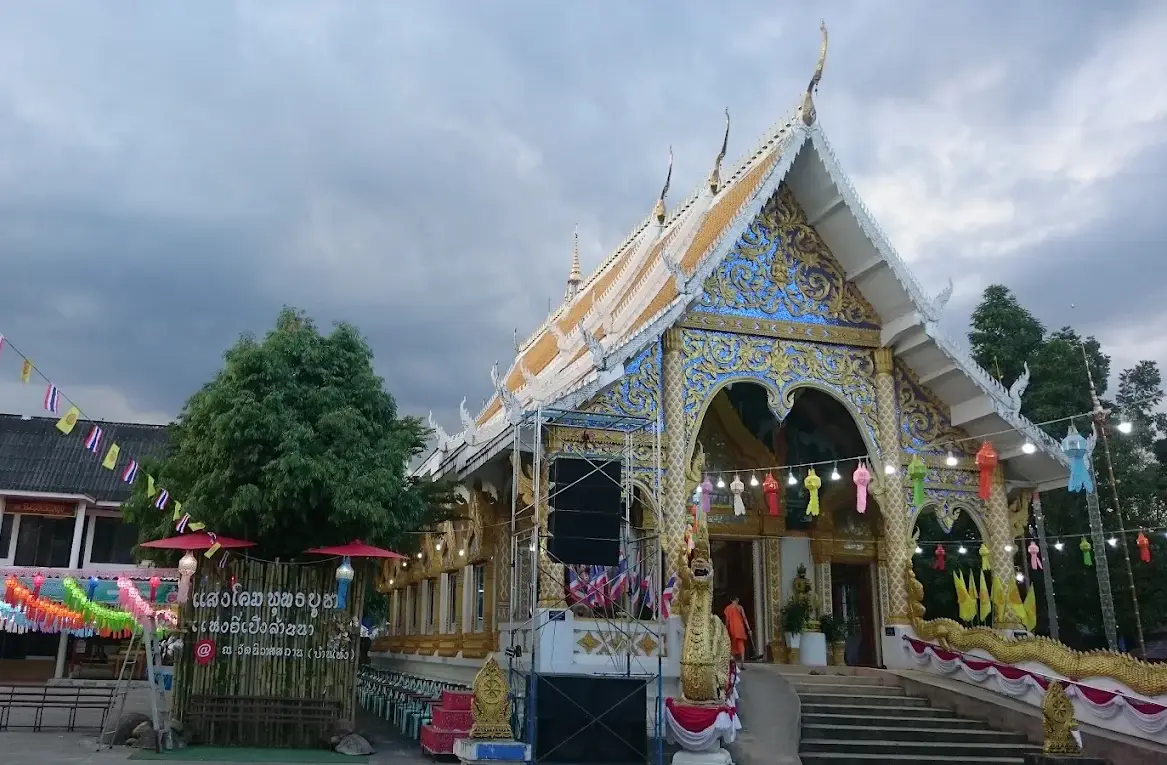
Wat Niwas Sathan (Ban Hong) is a Maha Nikaya Buddhist temple located at 300 Moo 8, Mae Ai Subdistrict, Mae Ai District, Chiang Mai Province. Also known locally as Wat Ban Hong, this community temple is valued for its graceful ordination hall, bright yellow-tiled roof, serene Buddha images, Vessantara Jataka murals, and a peaceful temple environment suitable for worship, merit-making, and meditation.
Wat Niwas Sathan is closely connected with the Ban Hong community in Mae Ai. The temple is not a large commercial tourist attraction; its strength lies in its role as a living community temple where local people continue to make merit, practice Buddhism, and gather for religious activities. Travelers who want to understand Mae Ai beyond its main tourist sites will find this temple meaningful and culturally grounded.
The temple is situated in northern Chiang Mai, within a travel corridor that connects Fang, Mae Ai, Tha Ton, and Chiang Rai. This makes Wat Niwas Sathan a suitable cultural stop for travelers following the Fang–Mae Ai–Tha Ton route. It can be combined with nearby temples, riverside attractions, orchards, and community-based destinations in the Mae Ai area.
Wat Niwas Sathan received its royal consecrated boundary on 9 February 1973. In Thai Buddhism, a consecrated boundary is essential for formal monastic ceremonies, especially those connected with the ordination hall. This confirms the temple’s religious status and its long-standing function as an important Buddhist site for the local community.
The early history of the temple is associated with Phra Bandit Arindaro, who served as the first abbot around 1917 to 1921. The first abbot played an important role in laying the foundations of the temple, guiding the local Buddhist community, and establishing the temple as a center for worship, teaching, and village merit-making.
Today, Wat Niwas Sathan is associated with Phra Khru Wisit Sutanukun, also known as Phra Khru Palat Oros Wachiramethi, who serves as the abbot. He is connected with the ecclesiastical lineage of Phra Thep Mangalajarn of Wat Tha Ton Royal Temple. In a community temple, the abbot plays an essential role in maintaining the temple grounds, leading Buddhist activities, and supporting the spiritual life of local residents.
The name “Niwas Sathan” suggests a place of peaceful residence or spiritual refuge. This meaning fits the temple’s atmosphere well. The grounds are clean, shaded by trees, and suitable for quiet reflection. Visitors can experience the calm rhythm of a northern Thai village temple without the crowded feeling of major tourist landmarks.
The ordination hall is one of the most notable features of Wat Niwas Sathan. Its bright yellow-tiled roof gives the building a distinctive and uplifting appearance. The color creates a sense of clarity and devotion, while the hall itself serves as the central sacred space for worship and monastic ceremonies.
Inside the ordination hall, the Buddha images are dignified and serene. Visitors come here to pay respect, make merit, sit quietly, and reflect. The space should be entered with proper respect, modest clothing, and calm behavior. As an active Buddhist temple, Wat Niwas Sathan should be treated first as a place of worship.
The Vessantara Jataka murals inside the ordination hall add significant cultural and religious value. The Vessantara Jataka is one of the most important Buddhist stories in Thai tradition. It teaches generosity, sacrifice, and the perfection of giving. These murals make the ordination hall not only a sacred space but also a visual teaching space where Buddhist values are communicated through art.
The murals also connect the temple with the broader Thai and Lanna tradition of Buddhist storytelling. In northern communities, stories from the Jataka tradition have long been used to teach moral values and strengthen faith. At Wat Niwas Sathan, the murals help preserve this connection between art, teaching, and community devotion.
The temple grounds are clean, orderly, and shaded by trees. This atmosphere makes the temple suitable for meditation, quiet visits, and merit-making. Visitors who prefer peaceful local temples over crowded attractions will appreciate the calm environment of Wat Niwas Sathan.
Wat Niwas Sathan also plays a role in meditation and community merit-making activities. The temple has been associated with novice ordination programs, robe-offering activities, drinking water donations, fish-release merit-making, and other religious support projects. These activities show that the temple continues to function as a living religious center, not merely as a historic site.
The temple’s merit-making activities reflect its importance to the community. Ceremonies such as Kathin, robe offerings, novice ordination, and support for temple facilities bring local people and donors together. Through these activities, the temple helps sustain the relationship between monks, laypeople, and the wider Buddhist community.
In Lanna culture, temples are central to community identity. They are spaces for seasonal ceremonies, moral learning, meditation, and social connection. Wat Niwas Sathan reflects this role clearly. It is a community temple where faith, local life, and Buddhist practice remain closely connected.
Key things to see at Wat Niwas Sathan include the ordination hall with its yellow-tiled roof, the Buddha images inside the hall, the Vessantara Jataka murals, the clean temple courtyard, and the shaded meditation-friendly atmosphere. The temple is especially suitable for travelers interested in local temples, Buddhist art, and quiet cultural routes in northern Chiang Mai.
Visitors should dress modestly, speak quietly, and avoid disturbing monks, local residents, or people practicing meditation. Photography should be done with care, especially inside sacred buildings. The best way to visit the temple is to slow down, pay respect, and observe the calm setting of a living Buddhist community.
Wat Niwas Sathan can be included in a Mae Ai itinerary with Wat Mae Ai Luang, Wat Phra That Pu Chae, Wat Tha Ton Royal Temple, Tha Ton Boat Pier, Thanathon Orchard, and Roi Jai Rak Project. This route combines local temples, Buddhist art, riverside scenery, orchards, and community-based travel in one northern Chiang Mai journey.
Getting There is most convenient by private car. From Chiang Mai city, travel north via Mae Rim, Chiang Dao, Fang, and Mae Ai, then continue to Moo 8 in Mae Ai Subdistrict. From Chiang Rai, travelers can approach Mae Ai via Mae Chan and Tha Ton. Public transport users can take a bus or van toward Fang or Tha Ton and then use local transport for the final section to the temple.
For a half-day trip, visitors can start at Wat Niwas Sathan and continue to Wat Mae Ai Luang or Wat Phra That Pu Chae before heading toward Tha Ton. For a full-day route, add Wat Tha Ton Royal Temple, Tha Ton Boat Pier, Thanathon Orchard, and Roi Jai Rak Project. This route offers a balanced combination of temples, Lanna culture, riverside views, and local food.
Wat Niwas Sathan is a worthwhile temple for travelers who want to experience Mae Ai through faith, art, and local community life. Its ordination hall, murals, Buddha images, shaded grounds, and active religious role make it a meaningful stop in northern Chiang Mai.
| Name | Wat Niwas Sathan (Ban Hong) |
| Location | 300 Moo 8, Mae Ai Subdistrict, Mae Ai District, Chiang Mai Province |
| Address | 300 Moo 8, Mae Ai Subdistrict, Mae Ai District, Chiang Mai 50280, Thailand |
| Highlights | Graceful ordination hall with a bright yellow-tiled roof, serene Buddha images, Vessantara Jataka murals, and a shaded meditation-friendly atmosphere |
| History | Long-standing Ban Hong community temple; received its royal consecrated boundary on 9 February 1973; Phra Bandit Arindaro served as the first abbot around 1917 – 1921 |
| Name Origin | The name suggests a peaceful residence or spiritual refuge, matching the temple’s role as a place for worship, merit-making, and meditation |
| Distinctive Features | A beautiful local temple with Buddhist art, clean grounds, trees, and a calm environment suitable for meditation and respectful cultural visits |
| Travel Information | Accessible by private car via Chiang Mai – Mae Rim – Chiang Dao – Fang – Mae Ai, or from Chiang Rai via Mae Chan and Tha Ton; local transport is needed for the final section |
| Current Status | Active community temple, Buddhist site, and meditation-related religious space in Mae Ai Subdistrict |
| Open Days | Daily |
| Opening Hours | 08.00 – 17.00 |
| Facilities | Temple courtyard, merit-making area, meditation space, and toilets for temple visitors |
| Main Areas / Zones | Ordination hall, Buddha images inside the ordination hall, Vessantara Jataka murals, temple courtyard, and meditation area |
| Abbot / Caretaker | Phra Khru Wisit Sutanukun, also known as Phra Khru Palat Oros Wachiramethi |
| Main Contact Number | 089-950-7538, 053-459-811 |
| Official Website / Official Page | facebook.com/NivassathanTemple |
| Nearby Tourist Attractions | 1. Wat Mae Ai Luang, about 3 km 2. Wat Phra That Pu Chae, about 6 km 3. Wat Tha Ton Royal Temple, about 15 km 4. Tha Ton Boat Pier, about 16 km 5. Thanathon Orchard, about 16 km 6. Roi Jai Rak Project, about 23 km |
| Nearby Restaurants | 1. Chonglak Khao Man Kai Ton, about 2 km, Tel. 095-687-8225 2. Mae Amara Cooked-to-Order Restaurant, about 5 km, Tel. 093-264-6864 3. De’ Love Tree Cafe & Restaurant Thaton Mae Ai, about 14 km, Tel. 061-419-5835 4. Sunshine Cafe Thaton, about 15 km, Tel. 094-619-3599 5. Sane Chai Nam Thaton, about 16 km, Tel. 087-177-1727 6. Tha Ton River View, about 16 km, Tel. 053-459-289, 053-373-173-5, 093-256-7969 |
| Nearby Accommodations | 1. Thaton Hill Resort, about 14 km 2. Saranya River House, about 16 km, Tel. 053-053-672, 089-851-7072 3. Areeya Phuree Resort, about 16 km 4. Thaton Beach Resort, about 16 km 5. Thaton River View Resort, about 16 km, Tel. 053-459-289, 053-373-173-5, 093-256-7969 6. Maekok River Village Resort, about 18 km, Tel. 053-053-628 |
Frequently Asked Questions (FAQ)
Q: Where is Wat Niwas Sathan located?
A: Wat Niwas Sathan is located at 300 Moo 8, Mae Ai Subdistrict, Mae Ai District, Chiang Mai Province 50280.
Q: Why is Wat Niwas Sathan important?
A: It is a Maha Nikaya community temple in Ban Hong, received its royal consecrated boundary on 9 February 1973, and remains an important Buddhist center for the Mae Ai community.
Q: What are the main highlights of Wat Niwas Sathan?
A: The main highlights are the yellow-roofed ordination hall, the Buddha images, the Vessantara Jataka murals, and the shaded temple grounds suitable for meditation.
Q: Is Wat Niwas Sathan open every day?
A: Yes. The temple is open daily from 08.00 to 17.00.
Q: What is the contact number for Wat Niwas Sathan?
A: The contact numbers for Wat Niwas Sathan are 089-950-7538 and 053-459-811.
Q: Is Wat Niwas Sathan suitable for meditation?
A: Yes. The temple has clean, shaded, and peaceful grounds and is associated with meditation and merit-making activities.
Q: What nearby attractions can travelers visit with Wat Niwas Sathan?
A: Nearby attractions include Wat Mae Ai Luang, Wat Phra That Pu Chae, Wat Tha Ton Royal Temple, Tha Ton Boat Pier, Thanathon Orchard, and Roi Jai Rak Project.
 Category: ●Places of Worship
 Group: ●Temple
Last Update : 2 WeekAgo
 Last Update : 2 WeekAgo
 Click to Access the Navigation Map GPS
Wat Niwas Sathan (Ban Hong) Map
Recommend

 Muang Chiang Mai(121)Chom Thong(47)Mae Chaem(25)Chiang Dao(33)Doi Saket(68)Mae Taeng(85)Mae Rim(69)Samoeng(29)Fang(71)Mae Ai(59)Phrao(70)San Pa Tong(103)San Kamphaeng(66)San Sai(73)Hang Dong(73)Hot(32)Doi Tao(22)Omkoi(11)Saraphi(74)Wiang Haeng(15)Chai Prakan(28)Mae Wang(32)Mae On(22)Doi Lo(33)Galyani Vadhana(1)


