
lovethailand home >North Travel Attractions >Chiang Mai Travel Attractions >Mae Ai >Mae Na Wang > Wat Sila At
TL;DR: Wat Sila At is located at Ban Khai Nok, Moo 15, Tambon Mae Na Wang, Mae Ai District, Chiang Mai Province, open Daily, hours 08.00 – 17.00.
Wat Sila At
Open Days: Daily
Opening Hours: 08.00 – 17.00
Wat Sila At is located at 168 Ban Khai Nok, Moo 15, Tambon Mae Na Wang, Mae Ai District, Chiang Mai Province. It is a local community temple under the Maha Nikaya order and one of the important Buddhist temples serving the Ban Khai Nok community. The temple was established in 1923 by Chao Pho Phaya Sit Kong Pingkham together with Phra Techa Chakaro, the abbot at that time, and the local devotees of Ban Khai Nok. Wat Sila At therefore grew directly from community faith and remains a spiritual center for worship, merit-making, Buddhist ceremonies, and village traditions.
Ban Khai Nok is a village in Tambon Mae Na Wang, Mae Ai District. The area is a rural northern Thai landscape shaped by waterways, irrigation channels, local roads, agricultural land, and village life. Wat Sila At is not an isolated tourist attraction. It is part of the living structure of the village, where home, temple, fields, water systems, and Buddhist practice remain closely connected.
Tambon Mae Na Wang has a local history connected with migration, settlement, agriculture, and the Mae Na Wang stream that runs through the area. This background gives the temple a wider cultural setting. Wat Sila At stands within a community where Lanna Buddhist traditions, farming life, local language, and village ceremonies continue to shape daily life.
The temple has long been known locally as Wat Khai Nok because it is the main temple of Ban Khai Nok. The later name Wat Sila At carries a more formal Buddhist meaning. “Sila” evokes morality, discipline, and firmness, while “At” can suggest a seat or sacred base. The name therefore reflects the temple’s role as a place of discipline, faith, and spiritual stability for the community.
The temple land covers 4 rai, 3 ngan, and 52 square wah, with title deed number 82. Its boundaries show how closely the temple is embedded in the village landscape. To the north and east are public irrigation channels, to the south is a rural road, and to the west is a village lane. This setting shows that the temple stands at the heart of local life, surrounded by the practical routes and water systems of the community.
Wat Sila At received its Wisungkham Sima on 24 March 1969. The boundary is 40 meters wide and 80 meters long. This is an important religious milestone because the Wisungkham Sima defines the consecrated area for formal Sangha acts, especially those connected with the ubosot. It confirms the temple’s formal Buddhist status and its ability to support monastic ceremonies properly.
Important structures at the temple include the viharn, ubosot, monks’ residences, Buddhist scripture school, Sila At community hall, bell tower, dining hall, temple courtyard, and community religious activity areas. These buildings show that Wat Sila At supports worship, monastic life, Buddhist education, community gatherings, and regular temple ceremonies.
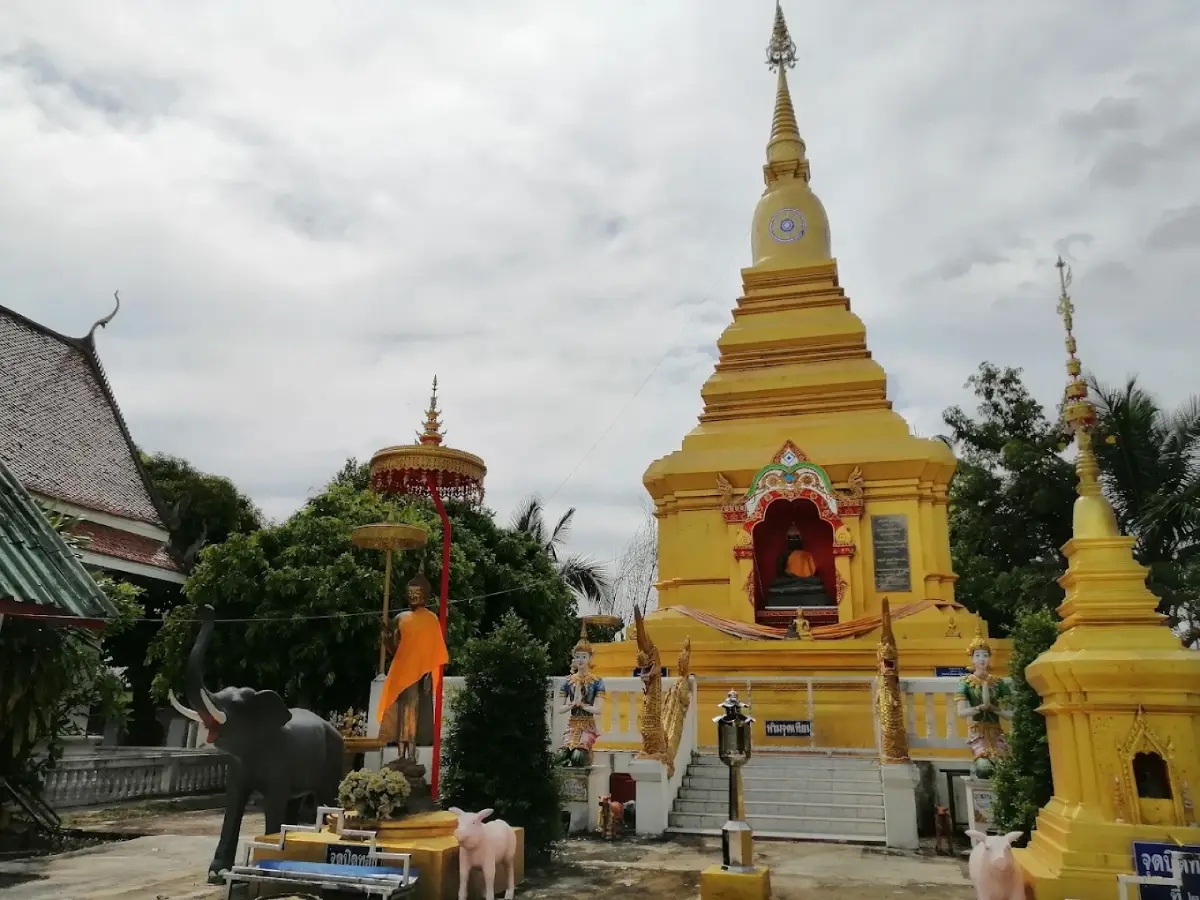
The important sacred site at Wat Sila At is Phra That Sam Suk, also known in connection with Wat Sila At Khai Nok. In northern Thai temple culture, a temple relic shrine often functions as a center of devotion for the local community. Visitors should begin by paying respect to the Buddha, worshipping the relic shrine, and spending time calmly within the temple compound.
Wat Sila At is listed in temple records with the temple code 350100406. It belongs to the Maha Nikaya order and is located in Tambon Mae Na Wang, Mae Ai District, Chiang Mai Province. This registry information helps distinguish it from other temples with similar names in other provinces or districts. Visitors should search for the temple together with Ban Khai Nok, Mae Na Wang, or Mae Ai to avoid confusion.
The temple has several roles in the community. Religiously, it is used for worship, merit-making, sermons, Sangha offerings, and Buddhist holy day observances. Socially, it provides a place where villagers meet, organize ceremonies, and support temple activities. Culturally, it helps maintain Lanna traditions and the memory of Ban Khai Nok.
One cultural activity associated with Wat Sila At is a Lanna rain-seeking ritual connected with the sermon of Matcha Phaya Pla Chon. Villagers once formed a procession from Wat Sila At to the Huai Chang Si reservoir for a ritual related to drought and the hope for rain. This shows that the temple’s role extends beyond its compound, linking Buddhist practice with water, rain, agriculture, and local belief.
In Lanna society, rain-seeking rituals arise from the close relationship between people and seasonal cycles. When rainfall is delayed or farming communities face drought, ritual, Buddhist sermons, and collective faith become a way to restore hope and community strength. Wat Sila At’s connection with such a ritual makes it culturally significant beyond ordinary temple worship.
Religious events connected with Wat Sila At include Buddhist holy day observances, Sangha offerings, sermons, Kathin after Buddhist Lent, forest robe offerings, Salak Phat, and other annual Buddhist activities. Salak Phat is an important Lanna merit-making tradition in Tambon Mae Na Wang, often rotating among villages and temples. These events bring villagers, monks, families, elders, and lay supporters together.
The Buddhist scripture school at Wat Sila At adds an educational dimension to the temple. The temple is not only a place of ceremony, but also a place where Buddhist knowledge, monastic discipline, and religious learning are transmitted. This makes the temple important for both faith and education in the local community.
Important things to see at Wat Sila At include Phra That Sam Suk, the viharn, ubosot, community hall, bell tower, dining hall, Buddhist scripture school, temple courtyard, and the atmosphere of Ban Khai Nok. Visitors should walk respectfully, observe quietly, and avoid disturbing monks or local residents during ceremonies.
The atmosphere of Wat Sila At is suitable for travelers who want to make merit, visit a long-standing village temple, and understand the relationship between Buddhism and Lanna rural life in Mae Ai District. Its value lies in its history, sacred site, monastic structures, community role, and connection with local rain-seeking ritual traditions.
Tambon Mae Na Wang has several Buddhist temples and religious sites, including Wat Chai Mongkhon, Wat Huai Muang, Wat Rong Ha Luang, Wat Phra That Sop Fang, Wat Thammikawat, Wat Nong Bua Ngam, Wat Doi Saeng Tham, Wat Den Chai, Wat Wang Hai, and Wat Champa Khao. This network of temples shows the continuing importance of Buddhism in the village life of the subdistrict.
For travel planning, Wat Sila At can be combined with nearby temples and attractions such as Wat Chai Mongkhon, Wat Huai Muang, Wat Rong Ha Luang, Wat Phra That Sop Fang, the sandy riverside area near Wat Phra That Sop Fang, Wat Tha Ton Royal Temple, Tha Ton Pier, Thanathon Orchard, and Malika Hot Spring. This route combines village temples, sacred sites, Kok River scenery, orchards, and nature-based recreation in Mae Ai District.
Getting There can be done by road from Chiang Mai city. Travel north on Highway 107 through Mae Rim, Mae Taeng, Chiang Dao, Chai Prakan, Fang, and into Mae Ai District. Continue to Tambon Mae Na Wang and Ban Khai Nok, Moo 15. The temple is best reached by private car, rental car, or local transport familiar with rural roads in Mae Ai District.
Visitors should travel during the daytime, dress modestly, speak quietly, and respect the temple as an active religious site. Do not enter monastic or restricted areas without permission, and do not touch sacred objects. During merit-making events, visitors should give priority to local residents and avoid interrupting ceremonies.
Wat Sila At is therefore a meaningful cultural and religious stop in Mae Ai District. Its establishment in 1923, connection with Ban Khai Nok, Phra That Sam Suk, viharn, ubosot, bell tower, Buddhist scripture school, and link with Lanna rain-seeking traditions make it a valuable community temple for merit-making, cultural learning, and deeper travel in northern Chiang Mai.
| Name | Wat Sila At |
| Local Name | Wat Khai Nok |
| Location | Ban Khai Nok, Moo 15, Tambon Mae Na Wang, Mae Ai District, Chiang Mai Province |
| Address | 168 Ban Khai Nok, Moo 15, Tambon Mae Na Wang, Mae Ai District, Chiang Mai 50280, Thailand |
| Temple Type | Community Temple Under The Maha Nikaya Order |
| Temple Code | 350100406 |
| History | Established in 1923 by Chao Pho Phaya Sit Kong Pingkham together with Phra Techa Chakaro and the local devotees of Ban Khai Nok |
| Temple Area | 4 rai, 3 ngan, 52 square wah, title deed no. 82 |
| Temple Boundaries | North: Public irrigation channel South: Rural road West: Village lane East: Public irrigation channel |
| Wisungkham Sima | Granted on 24 March 1969; 40 meters wide and 80 meters long |
| Important Sacred Site | Phra That Sam Suk of Wat Sila At Khai Nok |
| Main Structures / Areas | Viharn, ubosot, monks’ residences, Buddhist scripture school, community hall, bell tower, dining hall, temple courtyard, and community religious activity areas |
| Highlights | A long-standing Ban Khai Nok community temple with Phra That Sam Suk, ubosot, viharn, bell tower, Buddhist scripture school, and links with a Lanna rain-seeking ritual |
| What To See | Phra That Sam Suk, viharn, ubosot, community hall, bell tower, dining hall, Buddhist scripture school, and Ban Khai Nok village-temple atmosphere |
| Travel Information | From Chiang Mai, travel north on Highway 107 through Mae Rim, Mae Taeng, Chiang Dao, Chai Prakan, Fang, and Mae Ai, then continue to Tambon Mae Na Wang and Ban Khai Nok, Moo 15 |
| Current Status | Active community temple used for Buddhist worship, merit-making, local traditions, and Ban Khai Nok religious activities |
| Open Days | Daily |
| Opening Hours | 08.00 – 17.00 |
| Related Religious Events | Salak Phat, Kathin after Buddhist Lent, forest robe offerings, Buddhist holy day observances, Sangha offerings, sermons, and the Lanna rain-seeking ritual connected with the Matcha Phaya Pla Chon sermon |
| Community Context | Ban Khai Nok is part of Tambon Mae Na Wang, a rural Mae Ai community area shaped by streams, irrigation channels, agriculture, and Lanna Buddhist traditions |
| Local Coordination Contact | Mae Na Wang Subdistrict Administrative Organization, Tel. 0-5347-3010 |
| Nearby Tourist Attractions | 1. Wat Chai Mongkhon, about 2 km 2. Wat Huai Muang, about 4 km 3. Wat Rong Ha Luang, about 5 km 4. Wat Phra That Sop Fang, about 18 km 5. Wat Phra That Sop Fang Sandy River Area, about 19 km 6. Wat Tha Ton Royal Temple, about 20 km 7. Tha Ton Pier / Kok River Boat Route, about 20 km |
| Nearby Restaurants | 1. Khrua Khun Mae Moo Kratha, about 12 km 2. Tha Ton River View, about 20 km, Tel. 053-459-289, 053-373-173-5, 093-256-7969 3. Tha Ton Hill, about 21 km, Tel. 053-053-669 4. Baan Suan Chom Chan, about 21 km, Tel. 088-435-4467 5. Khun Mai Baan Suan Resort, about 22 km, Tel. 053-053-551, 088-952-6196 6. Nam Som Thanathon, about 22 km, Tel. 083-734-9555 |
| Nearby Accommodations | 1. Tha Ton River View Resort, about 20 km, Tel. 053-373-173 2. Tha Ton Chalet, about 20 km, Tel. 053-373-155 3. Tha Ton Hill Resort, about 21 km, Tel. 053-053-669 4. Khun Mai Baan Suan Resort, about 22 km, Tel. 053-053-551, 088-952-6196 5. Nicha Homestay Tha Ton, about 24 km, Tel. 093-549-7419 |
Frequently Asked Questions (FAQ)
Q: Where Is Wat Sila At Located?
A: Wat Sila At is located at 168 Ban Khai Nok, Moo 15, Tambon Mae Na Wang, Mae Ai District, Chiang Mai 50280, Thailand.
Q: When Was Wat Sila At Established?
A: Wat Sila At was established in 1923 by Chao Pho Phaya Sit Kong Pingkham, Phra Techa Chakaro, and local devotees of Ban Khai Nok.
Q: Why Is Wat Sila At Also Called Wat Khai Nok?
A: It is locally called Wat Khai Nok because it is the main temple of Ban Khai Nok and has served the community since its early history.
Q: What Are The Main Things To See At Wat Sila At?
A: Main features include Phra That Sam Suk, the viharn, ubosot, community hall, bell tower, dining hall, and Buddhist scripture school.
Q: When Did Wat Sila At Receive Its Wisungkham Sima?
A: The temple received its Wisungkham Sima on 24 March 1969, with a boundary 40 meters wide and 80 meters long.
Q: What Lanna Ritual Is Connected With Wat Sila At?
A: The temple is connected with a Lanna rain-seeking ritual and the Matcha Phaya Pla Chon sermon, reflecting the relationship between temple, community, water, rain, and agriculture.
Q: When Can Visitors Visit Wat Sila At?
A: The temple is open daily from 08.00 to 17.00.
Q: What Nearby Places Can Be Visited With Wat Sila At?
A: Nearby route options include Wat Chai Mongkhon, Wat Huai Muang, Wat Rong Ha Luang, Wat Phra That Sop Fang, the sandy riverside area near Wat Phra That Sop Fang, Wat Tha Ton Royal Temple, and Tha Ton Pier.
 Category: ●Places of Worship
 Group: ●Temple
Last Update : 2 WeekAgo
 Last Update : 2 WeekAgo
 Click to Access the Navigation Map GPS
 Muang Chiang Mai(121)Chom Thong(47)Mae Chaem(25)Chiang Dao(33)Doi Saket(68)Mae Taeng(85)Mae Rim(69)Samoeng(29)Fang(71)Mae Ai(59)Phrao(70)San Pa Tong(103)San Kamphaeng(66)San Sai(73)Hang Dong(73)Hot(32)Doi Tao(22)Omkoi(11)Saraphi(74)Wiang Haeng(15)Chai Prakan(28)Mae Wang(32)Mae On(22)Doi Lo(33)Galyani Vadhana(1)


