
lovethailand home >North Travel Attractions >Chiang Mai Travel Attractions >Mae Ai >Mae Na Wang > Wat Huai Muang (Mae Na Wang)
TL;DR: Wat Huai Muang (Mae Na Wang) is located at Ban Huai Muang, Tambon Mae Na Wang, Mae Ai District, Chiang Mai Province, open Daily, hours 08.00 – 17.00.

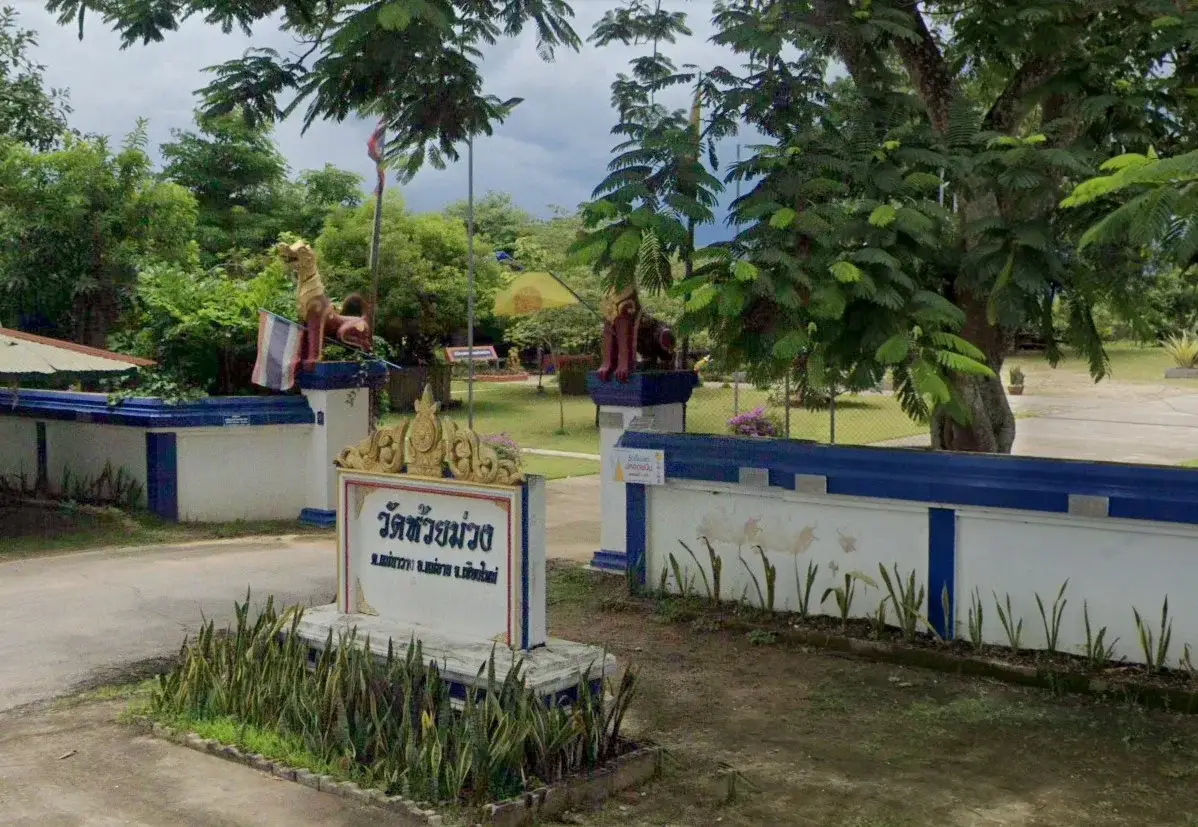
Wat Huai Muang (Mae Na Wang)
Open Days: Daily
Opening Hours: 08.00 – 17.00
Wat Huai Muang (Mae Na Wang) is located in Ban Huai Muang, Tambon Mae Na Wang, Mae Ai District, Chiang Mai Province. It is a local community temple under the Maha Nikaya order and was officially permitted as a Buddhist temple in 1941. The current abbot is Phra Athikan Worawut Thanuttaro. The temple remains an important spiritual center for Ban Huai Muang, supporting worship, merit-making, Buddhist ceremonies, and local community traditions.
Tambon Mae Na Wang is a rural area in Mae Ai District, northern Chiang Mai. Its landscape is shaped by streams, forests, agricultural land, and several village communities. The name Mae Na Wang is connected with the Mae Na Wang stream, which runs through the subdistrict and supports local livelihoods. Wat Huai Muang therefore belongs to a living rural landscape where Buddhism, agriculture, waterways, and village culture remain closely connected.
The name “Huai Muang” is connected with both local geography and village memory. “Huai” refers to a small stream or watercourse, while “Muang” is associated with a large wild mango tree remembered by older villagers. The temple name therefore preserves the relationship between the community, the stream, the tree, and the landscape of Ban Huai Muang.
Before it became known as Wat Huai Muang, the temple was called Wat San Ton Pao. It was later renamed to match the village name. This reflects a common pattern among northern Thai village temples, where the temple name is closely tied to the settlement, geography, or local memory of the community that supports it.
Wat Huai Muang was built in 1941, with Phra Duang Kham as the founding monk. The establishment of a village temple during this period reflected the community’s need for a central Buddhist space where residents could observe holy days, listen to sermons, make offerings, conduct ceremonies, and gather for local merit-making activities.
The temple land covers 5 rai and 20 square wah. Its boundaries are connected with fields, an irrigation channel, the local road, and surrounding farmland. To the north and west are rice fields, to the south is an irrigation channel, and to the east is a local road. This setting shows that Wat Huai Muang is deeply embedded in the agricultural landscape of Ban Huai Muang.
Important structures at Wat Huai Muang include the viharn, kitchen, monks’ residences, bowl hall, sermon hall, merit-making hall, temple courtyard, and community activity areas. These structures support both monastic life and lay Buddhist practice. The sermon hall and merit-making hall are especially important for community ceremonies, Buddhist teachings, and gatherings of lay supporters.
The main sacred object of the temple is a brass Buddha image in the meditation posture. This Buddha image serves as a spiritual focus for villagers and visitors. Travelers visiting Wat Huai Muang should begin by paying respect to the Buddha image calmly and respectfully before walking around the temple compound.
Wat Huai Muang is listed in temple records with the temple code 350100407. It belongs to the Maha Nikaya order and is located in Tambon Mae Na Wang, Mae Ai District, Chiang Mai Province. This official registry information helps distinguish it from other temples with the same name in other districts or provinces.
The temple plays several roles in community life. Religiously, it is used for worship, sermons, alms-giving, Sangha offerings, and Buddhist holy day observances. Socially, it is a meeting place during merit-making events and temple festivals. Culturally, it helps maintain Lanna Buddhist traditions and the relationship between temple, village, and local identity.
Religious events connected with Wat Huai Muang include Buddhist holy day activities, Sangha offerings, sermons, Kathin after Buddhist Lent, forest robe offerings, Salak Phat, and regular merit-making ceremonies. Salak Phat is an important Lanna Buddhist tradition in which villagers prepare offerings and requisites to be offered to monks by lot. In Tambon Mae Na Wang, this tradition rotates among communities and remains part of the local merit-making calendar.
As abbot, Phra Athikan Worawut Thanuttaro plays an important role in maintaining temple life, leading religious activities, and coordinating with lay supporters. A village temple depends on cooperation between monks, residents, elders, youth, temple committees, and devotees. Wat Huai Muang continues through this ongoing relationship between monastic leadership and community faith.
The atmosphere of Wat Huai Muang is suitable for travelers who want to make merit and experience a quiet local temple rather than a large tourist landmark. Its value lies in its long history, its community role, its sacred Buddha image, and its place within the everyday religious life of Ban Huai Muang.
Important things to see at Wat Huai Muang include the brass Buddha image in meditation posture, the viharn, sermon hall, merit-making hall, bowl hall, monks’ residences, temple courtyard, and the surrounding village atmosphere. Visitors should take time to observe how the temple is positioned among local roads, fields, and water channels.
Tambon Mae Na Wang has many temples and religious sites, including Wat Sila At, Wat Thammikawat, Wat Nong Bua Ngam, Wat Chai Mongkhon, Wat Rong Ha, Wat Huai Muang, Wat Doi Saeng Tham, Wat Den Chai, Wat Phra That Saeng Rung, Wat Phra That Sop Fang, Wat Wang Hai, and Wat Champa Khao. This network of temples shows the continuing importance of Buddhism in village life across the subdistrict.
For travel planning, Wat Huai Muang can be combined with Wat Rong Ha Luang, Wat Phra That Sop Fang, the sandy riverside area near Wat Phra That Sop Fang, Wat Tha Ton Royal Temple, Tha Ton Pier, Thanathon Orchard, and Malika Hot Spring. This route combines village temples, sacred sites, river scenery, orchards, and relaxation spots in Mae Ai District.
Wat Phra That Sop Fang is especially worth adding to the same route. It is an important sacred site in Tambon Mae Na Wang, located on Doi Sop Fang beside the Kok River. The nearby sandy riverside area is also a local recreation spot, especially during the hot season. Combining Wat Huai Muang with Wat Phra That Sop Fang gives visitors both community-temple and sacred-hill temple experiences.
Visitors should dress modestly, speak quietly, and respect the temple as an active religious space. During merit-making events, visitors should give priority to local residents and avoid disturbing ceremonies. Photography should be respectful and should not interfere with monks or people making merit.
Getting There can be done by road from Chiang Mai city. Travel north on Highway 107 through Mae Rim, Mae Taeng, Chiang Dao, Chai Prakan, Fang, and into Mae Ai District. Continue to Tambon Mae Na Wang and Ban Huai Muang. The temple is best reached by private car, rental car, or local transport familiar with rural roads in Mae Ai District.
A practical travel route can begin at Wat Huai Muang for merit-making and learning about a long-standing community temple. Continue to Wat Rong Ha Luang, Wat Phra That Sop Fang, the sandy riverside area near Wat Phra That Sop Fang, Wat Tha Ton Royal Temple, Tha Ton Pier, Thanathon Orchard, and Malika Hot Spring. Travelers who wish to stay overnight can choose accommodation in the Tha Ton area.
Wat Huai Muang is therefore a meaningful stop for travelers who want to understand Mae Ai beyond major landmarks. Its founding in 1941, its connection with Ban Huai Muang, its brass Buddha image, its temple structures, and its continuing role in local Buddhist life make it a valuable community temple for merit-making, cultural observation, and a deeper travel route in northern Chiang Mai.
| Name | Wat Huai Muang (Mae Na Wang) |
| Former Name | Wat San Ton Pao |
| Location | Ban Huai Muang, Tambon Mae Na Wang, Mae Ai District, Chiang Mai Province |
| Address | Moo 4, Tambon Mae Na Wang, Mae Ai District, Chiang Mai 50280, Thailand |
| Coordinates | 19.97126, 99.31027 |
| Temple Type | Community temple under the Maha Nikaya order |
| Temple Code | 350100407 |
| History | Built and officially permitted as a Buddhist temple in 1941; a local community temple of Ban Huai Muang in Tambon Mae Na Wang, Mae Ai District |
| Founding Monk | Phra Duang Kham |
| Temple Area | 5 rai, 20 square wah |
| Temple Boundaries | North: Rice fields South: Irrigation channel East: Local road West: Rice fields |
| Name Origin | The name is connected with the Huai Muang stream passing through the village and a large wild mango tree remembered by older villagers |
| Highlights | A long-standing community temple established in 1941, with a brass Buddha image in meditation posture and temple structures supporting village merit-making |
| Distinctive Features | A quiet local temple suitable for merit-making, observing community Buddhism, and understanding village-temple life in Mae Ai District |
| Main Structures / Areas | Viharn, kitchen, monks’ residences, bowl hall, sermon hall, merit-making hall, temple courtyard, and community religious activity areas |
| Sacred Object | Brass Buddha image in meditation posture |
| What To See | Brass Buddha image, viharn, sermon hall, merit-making hall, bowl hall, monks’ residences, temple courtyard, and Ban Huai Muang village atmosphere |
| Travel Information | From Chiang Mai, travel north on Highway 107 through Mae Rim, Mae Taeng, Chiang Dao, Chai Prakan, Fang, and Mae Ai, then continue to Tambon Mae Na Wang and Ban Huai Muang |
| Current Status | Active community temple used for Buddhist worship, merit-making, and local religious activities |
| Open Days | Daily |
| Opening Hours | 08.00 – 17.00 |
| Abbot / Caretaker | Phra Athikan Worawut Thanuttaro |
| Local Coordination Contact | Mae Na Wang Subdistrict Administrative Organization, Tel. 0-5347-3010 |
| Related Religious Events | Salak Phat, Kathin after Buddhist Lent, forest robe offerings, Buddhist holy day observances, Sangha offerings, sermons, and regular merit-making |
| Nearby Tourist Attractions | 1. Wat Rong Ha Luang, about 2 km 2. Wat Doi Saeng Tham, about 3 km 3. Wat Phra That Sop Fang, about 18 km 4. Wat Phra That Sop Fang Sandy River Area, about 19 km 5. Wat Tha Ton Royal Temple, about 20 km 6. Tha Ton Pier / Kok River Boat Route, about 20 km 7. Thanathon Orchard, about 22 km |
| Nearby Restaurants | 1. Khrua Khun Mae Moo Kratha, about 12 km, Tel. 053-459-191 2. Tha Ton River View, about 20 km, Tel. 053-459-289, 053-373-173-5, 093-256-7969 3. Tha Ton Hill, about 21 km, Tel. 053-053-669 4. Baan Suan Chom Chan, about 21 km, Tel. 088-435-4467 5. Khun Mai Baan Suan Resort, about 22 km, Tel. 053-053-551, 088-952-6196 6. Nam Som Thanathon, about 22 km, Tel. 083-734-9555 |
| Nearby Accommodations | 1. Tha Ton River View Resort, about 20 km, Tel. 053-373-173 2. Tha Ton Chalet, about 20 km, Tel. 053-373-155, 053-373-156 3. Tha Ton Hill Resort, about 21 km, Tel. 053-053-669 4. Khun Mai Baan Suan Resort, about 22 km, Tel. 053-053-551, 088-952-6196 5. Nicha Homestay Tha Ton, about 24 km, Tel. 093-549-7419 |
Frequently Asked Questions (FAQ)
Q: Where Is Wat Huai Muang Located?
A: Wat Huai Muang is located in Ban Huai Muang, Tambon Mae Na Wang, Mae Ai District, Chiang Mai 50280, Thailand.
Q: When Was Wat Huai Muang Officially Established?
A: Wat Huai Muang was officially permitted as a Buddhist temple in 1941.
Q: Who Is The Abbot Of Wat Huai Muang?
A: The abbot is Phra Athikan Worawut Thanuttaro.
Q: What Are The Main Things To See At Wat Huai Muang?
A: Main features include the brass Buddha image in meditation posture, viharn, sermon hall, merit-making hall, bowl hall, monks’ residences, and the quiet village-temple atmosphere.
Q: What Is The Origin Of The Name Wat Huai Muang?
A: The name is connected with the Huai Muang stream passing through the village and a large wild mango tree remembered by older villagers.
Q: When Can Visitors Visit Wat Huai Muang?
A: The temple is open daily from 08.00 to 17.00.
Q: Who Should Visit Wat Huai Muang?
A: It is suitable for travelers who want to make merit, visit a quiet local temple, and learn about village Buddhist life in Mae Na Wang and Mae Ai District.
Q: What Nearby Places Can Be Visited With Wat Huai Muang?
A: Nearby route options include Wat Rong Ha Luang, Wat Phra That Sop Fang, the sandy riverside area near Wat Phra That Sop Fang, Wat Tha Ton Royal Temple, Tha Ton Pier, and Thanathon Orchard.
 Category: ●Places of Worship
 Group: ●Temple
Last Update : 1 WeekAgo
 Last Update : 1 WeekAgo
 Click to Access the Navigation Map GPS
Wat Huai Muang (Mae Na Wang) Map
Recommend

 Muang Chiang Mai(121)Chom Thong(47)Mae Chaem(25)Chiang Dao(33)Doi Saket(68)Mae Taeng(85)Mae Rim(69)Samoeng(29)Fang(71)Mae Ai(59)Phrao(70)San Pa Tong(103)San Kamphaeng(66)San Sai(73)Hang Dong(73)Hot(32)Doi Tao(22)Omkoi(11)Saraphi(74)Wiang Haeng(15)Chai Prakan(28)Mae Wang(32)Mae On(22)Doi Lo(34)Galyani Vadhana(1)


