
lovethailand home >North Travel Attractions >Chiang Mai Travel Attractions >Mae On >Mae Tha > Wat Huai Sai
TL;DR: Wat Huai Sai is located at 102 Ban Huai Sai, Moo 4, Mae Tha, Mae On District, Chiang Mai 50130, Thailand.
Wat Huai Sai
Operating day: Daily
Operating time: 08.00 - 17.00
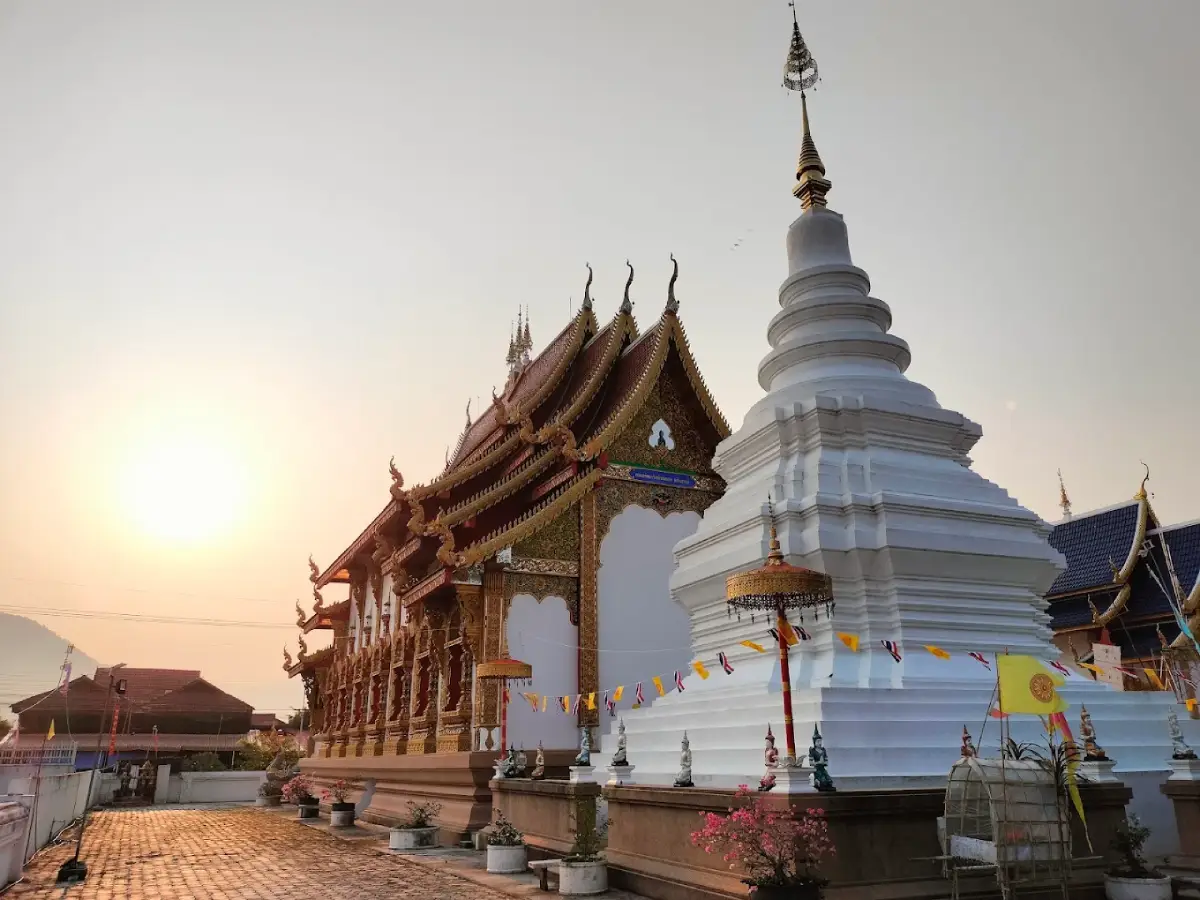
Wat Huai Sai (Mae Tha), located at 102 Ban Huai Sai, Moo 4, Mae Tha Subdistrict, Mae On District, Chiang Mai Province, is a community Buddhist temple belonging to the Mahanikaya order. The temple covers approximately 5 rai and 1 ngan and was officially established in 1907. It remains an active monastery today. Information for the 2025 Kathin season identifies Phra Athikan Bunpan Khemacharo as the abbot and records five monks in residence, confirming that Wat Huai Sai continues to function as a living religious center rather than a historical site maintained only for visitors.
The main appeal of Wat Huai Sai lies in its character as a genuine village monastery. Unlike major tourist temples in central Chiang Mai, it has not been developed around a large landmark or a heavily commercialized visitor zone. The temple belongs to the everyday landscape of Ban Huai Sai, where Buddhist religious life, a local school, village homes, agricultural land and community water systems exist within the same rural environment.
Ban Huai Sai is Moo 4 of Mae Tha Subdistrict. Current water-management information for Chiang Mai also associates the village with the Mae Tha water system, illustrating the continuing relationship between the settlement, agriculture and local waterways. This wider setting is essential to understanding the temple because Wat Huai Sai was established within an agricultural community rather than as an isolated pilgrimage site.
The official establishment year of 1907 gives Wat Huai Sai a history of more than a century. During that period, Mae Tha changed from a rural community dependent largely on local roads and farming networks into an area connected by modern roads, electricity, schools and wider public services. Wat Huai Sai existed throughout these changes and remained one of the religious institutions around which village life was organized.
In a traditional northern Thai community, a monastery served far more than a ceremonial function. Before modern education became widely available, temples frequently supported basic learning, religious instruction, community meetings and cultural transmission. Merit-making days and religious festivals brought households together, creating a social connection among monks, elders, families and younger generations.
That relationship is particularly visible in Ban Huai Sai because Wat Huai Sai School is located in the same Moo 4 community. The school remains under the Chiang Mai Primary Educational Service Area Office 1. Its name preserves an important historical pattern found throughout Thailand, in which temples and formal education developed close to one another even though the two institutions are now administered separately.
The physical and social proximity of temple and school makes Ban Huai Sai an especially useful place for travelers interested in everyday community culture. Children grow up with the monastery as part of the village environment rather than as a remote religious site visited only on special occasions. The temple remains relevant to families through religious observances, community events and major life ceremonies.
The current abbot is Phra Athikan Bunpan Khemacharo. The 2025 Kathin information identifies him as abbot and lists five monks in residence. Earlier documents from the Chiang Mai Provincial Office of Buddhism also associate Phra Athikan Bunpan Khemacharo with telephone number 091-720-1452, providing a consistent administrative link across several years.
Phra Bunpan Khemacharo also appears in Buddhist educational records. His name was recorded in the 2015 Nak Tham examination results for Wat Huai Sai in Mae On District. This provides another perspective on monastic life at the temple, showing a connection with formal Buddhist education as well as village religious administration.
In 2022, Chiang Mai cultural information listed the Wat Huai Sai community among the moral-community initiatives of Mae On District and gave the address as 102 Moo 4, Mae Tha Subdistrict. This designation is significant because it shows that the temple has been used as a reference point for community ethical and cultural development, not merely as a physical place of worship.
An earlier community document identified Phra Sombat Katapunyo in connection with the Wat Huai Sai moral-community program. That role should be distinguished from the current office of abbot. The latest 2025 temple information clearly names Phra Athikan Bunpan Khemacharo as abbot, and this is the name used throughout the current article.
Wat Huai Sai is one of five registered Buddhist temples in Mae Tha Subdistrict, together with Wat Chom Tham, Wat Don Chai, Wat Pong Ka and Wat Si Bun Rueang. Their distribution across different villages reflects the traditional Lanna settlement pattern in which individual communities maintained their own religious centers rather than relying on a single central monastery.
Each temple in Mae Tha has a different historical character. Wat Chom Tham is now known for large contemporary devotional monuments. Wat Si Bun Rueang has a history reaching back to 1807 and an old Wisungkhamasima grant. Wat Don Chai preserves a story of relocation away from a flood-prone earlier site, while Wat Pong Ka represents a revived temple. Wat Huai Sai, by contrast, stands out for its continuing village role and its close relationship with Ban Huai Sai and the local school.
Travelers interested in local history should therefore view Wat Huai Sai as part of a network rather than an isolated attraction. Visiting several Mae Tha temples in the same day reveals how different villages developed their religious centers in response to settlement patterns, agricultural landscapes and changing community needs.
Publicly accessible sources currently do not provide sufficiently detailed and reliable information about the dimensions, construction dates or architectural styles of the viharn, ubosot, stupa, assembly hall, principal Buddha image or bell tower at Wat Huai Sai. For that reason, this article does not invent architectural details based on neighboring temples. The most secure information concerns the temple's foundation year, land area, address, current abbot, resident monks, community role and religious activities.
This lack of published architectural documentation does not reduce the temple's cultural value. Instead, it shifts attention from a checklist of monuments to the way the monastery actually functions within the village. Visitors can observe the relationship between sacred spaces, community use, the nearby school and the surrounding rural landscape.
Visitors can begin by paying respect to the Buddha images and religious spaces that are open to the public, then move quietly through the compound. Private monks' residential areas should not be entered without permission, and old religious objects or sacred images should not be handled unnecessarily.
Wat Huai Sai is particularly suitable for cultural travelers who want to understand an ordinary functioning Lanna village temple. The experience is less about a single dramatic landmark and more about seeing how Buddhism remains integrated into education, community events and relationships among families in a rural Chiang Mai settlement.
Kathin is the most clearly documented annual religious event. In 2025, Wat Huai Sai scheduled its Kathin ceremony for 5 November at 13.00, with five monks recorded in residence during the rains retreat. Kathin is held once each year after the end of Buddhist Lent and is one of the most important moments in the relationship between a temple and its lay supporters.
At a village monastery, Kathin is more than the formal offering of robes. Residents help organize food, offerings, ceremonial space and hospitality. Former residents and relatives may return to the village, making the event an important social reunion as well as a Buddhist ritual.
Travelers visiting during Kathin can gain insight into living religious culture, but respectful behavior is essential. Do not block processions or offering areas, and avoid taking close photographs of people without permission. Those looking for a quieter experience should visit on an ordinary weekday.
Wat Huai Sai also continues to participate in the regular Buddhist calendar as an active monastery with resident monks. Because there is no current public announcement confirming fixed dates for other specific annual festivals, forest-robes ceremonies or Buddha-image bathing events at this temple, no unverified schedule is added here.
The temple's community role can also be seen through its association with the moral-community program documented in Chiang Mai's cultural records. Using the temple as the reference point for a community initiative indicates that Wat Huai Sai serves as more than religious property; it is part of the local social framework.
The wider Mae Tha context adds another dimension. The subdistrict is well known for organic and sustainable agriculture, farmer networks and community enterprises. Farming depends on local waterways and irrigation channels, making agriculture and water management fundamental parts of the cultural landscape in which Wat Huai Sai operates.
Current Chiang Mai water-management information identifies Moo 4 Ban Huai Sai within the Mae Tha river system linked to the Mae Kuang and Ping basins. Although this does not provide enough evidence to state an official origin story for the name Huai Sai, it confirms that waterways remain an important feature of the local geography.
For visitors, this means the surrounding village is part of the experience. Looking at the school, homes, local roads and agricultural land helps explain the role of the monastery far better than rushing directly into the sacred buildings and leaving immediately afterward.
Morning is generally the best time for a quiet visit, with more comfortable temperatures and less intense sunlight. During the rainy season, travelers should take additional care on local roads and any wet surfaces around the temple. The cool season is particularly suitable for combining several temples and community sites in one day.
Standard Thai temple etiquette applies. Shoulders and knees should be covered, shoes removed where required, voices kept low and monks' private quarters respected. Visitors should not climb onto Buddha-image bases or touch sacred objects without permission. If school or village activities are taking place nearby, local community use of the area should take priority.
Photographers should look for compositions that show the relationship between the temple and the village rather than expecting a purpose-built tourist viewpoint. Temple buildings, fields, village roads and the quiet morning environment communicate the identity of Wat Huai Sai more accurately than a staged landmark photograph.
One practical issue is the distinction between the telephone numbers of Wat Huai Sai School and the temple itself. Current educational databases publish telephone numbers for the school, but those numbers belong to the educational institution and should not be treated as temple contacts. Chiang Mai Provincial Office of Buddhism documents associate 091-720-1452 with Phra Athikan Bunpan Khemacharo, making it the more appropriate contact for temple-related matters.
The place name also requires care because several temples called Wat Huai Sai exist in Thailand, including more than one in Chiang Mai Province. When searching maps or online information, use the full phrase “Wat Huai Sai Mae Tha Mae On Chiang Mai” to avoid being directed to temples in Phrao, Chom Thong, Hot or other districts.
Getting There is easiest by private car, rental car or hired driver. From Chiang Mai city, travel east through San Kamphaeng and Mae On, then continue into Mae Tha Subdistrict and Ban Huai Sai, Moo 4. The final section passes through a local village area, so drivers should reduce speed near houses and the school.
When using navigation, verify that the destination is in Moo 4, Mae Tha Subdistrict. Do not automatically use the published coordinates of Wat Huai Sai School as temple coordinates. Although the school and temple belong to the same community, currently accessible databases provide a clearly identified coordinate for the school rather than a separately verified coordinate for the monastery.
Wat Huai Sai fits naturally into a community-temple route through Mae Tha. Nearby religious stops include Wat Si Bun Rueang, Wat Don Chai, Wat Pong Ka and Wat Chom Tham. Visiting several of them together reveals different periods of local history and different ways village monasteries have developed.
Wat Si Bun Rueang is useful for travelers interested in a temple with more than two centuries of recorded history. Wat Don Chai illustrates how a community responded to flooding by relocating its religious center. Wat Chom Tham shows a historic temple that has developed larger contemporary devotional attractions. Wat Huai Sai completes this picture with a quieter community-centered identity.
Mae Tha also offers agricultural and food experiences. Maetha Organic and related community farming activities provide an introduction to the subdistrict's sustainable agricultural identity. A morning temple visit can therefore be followed by a café or organic-farming stop, creating an itinerary that combines religion, community culture, local food and agriculture.
Current food options in Mae Tha include Maetha Organic Cafe, Khao Soi Ka Kai, Ban Nai Chang Coffee, Huen Hom Doi and MADi.COFF. These small local businesses make it possible to remain within the Mae Tha area for meals rather than driving back toward Chiang Mai city between temple visits.
Maetha Organic Cafe is closely connected with the agricultural atmosphere of the subdistrict and serves food and drinks. Khao Soi Ka Kai is a practical small restaurant for lunch, while Ban Nai Chang Coffee is useful for an early coffee stop. Huen Hom Doi stays open later and can work well as an evening meal after a full day of temple and community visits.
Accommodation in and around Mae Tha is mostly small-scale. Small cottage in the big forest is located within Mae Tha itself, while Suksamer Coffee & Homestay provides another local option. Travelers wanting more resort-style accommodation can stay elsewhere in Mae On at 100 LOVE Resort, Monraumsuk Home Stay Chiang Mai or Blessing Homestay @Mae-On Chiang Mai.
An overnight stay is useful for travelers planning to continue toward Tha Nuea, Wat Mae Takhrai, Muang On Cave, San Kamphaeng Hot Springs or Mae Kampong the following day. For a shorter trip, Wat Huai Sai and the other Mae Tha temples can still be visited as a day trip from Chiang Mai.
Beyond Mae Tha, Muang On Cave and San Kamphaeng Hot Springs are practical extensions of the route. Muang On Cave combines natural limestone formations with Buddhist sacred elements, while the hot springs provide a relaxing stop later in the day. Beginning with Wat Huai Sai and other village temples gives the journey a stronger local-history dimension before moving to Mae On's better-known attractions.
The nearby school also offers an important social context. Wat Huai Sai School continues to operate under the Chiang Mai Primary Educational Service Area Office 1, preserving the temple name within the formal education system. Even though school administration is separate from the monastery, the shared name remains a reminder of the historical relationship between Buddhist institutions and village education.
Wat Huai Sai is also a useful case study for understanding moral-community programs in northern Thailand. Provincial cultural records used the temple as the reference point for a designated moral community in Mae On. Such programs emphasize religious values, cultural participation and local cooperation as part of community development.
Travelers expecting a famous antiquity or a highly documented architectural complex should understand that Wat Huai Sai currently has much less published art-historical information than major temples in central Chiang Mai. This is not a weakness. It changes the focus from rare objects to the reality of a working village monastery.
Allow around 45 minutes to one hour for a relaxed temple visit. If combining Wat Huai Sai with the other temples of Mae Tha, planning roughly an hour for each major stop leaves enough time for food, farming activities and travel between villages without turning the day into a rushed checklist.
Most importantly, Wat Huai Sai should be approached as an active monastery. Monks still reside here, villagers continue to make merit, and religious activities are part of normal community life. Visitors should adapt to the rhythm of the place rather than expecting the site to operate entirely around tourism.
From its establishment in 1907 to the documented 2025 Kathin ceremony, Wat Huai Sai demonstrates more than a century of institutional continuity. The community, school, farming landscape and Buddhist monastery have all changed over time, but the temple continues to function as a spiritual and social center in Ban Huai Sai.
Wat Huai Sai is therefore best suited to travelers interested in local temples, Lanna village life, community history and slow travel. It offers an opportunity to see a side of Chiang Mai that is far removed from the heavily visited Old City and major mountain attractions: a farming village where the temple still belongs primarily to the people who live around it.
A full-day Mae Tha route can begin at Wat Huai Sai, continue to Maetha Organic, Wat Si Bun Rueang, Wat Don Chai, Wat Pong Ka and Wat Chom Tham, then extend toward Muang On Cave or San Kamphaeng Hot Springs. The result is a day that combines Buddhist history, community life, education, sustainable agriculture, local food and nature.
Ultimately, the importance of Wat Huai Sai comes not simply from being an old temple, but from remaining a functioning religious institution. It has a current abbot, resident monks, annual Kathin, a community identified with the temple name and a school in the same village. Together these elements make Wat Huai Sai a living record of the relationship between Buddhism and everyday life in Mae Tha.
| Name | Wat Huai Sai (Mae Tha) |
| Type | Community Buddhist Temple, Mahanikaya Order |
| Temple Code | 350230505 |
| Address | 102 Ban Huai Sai, Moo 4, Mae Tha, Mae On District, Chiang Mai 50130, Thailand |
| Established | 1907 |
| Temple Land | Approximately 5 rai and 1 ngan |
| Abbot | Phra Athikan Bunpan Khemacharo |
| Main Contact Number | 091-720-1452 |
| Resident Monks | Five monks according to the 2025 Kathin record |
| Community Role | Spiritual center of Ban Huai Sai, connected with community activities, moral-community programs and Wat Huai Sai School in the same village |
| Annual Religious Activity | Kathin and normal Buddhist observances; the 2025 Kathin ceremony was scheduled for 5 November at 13.00 |
| Open Days | Daily |
| Travel Information | Travel from Chiang Mai through San Kamphaeng and Mae On into Mae Tha Subdistrict and Ban Huai Sai, Moo 4. Private car or rental car is the most convenient option. Search for Wat Huai Sai Mae Tha Mae On Chiang Mai. |
| Current Status | Active Buddhist monastery with resident monks and continuing religious activities |
| Nearby Tourist Attractions | 1. Maetha Organic and Mae Tha organic-farming area, about 4 km 2. Wat Si Bun Rueang, about 5 km 3. Wat Don Chai, about 5 km 4. Wat Pong Ka, about 6 km 5. Wat Chom Tham, about 8 km |
| Nearby Restaurants And Cafés | 1. Maetha Organic Cafe, about 4 km, Tel. 096-697-0079 2. Khao Soi Ka Kai, about 4 km, Tel. 099-396-7056 3. Ban Nai Chang Coffee, about 5 km, Tel. 062-190-2595 4. Huen Hom Doi, about 6 km, Tel. 080-135-1848 5. MADi.COFF, about 6 km |
| Nearby Accommodations | 1. Small cottage in the big forest, about 4 km, Tel. 062-048-7766 2. Suksamer Coffee & Homestay Mae Tha, about 6 km 3. 100 LOVE Resort Mae On, about 16 km, Tel. 065-462-5627 4. Monraumsuk Home Stay Chiang Mai, about 18 km, Tel. 084-074-5329 5. Blessing Homestay @Mae-On Chiang Mai, about 19 km, Tel. 089-011-4668 |
Frequently Asked Questions (FAQ)
Q: Where is Wat Huai Sai in Mae Tha?
A: Wat Huai Sai is at 102 Ban Huai Sai, Moo 4, Mae Tha Subdistrict, Mae On District, Chiang Mai 50130. It is a community Buddhist temple of the Mahanikaya order.
Q: When was Wat Huai Sai established?
A: Wat Huai Sai was officially established in 1907 and has served Ban Huai Sai for more than a century.
Q: Who is the current abbot of Wat Huai Sai?
A: Phra Athikan Bunpan Khemacharo is the current abbot. The 2025 Kathin information records five monks in residence.
Q: What is the temple contact number?
A: Chiang Mai Provincial Office of Buddhism documents associate telephone number 091-720-1452 with Phra Athikan Bunpan Khemacharo.
Q: What important annual event is held at Wat Huai Sai?
A: Kathin is the best-documented annual community ceremony. In 2025 it was scheduled for 5 November at 13.00.
Q: Why is Wat Huai Sai important to the local community?
A: The temple serves as the Buddhist spiritual center of Ban Huai Sai and is connected with community moral initiatives and the local Wat Huai Sai School in the same village.
Q: How do I get to Wat Huai Sai?
A: From Chiang Mai city, travel through San Kamphaeng into Mae On and continue to Mae Tha Subdistrict and Ban Huai Sai, Moo 4. Private car or rental car is the easiest option. Search specifically for Wat Huai Sai Mae Tha Mae On Chiang Mai.
Q: What can I visit after Wat Huai Sai?
A: Nearby options include Maetha Organic, Wat Si Bun Rueang, Wat Don Chai, Wat Pong Ka and Wat Chom Tham. A full-day route can continue toward Muang On Cave or San Kamphaeng Hot Springs.
 Category: ●Places of Worship
 Group: ●Temple
Last Update : 3 DayAgo
 Last Update : 3 DayAgo
 Click to Access the Navigation Map GPS
 Muang Chiang Mai(121)Chom Thong(47)Mae Chaem(25)Chiang Dao(33)Doi Saket(68)Mae Taeng(85)Mae Rim(69)Samoeng(29)Fang(71)Mae Ai(59)Phrao(70)San Pa Tong(103)San Kamphaeng(66)San Sai(73)Hang Dong(73)Hot(32)Doi Tao(22)Omkoi(11)Saraphi(74)Wiang Haeng(15)Chai Prakan(28)Mae Wang(32)Mae On(22)Doi Lo(33)Galyani Vadhana(1)


