
lovethailand home >North Travel Attractions >Chiang Mai Travel Attractions >Mae Wang >Thung Ruang Thong > Wat Sri Chum
TL;DR: Wat Sri Chum is located at Ban Rai Luang, Moo 3, Thung Ruang Thong Subdistrict, Mae Wang District, Chiang Mai. is located at 7 Moo 3, Ban Rai Luang, Thung Ruang Thong Subdistrict, Mae Wang District, Chiang Mai 50360, Thailand. It is a local Buddhist.

Wat Sri Chum
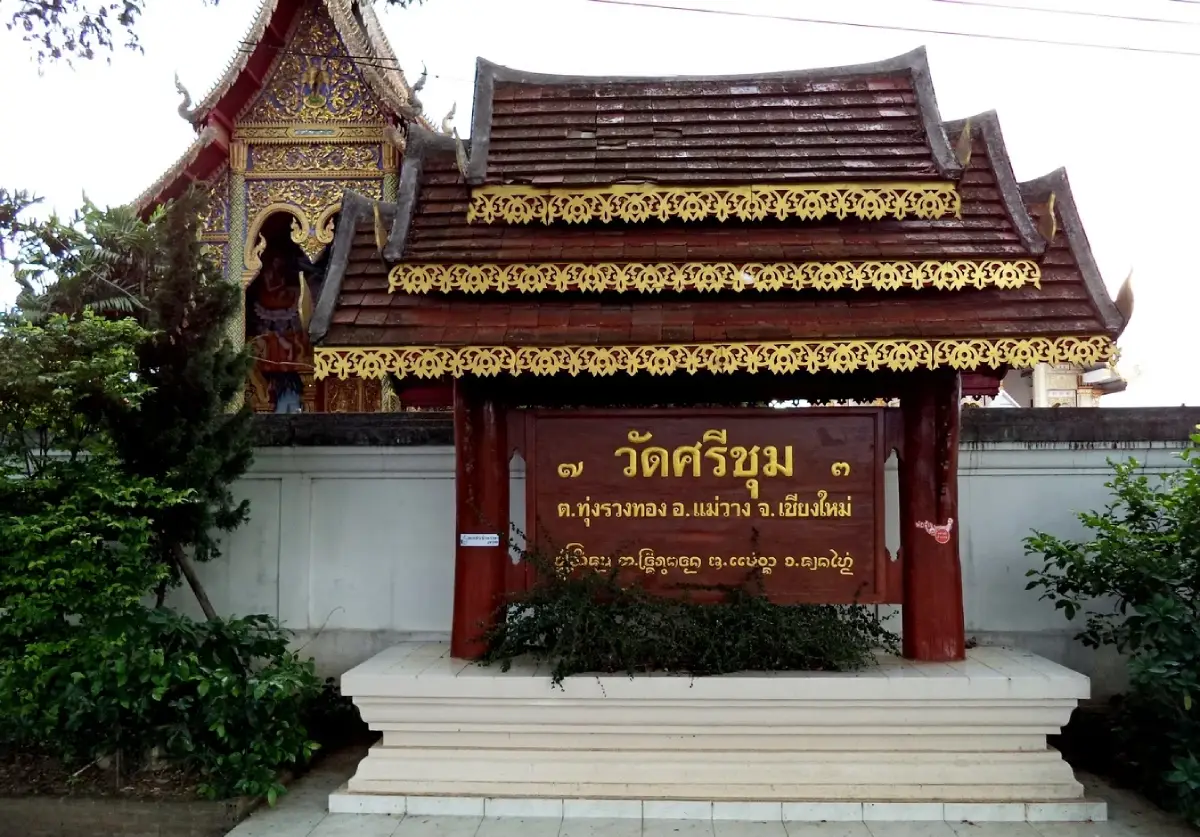
Operating day: Daily
Operating time: 08.00 - 17.00
Wat Sri Chum is located at 7 Moo 3, Ban Rai Luang, Thung Ruang Thong Subdistrict, Mae Wang District, Chiang Mai 50360, Thailand. It is a local Buddhist temple under the Mahanikaya order and has served the Ban Rai Luang community for more than a century. The temple was officially established in 1921 and received its royal consecrated boundary, or wisungkhamsima, in 1995.
Travelers searching for Wat Sri Chum in Chiang Mai should pay close attention to the district and subdistrict because several temples in Thailand share the same name. This Wat Sri Chum is located in Thung Ruang Thong Subdistrict, Mae Wang District, Chiang Mai, with temple registration code 350220304. It should not be confused with the famous Wat Si Chum in Sukhothai Historical Park, which is known for the monumental Phra Achana Buddha image.
The documented history of Wat Sri Chum begins in 1921, when it was officially recognized as a Buddhist temple. By 2026, its registered history spans more than 100 years. The temple developed as part of Ban Rai Luang, a rural community in Mae Wang where temples have traditionally formed an important element of village life and local Buddhist practice.
Wat Sri Chum is classified as a wat rat, or non-royal public temple, under Thailand’s Mahanikaya monastic order. Temple databases list it together with several other temples in Thung Ruang Thong, including Wat Chan Kasem, Wat Don Pin, Wat Maha Wan, Wat Saraphi, and Wat Saen Khantha. Together, these temples illustrate the close relationship between Buddhist institutions and individual villages in this part of Mae Wang.
An important event in the temple’s institutional history occurred in 1995, when Wat Sri Chum received its royal consecrated boundary. Known in Thai as wisungkhamsima, this formally designated sacred boundary is used for important monastic ceremonies, particularly ordination and other official acts of the Sangha. Its granting therefore represents a significant stage in the temple’s development.
The specific origin of the name “Sri Chum” at Ban Rai Luang is not documented clearly enough in currently available published records. The temple is therefore best understood through its confirmed history, location, and relationship with the surrounding community. Its name appears consistently in current temple directories as a Mahanikaya temple in Thung Ruang Thong, Mae Wang District.
Thung Ruang Thong is one of the rural subdistricts of Mae Wang, and Wat Sri Chum forms part of the religious landscape of Ban Rai Luang. Visiting the temple provides a different perspective on Chiang Mai from the major monuments of the Old City. Rural temples such as Wat Sri Chum remain closely integrated with villages and reflect the continuing role of Buddhism in local northern Thai communities.
The temple also has historical links with the ecclesiastical administration of Mae Wang District. Official records of the Sangha Supreme Council of Thailand identify Phra Khru Panya Waraphon of Wat Sri Chum as a former Ecclesiastical District Chief of Mae Wang. In 2010, after reaching the age of 80 following years of service, he was appointed adviser to the Ecclesiastical District Chief of Mae Wang.
This connection gives Wat Sri Chum significance beyond Ban Rai Luang itself. The temple was associated not only with village religious life but also with the administrative structure of the Buddhist Sangha at district level. For travelers interested in the religious history of Chiang Mai, this offers an additional reason to view Wat Sri Chum as more than a small rural temple.
Wat Sri Chum is particularly suitable for travelers who prefer quiet community temples rather than major tourist complexes. The surrounding environment of Thung Ruang Thong and Mae Wang is characterized by local settlements, agricultural landscapes, community roads, and village temples. A visit therefore offers an opportunity to experience a more everyday side of Chiang Mai.
Visitors can use the temple as part of a slow cultural journey through Mae Wang. Rather than treating it simply as a photographic stop, the temple is best appreciated in relation to Ban Rai Luang and the surrounding temples of Thung Ruang Thong. This perspective helps reveal how Buddhist temples remain embedded in the social geography of northern Thai villages.
A temple route through Thung Ruang Thong can include Wat Sri Chum together with Wat Maha Wan, Wat Saraphi, Wat Chan Kasem, Wat Don Pin, and Wat Saen Khantha. Each temple is associated with a local village, allowing travelers to understand how communities across the subdistrict developed around their own religious centers.
Wat Sri Chum can also be combined with the natural attractions of Mae Wang District. Mae Wang is widely known for its river landscape, bamboo rafting, waterfalls, and outdoor attractions toward Mae Win. Travelers can therefore plan a day that begins with quiet temple visits in Thung Ruang Thong before continuing toward the natural areas farther west.
Mae Wang Waterfall is one of the better-known natural attractions in the district and provides a contrast with the cultural character of Wat Sri Chum. Another important destination in a wider Mae Wang itinerary is Pha Chor in Mae Wang National Park, where erosion has created dramatic earth pillars and cliff formations. Combining these destinations creates an itinerary that includes religion, village culture, landscape, and geology.
Food and refreshment options are available along the main routes through Thung Ruang Thong and Mae Wang. Café Amazon at the PTT station in Thung Ruang Thong is one convenient stop, while local establishments such as Tong Him Wang and Baan Kao Coffee provide additional options within the subdistrict. More restaurants and everyday food stalls are available around Ban Kat, the main service area of Mae Wang District.
Accommodation is available in several parts of Mae Wang. Travelers can stay around Ban Kat for easier access to the district center or continue toward Mae Win for resorts and nature-oriented accommodation. This makes it practical to include Wat Sri Chum in a two-day Mae Wang itinerary that combines temples, villages, local food, and outdoor attractions.
Wat Sri Chum is therefore best suited to cultural travelers, visitors interested in local Buddhist history, and those who want to explore Chiang Mai beyond the city’s famous temples. Its importance lies in its more than century-long documented history, its role within Ban Rai Luang, and its historical connection with the Buddhist administration of Mae Wang District.
Visitors should dress modestly and behave respectfully because Wat Sri Chum remains a functioning Buddhist religious site. Quiet conduct is appropriate around prayer and ceremonial areas, and shoes should be removed before entering sacred buildings whenever local practice requires it.
Getting There Wat Sri Chum is located in Ban Rai Luang, Thung Ruang Thong Subdistrict, Mae Wang District. From Chiang Mai city, the most convenient option is to travel by private car or rental vehicle toward San Pa Tong and Mae Wang before continuing into Thung Ruang Thong and Ban Rai Luang. Searching for “Wat Sri Chum Thung Ruang Thong Mae Wang” helps distinguish the temple from other temples of the same name. The mapped area is identified by Plus Code HRCF+6G in Mae Wang, Chiang Mai.
Travelers interested in a local temple circuit can connect Wat Sri Chum with Wat Maha Wan, Wat Saraphi, Wat Chan Kasem, Wat Don Pin, and Wat Saen Khantha. Exploring these temples together provides a useful introduction to the relationship between Buddhist temples and individual villages in Thung Ruang Thong.
Overall, Wat Sri Chum is a historic community temple of Mae Wang with a documented foundation dating to 1921. It is a Mahanikaya temple, received its royal consecrated boundary in 1995, and was historically associated with Phra Khru Panya Waraphon, a former Ecclesiastical District Chief of Mae Wang. For visitors seeking a quieter and more locally grounded side of Chiang Mai, Wat Sri Chum offers a meaningful connection with the Buddhist and community heritage of the district.
| Name | Wat Sri Chum |
| Location | Ban Rai Luang, Moo 3, Thung Ruang Thong Subdistrict, Mae Wang District, Chiang Mai |
| Address | 7 Moo 3, Ban Rai Luang, Thung Ruang Thong Subdistrict, Mae Wang District, Chiang Mai 50360, Thailand |
| Map Reference | Plus Code HRCF+6G, Mae Wang, Chiang Mai |
| Temple Type | Public non-royal temple |
| Monastic Order | Mahanikaya |
| Temple Registration Code | 350220304 |
| Established | 1921 |
| Royal Consecrated Boundary | Granted in 1995 |
| Historical Importance | More than a century of documented history and a historical connection with the ecclesiastical administration of Mae Wang District |
| Historical Religious Figure | Phra Khru Panya Waraphon, former Ecclesiastical District Chief and later adviser to the Ecclesiastical District Chief of Mae Wang |
| Travel Information | Travel from Chiang Mai toward San Pa Tong and Mae Wang, then continue into Thung Ruang Thong Subdistrict and Ban Rai Luang. Private car or rental vehicle is the most convenient option. |
| Current Status | Listed in current Thai temple directories as a Mahanikaya temple in Thung Ruang Thong, Mae Wang District |
| Nearby Temples and Attractions | 1. Wat Maha Wan, Thung Ruang Thong 2. Wat Saraphi, Thung Ruang Thong 3. Wat Chan Kasem, Thung Ruang Thong 4. Wat Don Pin, Thung Ruang Thong 5. Wat Saen Khantha, Thung Ruang Thong 6. Mae Wang Waterfall 7. Pha Chor, Mae Wang National Park |
| Nearby Restaurants and Cafes | 1. Café Amazon, PTT Thung Ruang Thong, Tel. 062-601-8048 2. Tong Him Wang, Tel. 084-047-6708 3. Baan Kao Coffee, Tel. 097-967-9882 4. Mae Wang Coffee 5. Local restaurants and food stalls around Ban Kat |
| Accommodation in Mae Wang Area | 1. Raibumrungphol, Ban Kat 2. Khum Khun Wang Resort, Ban Kat 3. Namrae Maewang Phairin Resort 4. Plern Malee Resort, Mae Win 5. Chiang Mai Elephant Friends, Mae Win 6. 3 Pok Resort MaeWang, Chiang Mai |
Frequently Asked Questions (FAQ)
Q: Where is Wat Sri Chum in Mae Wang located?
A: Wat Sri Chum is located at 7 Moo 3, Ban Rai Luang, Thung Ruang Thong Subdistrict, Mae Wang District, Chiang Mai 50360, Thailand.
Q: Is Wat Sri Chum in Mae Wang the same temple as Wat Si Chum in Sukhothai?
A: No. This Wat Sri Chum is located in Mae Wang District, Chiang Mai. The famous Wat Si Chum with the monumental Phra Achana Buddha image is in Sukhothai Historical Park.
Q: When was Wat Sri Chum in Mae Wang established?
A: Wat Sri Chum was officially established as a Buddhist temple in 1921.
Q: When did Wat Sri Chum receive its royal consecrated boundary?
A: The temple received its royal consecrated boundary in 1995.
Q: Who was Phra Khru Panya Waraphon?
A: Phra Khru Panya Waraphon of Wat Sri Chum served as the Ecclesiastical District Chief of Mae Wang and was appointed adviser to the Ecclesiastical District Chief of Mae Wang in 2010.
Q: What other places can be visited together with Wat Sri Chum?
A: A local itinerary can include Wat Maha Wan, Wat Saraphi, Wat Chan Kasem, Wat Don Pin, Wat Saen Khantha, Mae Wang Waterfall, and Pha Chor in Mae Wang National Park.
Q: What type of traveler is Wat Sri Chum best suited for?
A: It is particularly suitable for travelers interested in local temples, Buddhist history, Lanna community culture, and quieter destinations outside central Chiang Mai.
 Category: ●Places of Worship
 Group: ●Temple
Last Update : 3 DayAgo
 Last Update : 3 DayAgo
 Click to Access the Navigation Map GPS
Wat Sri Chum Map
Recommend

 Muang Chiang Mai(121)Chom Thong(47)Mae Chaem(25)Chiang Dao(33)Doi Saket(68)Mae Taeng(85)Mae Rim(69)Samoeng(29)Fang(71)Mae Ai(59)Phrao(70)San Pa Tong(103)San Kamphaeng(66)San Sai(73)Hang Dong(73)Hot(32)Doi Tao(22)Omkoi(11)Saraphi(74)Wiang Haeng(15)Chai Prakan(28)Mae Wang(32)Mae On(22)Doi Lo(33)Galyani Vadhana(1)


