
lovethailand home >North Travel Attractions >Chiang Mai Travel Attractions >Mae Rim >Sa Luang > Wat Suwannawa
TL;DR: Wat Suwannawa is located at Moo 1, Ban Na Huek, Saluang Subdistrict, Mae Rim District, Chiang Mai Province, open Daily, hours Official hours not specified.
Wat Suwannawa
Open Days: Daily
Opening Hours: Official hours not specified
Wat Suwannawa, also found in local and news sources as Wat Suwannanaowa or Wat Suwannawa / Suwannanaowa of Ban Na Huek, is a Maha Nikaya Buddhist temple in Moo 1, Ban Na Huek, Saluang Subdistrict, Mae Rim District, Chiang Mai Province 50330. Officially permitted as a Buddhist temple in 1876, it is one of the long-standing village temples of Saluang. The temple is closely connected with Ban Na Huek, an agricultural community in the hilly landscape of Mae Rim, and continues to function as a place for worship, merit-making, local Buddhist ceremonies, and community activities.
Wat Suwannawa is valuable not because it is a large tourist landmark, but because it represents the religious and social life of Ban Na Huek. Local residents use the temple for Buddhist holy day merit-making, sermons, Kathin, robe-offering events, funerary merit-making, and village gatherings. For travelers who want to understand Mae Rim beyond Mon Jam, cafés, gardens, and major attractions, Wat Suwannawa offers a quieter and more local view of Lanna community life.
Ban Na Huek is a traditional agricultural community in Saluang Subdistrict. It sits in a small basin-like area between hills on the western side of the Chiang Mai–Fang route. The village landscape is shaped by rice fields, streams, foothills, and local routes connecting the communities of Saluang. The name Na Huek is connected with agricultural land and the fertility of the old village area. This makes the temple inseparable from the farming identity of the community.
The temple name is also interesting from a cultural and linguistic perspective. The form Suwannanaowa can be interpreted as a golden boat or golden vessel, while the local village name Na Huek is rooted in land and farming. This contrast reflects a common pattern in Thai and Lanna temple naming: the village name often preserves local geography and livelihood, while the temple name is elevated into a more auspicious Buddhist form. Wat Suwannawa therefore carries both local memory and religious meaning.
The temple was officially permitted in 1876, giving Wat Suwannawa a history of nearly 150 years. This period was a time when many Lanna villages still relied strongly on agriculture, temple-centered social life, and local Buddhist learning. A village temple in Ban Na Huek reflected the stability of the settlement and the faith of local residents. The temple served as a shared space for religious practice, education, ceremony, and social organization.
Phra Khru Sunthon Kittithada Subharo is named in the original temple information as the abbot of Wat Suwannawa. In a community temple, the abbot’s role is central to maintaining monastic practice, temple buildings, merit-making events, lay support, and the temple’s continuity as a spiritual center. Wat Suwannawa remains meaningful because the temple is still connected with local Buddhist and community activity.
Wat Suwannawa also played a role in local education. Ban Na Huek School once used the temple grounds as its early school site before the school later moved to its own location. This reflects a common pattern in northern Thai villages, where temples were among the first community institutions to support children’s learning before modern school infrastructure became fully established. The temple was therefore a religious space and an educational starting point for the community.
Another important local memory connected with Wat Suwannawa is an old Buddha image associated with a former deserted temple site near Lam Huai Na Huek. The Buddha image is respected by local residents and reflects the deeper sacred landscape of the area. Ban Na Huek is not only a present-day village with an active temple, but also a place where older layers of Buddhist memory remain connected with fields, streams, and local belief.
Wat Suwannawa can be understood through four main values. First, it has religious value as a place of worship and Buddhist ceremony. Second, it has historical value as a temple officially permitted in 1876. Third, it has social value because it has supported community activities and early education. Fourth, it has cultural value because its name, village context, and local Buddha-image memory reflect the connection between Buddhism, agriculture, streams, and Lanna village life.
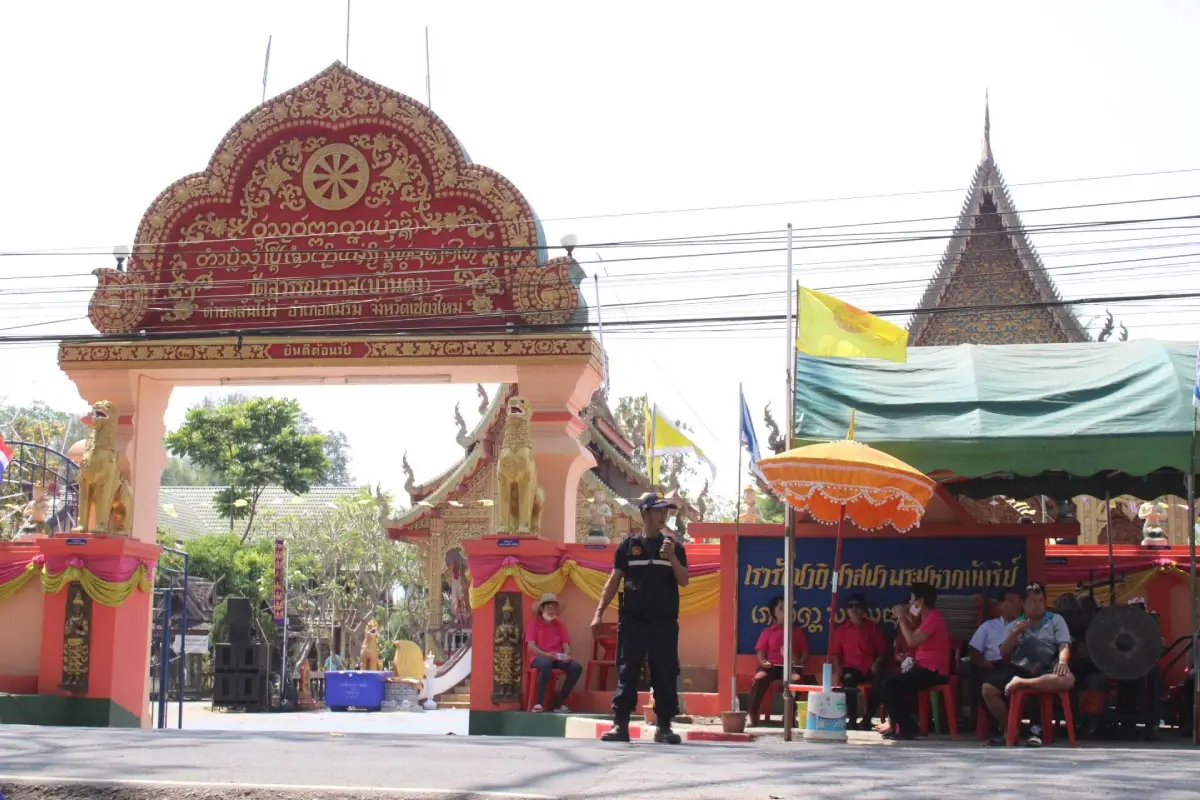
The confirmed areas of the temple include the temple gate, courtyard, temple hall, community activity spaces, and worship areas for Buddha images. Wat Suwannawa should be understood as an active village temple rather than a commercial tourist attraction. Visitors should walk quietly, dress respectfully, and avoid entering restricted areas. The temple belongs to the community, and respectful behavior is essential.
The temple gate marks the transition from ordinary village space into sacred Buddhist space. The courtyard is used for merit-making events and community activities. In a rural temple, the courtyard is not simply an empty area; it is where villagers gather for Buddhist holy days, Kathin, robe-offering events, funerary activities, and local ceremonies. This makes the courtyard one of the most important social spaces in the village.
The temple hall and community buildings are also important. They support merit-making, meetings, moral activities, and local development programs. In 2024, Wat Suwannawa appeared in a community activity connected with sustainable drug-prevention cooperation and food-security planting activities along the riverside path leading to the temple. This shows that the temple remains part of contemporary community development, not only religious life.
The atmosphere of Wat Suwannawa is calm, local, and agricultural. It is suitable for travelers who enjoy small community temples, rural routes, and local history. The temple is not crowded, so visitors can experience a slower pace of Mae Rim. The value of the visit lies in understanding the relationship between the temple and Ban Na Huek, rather than looking only for a large architectural landmark.
Temple traditions at Wat Suwannawa follow the rhythm of Buddhist and Lanna village life. These include Buddhist holy day merit-making, Buddhist Lent, the end of Lent, Kathin, robe-offering events, funerary merit-making, and village merit-making occasions. These events bring the community together, support temple maintenance, and maintain the relationship between monks and laypeople.
Kathin is especially important because it takes place after Buddhist Lent and allows lay supporters to offer robes and donations to monks. Robe-offering events can also be held at various times to support temple maintenance or development. For an old community temple like Wat Suwannawa, local support is essential for keeping the temple active and useful for future generations.
The role of Wat Suwannawa in Ban Na Huek can be seen in several layers. It is a spiritual center for worship and merit-making. It is a social space for village gatherings. It once supported early education in the community. It is also part of the cultural memory of Saluang, where place names, fields, streams, and Buddhist stories are closely connected.
Wat Suwannawa can be included in a cultural route through Saluang Subdistrict. Nearby places include Wat Sitthi Songtham or Wat Saluang Nai, Wat Saluang or Wat Saluang Nok, Wat Prakat Tham in Ban Kad Hao, Ban Mueang Ka, the Khun Luang Wilangka Stupa, and Wat Phra Phutthabat Si Roi. This route helps visitors understand Saluang as a district of village temples, agricultural communities, mountain pilgrimage routes, and local memory.
Wat Phra Phutthabat Si Roi is one of the major sacred destinations connected with the Saluang route. Travelers visiting Wat Suwannawa can continue toward that temple, but should allow enough time because parts of the route pass through local communities and hilly terrain. Daytime travel is recommended, especially during the rainy season or when visibility is reduced by fog.
Getting There from Chiang Mai city is most convenient by private car, rental car, or hired vehicle. Take Highway 107, the Chiang Mai–Fang Road, toward Mae Rim District, then continue onto local roads into Saluang Subdistrict and Ban Na Huek. Another route mentioned by travelers is Rural Road 3009, an inner route used to access the Saluang area and, in some cases, as a quieter route toward Pai. Public transport is limited, so advance planning is recommended.
A practical travel route can begin in Chiang Mai city, continue to Mae Rim, and then enter Ban Na Huek to visit Wat Suwannawa. From there, travelers can continue to Wat Sitthi Songtham, Wat Saluang, Wat Pah Saluang, Wat Prakat Tham, or Ban Mueang Ka. Those with more time can continue to Wat Phra Phutthabat Si Roi, Mon Jam, or Queen Sirikit Botanic Garden. The route is best enjoyed slowly, with enough time for local roads and stops.
The best time to visit Wat Suwannawa is in the morning or late afternoon. Visitors should dress modestly, speak quietly, remove shoes where required, avoid touching Buddha images or temple objects without permission, and give space to local residents during ceremonies. A community temple should be visited with respect for both religious practice and local life.
Overall, Wat Suwannawa is an important old temple of Ban Na Huek and Saluang Subdistrict. Its value lies in its official temple history from 1876, its connection with an agricultural village, its former educational role, local memories of an old Buddha image near Lam Huai Na Huek, and its continued use for Buddhist and community activities. For travelers who want to see Mae Rim in a deeper and more local way, Wat Suwannawa is a meaningful cultural stop.
| Name | Wat Suwannawa, also found as Wat Suwannanaowa |
| Location | Moo 1, Ban Na Huek, Saluang Subdistrict, Mae Rim District, Chiang Mai Province |
| Address | Moo 1, Na Huek, Saluang, Mae Rim, Chiang Mai 50330, Thailand |
| Highlights | Historic village temple of Ban Na Huek, agricultural community heritage, local Buddhist life, and the Saluang route toward Wat Phra Phutthabat Si Roi |
| History | Officially permitted as a Buddhist temple in 1876; a Maha Nikaya community temple of Ban Na Huek |
| Name Origin | The temple name Suwannawa or Suwannanaowa is an auspicious religious name, while Ban Na Huek reflects the older agricultural landscape and local place-name memory |
| Distinctive Features | A Lanna community temple connected with village Buddhism, agriculture, early education, local waterways, and contemporary community activities |
| Important Structures And Areas | Temple gate, courtyard, temple hall, community activity buildings, and Buddha-image worship areas |
| Sacred Object / Local Memory | An old Buddha image respected by local residents, connected with a former deserted temple site near Lam Huai Na Huek |
| Abbot / Caretaker | Phra Khru Sunthon Kittithada Subharo |
| Community Role | Spiritual center of Ban Na Huek, merit-making venue, community activity space, and early educational site for Ban Na Huek School |
| Travel Information | From Chiang Mai city, take Highway 107 toward Mae Rim, then continue into Saluang Subdistrict and Ban Na Huek. Rural Road 3009 is another local route mentioned by travelers. Private car, rental car, or hired vehicle is recommended. |
| Current Status | Active community Buddhist temple for worship, merit-making, Buddhist ceremonies, and community activities of Ban Na Huek |
| Open Days | Daily |
| Opening Hours | Official hours not specified |
| Admission Fee | Official admission fee not specified |
| Related Traditions / Temple Events | Buddhist holy day merit-making, Buddhist Lent, the end of Lent, Kathin, robe-offering events, funerary merit-making, and Ban Na Huek community ceremonies |
| Nearby Tourist Attractions | 1. Wat Sitthi Songtham or Wat Saluang Nai, about 4 km 2. Wat Saluang or Wat Saluang Nok, about 5 km 3. Wat Prakat Tham, Ban Kad Hao, about 7 km 4. Khun Luang Wilangka Stupa, Ban Mueang Ka, about 16 km 5. Wat Phra Phutthabat Si Roi, about 24 km 6. Mon Jam, about 32 km |
| Nearby Restaurants | 1. Kieng Namrim, about 3 km, Tel. 085-929-1746 2. Petchburirama, about 6 km, Tel. 090-840-0030 3. Him Huoy Cafe, about 19 km, Tel. 094-696-6199 4. Baan Suan Mae Rim, about 22 km, Tel. 053-297-421, 088-266-5549 5. Sala Cafe, about 28 km, Tel. 053-860-996, 086-914-0777 6. The Ironwood, about 31 km, Tel. 081-858-3555 |
| Nearby Accommodations | 1. Forest Falls Garden Maerim Chiangmai, about 14 km, Tel. 064-609-4618 2. Dusai Tara Resort, about 22 km, Tel. 095-462-4269 3. Mae Rim Grace, about 25 km, Tel. 066-095-7267 4. Four Seasons Resort Chiang Mai, about 26 km, Tel. 053-298-181 5. Proud Phu Fah Resort, about 33 km, Tel. 053-879-389, 053-879-286, 081-647-7437 |
Frequently Asked Questions (FAQ)
Q: Where is Wat Suwannawa located?
A: Wat Suwannawa is located in Moo 1, Ban Na Huek, Saluang Subdistrict, Mae Rim District, Chiang Mai Province 50330, Thailand.
Q: Is Wat Suwannawa the same as Wat Suwannanaowa?
A: The original information uses the name Wat Suwannawa, while local and news sources also use the form Wat Suwannanaowa or Wat Suwannawa of Ban Na Huek.
Q: Why is Wat Suwannawa historically important?
A: Wat Suwannawa was officially permitted as a Buddhist temple in 1876 and has long served Ban Na Huek as a Maha Nikaya community temple.
Q: Who is the abbot of Wat Suwannawa?
A: The abbot named in the original temple information is Phra Khru Sunthon Kittithada Subharo.
Q: What is special about Wat Suwannawa?
A: The temple is special as an old community temple of Ban Na Huek, with links to agricultural village life, early local education, community activities, and local memory of an old Buddha image near Lam Huai Na Huek.
Q: What are the opening days and hours of Wat Suwannawa?
A: Wat Suwannawa is open daily, but official opening hours are not specified.
Q: What nearby places can be visited with Wat Suwannawa?
A: Nearby places include Wat Sitthi Songtham, Wat Saluang, Wat Prakat Tham, Ban Mueang Ka, the Khun Luang Wilangka Stupa, Wat Phra Phutthabat Si Roi, and Mon Jam.
 Category: ●Places of Worship
 Group: ●Temple
Last Update : 22 HourAgo
 Last Update : 22 HourAgo
 Click to Access the Navigation Map GPS
 Muang Chiang Mai(121)Chom Thong(47)Mae Chaem(25)Chiang Dao(33)Doi Saket(68)Mae Taeng(85)Mae Rim(69)Samoeng(29)Fang(71)Mae Ai(62)Phrao(70)San Pa Tong(105)San Kamphaeng(66)San Sai(73)Hang Dong(74)Hot(32)Doi Tao(22)Omkoi(11)Saraphi(74)Wiang Haeng(15)Chai Prakan(28)Mae Wang(32)Mae On(22)Doi Lo(34)Galyani Vadhana(1)


