
lovethailand home >North Travel Attractions >Chiang Mai Travel Attractions >Mae Rim >Sa Luang > Wat Sitthi Songtham
TL;DR: Wat Sitthi Songtham is located at Moo 2, Ban Saluang Nai, Saluang Subdistrict, Mae Rim District, Chiang Mai Province, open Daily, hours Official hours not specified.
Wat Sitthi Songtham
Open Days: Daily
Opening Hours: Official hours not specified
Wat Sitthi Songtham, also known locally as Wat Saluang Nai, is a Maha Nikaya Buddhist temple in Moo 2, Saluang Subdistrict, Mae Rim District, Chiang Mai Province 50330. The temple covers about 2 rai, was registered as a temple in 1892, and received its Wisungkhamsima in 1898. It is one of the important old Lanna temples of Ban Saluang Nai, valued for its Buddhist role, Lanna architecture, former water-surrounded ordination hall, palm-leaf manuscripts, Dhamma chests, and its long relationship with the local community.
Wat Sitthi Songtham is significant because it combines several layers of Lanna heritage in one place. Local history connects the temple with the reign of King Sam Fang Kaen of the Mangrai dynasty. The temple is also associated with the Lanka or Sinhala Buddhist tradition in earlier times. Its former ordination hall was built in a water setting, its viharn reflects Lanna architecture, and the temple preserves more than 500 bundles of Lanna-script palm-leaf manuscripts. These features make Wat Saluang Nai valuable for travelers interested in Buddhism, local history, manuscript culture, and northern Thai art.
The temple is located in Ban Saluang Nai, one of the important villages of Saluang Subdistrict. Saluang is a culturally rich area of Mae Rim District, with villages such as Saluang Nai, Saluang Nok, Kad Hao, Mueang Ka, Phra Bat Si Roi, Huai Som Suk, and nearby mountain communities. The area includes foothills, streams, forests, agricultural land, village temples, forest temples, and pilgrimage routes. Wat Sitthi Songtham belongs to this broader cultural landscape and helps explain the religious life of Saluang beyond the better-known tourist sites of Mae Rim.
The name Saluang is linked with local landscape memory. Local explanations connect it with Mae Saluang stream, the story of Sang Luang, and northern Thai beliefs related to water, forest, and local spiritual imagination. Because Wat Sitthi Songtham stands in Ban Saluang Nai, the temple should be understood as part of the village itself. It is not an isolated monument, but a spiritual and cultural center for the local community.
The historical background of Wat Sitthi Songtham is deeper than that of many ordinary village temples. Local tradition says that the temple was founded during the reign of King Sam Fang Kaen, a ruler of Chiang Mai in the Mangrai dynasty. Whether approached through formal temple registration or through local memory, the temple is clearly treated as an old Lanna religious site. Its official registration in 1892 and Wisungkhamsima in 1898 mark its recognized status within the monastic system.
The Wisungkhamsima is especially important because it defines a sacred boundary for formal Sangha acts. For a temple with an ordination hall, this boundary allows the monks to perform key monastic ceremonies properly. The fact that Wat Sitthi Songtham received its Wisungkhamsima in 1898 shows that the temple had a recognized religious function and an established Buddhist community by the late nineteenth century.
Phra Khru Supanyanuyut Wutthithammo is the abbot of Wat Sitthi Songtham. The abbot of a historic community temple has responsibilities that go beyond daily monastic practice. He helps care for temple buildings, monks, merit-making activities, lay supporters, and cultural objects such as palm-leaf manuscripts and Dhamma chests. At Wat Sitthi Songtham, this role is particularly important because the temple preserves rare manuscript and architectural heritage.
One of the temple’s most important historical points is its earlier association with the Lanka or Sinhala Buddhist tradition. This reflects the broader relationship between Lanna Buddhism and the Theravada Buddhist world. The Lanka tradition influenced monastic discipline, Buddhist learning, textual transmission, and religious reform in northern Thailand. This makes Wat Sitthi Songtham important not only as a village temple, but also as part of the historical Buddhist network of Lanna.
The former water-surrounded ordination hall is a major feature of Wat Sitthi Songtham. In Buddhist architecture, a water setting can help separate the sacred space used for Sangha acts from ordinary ground. The water once formed part of the temple’s sacred landscape. Today, the pond has become shallow and parts of the area have been filled with soil, so the old water setting is no longer as visually clear as in the past. Even so, the story of the water-surrounded ubosot remains central to the identity of the temple.
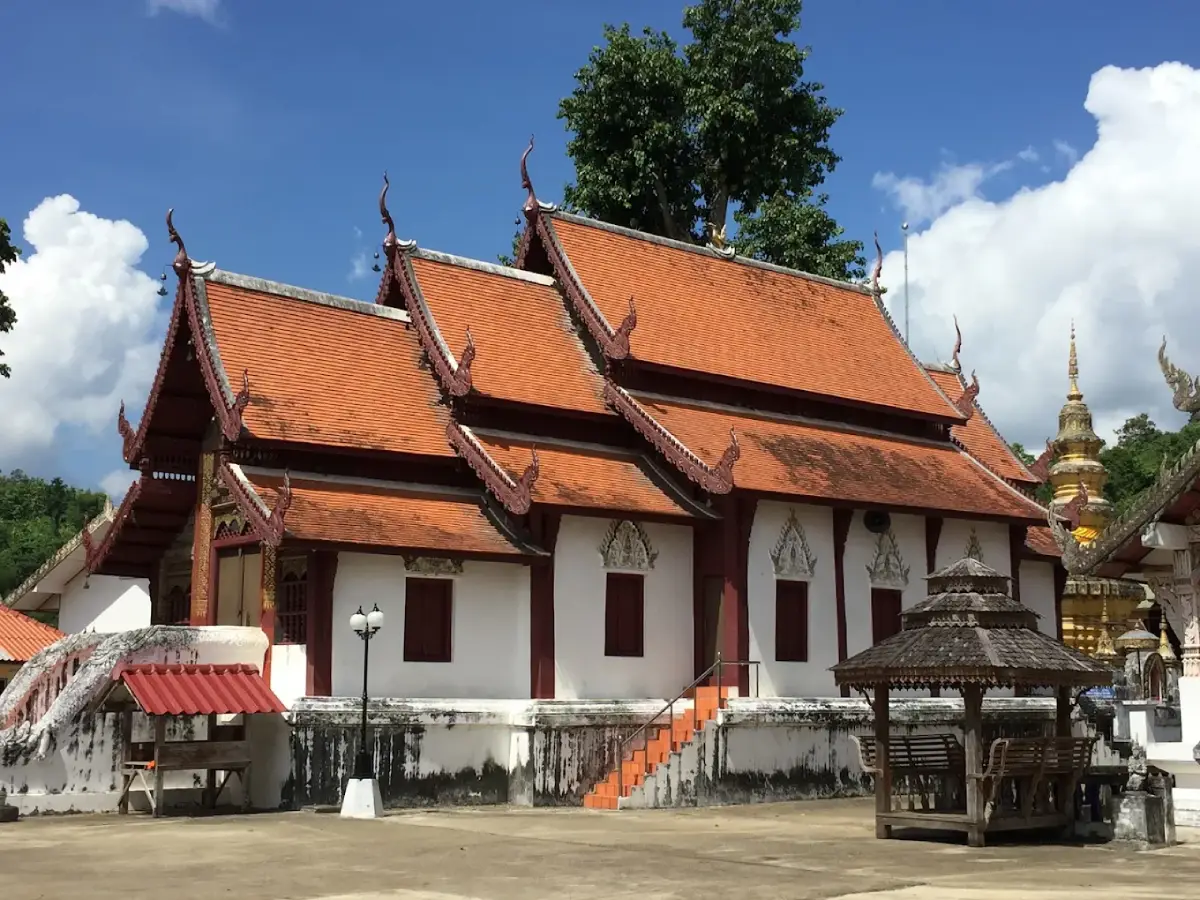
The viharn is another highlight of Wat Sitthi Songtham. It is a Lanna-style wooden viharn with a graceful form and carved wooden gable. Conservation information describes the visible gable as a later layer built over an older carved gable. This layered construction gives the viharn historical depth. It is not only a worship hall, but also a record of Lanna craftsmanship and later restoration work.
The Fine Arts Department has recorded restoration activity related to the viharn of Wat Sitthi Songtham. This reinforces the cultural value of the building. Visitors should treat the viharn as a living religious space and a heritage structure at the same time. Touching old carved wood, leaning on fragile surfaces, or entering restricted areas should be avoided. The best way to appreciate the viharn is to observe it calmly and respectfully.
The most intellectually important heritage of Wat Sitthi Songtham is its collection of Lanna-script palm-leaf manuscripts. The temple preserves more than 500 manuscript bundles. Palm-leaf manuscripts were central to Buddhist learning in Lanna. They record Buddhist texts, Vinaya material, sermons, Jataka stories, legends, and local religious knowledge. Each manuscript required careful preparation, inscription, binding, and preservation. These manuscripts are therefore both sacred objects and historical documents.
The temple also preserves Dhamma chests, or traditional manuscript chests. These chests were used to store palm-leaf manuscripts and protect them from damage. Conservation information notes that Wat Saluang Nai still has several well-preserved Dhamma chests with different shapes and decorative styles. These chests show that the temple and community treated Buddhist texts with high respect and maintained a culture of manuscript preservation.
The manuscript heritage of Wat Sitthi Songtham also appears in modern academic research. A study of Tham-script palm-leaf manuscripts of the Vinaya Pitaka, Parajika section, identifies Wat Sitthi Songtham or Saluang Nai as one of the Chiang Mai manuscript locations. The study records a set of 1–15 bundles, marked a-me, created in 1881, with complete content. This places the temple’s manuscript collection within the broader scholarly study of Buddhist textual transmission in Thailand.
Wat Sitthi Songtham can therefore be understood through four main values. First, it has religious value as an active Maha Nikaya Buddhist temple. Second, it has historical value as an old Lanna temple registered in 1892. Third, it has architectural value through its Lanna wooden viharn and former water-surrounded ubosot. Fourth, it has documentary value because of its palm-leaf manuscripts, Dhamma chests, and role in preserving Lanna Buddhist knowledge.
The atmosphere of Wat Sitthi Songtham is calm and community-based. It is suitable for visitors who want to study a temple slowly rather than take a quick photograph and leave. The temple is especially suitable for people interested in Lanna architecture, manuscript culture, Buddhist history, and local communities in Mae Rim. Visitors should understand that the manuscripts and old structures are part of the living heritage of Ban Saluang Nai.
Temple traditions at Wat Sitthi Songtham follow the rhythm of Buddhist and Lanna community life. These include Buddhist holy day merit-making, Buddhist Lent, the end of Lent, Kathin, robe-offering events, and community merit-making. The temple is also associated with a ninth northern lunar month relic-bathing tradition, an important Lanna-style ceremony in which local people express devotion and renew the sacred relationship between the temple and the community.
Kathin is important for a community temple because it takes place after Buddhist Lent and allows lay supporters to offer robes and donations to monks. Robe-offering events also help support maintenance, restoration, and religious activities. For a temple with old architecture and manuscript heritage, continued community support is especially important.
The role of Wat Sitthi Songtham in Ban Saluang Nai can be seen in several layers. It is a spiritual center for worship and merit-making. It is a social space where villagers gather for ceremonies. It is a cultural archive that preserves palm-leaf manuscripts and Dhamma chests. It is also a learning site for Lanna history, Buddhist texts, and local identity. This combination makes the temple highly meaningful even though it is not a large tourist attraction.
Getting There from Chiang Mai city is easiest by private car, rental car, or hired vehicle. Take Highway 107 toward Mae Rim District, then continue into Saluang Subdistrict and Ban Saluang Nai. Public transport is limited in this area, so visitors should plan the route and return trip in advance, especially if continuing toward Wat Phra Phutthabat Si Roi or the Mae Rim–Samoeng route.
A meaningful cultural itinerary can begin at Wat Sitthi Songtham in Ban Saluang Nai, then continue to Wat Saluang or Wat Saluang Nok, Wat Pah Saluang, Wat Prakat Tham in Ban Kad Hao, Ban Mueang Ka, the Khun Luang Wilangka Stupa, and Wat Phra Phutthabat Si Roi. This route combines village temples, old Lanna heritage, forest temples, local legends, and mountain pilgrimage sites. Travelers with a full day can also connect the route with Mon Jam or Queen Sirikit Botanic Garden.
The best time to visit Wat Sitthi Songtham is in the morning or late afternoon. Visitors should dress modestly, remove shoes where required, speak quietly, avoid touching old objects or manuscripts without permission, and avoid disturbing monks or villagers. A historic temple should be visited with respect for both religious practice and heritage conservation.
Overall, Wat Sitthi Songtham is one of the most culturally valuable temples in Saluang Subdistrict. Its importance comes from its old Lanna history, Wisungkhamsima, former water-surrounded ubosot, Lanna wooden viharn, carved gable, Dhamma chests, and large collection of Lanna-script palm-leaf manuscripts. For travelers who want to understand Mae Rim beyond its popular attractions, Wat Sitthi Songtham offers a quiet but deeply meaningful encounter with northern Thai Buddhist heritage.
| Name | Wat Sitthi Songtham, also known as Wat Saluang Nai |
| Location | Moo 2, Ban Saluang Nai, Saluang Subdistrict, Mae Rim District, Chiang Mai Province |
| Address | Moo 2, Saluang, Mae Rim, Chiang Mai 50330, Thailand |
| Highlights | Lanna wooden viharn, former water-surrounded ubosot, Dhamma chests, Lanna-script palm-leaf manuscripts, and old temple history of Ban Saluang Nai |
| History | An old Lanna temple, registered in 1892 and granted Wisungkhamsima in 1898; local history connects it with the reign of King Sam Fang Kaen of the Mangrai dynasty |
| Name Origin | Wat Sitthi Songtham is the temple name, while Wat Saluang Nai reflects the village name of Ban Saluang Nai where the temple is located |
| Distinctive Features | A Lanna community temple with religious, architectural, historical, and manuscript heritage value |
| Important Structures And Areas | Lanna wooden viharn, former water-surrounded ubosot, temple courtyard, monks’ residence, multipurpose hall, Dhamma chest room, and palm-leaf manuscript storage area |
| Key Heritage | More than 500 bundles of Lanna-script palm-leaf manuscripts, several Dhamma chests, and a Vinaya Pitaka Parajika manuscript set recorded in modern academic research |
| Temple Area | About 2 rai |
| Affiliation | Maha Nikaya Buddhist temple |
| Abbot / Caretaker | Phra Khru Supanyanuyut Wutthithammo |
| Travel Information | From Chiang Mai city, take Highway 107 toward Mae Rim, then continue into Saluang Subdistrict and Ban Saluang Nai. Private car, rental car, or hired vehicle is recommended. |
| Current Status | Active community Buddhist temple and local heritage site for worship, merit-making, Lanna architecture, Dhamma chests, and palm-leaf manuscripts |
| Open Days | Daily |
| Opening Hours | Official hours not specified |
| Related Traditions / Temple Events | Buddhist holy day merit-making, Buddhist Lent, the end of Lent, Kathin, robe-offering events, village merit-making, and the ninth northern lunar month relic-bathing tradition |
| Nearby Tourist Attractions | 1. Wat Saluang or Wat Saluang Nok, about 2 km 2. Wat Pah Saluang, about 3 km 3. Wat Prakat Tham, Ban Kad Hao, about 6 km 4. Khun Luang Wilangka Stupa, Ban Mueang Ka, about 14 km 5. Wat Phra Phutthabat Si Roi, about 22 km 6. Mon Jam, about 31 km |
| Nearby Restaurants | 1. Kieng Namrim, about 4 km, Tel. 085-929-1746 2. Petchburirama, about 5 km, Tel. 090-840-0030 3. Him Huoy Cafe, about 18 km, Tel. 094-696-6199 4. Baan Suan Mae Rim, about 23 km, Tel. 053-297-421, 088-266-5549 5. Sala Cafe, about 28 km, Tel. 053-860-996, 086-914-0777 6. The Ironwood, about 30 km, Tel. 081-858-3555 |
| Nearby Accommodations | 1. Forest Falls Garden Maerim Chiangmai, about 13 km, Tel. 064-609-4618 2. Dusai Tara Resort, about 21 km, Tel. 095-462-4269 3. Mae Rim Grace, about 25 km, Tel. 066-095-7267 4. Four Seasons Resort Chiang Mai, about 26 km, Tel. 053-298-181 5. Proud Phu Fah Resort, about 32 km, Tel. 053-879-389, 053-879-286, 081-647-7437 |
Frequently Asked Questions (FAQ)
Q: Where is Wat Sitthi Songtham located?
A: Wat Sitthi Songtham is located in Moo 2, Ban Saluang Nai, Saluang Subdistrict, Mae Rim District, Chiang Mai Province 50330, Thailand.
Q: Is Wat Sitthi Songtham the same as Wat Saluang Nai?
A: Yes. Wat Sitthi Songtham is the temple name, while Wat Saluang Nai is the local name connected with Ban Saluang Nai.
Q: Why is Wat Sitthi Songtham historically important?
A: The temple is an old Lanna temple, registered in 1892 and granted Wisungkhamsima in 1898. Local history connects it with the reign of King Sam Fang Kaen of the Mangrai dynasty.
Q: What are the main highlights of Wat Sitthi Songtham?
A: The main highlights are the Lanna wooden viharn, former water-surrounded ubosot, carved wooden gable, Dhamma chests, and Lanna-script palm-leaf manuscripts.
Q: Why are the palm-leaf manuscripts at Wat Sitthi Songtham important?
A: The manuscripts preserve Lanna Buddhist knowledge and include more than 500 manuscript bundles, as well as a Vinaya Pitaka Parajika manuscript set mentioned in academic research.
Q: Who is the abbot of Wat Sitthi Songtham?
A: The abbot is Phra Khru Supanyanuyut Wutthithammo.
Q: What nearby places can be visited with Wat Sitthi Songtham?
A: Nearby places include Wat Saluang, Wat Pah Saluang, Wat Prakat Tham, Ban Mueang Ka, the Khun Luang Wilangka Stupa, Wat Phra Phutthabat Si Roi, and Mon Jam.
 Category: ●Places of Worship
 Group: ●Temple
Last Update : 3 WeekAgo
 Last Update : 3 WeekAgo
 Click to Access the Navigation Map GPS
Wat Sitthi Songtham Map
Recommend

 Muang Chiang Mai(121)Chom Thong(47)Mae Chaem(25)Chiang Dao(33)Doi Saket(68)Mae Taeng(85)Mae Rim(69)Samoeng(29)Fang(71)Mae Ai(59)Phrao(70)San Pa Tong(103)San Kamphaeng(66)San Sai(73)Hang Dong(73)Hot(32)Doi Tao(22)Omkoi(11)Saraphi(74)Wiang Haeng(15)Chai Prakan(28)Mae Wang(32)Mae On(22)Doi Lo(33)Galyani Vadhana(1)


