
lovethailand home >North Travel Attractions >Chiang Mai Travel Attractions >Mae Rim >Mae Sa > Wat Sawang Banthoeng
TL;DR: Wat Sawang Banthoeng is located at Ban Thong Fai Or Ban Waree Tham, Mae Sa Subdistrict, Mae Rim District, Chiang Mai Province 50180, open Daily, hours 08.00 – 17.00.

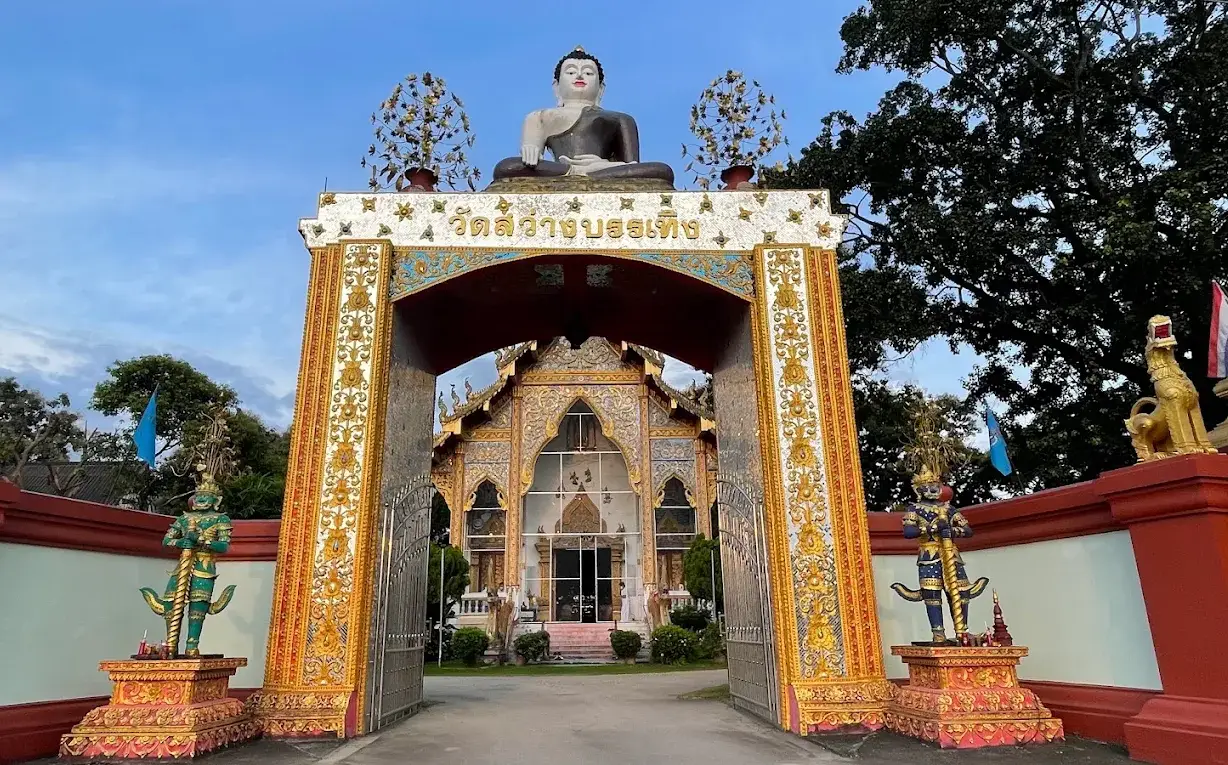
Wat Sawang Banthoeng
Open Days: Daily
Opening Hours: 08.00 – 17.00
Wat Sawang Banthoeng is located at No. 1, Moo 6, Ban Thong Fai or Ban Waree Tham, Mae Sa Subdistrict, Mae Rim District, Chiang Mai Province 50180. It is a community Buddhist temple under the Mahanikaya monastic order. The temple was formerly known as Wat Mae Sa Noi, was registered as a temple on May 21, 1842, later renamed Wat Sawang Banthoeng, and received its royal Wisungkhamasima boundary on July 31, 1950. The temple covers 2 rai, 2 ngan, and 23 square wah and serves as an important spiritual center for Ban Mae Sa Noi, Ban Thong Fai, and Ban Waree Tham.
Wat Sawang Banthoeng is suitable for travelers who want to understand Mae Rim beyond waterfalls, cafés, resorts, and scenic viewpoints. The temple tells the story of a village community that once had no local temple of its own. During merit-making festivals and Buddhist ceremonies, villagers had to travel to other temples they respected. In the rainy season, especially during the Buddhist Lent period, traveling to distant temples was difficult. The establishment of the temple therefore came from a practical community need and the shared faith of local residents.
Ban Mae Sa Noi is an old community in Mae Sa Subdistrict. Its name reflects the local distinction between more densely populated areas and less densely populated areas. A larger settlement was called Ban Mae Sa Luang, while the smaller settlement was called Ban Mae Sa Noi. The area was historically associated with orchards, agricultural land, the Mae Sa Stream, and village-based Buddhist life. As Mae Rim developed, Ban Mae Sa Noi gradually became a semi-urban and semi-rural community while retaining its temple-centered cultural identity.
Ban Waree Tham, locally known as Ban Thong Fai, is Moo 6 of Mae Sa Subdistrict. It separated from Ban Mae Sa Noi in 2000 after the Chiang Mai–Fang road divided the original village area and the older community became larger. The name Ban Thong Fai comes from the area’s location near an irrigation weir. After a serious flood on November 4, 2002, the village was renamed Ban Waree Tham in 2003. Even today, many local residents still call it Ban Thong Fai.
The history of Wat Sawang Banthoeng began when the people of Ban Mae Sa Noi joined together to build a temple for their village. As the local population grew, villagers selected a small hill surrounded by trees and located near the village as the site of the temple. The original name was Wat Mae Sa Noi, directly reflecting its connection with Ban Mae Sa Noi. The temple was created to be a spiritual center and a place where villagers could hold religious and community activities without having to travel to other temples.
Wat Mae Sa Noi was registered as a temple on May 21, 1842. Khruba Chao Kham Pan Panyasaro, the ecclesiastical leader of Tha Khrai Subdistrict, served as abbot and received support from local devotees. This registration marked the temple’s formal status as a Buddhist site for the village and became the foundation for its later development as Wat Sawang Banthoeng.
Another important figure in the temple’s history was Pho Khun Banthoeng, the headman of Tha Khrai Subdistrict. He led local supporters in developing the temple and constructing permanent religious buildings such as monks’ residences, a viharn, and halls. This period reflects the typical development of a Lanna community temple, where monks, local leaders, and villagers worked together to maintain Buddhism and community life.
Around 1941, during the state cultural reform period, temples and local places were encouraged to adopt new names. Phra Khru Udom Wutthikhun, then ecclesiastical chief of Mae Rim District, gave the temple the new name Wat Sawang Banthoeng. The word “Sawang” came from the meaning of Khruba Chao Kham Pan’s monastic name, Panyasaro, referring to wisdom that brings brightness to the mind. The word “Banthoeng” came from Pho Khun Banthoeng, the local leader who supported the temple’s development. The temple’s name therefore combines Buddhist wisdom, community leadership, and local memory.
The renaming from Wat Mae Sa Noi to Wat Sawang Banthoeng was more than an administrative change. It preserved the memory of the temple’s founders and supporters in the name itself. “Sawang” suggests clarity, wisdom, and the light of Dhamma, while “Banthoeng” honors the village leader who helped develop the temple. The name carries both Buddhist meaning and community history.
Wat Sawang Banthoeng received its royal Wisungkhamasima boundary on July 31, 1950, listed as No. 19 during the reign of King Bhumibol Adulyadej. The announcement appeared in the Royal Gazette, Volume 67, Part 44, dated August 15, 1950. In Thai Buddhist tradition, the Wisungkhamasima boundary defines the sacred area used for formal monastic acts, especially ceremonies connected with the ordination hall and the Sangha. This milestone reflects the temple’s development into a more complete Buddhist institution.
The temple’s land covers 2 rai, 2 ngan, and 23 square wah, according to land title deed No. 28384, Volume 284, Page 84, issued on February 11, 1999. The temple stands within the community context of Ban Thong Fai or Ban Waree Tham while preserving its historical connection with Ban Mae Sa Noi. It therefore links several layers of local history: the early village, the creation of Wat Mae Sa Noi, the renaming to Wat Sawang Banthoeng, and the later formation of Ban Waree Tham.
Important structures at Wat Sawang Banthoeng include an ordination hall, sermon hall, Phra Pariyattidhamma school building, monks’ residences, viharn, and halls. These structures support Buddhist ceremonies, monastic education, and community activities. The ordination hall is used for formal Sangha functions, the sermon hall supports Dhamma talks and gatherings, the viharn serves as a worship space, and the school building reflects the temple’s role in Buddhist learning.
Important sacred objects at Wat Sawang Banthoeng include plaster Buddha images and brass Buddha images. These images are focal points for worship, merit-making, and local devotion. For local residents, they are not merely religious objects. They represent continuity, shared faith, and the relationship between the temple and the community.
Phra That Chaloem Phra Kiat is one of the temple’s main sacred landmarks. As a chedi within a community temple, it represents Buddhist devotion and the shared merit-making tradition of local people. Visitors can pay respect to the chedi, worship the Buddha images, make merit, and experience the quiet atmosphere of a functioning village temple in Mae Sa.
Wat Sawang Banthoeng is supported by people from both Ban Mae Sa Noi and Ban Waree Tham. In the past, the temple emerged from the needs of Ban Mae Sa Noi residents. In the present, it stands within the Ban Thong Fai or Ban Waree Tham community. This makes the temple a bridge between different stages of local history and a shared spiritual space for multiple community groups.
The temple plays an important role in community life. Local people use Wat Sawang Banthoeng for merit-making, sermons, Buddhist ceremonies, Kathin, forest robe offerings, and village activities. It also functions as a meeting point where residents maintain social ties, exchange information, and preserve local identity in a semi-urban setting where Mae Rim continues to grow.
Ban Waree Tham has several community groups, including the village committee, public health volunteers, women’s group, village fund group, youth group, civil defense volunteers, elderly group, and village water supply group. With Wat Sawang Banthoeng as a cultural landmark, the temple helps connect community organization, Buddhist practice, and public activities.
Important traditions related to Ban Waree Tham and Ban Mae Sa Noi include ancestor-spirit rituals, annual merit-making, Buddhist holy days, Kathin, and forest robe offerings. The ancestor-spirit ritual is usually held around May to June to honor family ancestors and bring relatives together. This reflects the way Buddhism, local beliefs, kinship, and Lanna identity coexist in village life.
Visitors should pay respect to Phra That Chaloem Phra Kiat, the plaster Buddha images, the brass Buddha images, and the Buddha images inside the viharn. The temple is appropriate for making merit, offering Sangha donations, quiet reflection, and learning about the history of Ban Mae Sa Noi, Ban Thong Fai, and Ban Waree Tham. Visitors should dress respectfully, speak softly, and avoid disturbing monks or local worshippers.
The atmosphere of Wat Sawang Banthoeng is calm and community-based. It is not a large commercial tourist attraction. Its value lies in its deep local history, meaningful name, sacred chedi, community buildings, and continuing role in the daily religious life of the people of Mae Sa.
Getting There is convenient from Chiang Mai city by taking Chotana Road or Highway 107 north toward Mae Rim District, then entering Mae Sa Subdistrict and Ban Waree Tham. Private car, rental car, or local transport is recommended. Travelers using public transportation toward Mae Rim can continue by local vehicle into the temple area.
A useful cultural route can begin at Wat Sawang Banthoeng, then continue to Wat Somdet Asaphawan, Wat Mae Sa Luang, Wat Sri Boon Rueang, Wat Tha Khrai, Wat Don Chai, or Wat Pa Daraphirom. Travelers can also extend the trip to Darabhiromya Royal Mansion Museum, Mae Rim Orchid and Butterfly Farm, Mae Sa Waterfall, or Queen Sirikit Botanic Garden. This route combines community temples, village history, Lanna culture, nature, food, and accommodation options in one Mae Rim itinerary.
Wat Sawang Banthoeng is also suitable for a half-day trip from Chiang Mai city or Mae Rim town. Visitors can spend time at the temple, learn its history, worship at the chedi, and observe the surrounding community context of Ban Waree Tham. The temple adds cultural depth to a Mae Rim trip and helps visitors see the district as a living community rather than only a tourism corridor.
In summary, Wat Sawang Banthoeng is a Mahanikaya community temple in Ban Thong Fai or Ban Waree Tham, Mae Sa Subdistrict, Mae Rim District, Chiang Mai Province. Formerly known as Wat Mae Sa Noi, it was registered as a temple on May 21, 1842, renamed Wat Sawang Banthoeng during the state cultural reform period, and received its royal Wisungkhamasima boundary on July 31, 1950. The temple covers 2 rai, 2 ngan, and 23 square wah and includes an ordination hall, sermon hall, Phra Pariyattidhamma school building, viharn, monks’ residences, halls, Phra That Chaloem Phra Kiat, plaster Buddha images, and brass Buddha images. It is suitable for merit-making, local history learning, and connecting a temple visit with the wider Mae Rim cultural route.
| Name | Wat Sawang Banthoeng |
| Location | Ban Thong Fai Or Ban Waree Tham, Mae Sa Subdistrict, Mae Rim District, Chiang Mai Province 50180 |
| Address | No. 1, Moo 6, Ban Thong Fai (Waree Tham), Mae Sa Subdistrict, Mae Rim District, Chiang Mai Province 50180, Thailand |
| Former Name | Wat Mae Sa Noi |
| Temple Type | Community Buddhist temple under the Mahanikaya monastic order |
| Open Days | Daily |
| Opening Hours | 08.00 – 17.00 |
| Ban Waree Tham Community Coordinates | 18.89675282, 98.9479968 |
| Temple Land | 2 Rai, 2 Ngan, 23 Square Wah |
| History | Formerly known as Wat Mae Sa Noi, registered as a temple on May 21, 1842, renamed Wat Sawang Banthoeng during the state cultural reform period, and received its royal Wisungkhamasima boundary on July 31, 1950 |
| Name Origin | “Sawang” reflects the meaning of Khruba Chao Kham Pan Panyasaro’s monastic name, referring to wisdom that brightens the mind; “Banthoeng” honors Pho Khun Banthoeng, a local leader who helped develop the temple |
| Important Structures | Ordination hall, sermon hall, Phra Pariyattidhamma school building, monks’ residences, viharn, and halls |
| Main Sacred Site | Phra That Chaloem Phra Kiat |
| Sacred Objects | Plaster Buddha images and brass Buddha images |
| Highlights | Historic community temple founded from the faith of Ban Mae Sa Noi residents, with a meaningful name linked to Khruba Chao Kham Pan and Pho Khun Banthoeng, and a continuing role as the spiritual center of Ban Thong Fai and Ban Waree Tham |
| Community Role | A place for merit-making, sermons, Buddhist ceremonies, Kathin, forest robe offerings, and community activities of Ban Mae Sa Noi, Ban Thong Fai, and Ban Waree Tham |
| Related Traditions | Ancestor-spirit rituals, Kathin, forest robe offerings, Buddhist holy days, and local community merit-making activities |
| Main Contact Number | 053-297-089 |
| Travel Information | Travel from Chiang Mai city along Chotana Road or Highway 107 toward Mae Rim District, then enter Mae Sa Subdistrict and Ban Waree Tham. Private car, rental car, or local transport is recommended. |
| Nearby Tourist Attractions | 1. Wat Somdet Asaphawan, about 2 km 2. Wat Mae Sa Luang, about 3 km 3. Wat Sri Boon Rueang, about 4 km 4. Darabhiromya Royal Mansion Museum, about 5 km 5. Wat Pa Daraphirom, about 6 km |
| Nearby Restaurants | 1. Baan Landai Fine Thai Cuisine Mae Rim, about 4 km, Tel. 064-469-2929 2. Per La Mer Cafe, about 7 km, Tel. 064-269-9795 3. Akha Ama Living Factory, about 8 km, Tel. 088-267-8014 4. Huen Lung Suea Mae Rim, about 8 km 5. Pongyang Angdoi Restaurant, about 15 km, Tel. 085-618-8885 |
| Nearby Accommodations | 1. Mae Rim Whale Park Resort, about 3 km, Tel. 053-299-409 2. The Grand Morocc Hotel, about 4 km, Tel. 053-299-835 3. Mae Rim Lagoon Hotel, about 5 km, Tel. 053-297-288 4. Four Seasons Resort Chiang Mai, about 7 km, Tel. 053-298-181 5. Pongyang Angdoi Resort, about 15 km, Tel. 053-879-151 |
Frequently Asked Questions (FAQ)
Q: Where Is Wat Sawang Banthoeng Located?
A: Wat Sawang Banthoeng is located at No. 1, Moo 6, Ban Thong Fai or Ban Waree Tham, Mae Sa Subdistrict, Mae Rim District, Chiang Mai Province 50180, Thailand.
Q: What Are The Open Days And Opening Hours Of Wat Sawang Banthoeng?
A: The temple is open daily from 08.00 to 17.00.
Q: What Was The Former Name Of Wat Sawang Banthoeng?
A: The former name of Wat Sawang Banthoeng was Wat Mae Sa Noi.
Q: When Was Wat Sawang Banthoeng Registered As A Temple?
A: Wat Mae Sa Noi, now Wat Sawang Banthoeng, was registered as a temple on May 21, 1842.
Q: When Did Wat Sawang Banthoeng Receive Its Royal Wisungkhamasima Boundary?
A: Wat Sawang Banthoeng received its royal Wisungkhamasima boundary on July 31, 1950.
Q: What Is The Origin Of The Name Wat Sawang Banthoeng?
A: “Sawang” comes from the meaning of Khruba Chao Kham Pan Panyasaro’s monastic name, referring to wisdom that brightens the mind, while “Banthoeng” honors Pho Khun Banthoeng, a local leader who helped develop the temple.
Q: What Are The Main Highlights Of Wat Sawang Banthoeng?
A: The main highlights are its history as a temple founded from local faith, Phra That Chaloem Phra Kiat, the ordination hall, sermon hall, Phra Pariyattidhamma school building, and its role as the spiritual center of Ban Mae Sa Noi, Ban Thong Fai, and Ban Waree Tham.
Q: What Nearby Attractions Can Be Visited With Wat Sawang Banthoeng?
A: Nearby attractions include Wat Somdet Asaphawan, Wat Mae Sa Luang, Wat Sri Boon Rueang, Darabhiromya Royal Mansion Museum, and Wat Pa Daraphirom.
 Category: ●Places of Worship
 Group: ●Temple
Last Update : 6 DayAgo
 Last Update : 6 DayAgo
 Click to Access the Navigation Map GPS
Wat Sawang Banthoeng Map
Recommend

 Muang Chiang Mai(121)Chom Thong(47)Mae Chaem(25)Chiang Dao(33)Doi Saket(68)Mae Taeng(85)Mae Rim(69)Samoeng(29)Fang(71)Mae Ai(59)Phrao(70)San Pa Tong(103)San Kamphaeng(66)San Sai(73)Hang Dong(74)Hot(32)Doi Tao(22)Omkoi(11)Saraphi(74)Wiang Haeng(15)Chai Prakan(28)Mae Wang(32)Mae On(22)Doi Lo(34)Galyani Vadhana(1)


