
lovethailand home >North Travel Attractions >Chiang Mai Travel Attractions >Mae Rim >Don Kaeo > Wat Phra Non (Khon Muang)
TL;DR: Wat Phra Non (Khon Muang) is located at Moo 5, Ban Phra Non, Don Kaew Subdistrict, Mae Rim District, Chiang Mai Province, open Daily, hours 08.00 – 17.00.

Wat Phra Non (Khon Muang)
Open Days: Daily
Opening Hours: 08.00 – 17.00
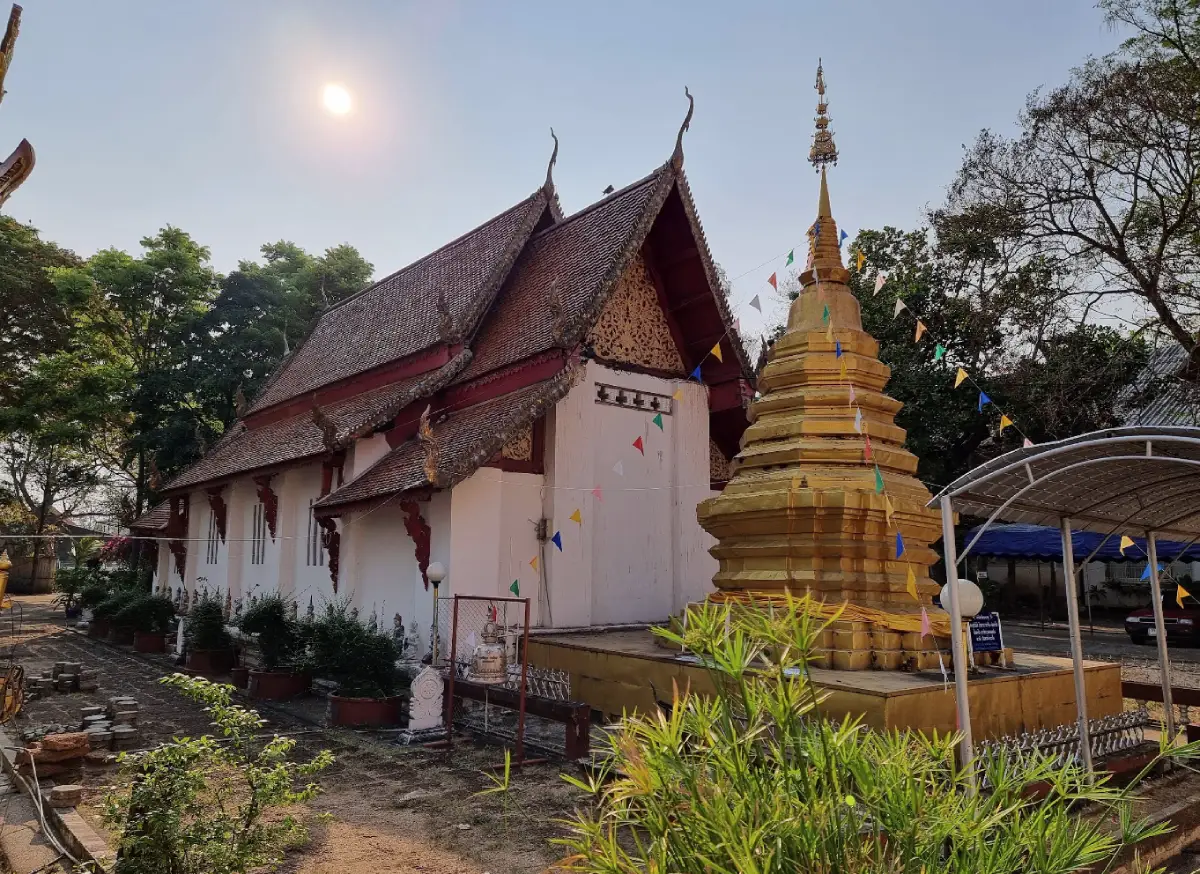
Wat Phra Non (Khon Muang) is located in Moo 5, Ban Phra Non, Don Kaew Subdistrict, Mae Rim District, Chiang Mai Province 50180. It is a non-royal Buddhist temple under the Maha Nikaya order, covering about 6 rai, 2 ngan, and 39 square wah. The temple was officially established in 1917 and is one of the important historical temples in Don Kaew Subdistrict. Wat Phra Non is known for its reclining Buddha image, Lanna-style chedi, old ordination hall, mural paintings, antique sermon throne, scripture cabinets, ancient manuscripts, and historical cloth painting connected with northern Thai royal patronage.
The name Wat Phra Non refers to the reclining Buddha image, the temple’s most important sacred object. The additional name “Khon Muang” is connected with local legend involving a purple log and the creation of the reclining Buddha image. This gives the temple a distinct identity and helps distinguish it from other temples named Wat Phra Non in Thailand. In Don Kaew, the temple is strongly connected with Ban Phra Non and the local Buddhist community.
Ban Phra Non is a community in Don Kaew Subdistrict, located between Chiang Mai city and Mae Rim. The area has old temples, community shrines, historical sites, and active Buddhist traditions. Wat Phra Non (Khon Muang) serves as a spiritual center for Ban Phra Non, a place for merit-making, dhamma listening, annual rituals, and community Buddhist activities. Its location close to Chiang Mai city also makes it suitable for travelers who want to visit a historical Lanna temple without going far from the city.
The history of Wat Phra Non (Khon Muang) is connected with the Phra Chao Liap Lok tradition and local belief in relic worship. Local narratives describe the creation of the reclining Buddha image along the trace of a collapsed purple log and the enshrinement of sacred relics. This makes the reclining Buddha more than a religious image; it is a focal point of local belief, temple legend, and Lanna Buddhist memory.
The temple’s importance is also confirmed by its registration as an ancient monument. Wat Phra Non (Khon Muang) was first registered in the Royal Gazette on 5 January 1954 and later again on 21 August 1979. This status shows that the temple is not only a village place of worship but also a site of cultural and artistic heritage that should be preserved.
One of the temple’s most important buildings is the Lanna-style ordination hall built of brick and plaster. Inside the ordination hall are mural paintings depicting the 13 chapters of the Vessantara Jataka. These murals are more than 150 years old. The Vessantara Jataka is one of the most important Buddhist stories teaching generosity, sacrifice, patience, and moral perfection. For visitors interested in Lanna art, the murals are among the most valuable features of the temple.
The old viharn is another major part of the temple. It houses the reclining Buddha image, which is the main sacred object of Wat Phra Non (Khon Muang). A reclining Buddha image represents the Buddha at the moment of final passing into parinirvana. It is associated with peace, release, and reflection on the nature of life. Paying respect to the reclining Buddha at this temple is therefore both a religious act and a quiet moment of contemplation.
The temple’s chedi is a Lanna-style structure with a circular form, indented base, and gilded jangko covering. It enshrines relics of the Buddha and serves as a central focus for the annual water-pouring ceremony. In Lanna Buddhist culture, pouring water over a chedi is an act of reverence, purification, and merit-making. At Wat Phra Non, the annual water-pouring ceremony for the reclining Buddha and the chedi is one of the temple’s most important traditions.
Wat Phra Non also has a ho tham, or scripture hall, in the form of a Lanna-style four-sided pavilion. A ho tham is important in northern Thai temples because it preserves Buddhist scriptures, palm-leaf manuscripts, and religious texts. Even when an old scripture hall shows the marks of age, its cultural value remains high because it reflects the temple’s role as a center of Buddhist learning and manuscript preservation.
The temple also preserves an antique sermon throne and two Lanna-style scripture cabinets. A sermon throne is the elevated seat from which monks teach the dhamma, while scripture cabinets were used to store Buddhist texts. These objects show that Wat Phra Non was not only a place for worship but also a place of teaching, learning, and manuscript culture.
Ancient manuscripts and phap sa are also part of the temple’s heritage. Phap sa are traditional northern Thai folded manuscripts used to record Buddhist teachings, rituals, and local knowledge. Their presence at Wat Phra Non gives the temple documentary and cultural value beyond architecture and sculpture.
Another important object is a phra bot, or Buddhist cloth painting, commissioned by Chao Inthawaroros Suriyawong and Princess Dara Rasmi. This connects Wat Phra Non (Khon Muang) with the history of northern Thai royal patronage and Buddhist art in Chiang Mai. The phra bot is significant not only as an object of devotion but also as a link between the temple, Lanna elites, and the preservation of Buddhist visual culture.
The temple’s restoration history is also connected with Khruba Srivichai, one of the most revered monks in northern Thailand. Temple history records that in 1927, Khruba Kaew Khantharo invited Khruba Srivichai to preside over restoration work on the reclining Buddha, the chedi, and the viharn housing the reclining Buddha. This connection adds further historical weight to the temple because Khruba Srivichai played a major role in restoring Buddhist monuments across northern Thailand.
Wat Phra Non (Khon Muang) remains active today. It has hosted summer novice ordination ceremonies, provincial Buddhist ceremonies, and the annual water-pouring ceremony for the reclining Buddha and chedi. These activities show that the temple is not a static historical site. It continues to be used by monks, villagers, government agencies, and devotees for Buddhist practice and community events.
The annual water-pouring ceremony for the reclining Buddha and the chedi is one of the temple’s major traditions. Held around June, the ceremony gives devotees the opportunity to pay respect to the reclining Buddha, the chedi, and the sacred heritage of the temple. It brings together local residents and visitors and reinforces the temple’s role as a spiritual center of Don Kaew.
Wat Phra Non (Khon Muang) is currently led by Phra Athikan Prasit Kittiyano. As abbot, he plays an important role in maintaining the temple, supporting Buddhist activities, and preserving the temple’s relationship with the Ban Phra Non community. The temple remains an important religious and cultural site in Mae Rim District.
Important things to see at Wat Phra Non (Khon Muang) include the reclining Buddha image, Lanna-style chedi, Lanna ordination hall, Vessantara Jataka murals, old viharn, scripture hall, antique sermon throne, Lanna scripture cabinets, phra bot, ancient manuscripts, phap sa, merit-making hall, and bell tower. The temple is best visited slowly because many of its important features are historical, artistic, and devotional rather than purely decorative.
The atmosphere of Wat Phra Non is peaceful and suitable for merit-making, cultural learning, and historical temple visits. It is not only a temple with a reclining Buddha; it is also a compact heritage site that brings together multiple elements of Lanna temple culture. These include architecture, murals, manuscripts, ritual objects, relic worship, and annual community traditions.
Wat Phra Non (Khon Muang) is suitable for travelers interested in old Lanna temples, Buddhist art, reclining Buddha images, ancient manuscripts, and quiet cultural routes near Chiang Mai city. It is also suitable for visitors who want to understand Don Kaew beyond its modern suburban setting. The temple gives a clear view of how faith, local community, and Lanna heritage continue to coexist in Mae Rim.
The temple can be included in several connected travel routes. A Don Kaew cultural route can include Wat Piyaram, Wat Don Kaew, Wat Dara Phimuk, Princess Sirindhorn AstroPark, and Chiang Mai 700th Anniversary Stadium. A wider Mae Rim route can continue to Wat Pa Dara Phirom Phra Aram Luang, Dara Pirom Palace Museum, Mae Sa Waterfall, and Queen Sirikit Botanic Garden. This makes Wat Phra Non a meaningful stop for travelers combining temples, history, science, and nature in one day.
Getting There is easiest by private car, rental car, or hired local transport. From Chiang Mai city, take Chotana Road toward Mae Rim and enter Don Kaew Subdistrict, Ban Phra Non, Moo 5. Search for “Wat Phra Non Khon Muang” or the Thai name “วัดพระนอนขอนม่วง” in a navigation app to avoid confusion with other temples named Wat Phra Non in Thailand.
Public transport is possible via local routes toward Mae Rim, followed by a local vehicle or hired transport into Ban Phra Non. For travelers planning to visit several places in one day, a private car or hired driver is recommended. This makes it easier to connect Wat Phra Non with Wat Piyaram, Wat Don Kaew, Wat Dara Phimuk, Princess Sirindhorn AstroPark, and Wat Pa Dara Phirom.
The best time to visit is in the morning or late afternoon, when the weather is more comfortable and the temple atmosphere is quieter. During the annual water-pouring ceremony for the reclining Buddha and chedi, visitors should allow extra time and respect the ceremonial setting. Dress modestly, speak quietly, and avoid touching ancient objects or conservation areas unnecessarily.
Overall, Wat Phra Non (Khon Muang) is one of the most important historical temples in Don Kaew and Mae Rim. Its value comes from the reclining Buddha image, Lanna-style chedi, old ordination hall, Vessantara Jataka murals, antique sermon throne, scripture hall, Lanna scripture cabinets, phra bot, ancient manuscripts, registration as an ancient monument, and the annual water-pouring tradition. It is recommended for travelers who want a deeper, quieter, and historically meaningful temple visit near Chiang Mai.
| Name | Wat Phra Non (Khon Muang) |
| Location | Moo 5, Ban Phra Non, Don Kaew Subdistrict, Mae Rim District, Chiang Mai Province |
| Address | Moo 5, Ban Phra Non, Don Kaew Subdistrict, Mae Rim District, Chiang Mai 50180, Thailand |
| Coordinates | Latitude 18.845405, Longitude 98.977532 |
| Temple Type | Non-Royal Buddhist Temple Under The Maha Nikaya Order |
| Temple Area | 6 rai, 2 ngan, 39 square wah |
| Year Established | Officially established in 1917 |
| Ancient Monument Status | Registered in the Royal Gazette on 5 January 1954 and 21 August 1979 |
| Abbot / Caretaker | Phra Athikan Prasit Kittiyano |
| Highlights | Reclining Buddha image, Lanna-style chedi, old ordination hall with Vessantara Jataka murals, antique sermon throne, scripture hall, Lanna scripture cabinets, phra bot, ancient manuscripts, and annual water-pouring ceremony |
| Important Structures | Lanna-style ordination hall, old viharn, sermon hall, 4 monks’ residences, Lanna four-sided scripture hall, merit-making hall, and bell tower |
| Sacred Objects / Antiquities | Reclining Buddha image, chedi, antique sermon throne, 2 Lanna scripture cabinets, phra bot, ancient manuscripts, and phap sa |
| Tradition / Buddhist Events | Annual water-pouring ceremony for the reclining Buddha and chedi, summer novice ordination, Kathin, Pha Pa, Buddhist holy days, and community Buddhist activities |
| Open Days | Daily |
| Opening Hours | 08.00 – 17.00 |
| Current Status | Open as a community temple and ancient monument in Don Kaew Subdistrict, Mae Rim District, Chiang Mai Province |
| Travel Information | From Chiang Mai city, take Chotana Road toward Mae Rim and enter Don Kaew Subdistrict, Ban Phra Non, Moo 5. Private car, rental car, or hired local transport is recommended. |
| Nearby Tourist Attractions | 1. Wat Piyaram, about 2 km 2. Wat Don Kaew, about 3 km 3. Wat Dara Phimuk, about 4 km 4. Princess Sirindhorn AstroPark, about 4 km 5. Chiang Mai 700th Anniversary Stadium, about 4 km 6. Wat Pa Dara Phirom Phra Aram Luang, about 12 km 7. Dara Pirom Palace Museum, about 12 km 8. Mae Sa Waterfall, about 18 km 9. Queen Sirikit Botanic Garden, about 23 km |
| Nearby Restaurants | 1. Khao Soi Phra Non Don Kaew, about 1 km, Tel. 091-879-7539 2. Mae Kha Indy Cooked-To-Order, about 3 km, Tel. 062-331-9163 3. Mala Don Kaew Grill, about 3 km, Tel. 086-329-9462, 088-252-6062 4. Tod Suk Fried Meatballs, Ban Don Kaew Branch, about 3 km, Tel. 091-808-0588 5. Giant Grilled Fish Wrap Don Kaew, about 3 km, Tel. 080-539-5952 6. Pla Phao Na Mike Don Kaew, about 4 km, Tel. 063-696-6406 7. Pork Knuckle Rice Nay Aor Don Kaew Mae Rim, about 5 km, Tel. 094-629-8895 |
| Nearby Accommodations | 1. My Home 103, Wat Phra Non Khon Muang Lane, about 1 km, Tel. 081-595-5650 2. M Place Mae Rim, about 4 km, Tel. 083-152-0805 3. Inghome & Guesthouse, about 5 km, Tel. 088-599-0465 4. The Imperial Chiang Mai Resort & Sport Club, about 5 km, Tel. 053-121-650 5. Golden Cupids Hotel, about 9 km, Tel. 053-844-503 |
Frequently Asked Questions (FAQ)
Q: Where is Wat Phra Non (Khon Muang) located?
A: Wat Phra Non (Khon Muang) is located in Moo 5, Ban Phra Non, Don Kaew Subdistrict, Mae Rim District, Chiang Mai 50180, Thailand.
Q: Why is Wat Phra Non (Khon Muang) important?
A: It is an old historical temple and registered ancient monument with a reclining Buddha image, Lanna-style chedi, Vessantara Jataka murals, antique sermon throne, scripture cabinets, phra bot, ancient manuscripts, and annual water-pouring tradition.
Q: When was Wat Phra Non (Khon Muang) officially established?
A: Wat Phra Non (Khon Muang) was officially established in 1917.
Q: Who is the abbot of Wat Phra Non (Khon Muang)?
A: The abbot of Wat Phra Non (Khon Muang) is Phra Athikan Prasit Kittiyano.
Q: What should visitors see at Wat Phra Non (Khon Muang)?
A: Important features include the reclining Buddha image, chedi, Lanna ordination hall, Vessantara Jataka murals, old viharn, scripture hall, antique sermon throne, Lanna scripture cabinets, phra bot, ancient manuscripts, and phap sa.
Q: What important tradition is held at Wat Phra Non (Khon Muang)?
A: The temple’s important tradition is the annual water-pouring ceremony for the reclining Buddha and chedi, along with summer novice ordination, Kathin, Pha Pa, and Buddhist community activities.
Q: What are the opening hours of Wat Phra Non (Khon Muang)?
A: Wat Phra Non (Khon Muang) is open daily from 08.00 to 17.00.
Q: What nearby places can be visited with Wat Phra Non (Khon Muang)?
A: Nearby places include Wat Piyaram, Wat Don Kaew, Wat Dara Phimuk, Princess Sirindhorn AstroPark, Chiang Mai 700th Anniversary Stadium, Wat Pa Dara Phirom, Dara Pirom Palace Museum, Mae Sa Waterfall, and Queen Sirikit Botanic Garden.
 Category: ●Places of Worship
 Group: ●Temple
Last Update : 3 DayAgo
 Last Update : 3 DayAgo
 Click to Access the Navigation Map GPS
Wat Phra Non (Khon Muang) Map
Recommend

 Muang Chiang Mai(121)Chom Thong(47)Mae Chaem(25)Chiang Dao(33)Doi Saket(68)Mae Taeng(85)Mae Rim(69)Samoeng(29)Fang(71)Mae Ai(61)Phrao(70)San Pa Tong(105)San Kamphaeng(66)San Sai(73)Hang Dong(74)Hot(32)Doi Tao(22)Omkoi(11)Saraphi(74)Wiang Haeng(15)Chai Prakan(28)Mae Wang(32)Mae On(22)Doi Lo(34)Galyani Vadhana(1)


