
lovethailand home >North Travel Attractions >Chiang Mai Travel Attractions >Mae Taeng >Thakhin > Wat Aranyawiwake
TL;DR: Wat Aranyawiwake is located at Ban Pong, Village No. 7, Inthakhin Subdistrict, Mae Taeng District, Chiang Mai Province, open Daily, hours 08.00 – 17.00.

Wat Aranyawiwake
Open Days: Daily
Opening Hours: 08.00 – 17.00
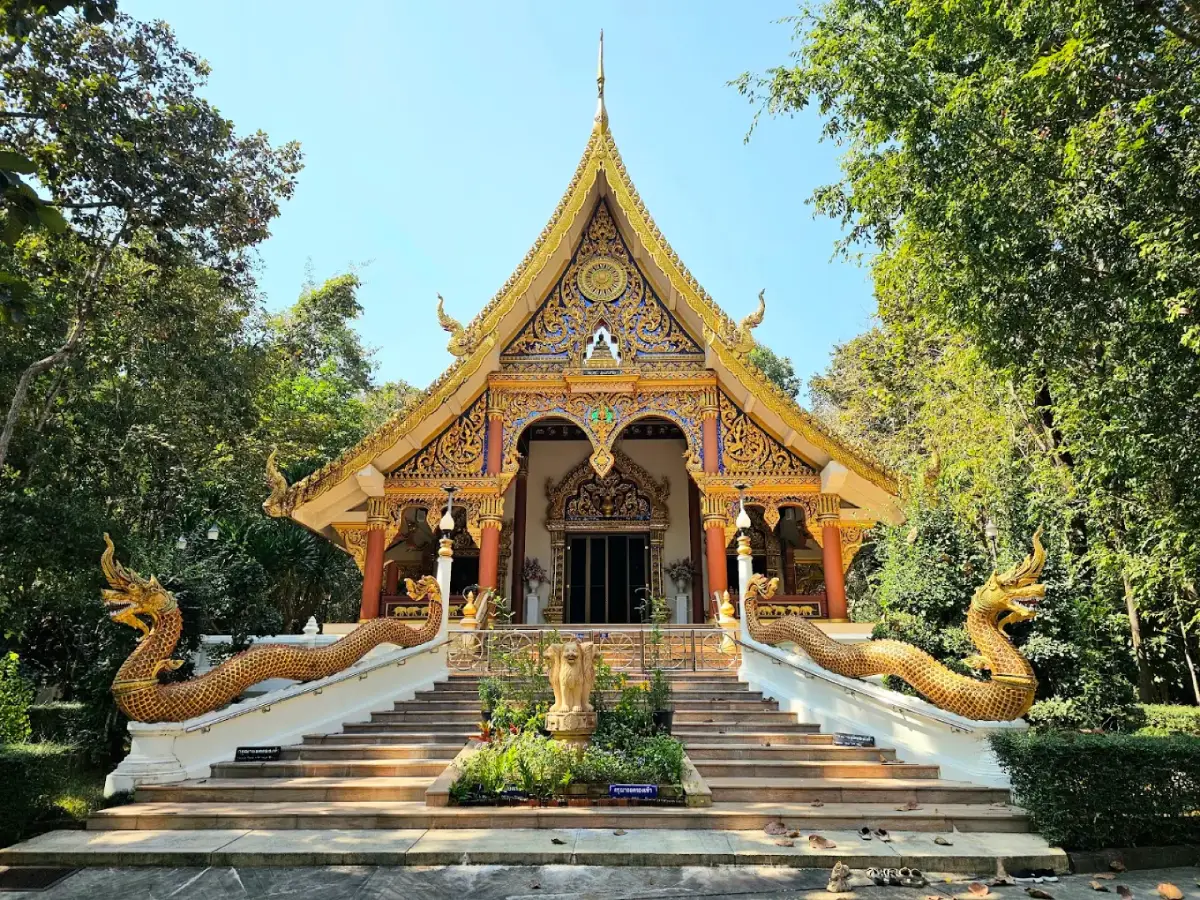
Wat Aranyawiwake, also known as Wat Aranyawiwake Ban Pong, is located in Ban Pong, Inthakhin Subdistrict, Mae Taeng District, Chiang Mai Province. It is an important forest meditation temple in northern Thailand, deeply connected with the Thai forest tradition and the legacy of Luang Pu Mun Bhuridatto. The temple began as an old monastic residence created through the faith of Ban Pong villagers who wanted to invite respected meditation monks to live in the community and teach the Dhamma.
The name “Aranyawiwake” carries the essence of the place. “Aranya” means forest, while “wiwake” means seclusion, solitude, and peaceful withdrawal from distraction. The name was given by Luang Pu Mun Bhuridatto after he stayed and practiced in the area. It reflects the temple’s character as a quiet forest place suited to meditation, Dhamma practice, and disciplined monastic life.
The temple is located on a low hill south of Ban Pong, Village No. 7, Inthakhin Subdistrict. The area is a lightly forested landscape with many trees, shade, and a peaceful atmosphere. The temple grounds cover about 102 rai, allowing space for monastic living, meditation, and quiet walking. Wat Aranyawiwake is not a temple defined by crowds or grand display. Its importance comes from stillness, natural surroundings, and the long continuity of forest meditation practice.
Before becoming Wat Aranyawiwake, the site was an old monastic residence. The villagers of Ban Pong had strong faith in Buddhism and wanted to invite a meditation master to stay in the village so that local people could hear the Dhamma and learn the path of practice. When they heard that meditation monks were staying at Wat Ngiao in Mae Taeng, they invited Luang Pu Mun Bhuridatto. Luang Pu Mun accepted and then explored the area with his disciples and local supporters to find a suitable place for meditation.
The search took about four days before Luang Pu Mun found the place that later became Samnak Song Aranyawiwake. He considered the area peaceful and suitable for meditation. After the rains retreat, when he was preparing to continue his tudong journey, he instructed the Ban Pong supporters to take good care of the place and named it “Samnak Song Aranyawiwake.” From that time onward, the name became closely connected with the temple’s identity as a place of forest solitude and Dhamma practice.
The history of Wat Aranyawiwake is therefore more significant than an ordinary village temple. It is connected with Luang Pu Mun, the central figure of the Thai forest meditation tradition, and with many important meditation masters who later stayed or practiced there. These include Luang Pu Khao Analayo, Luang Pu Thet Thetsarangsi, Luang Pu Chob Thanasamo, Luang Pu Tue Achalathammo, Luang Pu Phrom Chirapunno, Luang Pu Kham Saen, Luang Pu Khong, and Luang Pu Kham Ai Thitathammo. This lineage makes the temple a major forest tradition site in Chiang Mai.
Around 1952, Luang Pu Waen Suchinno returned to stay at the monastic residence for ten consecutive years. During the following period, other forest masters such as Luang Pu Tue Achalathammo, Luang Pu Sam Akinchano, and Luang Pu Kham Ai Thitathammo also spent rains retreats there. After the rains retreat, forest monks often continued their tudong journeys. During some dry seasons, the residence was left without monks or novices, and only the old viharn remained as time passed.
A major turning point came in 1966, when Luang Por Plien Panyapatipo, a disciple in the lineage of Luang Pu Phrom, Luang Pu Waen, and Luang Pu Tue, arrived alone during his tudong journey. He later stayed and spent rains retreats at the monastic residence continuously. Luang Por Plien played a major role in restoring, maintaining, and continuing the meditation atmosphere of Wat Aranyawiwake, making it once again a center for practitioners and followers of the Thai forest tradition.
Wat Aranyawiwake was officially established as a temple in 1982 and received its royal consecrated boundary in 1984. This boundary is important in Thai Buddhist practice because it marks the proper area for formal monastic ceremonies, including ordination and other Sangha acts. With this recognition, the old monastic residence developed into a complete temple within the Thai Sangha system.
The current abbot recorded in official temple-related information is Phra Khru Thammawiwatthana Khun, also known as Phra Ajahn Charoen Chattasallo. He serves as the abbot of Wat Aranyawiwake and holds a role within the Dhammayut Sangha of Mae Taeng District. This confirms that the temple remains an active Buddhist institution, not only a historical forest site.
Important areas of Wat Aranyawiwake include the ordination hall, old viharn area, monks’ residences, temple courtyard, meditation areas, forested grounds, and areas associated with the residence of forest meditation masters. Some historical accounts also mention the remaining symbolic traces of the hut area connected with Luang Pu Mun. These features show that the temple’s importance is rooted in practice, memory, and spiritual continuity rather than in decorative architecture alone.
Visitors should spend time respectfully at the ordination hall and walk quietly through the temple grounds. The temple is associated with Luang Pu Mun, Luang Pu Waen, Luang Por Plien, and many other forest masters, so the site should be approached with calmness and respect. Its beauty lies in its quiet forest setting, clean atmosphere, and the sense of disciplined meditation practice preserved through generations.
Wat Aranyawiwake has played an important role in Ban Pong community life since its early days. The temple arose from the faith of local people who wanted meditation monks to guide them in Dhamma practice. The villagers did not merely build a residence; they supported the monks, maintained the place, and followed Luang Pu Mun’s instruction to preserve it. The temple became a spiritual center where local people could listen to teachings and learn from the example of practicing monks.
The temple is also important for the continuation of the Thai forest tradition in northern Thailand. Forest monks who stayed here often continued their journeys through forests, mountains, and rural communities. Their journeys were not only personal quests for liberation. They also spread Buddhist teachings, built faith, and allowed local people to encounter living examples of morality, concentration, and wisdom.
Religious activities at Wat Aranyawiwake follow the character of a forest temple and local Buddhist community. Important occasions include Buddhist observance days, major Buddhist holy days, Kathin, robe-offering ceremonies, almsgiving, Dhamma listening, and meditation activities. Visitors who come during temple events should dress modestly, keep quiet, and follow the temple’s rules, because forest temples place strong emphasis on restraint and respect.
Wat Aranyawiwake is suitable for travelers interested in Luang Pu Mun Bhuridatto, Luang Pu Waen Suchinno, Luang Por Plien Panyapatipo, and the Thai forest meditation tradition. Visitors who take time to understand the temple will gain more than a quick sightseeing experience. Every part of the temple is connected with forest practice, solitude, discipline, and the transmission of Dhamma through lived example.
A meaningful travel route can connect Wat Aranyawiwake with nearby temples and attractions in Mae Taeng. For a route focused on local history, visitors can continue to Wat Ban Pong, Wat San Pa Tong Inthakhin, and the Inthakhin Muang Kaen Kiln Site. For a forest temple route, Wat Pa Achan Tue, Wat Pa Pha Daen, and Wat Pa Achan Man in Phrao District can be added. For a mixed temple-and-nature route, travelers can continue to Mae Ngat Somboon Chon Dam, Wat Den Sali Sri Muang Kaen, and Mae Taeng Pine Forest.
Getting There from Chiang Mai city is convenient by following Highway 107 toward Mae Taeng District. The route passes Mae Rim and Mae Malai Market before entering Mae Taeng. From Mae Taeng, turn toward Mae Ngat Somboon Chon Dam. After passing Mae Taeng Hospital for about 2.4 km, signs lead to Wat Aranyawiwake. A private car, rental car, or hired local vehicle is the most practical option, especially for travelers who plan to visit several nearby temples and attractions.
The best time to visit is in the morning or late afternoon, when the weather is more comfortable and the temple atmosphere is calm. Visitors who plan to see only Wat Aranyawiwake should allow at least one to two hours. Those planning a wider Mae Taeng temple route should allow a half-day or full-day trip to include worship, quiet walking, meals, and nearby attractions.
Temple etiquette is especially important at Wat Aranyawiwake. Visitors should dress respectfully, keep their voices low, avoid inappropriate photography, and not enter monks’ residences or meditation areas without permission. The temple is a forest monastery with deep connections to important meditation masters, so it should be visited with calmness, respect, and awareness of its spiritual significance.
Wat Aranyawiwake offers a deeper understanding of Mae Taeng beyond ordinary sightseeing. It brings together Ban Pong community history, Luang Pu Mun Bhuridatto, forest meditation masters, Luang Pu Waen, Luang Por Plien, and the continuing Buddhist life of Inthakhin Subdistrict. A visit here reveals the quiet strength of Chiang Mai’s forest temple tradition and the enduring relationship between Buddhism, community, and nature.
| Name | Wat Aranyawiwake |
| Also Known As | Wat Aranyawiwake Ban Pong / Former Samnak Song Aranyawiwake |
| Location | Ban Pong, Village No. 7, Inthakhin Subdistrict, Mae Taeng District, Chiang Mai Province |
| Address | Wat Aranyawiwake, Ban Pong, Inthakhin Subdistrict, Mae Taeng District, Chiang Mai Province 50150, Thailand |
| Telephone | 053-857-544, 053-857-991 |
| Highlights | A forest meditation temple named by Luang Pu Mun Bhuridatto, with a peaceful forest setting suitable for worship, meditation, and learning about the Thai forest tradition |
| History | Originally an old monastic residence in Ban Pong, named Aranyawiwake by Luang Pu Mun Bhuridatto, officially established as a temple in 1982, and granted a royal consecrated boundary in 1984 |
| Name Origin | The name Aranyawiwake means forest seclusion, reflecting the temple’s quiet and meditative forest character |
| Distinctive Features | A lightly forested meditation temple of about 102 rai, located on a low hill and associated with many important forest meditation masters |
| Important Areas / Structures | Ordination hall, old viharn area, monks’ residences, temple courtyard, meditation areas, forested grounds, and places associated with the history of forest meditation teachers |
| Associated Teachers | Luang Pu Mun Bhuridatto, Luang Pu Waen Suchinno, Luang Pu Khao Analayo, Luang Pu Thet Thetsarangsi, Luang Pu Chob Thanasamo, Luang Pu Tue Achalathammo, Luang Pu Phrom Chirapunno, Luang Pu Kham Saen, Luang Pu Khong, Luang Pu Kham Ai Thitathammo, and Luang Por Plien Panyapatipo |
| Abbot / Caretaker | Phra Khru Thammawiwatthana Khun, also known as Phra Ajahn Charoen Chattasallo |
| Travel Information | From Chiang Mai city, follow Highway 107 toward Mae Taeng District, pass Mae Malai Market, then turn toward Mae Ngat Somboon Chon Dam. After passing Mae Taeng Hospital for about 2.4 km, follow the sign to the temple. |
| Current Status | An active forest temple and meditation place in Inthakhin Subdistrict, Mae Taeng District, Chiang Mai Province |
| Open Days | Daily |
| Opening Hours | 08.00 – 17.00 |
| Traditions / Merit-Making Events | Buddhist observance days, major Buddhist holy days, Kathin, robe-offering ceremonies, almsgiving, Dhamma listening, and forest meditation practice |
| Nearby Tourist Attractions | 1. Wat Ban Pong, about 2 km 2. Wat Pa Achan Tue, about 3 km 3. Mae Ngat Somboon Chon Dam, about 8 km 4. Wat San Pa Tong Inthakhin, about 9 km 5. Inthakhin Muang Kaen Kiln Site, about 10 km 6. Wat Den Sali Sri Muang Kaen, about 12 km |
| Nearby Restaurants | 1. Sri Kaew Restaurant @ Mae Taeng, about 6 km, Tel. 082-574-7870 2. Ran Kao, about 7 km, Tel. 097-017-4849 3. Mae Taeng House, about 9 km, Tel. 083-146-6453, 095-496-3235 4. Mont Raming, about 10 km, Tel. 053-372-144, 089-956-3674 5. Care Coffee, about 12 km, Tel. 053-047-097 |
| Nearby Accommodations | 1. Mae Malai Hotel, about 7 km, Tel. 053-842-620, 095-610-6489 2. Grand Hostel Maetang, about 10 km, Tel. 099-987-9432 3. Sabai Dee Resort, about 11 km, Tel. 090-276-9984 4. Nanon Banna, about 12 km, Tel. 098-824-9928 5. Maetang Phuphing Resort, about 16 km, Tel. 062-264-5277 |
Frequently Asked Questions (FAQ)
Q: Where is Wat Aranyawiwake located?
A: Wat Aranyawiwake is located in Ban Pong, Village No. 7, Inthakhin Subdistrict, Mae Taeng District, Chiang Mai Province.
Q: What are the opening hours of Wat Aranyawiwake?
A: Wat Aranyawiwake is open daily from 08.00 to 17.00.
Q: Why is Wat Aranyawiwake important?
A: Wat Aranyawiwake is an important forest meditation temple named by Luang Pu Mun Bhuridatto and associated with many respected Thai forest meditation masters.
Q: When was Wat Aranyawiwake officially established?
A: Wat Aranyawiwake was officially established as a temple in 1982 and received its royal consecrated boundary in 1984.
Q: How is Luang Por Plien Panyapatipo connected with Wat Aranyawiwake?
A: Luang Por Plien Panyapatipo arrived at the old monastic residence in 1966 and played an important role in maintaining and continuing the meditation atmosphere of Wat Aranyawiwake.
Q: Who is the abbot of Wat Aranyawiwake?
A: The abbot recorded in current temple-related information is Phra Khru Thammawiwatthana Khun, also known as Phra Ajahn Charoen Chattasallo.
Q: What nearby places can be visited with Wat Aranyawiwake?
A: Nearby places include Wat Ban Pong, Wat Pa Achan Tue, Mae Ngat Somboon Chon Dam, Wat San Pa Tong Inthakhin, Inthakhin Muang Kaen Kiln Site, and Wat Den Sali Sri Muang Kaen.
Q: How can travelers get from Chiang Mai city to Wat Aranyawiwake?
A: Travelers can follow Highway 107 toward Mae Taeng District, then turn toward Mae Ngat Somboon Chon Dam. After passing Mae Taeng Hospital for about 2.4 km, follow the sign to Wat Aranyawiwake.
 Category: ●Places of Worship
 Group: ●Temple
Last Update : 3 DayAgo
 Last Update : 3 DayAgo
 Click to Access the Navigation Map GPS
 Muang Chiang Mai(121)Chom Thong(47)Mae Chaem(25)Chiang Dao(33)Doi Saket(68)Mae Taeng(85)Mae Rim(69)Samoeng(29)Fang(71)Mae Ai(59)Phrao(70)San Pa Tong(105)San Kamphaeng(66)San Sai(73)Hang Dong(74)Hot(32)Doi Tao(22)Omkoi(11)Saraphi(74)Wiang Haeng(15)Chai Prakan(28)Mae Wang(32)Mae On(22)Doi Lo(34)Galyani Vadhana(1)


