
lovethailand home >North Travel Attractions >Chiang Mai Travel Attractions >Mae Taeng >San Mahaphon > Wat Pa Achan Tue
TL;DR: Wat Pa Achan Tue is located at Village No. 7, Ban Pak Thang, San Mahaphon Subdistrict, Mae Taeng District, Chiang Mai Province, open Daily, hours 08.00 – 17.00.
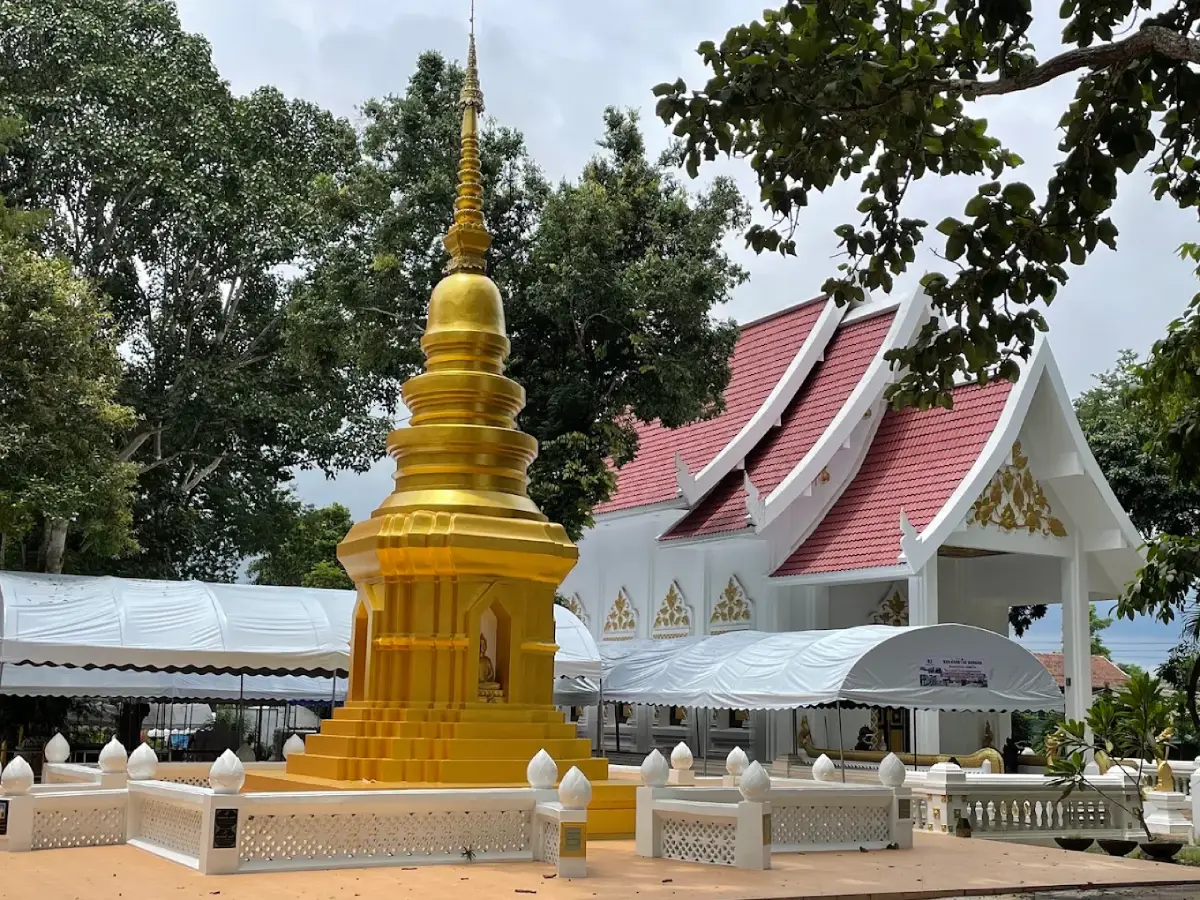
Wat Pa Achan Tue
Open Days: Daily
Opening Hours: 08.00 – 17.00
Wat Pa Achan Tue is located in Village No. 7, Ban Pak Thang, San Mahaphon Subdistrict, Mae Taeng District, Chiang Mai Province. It is a private Buddhist temple under the Dhammayut order and one of the meaningful forest meditation temples along the Mae Taeng route. The temple was officially established in 1980 and received its royal consecrated boundary in 1987. Its history is closely connected with Luang Pu Tue Achalathammo, an important Thai forest meditation master in the lineage of Luang Pu Mun Bhuridatto.
The temple is located near the Chiang Mai–Chiang Dao road, close to the junction leading to Mae Ngat Somboon Chon Dam. This makes Wat Pa Achan Tue easy to reach while still preserving the calm and orderly character of a forest temple. It can be included in a temple route through Mae Taeng together with Wat Aranyawiwake, Wat Den Sali Sri Muang Kaen, Mae Ngat Dam, and other forest meditation temples in the district.
The name of the temple directly honors Luang Pu Tue Achalathammo. Before becoming an officially established temple, the area was associated with Samakkhi Tham Monastic Residence, which grew from local faith and support from villagers in Ban Pak Thang. The temple later became known as Wat Pa Achan Tue in memory of Luang Pu Tue, whose Dhamma practice, forest meditation discipline, and spiritual influence shaped the identity of the place.
Luang Pu Tue Achalathammo was a respected forest meditation monk known for his strong character, direct teaching style, and commitment to practice. He was part of the Thai forest tradition connected with Luang Pu Mun Bhuridatto and spent many years traveling on tudong, practicing in forests, mountains, and remote areas. For many followers of the Thai forest tradition, Wat Pa Achan Tue is not simply a local temple. It is a place connected with a major meditation master and the living memory of forest monastic practice.
The original temple land was offered through the faith of local lay supporters, including villagers who wished to invite meditation monks to stay and teach the community. Before the temple was formally established, forest monks came and went, and villagers continued to support the place as a Dhamma residence. When Luang Pu Tue came to stay and guide the community, local faith became stronger and the site gradually developed into a more permanent forest monastery.
Around 1953, the local community invited Luang Pu Tue Achalathammo to stay in the Ban Pak Thang area. His presence was important because forest temples are not built only from structures. They grow from faith, meditation, discipline, and trust between monks and laypeople. Luang Pu Tue gave the place a clear forest temple character: quiet, disciplined, and centered on Buddhist practice rather than outward display.
In 1967, Luang Pu Tue built a sala for the benefit of Buddhism and the local community. The place became known as Samakkhi Tham Monastic Residence, and forest monks in the lineage of Luang Pu Mun continued to visit and stay there. In 1968, Luang Pu Tue was invited back to Nakhon Phanom, his home province. Luang Pu Sang Sangkitjo, his close disciple and relative, continued to care for and develop the monastery.
In 1980, the monastic residence was officially permitted to become a temple under the name Wat Pa Achan Tue. In 1987, the temple received its royal consecrated boundary. This boundary is important in Thai Buddhist practice because it marks the proper area for formal monastic ceremonies, including ordination and other Sangha acts. With this recognition, the temple gained a stable religious status and became a complete temple within the Thai Sangha system.
Wat Pa Achan Tue is known for orderliness, cleanliness, and calm. These qualities are closely associated with the discipline of Luang Pu Tue Achalathammo. The temple atmosphere reflects the character of a forest monastery: modest, quiet, and suitable for meditation. Visitors should approach the temple with respect and restraint, as it is a place for worship, Dhamma practice, and remembrance of forest meditation masters.
The temple contains several important religious structures and monastic facilities, including the ordination hall, chedi, sermon hall, monks’ residences, dining hall, bell tower, kitchen, boiling-water area, lay practitioners’ accommodation, and a replica of Buddhist holy sites. These elements allow the temple to support monastic ceremonies, merit-making, Dhamma listening, meditation, and visits by lay followers who come to pay respect to the teachers of the forest tradition.
Important sacred objects at the temple include metal Buddha images, the chedi, statues of Luang Pu Tue, and representations of forest meditation teachers connected with the temple. Visitors should spend time respectfully at the ordination hall, chedi, and areas associated with Luang Pu Tue. The beauty of the temple lies not in luxury, but in simplicity, discipline, clean surroundings, and the accumulated faith of monks and laypeople.
Another important figure in the temple’s history is Phra Khru Phawanaphirat, known as Luang Pu Sang Sangkitjo, the former abbot of Wat Pa Achan Tue. He was both a disciple and relative of Luang Pu Tue and played a major role in caring for, developing, and preserving the forest temple tradition here. Luang Pu Sang resided at the temple for many years and became deeply respected by his followers until his passing in 2022.
The story of Luang Pu Sang gives the temple greater spiritual depth. He traveled north in search of Luang Pu Tue and later helped continue Luang Pu Tue’s legacy at Wat Pa Achan Tue. The relationship between the two teachers was not only one of kinship, but also one of Dhamma practice, discipline, and devotion to the forest tradition. This makes the temple an important place for those who respect the lineage of Luang Pu Tue.
Ban Pak Thang and San Mahaphon Subdistrict are central to the temple’s local identity. San Mahaphon includes several villages, and Wat Pa Achan Tue is located in Village No. 7, Ban Pak Thang. The temple is therefore closely tied to the daily religious life of the local community. It serves as a place for worship, merit-making, Dhamma activities, and community gatherings.
The temple’s community role extends beyond ordinary worship. It supports Buddhist observance days, merit-making, Dhamma listening, meditation practice, and seasonal ceremonies. Local traditions in San Mahaphon, such as Songkran or Pi Mai Mueang, Yi Peng, Poi Luang, candle offerings for Buddhist Lent, and robe offerings, form the cultural background in which the temple continues to serve the community.
Religious activities associated with Wat Pa Achan Tue include Buddhist observance days, major Buddhist holy days, Kathin, robe-offering ceremonies, Buddhist Lent candle offerings, bathing-cloth offerings, and meditation activities in the forest temple tradition. Visitors who come during temple events should dress modestly, remain quiet, and allow space for monks, practitioners, and local residents to carry out religious activities properly.
The main highlight of Wat Pa Achan Tue is the combination of forest meditation history and complete temple structures. Visitors should pay respect to the Buddha images, chedi, and statue of Luang Pu Tue, then walk quietly through the temple grounds to experience the atmosphere. The temple is meaningful because it preserves not only buildings but also the discipline and spirit of the Thai forest tradition.
Wat Pa Achan Tue is suitable for travelers interested in Thai forest meditation, Dhammayut temples, the lineage of Luang Pu Mun, and a quieter side of Chiang Mai. It is best visited slowly and respectfully. Rather than treating it as a quick photo stop, visitors should take time to understand how the ordination hall, chedi, sermon hall, dining hall, monks’ residences, and meditation spaces work together as a living forest monastery.
A good half-day route can begin at Wat Pa Achan Tue, continue to Wat Aranyawiwake, and then proceed to Mae Ngat Somboon Chon Dam. A full-day route can add Wat Den Sali Sri Muang Kaen, Mae Taeng Pine Forest, or the Chiang Mai–Phrao route, which passes several forest meditation temples and scenic areas. This makes Wat Pa Achan Tue a strong starting point for a cultural and spiritual route through Mae Taeng.
Wat Aranyawiwake is an important nearby temple on the road toward Mae Ngat Dam and is also associated with forest meditation practice. Visiting Wat Pa Achan Tue together with Wat Aranyawiwake gives travelers a clearer view of forest temples in Mae Taeng. Mae Ngat Dam adds a natural and recreational dimension, making the route suitable for those who want to combine temple history, Dhamma practice, and nature in one trip.
Getting There from Chiang Mai city is straightforward by following Highway 107, the Chiang Mai–Chiang Dao route, toward Mae Taeng District. The temple is located at Ban Pak Thang, close to the junction to Mae Ngat Somboon Chon Dam. A private car, rental car, or hired local vehicle is recommended, especially for travelers who plan to continue to nearby temples, the dam, restaurants, or accommodations in Mae Taeng.
Travelers should allow at least half a day if visiting Wat Pa Achan Tue alone. A full-day plan is better if continuing to other attractions in Mae Taeng. Morning is a good time to visit because the weather is usually more comfortable and the temple atmosphere is calm. Afternoon can be used for Mae Ngat Dam, Wat Den, local restaurants, or nearby accommodations.
Temple etiquette is especially important at Wat Pa Achan Tue. Visitors should dress respectfully, keep their voices low, avoid entering monks’ residential areas without permission, and avoid disturbing people who are chanting or meditating. Anyone wishing to join activities or practice meditation should follow temple instructions and ask respectfully when needed.
Wat Pa Achan Tue should be visited with calmness and respect. Its value lies in the history of Luang Pu Tue Achalathammo, the legacy of Luang Pu Sang Sangkitjo, the atmosphere of a forest temple, and the temple’s continuing role in Ban Pak Thang and San Mahaphon community life. For travelers who want a deeper and quieter side of Chiang Mai, this temple offers a meaningful connection between Buddhist faith, forest meditation practice, and local history.
| Name | Wat Pa Achan Tue |
| Location | Village No. 7, Ban Pak Thang, San Mahaphon Subdistrict, Mae Taeng District, Chiang Mai Province |
| Address | Village No. 7, Ban Pak Thang, San Mahaphon Subdistrict, Mae Taeng District, Chiang Mai Province 50150, Thailand |
| Coordinates | 19.128164, 98.951752 |
| Highlights | A peaceful forest meditation temple connected with Luang Pu Tue Achalathammo, suitable for worship, paying respect to forest meditation teachers, and learning about Mae Taeng’s Buddhist history |
| History | Developed from Samakkhi Tham Monastic Residence, officially established as a temple in 1980, and granted a royal consecrated boundary in 1987 |
| Name Origin | Named in honor of Luang Pu Tue Achalathammo, an important forest meditation teacher in the lineage of Luang Pu Mun Bhuridatto |
| Distinctive Features | A Dhammayut forest temple known for calmness, cleanliness, discipline, and complete monastic facilities including the ordination hall, chedi, sermon hall, dining hall, bell tower, monks’ residences, and meditation spaces |
| Important Structures | Ordination hall, chedi, sermon hall, monks’ residences, dining hall, bell tower, kitchen, boiling-water area, lay practitioners’ accommodation, and replica of Buddhist holy sites |
| Sacred Objects | Metal Buddha images, chedi, statue of Luang Pu Tue, and statues of forest meditation teachers connected with the temple |
| Important Former Abbot | Phra Khru Phawanaphirat, also known as Luang Pu Sang Sangkitjo, former abbot of Wat Pa Achan Tue |
| Travel Information | From Chiang Mai city, follow Highway 107 toward Mae Taeng District. The temple is located at Ban Pak Thang near the junction to Mae Ngat Somboon Chon Dam. A private car, rental car, or hired local transport is recommended. |
| Current Status | An active forest temple and Buddhist religious site for worship, merit-making, and meditation practice |
| Open Days | Daily |
| Opening Hours | 08.00 – 17.00 |
| Traditions / Merit-Making Events | Buddhist observance days, major Buddhist holy days, Kathin, robe-offering ceremonies, Buddhist Lent candle offerings, bathing-cloth offerings, and forest meditation activities |
| Nearby Tourist Attractions | 1. Wat Aranyawiwake, about 3 km 2. Mae Ngat Somboon Chon Dam, about 5 km 3. Wat Den Sali Sri Muang Kaen, about 8 km 4. Mae Taeng Pine Forest, about 13 km 5. Wat Pa Achan Man, Phrao District, about 27 km 6. Bua Tong Waterfall and Nam Phu Chet Si, about 31 km |
| Nearby Restaurants | 1. Hat Yai Fried Chicken Pak Thang Mae Taeng, about 1 km, Tel. 089-852-7172 2. Mont Raming, about 4 km, Tel. 089-956-3674 3. Mont Cafe, Mont Raming Project, about 4 km 4. Care Coffee, about 8 km, Tel. 053-047-097 5. Mu-Kai Op Ong Mae Taeng, about 9 km, Tel. 097-921-8447 |
| Nearby Accommodations | 1. Mae Malai Hotel, about 4 km, Tel. 053-842-620, 095-610-6489 2. Grand Hostel Maetang, about 11 km, Tel. 099-987-9432 3. Sabai Dee Resort, about 11 km, Tel. 090-276-9984 4. Nanon Banna, about 12 km, Tel. 098-824-9928 5. Maetang Phuphing Resort, about 16 km, Tel. 062-264-5277 |
Frequently Asked Questions (FAQ)
Q: Where is Wat Pa Achan Tue located?
A: Wat Pa Achan Tue is located in Village No. 7, Ban Pak Thang, San Mahaphon Subdistrict, Mae Taeng District, Chiang Mai Province.
Q: What are the opening hours of Wat Pa Achan Tue?
A: Wat Pa Achan Tue is open daily from 08.00 to 17.00.
Q: Why is Wat Pa Achan Tue important?
A: Wat Pa Achan Tue is an important forest meditation temple connected with Luang Pu Tue Achalathammo and the Thai forest tradition in Mae Taeng District.
Q: When was Wat Pa Achan Tue officially established?
A: Wat Pa Achan Tue was officially established as a temple in 1980 and received its royal consecrated boundary in 1987.
Q: What important structures are inside Wat Pa Achan Tue?
A: The temple includes an ordination hall, chedi, sermon hall, monks’ residences, dining hall, bell tower, kitchen, lay practitioners’ accommodation, Buddha images, and a statue of Luang Pu Tue.
Q: Who was Luang Pu Sang Sangkitjo?
A: Luang Pu Sang Sangkitjo, formally Phra Khru Phawanaphirat, was a disciple and relative of Luang Pu Tue Achalathammo and a former abbot of Wat Pa Achan Tue.
Q: What nearby places can be visited with Wat Pa Achan Tue?
A: Nearby places include Wat Aranyawiwake, Mae Ngat Somboon Chon Dam, Wat Den Sali Sri Muang Kaen, Mae Taeng Pine Forest, Wat Pa Achan Man in Phrao District, and Bua Tong Waterfall with Nam Phu Chet Si.
Q: How can travelers get from Chiang Mai city to Wat Pa Achan Tue?
A: Travelers can follow Highway 107 from Chiang Mai city toward Mae Taeng District. The temple is located at Ban Pak Thang near the junction to Mae Ngat Somboon Chon Dam. A private car, rental car, or hired local transport is recommended.
 Category: ●Places of Worship
 Group: ●Temple
Last Update : 2 DayAgo
 Last Update : 2 DayAgo
 Click to Access the Navigation Map GPS
 Muang Chiang Mai(121)Chom Thong(47)Mae Chaem(25)Chiang Dao(33)Doi Saket(68)Mae Taeng(85)Mae Rim(69)Samoeng(29)Fang(71)Mae Ai(62)Phrao(70)San Pa Tong(105)San Kamphaeng(66)San Sai(73)Hang Dong(74)Hot(32)Doi Tao(22)Omkoi(11)Saraphi(74)Wiang Haeng(15)Chai Prakan(28)Mae Wang(32)Mae On(22)Doi Lo(34)Galyani Vadhana(1)


