
lovethailand home >North Travel Attractions >Chiang Mai Travel Attractions >Mae Taeng >Thakhin > Wat Mut Ka Phatthanaram
TL;DR: Wat Mut Ka Phatthanaram is located at Ban Muet Ka, Moo 17, Intakhin Subdistrict, Mae Taeng District, Chiang Mai Province.
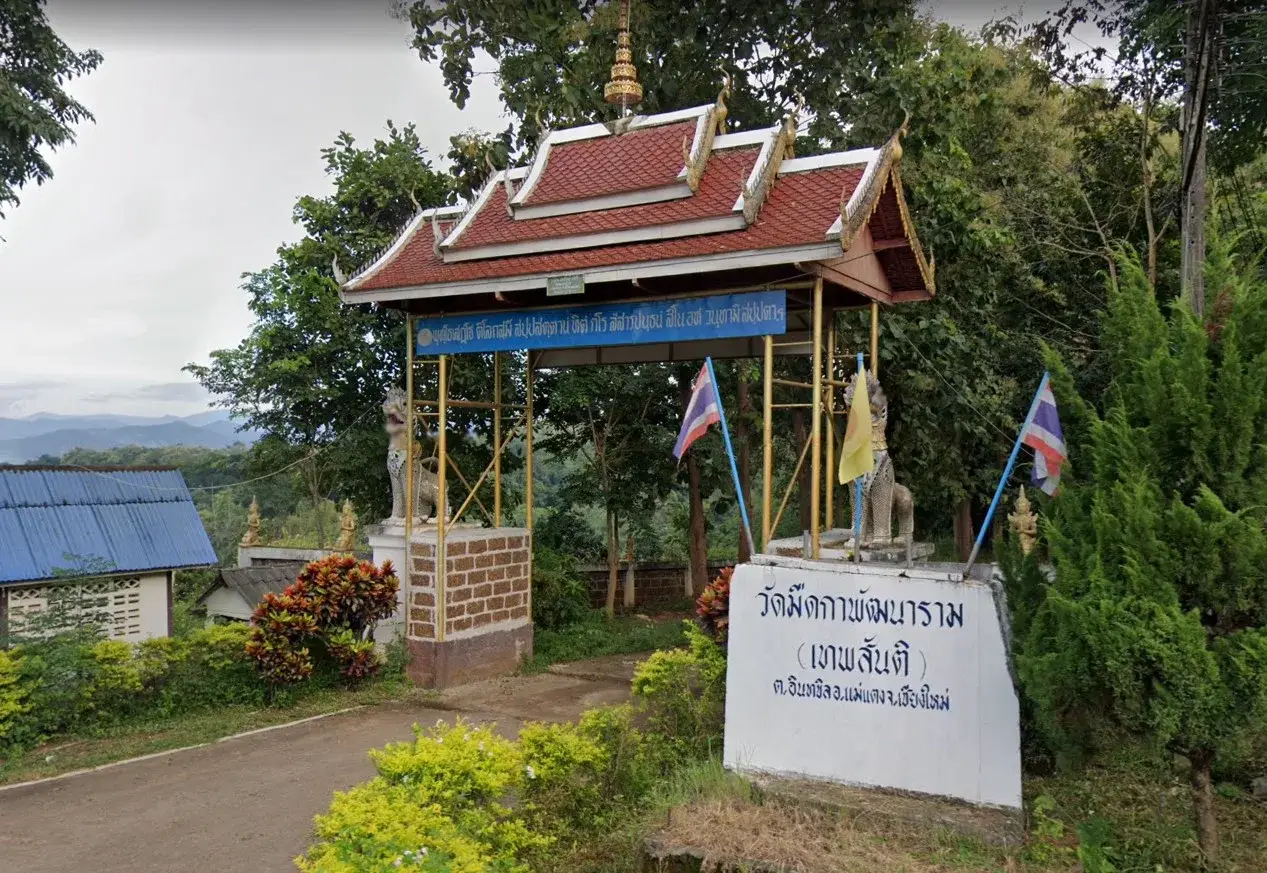
Wat Mut Ka Phatthanaram
Operating day: Daily
Operating time: 08.00 - 17.00
Wat Muet Ka Phatthanaram is a community Buddhist temple of the Maha Nikaya order in Ban Muet Ka, Moo 17, Intakhin Subdistrict, Mae Taeng District, Chiang Mai Province. The temple was officially established in 1993 and continues to function as a spiritual center for the surrounding village. It remains an active religious site used for merit-making, Buddhist ceremonies, and community activities. A major recent development took place in late 2024, when more than 3 rai of land was donated to the temple as monastic property and a communal Pha Pa merit-making ceremony was held with local residents. These developments show that Wat Muet Ka Phatthanaram remains closely connected with community life and is a suitable stop for travelers who want to experience a quiet village temple in Mae Taeng rather than a heavily visited tourist site.
Wat Muet Ka Phatthanaram is located in Moo 17 of Intakhin Subdistrict. The local administrative area identifies the community as Ban Muet Ka, while some temple records use the locality name Muet Ka Phatthana. The temple lies in Mae Taeng District, north of Chiang Mai city, within a landscape that is distinctly different from the urban center. Mountains, forest, agricultural land, and scattered villages remain important parts of the local environment, allowing travelers to see a quieter and more rural side of Chiang Mai.
Intakhin Municipality covers approximately 35.76 square kilometers. Much of its landscape consists of mountainous terrain, forest, and watershed areas. The municipal area includes nine villages: Ban Thap Duea, Ban Pang Huai Tat, Ban Pang Kwang, Ban Mae Thalai, Ban Pang Wiang Dong, Ban Pang Kuet, Ban Muet Ka, Ban Nong Phueng, and Ban Huai Fak Dap. This settlement pattern helps explain the continuing importance of village temples. Communities are distributed across the subdistrict rather than concentrated in one urban center, so temples remain important local spaces connecting residents through religion, social life, education, and cultural activities.
Ban Muet Ka is Moo 17 of Intakhin and continues to develop as a living rural community. Agricultural activities such as rubber and longan cultivation are documented in the village, while local infrastructure has also been improved. Intakhin Municipality has continued concrete road projects in several village lanes through 2024–2026. In 2025 Ban Muet Ka also served as a model community for local waste management, demonstrating that the village combines its traditional rural character with ongoing improvements in infrastructure and environmental management.
Wat Muet Ka Phatthanaram developed within this community setting. Because the temple was established in 1993, it is much younger than Chiang Mai's centuries-old historic temples. Its significance, however, lies in a different area. The temple represents the continuation of Buddhist institution-building in a modern northern Thai village. Rather than being preserved mainly as a historical monument, Wat Muet Ka Phatthanaram was created to serve the religious needs of a contemporary community and continues to perform that function today.
The temple registry records Wat Muet Ka Phatthanaram as having been registered on 18 August 1993. It is classified as a private community temple under the Maha Nikaya order. The status of a community temple reflects the importance of lay support and local participation. This relationship remains visible decades after the temple's establishment, with village leaders, temple lay stewards, residents, and outside donors continuing to contribute to religious activities and the development of temple property.
Earlier information about Wat Muet Ka Phatthanaram identified Phra Ruean Narindo as the abbot. A later national Buddhist administration record for the 2024 Kathin season identifies Phra Athikan Chaisit Achito as the abbot. The change reflects the normal succession of monastic leadership over time and helps connect the earlier history supplied for the temple with its more recent administrative record.
The temple's active status is also supported by its continued appearance in current temple databases under Maha Nikaya temple code 350061306. More importantly, Wat Muet Ka Phatthanaram was the site of a significant land donation in December 2024. Bangkok Commercial Asset Management Public Company Limited, or BAM, transferred a parcel identified by Nor Sor 3 Kor document no. 2386 in Intakhin Subdistrict to the temple as monastic property. The parcel measures 3 rai, 2 ngan, and 60 square wah and was valued at 949,000 baht.
The 2024 land donation is an important part of the temple's contemporary history because the land was transferred for religious and public-benefit purposes. Its intended uses include Buddhist ceremonies, merit-making, cultural activities, and the continuation of religious traditions within the community. For a village temple, additional monastic land of this size can provide valuable space for activities involving monks, residents, and visitors during important religious occasions.
The transfer was received on behalf of the local community by Praphat Thasom, the village headman of Ban Muet Ka, and Thong-in Saenchai Noi, a lay steward of the temple. Their involvement illustrates the close relationship between the temple and the village administration. Wat Muet Ka Phatthanaram does not operate in isolation from local society. Religious events and temple development involve cooperation among monks, lay temple representatives, community leaders, residents, and supporters from outside the village.
A communal Pha Pa offering was also held in connection with the land donation. BAM staff, supporters, and Ban Muet Ka residents joined in making merit and raising funds for temple maintenance. This event is one of the clearest recent examples of Wat Muet Ka Phatthanaram functioning as a community spiritual center. Pha Pa ceremonies are not only acts of religious giving; in village temples they also bring families, residents, and supporters together around a shared responsibility for maintaining the temple.
Wat Muet Ka Phatthanaram also appeared in the national survey of temples for the 2024 Kathin season. Kathin is an important post-Buddhist Lent tradition in which lay Buddhists present robes and other offerings to monks. At community temples, the event often becomes one of the major annual occasions for residents to return, cooperate, prepare food, make donations, and participate in ceremonies together. Its significance therefore extends beyond the formal presentation of robes and includes the strengthening of relationships within the village.
Wat Muet Ka Phatthanaram also belongs to the broader cultural environment of Intakhin Subdistrict, where important local traditions include Pi Mai Mueang, Yi Peng, Poi Luang, candle and bathing-cloth offerings for Buddhist Lent, Kin Wo, and the new-rice tradition. These customs show the continuing relationship between Buddhism, Lanna culture, the agricultural calendar, and community life. Visiting a temple in Intakhin therefore offers more than a religious stop; it provides an entry point into a cultural landscape where Buddhist and local traditions remain closely connected.
Most residents of Intakhin follow Buddhism, and temples are distributed across its villages. Wat Muet Ka Phatthanaram forms part of this wider religious network together with Wat Inthakin, Wat Pa Chi, Wat Aranyawiwake, Wat Ban Pong, Wat Ban Den, and other temples in Mae Taeng. Each temple primarily serves its surrounding community while also remaining connected to the wider monastic and cultural life of the district.
The natural environment contributes strongly to the atmosphere of temples in this area. Intakhin contains mountainous forest, watershed land, agricultural areas, and scattered settlements. Ban Muet Ka also has a registered community forest area. These characteristics create a very different setting from urban Chiang Mai temples surrounded by commercial streets and dense traffic. Travelers who prefer quiet rural temples and local landscapes are likely to find this part of Mae Taeng particularly rewarding.
The main appeal of Wat Muet Ka Phatthanaram is therefore not a collection of large tourist structures or staged photo spots. Its importance is found in its relationship with Ban Muet Ka, its establishment in 1993, its continuing Maha Nikaya status, and the recent expansion of its monastic land. Visitors who approach the temple as a cultural and community site can gain a clearer understanding of how Buddhism functions at village level in northern Thailand.
Visitors may pay respect in areas that the temple normally opens for worship, make merit, and spend time quietly within the grounds. Because this is an active religious space used by monks and local residents, respectful behavior is more important than sightseeing. Travelers should keep voices low, avoid entering private monastic areas, remove shoes where required, and follow signs or directions given by monks or temple caretakers.
For travelers interested in the history of Chiang Mai temples, Wat Muet Ka Phatthanaram provides a useful contrast with much older temples in the city and surrounding districts. Its 1993 establishment demonstrates that Buddhist temple development in Lanna is not simply a historical phenomenon. New temples continue to emerge and develop when communities require religious spaces closer to their homes. Studying such temples helps explain how Buddhism continues to adapt to changing settlement patterns and community needs.
From a cultural-travel perspective, Wat Muet Ka Phatthanaram suits visitors who want to move beyond Chiang Mai's most famous temples and explore village life. Traveling through Ban Muet Ka and Intakhin reveals local roads, agricultural land, forested hills, homes, and a network of small temples serving individual communities. Photographers should remember that this is a residential area rather than a tourism set, so the privacy of villagers and people attending ceremonies should always be respected.
Ban Muet Ka has continued to develop in recent years while retaining its community identity. Concrete road improvements have been carried out in several lanes of Moo 17 through 2026, while the village's 2025 community waste-management project reflects local efforts to improve environmental conditions. Wat Muet Ka Phatthanaram exists within this evolving community, where traditional religious life and modern local administration continue side by side.
The expansion of monastic land in 2024 is particularly important in this context. A parcel measuring 3 rai, 2 ngan, and 60 square wah is substantial for a community religious site, and its designated use for ceremonies, merit-making, and cultural activities gives it a clear public function. The donation demonstrates how the private sector, village residents, and the temple can cooperate to preserve and expand community religious space.
Travelers who want to understand Wat Muet Ka Phatthanaram more fully should also observe the surrounding village rather than treating the visit as a quick stop. Driving through Ban Muet Ka and neighboring parts of Intakhin reveals how the temple fits into the physical structure of the settlement, with homes, agricultural plots, local roads, and nearby temples forming one connected cultural landscape.
Getting There from Chiang Mai city is most convenient by private car or rental car. Take Highway 107, the Chiang Mai–Fang road, north toward Mae Taeng District. From Mae Taeng, continue into Intakhin Subdistrict and follow local roads toward Ban Muet Ka, Moo 17. A private vehicle is especially useful for travelers planning to combine the temple with other sites in Mae Taeng, because many nearby temples and attractions are spread among different villages.
The approximate coordinates of Wat Muet Ka Phatthanaram are 19.191392, 98.969694. Using both the temple name and Ban Muet Ka, Moo 17, when navigating can help avoid confusion with other places in Chiang Mai Province that also use the name Muet Ka, particularly locations in Doi Tao District.
Travelers relying on public transportation can first travel from Chiang Mai to Mae Taeng and then continue by local transport or hired vehicle into Intakhin and Ban Muet Ka. Additional transfer time should be allowed because the temple is located in a local village rather than at a major tourist transport stop. For travelers visiting several temples in one day, a private or rental vehicle remains the most practical option.
Morning is a comfortable time for a visit, especially for travelers who want to pay respect and continue to other temples during the day. Late afternoon can also work well when Wat Muet Ka Phatthanaram is included near the end of a Mae Taeng itinerary. During the rainy season, travelers should check local weather and road conditions because Intakhin includes mountainous terrain and a network of smaller local roads.
A convenient temple route begins with nearby Wat Inthakin, approximately 2 km away, followed by Wat Pa Chi and Wat Aranyawiwake, each around 2 km from Wat Muet Ka Phatthanaram. Travelers with additional time can continue to Wat Ban Den Sali Sri Mueang Kaen, approximately 4 km away, and Wat Tharathip Chaiyapradit, about 5 km away. This allows several different styles of Buddhist sites to be visited within a relatively compact area.
Wat Inthakin is particularly useful for understanding the religious geography of the subdistrict because it lies very close to Wat Muet Ka Phatthanaram. Traveling between the two shows how temples serve different villages within the same local administrative area. Wat Pa Chi provides another nearby village-temple stop, allowing a cultural itinerary to include places used by local residents rather than only prominent tourist temples.
Wat Aranyawiwake is also approximately 2 km away and is suitable for travelers interested in a quieter religious atmosphere. Wat Ban Den Sali Sri Mueang Kaen offers a very different experience, with a much larger complex and elaborate Buddhist art that attracts considerably more visitors. Seeing both a village temple such as Wat Muet Ka Phatthanaram and a major temple such as Wat Ban Den in one day gives travelers a broader understanding of Buddhist landscapes in Mae Taeng.
Several places to eat are available within a short drive. Pa Wandi made-to-order food and noodle shop is about 2 km away and suits travelers looking for a simple local meal. I-DIN KLIN NA Thai Food Restaurant is around 6 km away and offers Thai food in a setting suitable for families. ULin Cafe is also around 6 km away, while Pa Taen made-to-order restaurant and Jane Spicy Thai Food are approximately 7 km away. Choosing a restaurant according to the direction of the next attraction can reduce unnecessary backtracking.
Travelers who want to stay overnight in Mae Taeng have several nearby options. Wasana Guesthouse is approximately 2 km from the temple and is the closest of the verified accommodations used in this guide. Riverside Resort is about 7 km away, DooNa Resort about 8 km, while Yaowarate Sport Club & Resort Hotel and Dino Homestay are approximately 10 km away. Staying in Mae Taeng makes it easier to begin early-morning visits to temples and natural attractions without driving from Chiang Mai city each day.
Wat Muet Ka Phatthanaram is suitable for families, older travelers, and visitors who prefer quiet cultural activities. Parents can use the visit as an opportunity to introduce children to temple etiquette, merit-making, and the community role of Buddhist temples. Older visitors can plan a short temple route because several religious sites lie within only a few kilometers of one another.
Visitors should dress modestly and avoid clothing that is overly revealing. Shoes should be removed before entering buildings where required, feet should not be pointed toward Buddha images or monks, and voices should be kept low. If a local ceremony is taking place, visitors should allow participants sufficient space. Permission should be requested before taking close photographs of monks or residents participating in religious events.
Merit-making does not need to involve a large donation. Visitors may contribute at designated temple donation points or join officially announced Pha Pa, Kathin, or other merit-making events. It is preferable to use contact information connected with the temple or local community rather than transferring funds to unverified third-party accounts.
Responsible travel can also support Ban Muet Ka by using local restaurants, accommodations, and services in Mae Taeng. Visitors should take particular care with waste and avoid leaving rubbish in the temple or village. Ban Muet Ka has already developed community-level waste-management initiatives, so travelers can support these efforts by minimizing waste and respecting local public and private spaces.
What distinguishes Wat Muet Ka Phatthanaram from Chiang Mai's better-known temple attractions is the experience of entering a religious space that remains part of everyday village life. The temple does not require a long checklist of photo spots. Its value is found in the opportunity to observe a quieter Buddhist setting, make merit, and understand why villagers continue to support the temple. The 2024 monastic-land donation and communal Pha Pa ceremony provide a clear modern example of that continuing relationship.
Historically, a temple established in 1993 cannot compete with centuries-old Chiang Mai monuments in terms of antiquity, but that is not the point of Wat Muet Ka Phatthanaram. Its significance lies in documenting how communities continue to create and maintain Buddhist institutions in modern times. The temple's ability to remain active, receive new monastic land, and maintain community participation more than three decades after its establishment makes it a useful case study in the continuing role of Buddhism in rural Mae Taeng.
A visit is most rewarding when Wat Muet Ka Phatthanaram is treated as part of a wider Intakhin cultural route. Travelers can begin with smaller community temples, continue to quiet religious sites, and finish at the larger Wat Ban Den complex or other Mae Taeng attractions. Local restaurants and accommodations can be added along the route, creating a full day that supports local businesses while providing a deeper understanding of the district.
Today, Wat Muet Ka Phatthanaram remains registered as a Maha Nikaya community temple. Phra Athikan Chaisit Achito is identified as the current abbot in the latest available Buddhist administration record, while recent Pha Pa, Kathin-related activity, and the expansion of monastic property demonstrate that the temple continues to serve Ban Muet Ka. It is therefore more than a name in a temple registry; it remains a functioning religious and community space.
For travelers searching for temples in Mae Taeng, Buddhist sites in Intakhin, or a quieter Chiang Mai temple route, Wat Muet Ka Phatthanaram offers a meaningful community-based stop. Its appeal lies not in monumental scale but in its documented 1993 establishment, Maha Nikaya affiliation, relationship with Ban Muet Ka, and continuing development. Combined with nearby temples, local food, and an overnight stay in Mae Taeng, the temple provides a more grounded view of northern Thai Buddhist life.
| Name | Wat Muet Ka Phatthanaram |
| Location | Ban Muet Ka, Moo 17, Intakhin Subdistrict, Mae Taeng District, Chiang Mai Province |
| Address | 73 Moo 17, Intakhin Subdistrict, Mae Taeng District, Chiang Mai 50150, Thailand |
| Coordinates | 19.191392, 98.969694 |
| Temple Type | Community Buddhist Temple, Maha Nikaya Order |
| Temple Code | 350061306 |
| History | Officially established in 1993; the temple registry records the date as 18 August 1993 |
| Abbot | Phra Athikan Chaisit Achito |
| Former Abbot in Earlier Records | Phra Ruean Narindo |
| Recent Development | In 2024 the temple received 3 rai, 2 ngan, and 60 square wah of additional monastic land under Nor Sor 3 Kor document no. 2386, valued at THB 949,000, for religious ceremonies, merit-making, and community cultural activities |
| Confirmed Religious Activities | Communal Pha Pa ceremony in 2024 and inclusion in the national Kathin-season temple survey for 2024 |
| Local Traditions in Intakhin | Pi Mai Mueang, Yi Peng, Poi Luang, Buddhist Lent candle and bathing-cloth offerings, Kin Wo, and new-rice traditions |
| Community Role | Spiritual center for Ban Muet Ka, supporting merit-making, Buddhist ceremonies, community charity, and local religious activities |
| Current Status | Active Maha Nikaya community temple with continuing local religious and community activity |
| Open Days | Daily |
| Opening Hours | 08.00 – 17.00 |
| Main Contact Number | 053-843-198 |
| Travel Information | From Chiang Mai city, follow Highway 107 or the Chiang Mai–Fang Road toward Mae Taeng, then continue into Intakhin Subdistrict and Ban Muet Ka, Moo 17. Private car or rental car is the most convenient option. |
| Nearby Tourist Attractions | 1. Wat Inthakin, about 2 km 2. Wat Pa Chi, about 2 km 3. Wat Aranyawiwake, about 2 km 4. Wat Ban Den Sali Sri Mueang Kaen, about 4 km 5. Wat Tharathip Chaiyapradit, about 5 km |
| Nearby Restaurants | 1. Pa Wandi Made-to-Order Food & Noodles, about 2 km, Tel. 080-125-7428 2. I-DIN KLIN NA Thai Food Restaurant, about 6 km, Tel. 098-497-8785 3. ULin Cafe, about 6 km, Tel. 086-966-5663 4. Pa Taen Made-to-Order Restaurant, about 7 km, Tel. 083-312-7682 5. Jane Spicy Thai Food, about 7 km, Tel. 082-668-9419 |
| Nearby Accommodations | 1. Wasana Guesthouse, about 2 km, Tel. 085-708-4650 2. Riverside Resort, about 7 km, Tel. 084-616-8955 3. DooNa Resort, about 8 km, Tel. 093-275-3888 4. Yaowarate Sport Club & Resort Hotel, about 10 km, Tel. 082-934-2223 5. Dino Homestay, about 10 km, Tel. 093-279-2000 |
Frequently Asked Questions (FAQ)
Q: Where is Wat Muet Ka Phatthanaram located?
A: The temple is in Ban Muet Ka, Moo 17, Intakhin Subdistrict, Mae Taeng District, Chiang Mai Province 50150. Its approximate coordinates are 19.191392, 98.969694.
Q: When was Wat Muet Ka Phatthanaram established?
A: The temple was officially established in 1993, with the temple registry recording the date as 18 August 1993.
Q: Who is the abbot of Wat Muet Ka Phatthanaram?
A: Phra Athikan Chaisit Achito is identified as the abbot in the latest available Buddhist administration record. Earlier information identified Phra Ruean Narindo as a previous abbot.
Q: What are the opening days and hours of Wat Muet Ka Phatthanaram?
A: The temple is open daily from 08.00 to 17.00.
Q: What confirmed merit-making activities take place at the temple?
A: A communal Pha Pa ceremony was held with Ban Muet Ka residents in 2024, and the temple also appears in the national Kathin-season temple survey.
Q: Why is Wat Muet Ka Phatthanaram important to Ban Muet Ka?
A: It serves as a spiritual and community center for merit-making, Buddhist ceremonies, charitable activities, and local religious traditions. In 2024 the temple also received additional monastic land for religious and cultural use.
Q: How can travelers get to Wat Muet Ka Phatthanaram?
A: From Chiang Mai city, take Highway 107 toward Mae Taeng and continue into Intakhin Subdistrict and Ban Muet Ka, Moo 17. Private car or rental car is the most convenient option.
Q: Which nearby temples can be visited on the same trip?
A: Nearby options include Wat Inthakin, Wat Pa Chi, Wat Aranyawiwake, Wat Ban Den Sali Sri Mueang Kaen, and Wat Tharathip Chaiyapradit, all within approximately 2–5 km.
 Category: ●Places of Worship
 Group: ●Temple
Last Update : 5 DayAgo
 Last Update : 5 DayAgo
 Click to Access the Navigation Map GPS
Wat Mut Ka Phatthanaram Map
Recommend

 Muang Chiang Mai(121)Chom Thong(47)Mae Chaem(25)Chiang Dao(33)Doi Saket(68)Mae Taeng(85)Mae Rim(69)Samoeng(29)Fang(71)Mae Ai(59)Phrao(70)San Pa Tong(104)San Kamphaeng(66)San Sai(73)Hang Dong(74)Hot(32)Doi Tao(22)Omkoi(11)Saraphi(74)Wiang Haeng(15)Chai Prakan(28)Mae Wang(32)Mae On(22)Doi Lo(34)Galyani Vadhana(1)


