
lovethailand home >North Travel Attractions >Chiang Mai Travel Attractions >Mae Taeng >Khi Lek > Wat San Pa Sak
TL;DR: Wat San Pa Sak is located at Moo 2, Ban Mae Malai, Khi Lek Subdistrict, Mae Taeng District, Chiang Mai Province, open Daily, hours 08.00 - 17.00.

Wat San Pa Sak
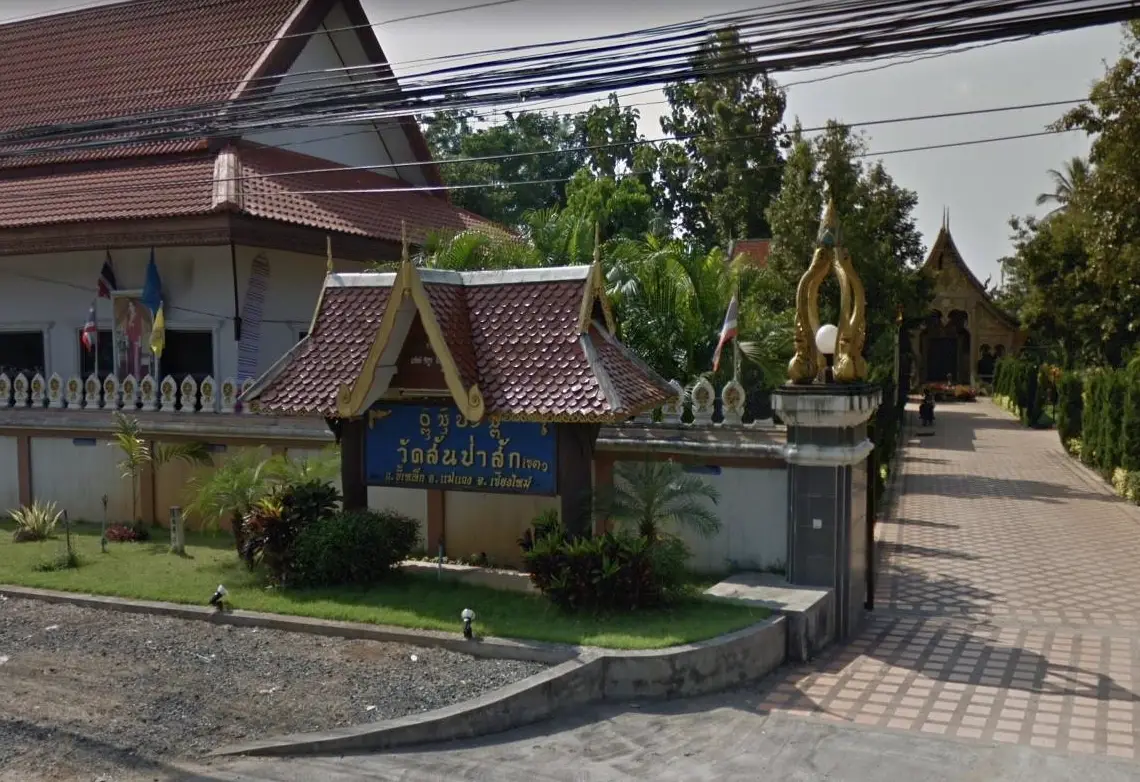
Open Days: Daily
Opening Hours: 08.00 - 17.00
Wat San Pa Sak is located in Moo 2, Ban Mae Malai, Khi Lek Subdistrict, Mae Taeng District, Chiang Mai Province. It is a public Buddhist temple under the Mahanikaya order and an important community temple for the Mae Malai area. The temple was officially permitted to be established in 1959 and received its royal ubosot boundary in 1973. Phra Samu Witthaya Thanasampunno serves as the abbot. Wat San Pa Sak is significant because it stands in one of Mae Taeng’s busiest community and travel zones, close to Mae Malai Market, the Chiang Mai-Fang road, and the route toward Pai.
Ban Mae Malai is an important community in Khi Lek Subdistrict, Mae Taeng District. It functions as a local commercial and transport area linking Chiang Mai city, Mae Taeng, Chiang Dao, Fang, and the Mae Taeng-Pai route. The surrounding area includes local markets, shops, restaurants, accommodations, homes, and main roads. Wat San Pa Sak therefore stands within a living community setting, not as an isolated temple, but as a religious center used by people who live, work, trade, and travel through Mae Malai.
The name “San Pa Sak” reflects the northern Thai style of place naming that is often connected with terrain and vegetation. “San” can refer to a raised ridge or higher ground, while “Pa Sak” suggests a place associated with teak trees. Although Mae Malai today is a developed roadside and market community, the temple name preserves an older memory of landscape, settlement, and local identity.
The temple’s official establishment in 1959 places Wat San Pa Sak within a period when Mae Taeng and Mae Malai were becoming more closely connected by settlement, road access, and local trade. As the community expanded, the temple served as a center for merit-making, Dhamma listening, religious ceremonies, and shared village activities.
The temple received its royal ubosot boundary in 1973, confirming its formal monastic status. A royal boundary is important because it allows the temple to conduct official Sangha acts such as ordination, ubosot ceremonies, and other formal monastic activities. This gives Wat San Pa Sak a complete role both as a community temple and as a recognized Buddhist religious site.
Wat San Pa Sak is a public Buddhist temple under the Mahanikaya order. A community-supported temple in northern Thailand is closely connected with local people’s lives. Villagers come to the temple for merit-making, food offerings, Dhamma listening, Kathin, robe-offering ceremonies, Buddhist holy day observances, and important rites throughout the year. Wat San Pa Sak therefore functions as both a sacred space and a social center.
Phra Samu Witthaya Thanasampunno, the abbot of Wat San Pa Sak, plays an important role in maintaining the temple and guiding Buddhist activities for the community. In a village temple, the abbot is central to religious ceremonies, temple care, lay support, and the relationship between monks and residents. His role helps keep the temple active as a living religious institution.
The temple’s importance is closely linked to its location. Moo 2 of Khi Lek Subdistrict is Ban Mae Malai, one of Mae Taeng’s key roadside communities. Mae Malai Market, also known locally as Talat Mae Malai, is an important market in the area. This gives the temple a strong relationship with daily life, local trade, and travel. The temple and the market together represent two sides of the community: one spiritual, one economic.
Wat San Pa Sak is also part of a wider network of community temples in the Mae Taeng area. In the same local context, Khi Lek Subdistrict includes other temples such as Wat Buak Mue and nearby temples in the broader subdistrict network. This reflects the Lanna village pattern in which each village has its own temple as a spiritual center, while all temples together form a larger Buddhist landscape.
Detailed public information about the temple’s individual architectural features, such as a specific vihara, principal Buddha image, chedi, bell tower, or sermon hall, is limited. However, as a temple that received a royal ubosot boundary, Wat San Pa Sak has a formal religious area for Sangha activities and Buddhist ceremonies. Visitors should focus on its worship areas, temple courtyard, monastic areas, and its role as a local community temple near Mae Malai Market.
The main appeal of Wat San Pa Sak is not monumental scale, but its identity as a community temple in one of Mae Taeng’s most practical travel zones. Visitors can stop here for worship before continuing toward Pai, Chiang Dao, Fang, or other attractions in Mae Taeng. It is especially suitable for travelers who want to add a cultural and spiritual dimension to a route that is often treated only as a transit corridor.
Wat San Pa Sak is also useful for understanding Mae Malai beyond its role as a road junction. The community is more than a place to pass through. It has its own market life, local history, Buddhist faith, and village identity. A visit to Wat San Pa Sak helps travelers see this deeper community layer clearly.
The temple serves the local community as a place for merit-making, Dhamma listening, food offerings, Kathin, robe-offering ceremonies, and Buddhist activities throughout the year. In a northern Thai village temple, such activities are important because they bring families, elders, youth, monks, and local residents together through shared faith and seasonal traditions.
Religious and cultural activities at Wat San Pa Sak follow the rhythm of Lanna Buddhism. These include Buddhist holy day merit-making, the rains retreat, the end of the rains retreat, Kathin, robe-offering ceremonies, candle offerings for the rains retreat, Dhamma listening, and community New Year activities. These traditions help keep the temple active throughout the year.
During the northern Thai New Year season, communities around Mae Taeng and Mae Malai take part in merit-making, Buddha image bathing, respect-paying ceremonies for elders, and local cultural activities. Temples in the area become important places for blessing, gathering, and community continuity. Wat San Pa Sak, as the temple of Ban Mae Malai, is part of this local cultural atmosphere.
Traveling to Wat San Pa Sak is convenient. From Chiang Mai city, take Highway 107 or the Chiang Mai-Fang road toward Mae Taeng District, passing Mae Rim and continuing to Mae Malai. Once in Ban Mae Malai, Khi Lek Subdistrict, visitors can reach the temple easily. A private car, rental car, or hired driver is the most convenient option, especially for travelers continuing toward Pai or other Mae Taeng attractions.
Travelers using public transportation should first reach Mae Malai or Mae Taeng District, then continue by local transport, hired vehicle, or pickup service to the temple area. Since Mae Malai is a major local junction, access is more convenient than to temples located deep in rural areas. However, a private vehicle is more flexible for visitors who want to combine the temple with markets, restaurants, nearby temples, and accommodations.
A suitable itinerary can begin at Wat San Pa Sak for worship and a quiet stop near Mae Malai Market. Visitors can then continue to Mae Malai Market for food or local products, followed by Wat Buak Mue, Wat Ram Poeng, Wat Phra That Doi Chom Chaeng, Wat Ma Ong Nok, Wat Sai Mun, or Wat Nong Khong. For nature-based travel, the route can continue to Suan Son Mae Taeng, Mae Ngat Somboon Chon Dam, Bua Tong Waterfall and Chet Si Spring, or the Mae Taeng-Pai route.
Wat San Pa Sak is suitable for travelers who prefer quiet local temples rather than crowded attractions. Visitors can stop briefly for worship, make merit, and rest before continuing their journey. Dress respectfully, keep quiet, avoid disturbing monks and local worshippers, avoid entering monastic or private areas without permission, and help keep the temple clean.
Overall, Wat San Pa Sak is an important community temple of Ban Mae Malai, Khi Lek Subdistrict, Mae Taeng District. It was established in 1959, received its royal ubosot boundary in 1973, and remains open daily for worship and merit-making. Its strength lies in its location near Mae Malai Market and the Chiang Mai-Fang road, making it both a spiritual center for the community and a meaningful cultural stop for travelers in Mae Taeng.
| Name | Wat San Pa Sak |
| Location | Moo 2, Ban Mae Malai, Khi Lek Subdistrict, Mae Taeng District, Chiang Mai Province |
| Address | Moo 2, Khi Lek Subdistrict, Mae Taeng District, Chiang Mai 50150, Thailand |
| Temple Type | Public Buddhist Temple Under The Mahanikaya Order |
| Temple Code | 350060309 |
| History / Temple Status | Officially permitted to be established in 1959 and received its royal ubosot boundary in 1973 |
| Abbot / Caretaker | Phra Samu Witthaya Thanasampunno |
| Highlights | Community temple of Ban Mae Malai, located near Mae Malai Market, the Chiang Mai-Fang road, and the route toward Pai; suitable for worship and merit-making before continuing through Mae Taeng |
| Community Context | Ban Mae Malai is Moo 2 of Khi Lek Subdistrict, located in an important market and transport area connecting the Chiang Mai-Fang road and the Mae Taeng-Pai route |
| Main Areas / Zones | Worship area, religious activity spaces, royal ubosot boundary area, temple courtyard, monastic areas, and community-use spaces |
| Community Role | A spiritual center for Ban Mae Malai, used for Buddhist ceremonies, merit-making, Dhamma listening, Kathin, robe-offering ceremonies, and village religious activities |
| Open Days | Daily |
| Opening Hours | 08.00 - 17.00 |
| Travel Information | From Chiang Mai city, take Highway 107 or the Chiang Mai-Fang road through Mae Rim toward Mae Taeng and Mae Malai, then continue to Ban Mae Malai, Moo 2, Khi Lek Subdistrict. Private car, rental car, or hired driver is recommended |
| Current Status | Open as a community temple and Buddhist religious site in Ban Mae Malai, Khi Lek Subdistrict, Mae Taeng District, Chiang Mai Province |
| Important Traditions | Buddhist holy day merit-making, rains retreat, end-of-rains retreat, Kathin, robe-offering ceremonies, candle offering for the rains retreat, Dhamma listening, and local northern Thai New Year activities |
| Visitor Etiquette | Dress respectfully, keep quiet, avoid disturbing monks and worshippers, do not enter monastic areas without permission, and keep the temple clean |
| Nearby Tourist Attractions | 1. Mae Malai Market, about 1 km 2. Wat Buak Mue, about 2 km 3. Wat Ram Poeng, about 5 km 4. Wat Phra That Doi Chom Chaeng, about 6 km 5. Suan Son Mae Taeng, about 8 km |
| Nearby Restaurants | 1. Khun Nai Pimpa, Mae Malai Market, about 1 km, Tel. 091-078-0525 2. Moo Inter Mae Malai, about 1 km, Tel. 093-135-2929 3. Baan Suan Chomchan Mae Taeng, about 7 km, Tel. 053-047-111, 089-433-5819 4. Sri Kaew Restaurant @ Mae Taeng, about 10 km, Tel. 082-574-7870 5. Doona Resort Restaurant, about 17 km, Tel. 093-275-3888 |
| Nearby Accommodations | 1. Mae Malai Mansion, about 1 km, Tel. 053-842620, 095-6106489 2. Rub Lom Resort Mae Taeng, about 5 km, Tel. 091-915-9359 3. Baan Suan Chomchan Mae Taeng, about 7 km, Tel. 053-047-111, 089-433-5819 4. Maetaeng Homestay & Resort, about 8 km, Tel. 086-399-9144 5. Phutawanpundao, about 10 km |
Frequently Asked Questions (FAQ)
Q: Where is Wat San Pa Sak located?
A: Wat San Pa Sak is located in Moo 2, Ban Mae Malai, Khi Lek Subdistrict, Mae Taeng District, Chiang Mai 50150, Thailand.
Q: What are the opening days and hours of Wat San Pa Sak?
A: Wat San Pa Sak is open daily from 08.00 to 17.00.
Q: What type of temple is Wat San Pa Sak?
A: Wat San Pa Sak is a public Buddhist temple under the Mahanikaya order. Its temple code is 350060309.
Q: When was Wat San Pa Sak officially established?
A: Wat San Pa Sak was officially permitted to be established in 1959 and received its royal ubosot boundary in 1973.
Q: Who is the abbot of Wat San Pa Sak?
A: Phra Samu Witthaya Thanasampunno is the abbot of Wat San Pa Sak.
Q: What is the main highlight of Wat San Pa Sak?
A: The main highlight is its role as a community temple of Ban Mae Malai, located near Mae Malai Market, the Chiang Mai-Fang road, and the route toward Pai. It is suitable for worship before continuing through Mae Taeng.
Q: What nearby places can be visited with Wat San Pa Sak?
A: Nearby places include Mae Malai Market, Wat Buak Mue, Wat Ram Poeng, Wat Phra That Doi Chom Chaeng, Suan Son Mae Taeng, and other attractions in Mae Taeng District.
 Category: ●Places of Worship
 Group: ●Temple
Last Update : 1 WeekAgo
 Last Update : 1 WeekAgo
 Click to Access the Navigation Map GPS
Wat San Pa Sak Map
Recommend

 Muang Chiang Mai(121)Chom Thong(47)Mae Chaem(25)Chiang Dao(33)Doi Saket(68)Mae Taeng(85)Mae Rim(69)Samoeng(29)Fang(71)Mae Ai(59)Phrao(70)San Pa Tong(103)San Kamphaeng(66)San Sai(73)Hang Dong(73)Hot(32)Doi Tao(22)Omkoi(11)Saraphi(74)Wiang Haeng(15)Chai Prakan(28)Mae Wang(32)Mae On(22)Doi Lo(34)Galyani Vadhana(1)


