
lovethailand home >North Travel Attractions >Chiang Mai Travel Attractions >Mae Taeng >Kuet Chang > Wat Mae Ta Man
TL;DR: Wat Mae Ta Man is located at Moo 2, Ban Mae Ta Man, Kuet Chang Subdistrict, Mae Taeng District, Chiang Mai Province.

Wat Mae Ta Man
Operating day: Daily
Operating time: 08.00 - 17.00
Wat Mae Ta Man is located in Moo 2, Ban Mae Ta Man, Kuet Chang Subdistrict, Mae Taeng District, Chiang Mai Province. It is a public Buddhist temple under the Mahanikaya order and an important spiritual center for the Mae Ta Man community. The temple was officially permitted to be established in 1909, and Phra Samu Uthai Pasanno serves as its abbot. Wat Mae Ta Man is therefore an old community temple that has supported local Buddhist life for more than a century through merit-making, Dhamma listening, Buddhist ceremonies, and community religious activities.
Ban Mae Ta Man is an important village in Kuet Chang Subdistrict, an area known for the Mae Taeng River, forested hills, elephant camps, rafting, homestays, and community-based tourism. Wat Mae Ta Man stands within this living local context. It is not simply a stop along the way to nature attractions. It is a religious center that helps define the cultural and spiritual character of the Mae Ta Man and Kuet Chang area.
The importance of Wat Mae Ta Man lies in its role as a village temple that supports the everyday religious life of the local community. A temple of this type is not active only on major Buddhist holy days. It is used throughout the year for merit-making, food offerings, Dhamma listening, Kathin, robe-offering ceremonies, and local Buddhist rites. Wat Mae Ta Man therefore reflects the traditional Lanna relationship between temple, monks, villagers, and community identity.
Wat Mae Ta Man is a public Buddhist temple under the Mahanikaya order. It is located in Moo 2, Kuet Chang Subdistrict, Mae Taeng District, Chiang Mai Province 50150. Temple registry information identifies it as temple code 350061202. This confirms its status within the Sangha system and its role as a recognized Buddhist temple in the Mae Taeng area.
The temple’s official establishment in 1909 makes it one of the old community temples of Kuet Chang Subdistrict. During the early 20th century, the Mae Taeng River area and upland routes were important for settlement, local movement, agriculture, and village life. The establishment of a temple in Ban Mae Ta Man shows that the community was already strong enough to support a permanent Buddhist institution. The temple therefore represents both religious faith and the stability of the village.
Wat Mae Ta Man stands in the same subdistrict as Wat Mueang Kuet, another important community temple in Kuet Chang. Together, these temples show how Buddhist places are distributed across local villages, each serving its own community while contributing to the broader cultural landscape of Mae Taeng. Wat Mae Ta Man is especially suitable for travelers who want to connect temple visits with the Mae Taeng River, Kaeng Kuet, and nearby elephant camps.
Phra Samu Uthai Pasanno, the abbot of Wat Mae Ta Man, plays an important role in maintaining the temple and guiding Buddhist activities for the community. In a rural village temple, the abbot is not only responsible for ceremonies. He also helps sustain the relationship between monks and laypeople, supports merit-making, and keeps the temple functioning as a place of faith and community life.
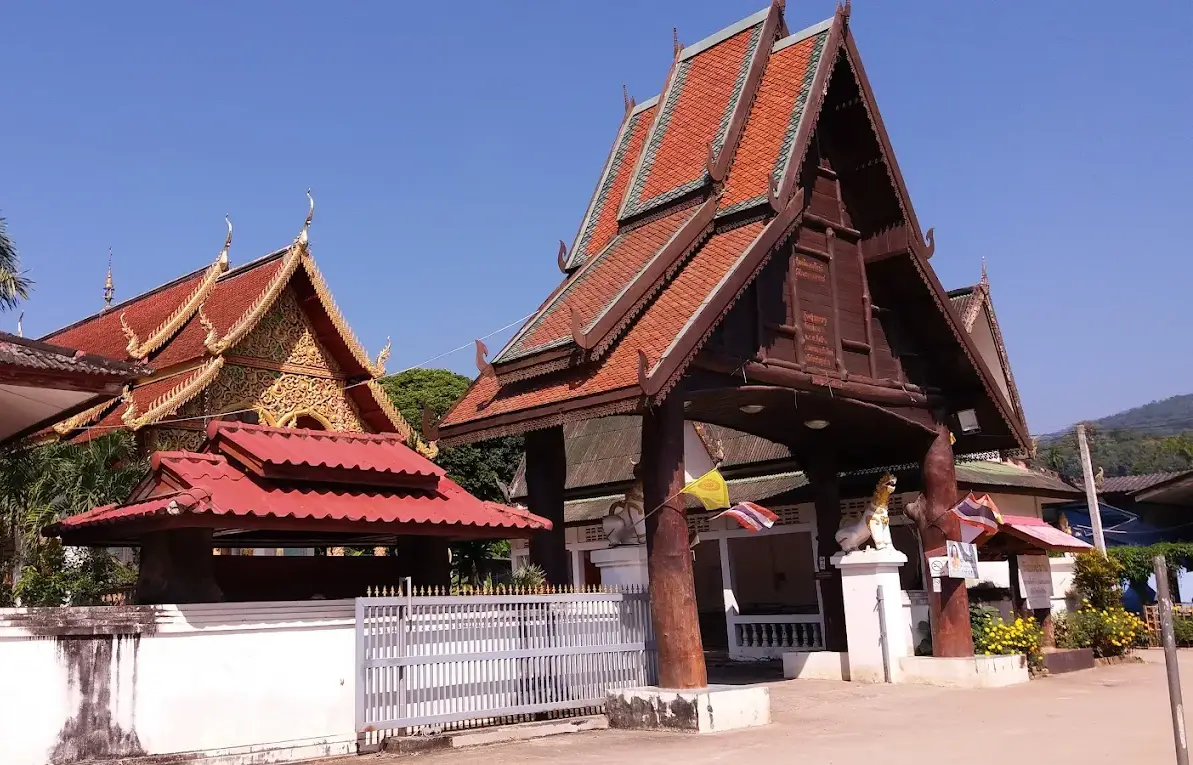
Detailed public information about the temple’s individual architectural features is limited, but Wat Mae Ta Man functions as a complete community temple. Important areas include worship spaces, religious activity areas, the temple courtyard, monastic areas, and community-use spaces. The temple’s value should therefore be understood through its long-standing role in the village rather than through architectural spectacle alone.
The main appeal of Wat Mae Ta Man is its position as an old community temple within one of Mae Taeng’s most active nature-tourism routes. Visitors can stop at the temple for worship before continuing to Kaeng Kuet, Mae Ta Man Elephant Camp, Mae Taeng Elephant Camp, and riverside restaurants along the Mae Taeng River. This makes the temple a meaningful cultural stop within a wider route of nature, river, and community tourism.
The surrounding area is closely connected with local education and village life. Ban Mae Ta Man School is located in the same community area, showing the village pattern in which school, temple, and local households form the core of social life. Wat Mae Ta Man is therefore part of a wider community structure that includes children, elders, monks, local residents, and visitors.
The atmosphere around Wat Mae Ta Man is shaped by the natural setting of Kuet Chang. The route toward Ban Mae Ta Man and Ban Mueang Kuet follows the wider Mae Taeng River tourism area, with forested hills, local roads, elephant camps, and riverside attractions nearby. A visit to the temple allows travelers to experience the cultural side of an area often known mainly for outdoor activities.
Religious activities at Wat Mae Ta Man follow the rhythm of village Buddhism. These include Buddhist holy day merit-making, the rains retreat, the end of the rains retreat, Kathin, robe-offering ceremonies, Dhamma listening, and local Buddhist rites. Such activities keep the connection between monks and villagers alive throughout the year.
For cultural travelers, Wat Mae Ta Man is a suitable place to stop before visiting Kaeng Kuet or nearby attractions. Beginning a trip with a temple visit helps travelers understand Kuet Chang beyond rafting, elephant tourism, and nature activities. The temple adds the dimensions of faith, community, and local identity to the journey.
Visitors should focus on the worship areas, religious activity spaces, temple courtyard, and the atmosphere of a village temple in Kuet Chang. If monks or local residents are holding religious activities, visitors should remain quiet, dress respectfully, and avoid entering monastic areas without permission. A respectful attitude is more important here than quick sightseeing.
Traveling to Wat Mae Ta Man is most convenient by private car, rental car, or hired driver. From Chiang Mai city, take the Chiang Mai-Mae Rim-Mae Taeng route or the Chiang Mai-Fang road toward Mae Taeng District, pass Mae Malai, then turn into the Ban Mae Ta Man-Ban Mueang Kuet route. This is the same route used to reach Mae Ta Man Elephant Camp, Mae Taeng Elephant Camp, and Kaeng Kuet.
Travelers using public transportation should first reach Mae Malai or Mae Taeng District, then continue by local transport, hired vehicle, or pickup service to Ban Mae Ta Man. Since public transport in rural areas is less frequent than in Chiang Mai city, planning ahead is recommended. For visitors who want to combine the temple with Kaeng Kuet and elephant camps, a private vehicle is the most flexible option.
A suitable itinerary can begin at Wat Mae Ta Man in the morning for worship and a quiet visit to the village temple. Travelers can then continue to Mae Ta Man Elephant Camp or Mae Taeng Elephant Camp, followed by Kaeng Kuet for riverside relaxation, rafting, or lunch. If time allows, continue to Wat Mueang Kuet, Ban Mueang Kuet, Huai Kub Kab Village, or other community-based tourism destinations in Kuet Chang.
The area around Wat Mae Ta Man has several restaurants and accommodations serving travelers heading toward Kaeng Kuet and the Mae Taeng River. Riverside restaurants such as Lung Sem Kaeng Kuet, Pa Nee Kaeng Kuet, and Chang Yim Kaeng Kuet are useful dining options after visiting the temple or doing river activities. Nearby accommodations include resorts, homestays, and cafés with lodging in Kuet Chang and Mae Taeng.
Visitors should remember that Wat Mae Ta Man is an active community temple, not a commercial tourist attraction. Dress politely, keep voices low, respect monks and villagers, avoid entering private monastic areas, and keep the temple clean. This approach helps preserve the peaceful atmosphere and allows visitors to experience the temple’s cultural value properly.
Overall, Wat Mae Ta Man is an important temple for understanding Kuet Chang beyond nature tourism. It has official temple history dating to 1909, a clear role as the spiritual center of Ban Mae Ta Man, and a strong connection with the Mae Taeng River tourism route. The temple is a meaningful stop for travelers who want to combine worship, community culture, and natural attractions in Mae Taeng District.
| Name | Wat Mae Ta Man |
| Location | Moo 2, Ban Mae Ta Man, Kuet Chang Subdistrict, Mae Taeng District, Chiang Mai Province |
| Address | Moo 2, Kuet Chang Subdistrict, Mae Taeng District, Chiang Mai 50150, Thailand |
| Temple Type | Public Buddhist Temple Under The Mahanikaya Order |
| Temple Code | 350061202 |
| History / Temple Status | Officially permitted to be established in 1909 as an old community temple of Ban Mae Ta Man, Kuet Chang Subdistrict |
| Abbot / Caretaker | Phra Samu Uthai Pasanno |
| Highlights | Old village temple on the Kuet Chang route, located near the Mae Taeng River, Kaeng Kuet, Mae Ta Man Elephant Camp, and Mae Taeng Elephant Camp |
| Community Context | Ban Mae Ta Man is a village in Kuet Chang Subdistrict connected with the Mae Taeng River, forested hills, community tourism, Ban Mae Ta Man School, and local rural life |
| Main Areas / Zones | Worship area, religious activity spaces, temple courtyard, monastic areas, and community-use spaces |
| Community Role | A spiritual center for Ban Mae Ta Man, used for Buddhist ceremonies, merit-making, Dhamma listening, Kathin, robe-offering ceremonies, and community religious activities |
| Travel Information | From Chiang Mai city, take the Chiang Mai-Mae Rim-Mae Taeng route or the Chiang Mai-Fang road, pass Mae Malai, then turn into the Ban Mae Ta Man-Ban Mueang Kuet route, the same route used for Mae Ta Man Elephant Camp, Mae Taeng Elephant Camp, and Kaeng Kuet |
| Current Status | Open as a community temple and cultural Buddhist site in Kuet Chang Subdistrict, Mae Taeng District, Chiang Mai Province |
| Important Traditions | Buddhist holy day merit-making, rains retreat, end-of-rains retreat, Kathin, robe-offering ceremonies, Dhamma listening, and local Buddhist rites |
| Visitor Etiquette | Dress respectfully, keep quiet, avoid disturbing monks and worshippers, do not enter monastic areas without permission, and keep the temple clean |
| Nearby Tourist Attractions | 1. Mae Ta Man Elephant Camp, about 2 km 2. Mae Taeng Elephant Camp, about 3 km 3. Kaeng Kuet, about 6 km 4. Wat Mueang Kuet, about 8 km 5. Huai Kub Kab Village, about 18 km |
| Nearby Restaurants | 1. Lung Sem Kaeng Kuet, about 6 km, Tel. 095-449-1658, 097-325-8798 2. Pa Nee Kaeng Kuet, about 6 km, Tel. 089-701-6441 3. Chang Yim Kaeng Kuet, about 6 km, Tel. 081-603-4210 4. Stay Wild & Café, about 8 km, Tel. 089-441-6365 5. Baan Suan Chomchan Mae Taeng, about 20 km, Tel. 053-047-111, 089-433-5819 |
| Nearby Accommodations | 1. Stay Wild & Café, about 8 km, Tel. 089-441-6365 2. Kaeng Kuet With A View, about 6 km 3. Huaykubkab Himm-Mok Homestay, about 18 km, Tel. 098-525-1943, 065-757-3193, 096-006-1212 4. Grand Hostel Maetang, about 22 km, Tel. 099-987-9432 5. Mok Far Mont Ngo Resort, about 32 km, Tel. 081-671-3006 |
Frequently Asked Questions (FAQ)
Q: Where is Wat Mae Ta Man located?
A: Wat Mae Ta Man is located in Moo 2, Ban Mae Ta Man, Kuet Chang Subdistrict, Mae Taeng District, Chiang Mai 50150, Thailand.
Q: What type of temple is Wat Mae Ta Man?
A: Wat Mae Ta Man is a public Buddhist temple under the Mahanikaya order. Its temple code is 350061202.
Q: When was Wat Mae Ta Man officially established?
A: Wat Mae Ta Man was officially permitted to be established in 1909 as an old community temple of Ban Mae Ta Man.
Q: Who is the abbot of Wat Mae Ta Man?
A: Phra Samu Uthai Pasanno is the abbot of Wat Mae Ta Man.
Q: What is the main highlight of Wat Mae Ta Man?
A: The main highlight is its role as an old community temple on the Kuet Chang route, close to the Mae Taeng River, Kaeng Kuet, Mae Ta Man Elephant Camp, and Mae Taeng Elephant Camp.
Q: How can travelers get to Wat Mae Ta Man?
A: From Chiang Mai city, take the Chiang Mai-Mae Rim-Mae Taeng route or the Chiang Mai-Fang road, pass Mae Malai, then turn into the Ban Mae Ta Man-Ban Mueang Kuet route. A private car or rental car is the most convenient option.
Q: What nearby places can be visited with Wat Mae Ta Man?
A: Nearby places include Mae Ta Man Elephant Camp, Mae Taeng Elephant Camp, Kaeng Kuet, Wat Mueang Kuet, Huai Kub Kab Village, and community-based tourism destinations in Kuet Chang.
 Category: ●Places of Worship
 Group: ●Temple
Last Update : 4 DayAgo
 Last Update : 4 DayAgo
 Click to Access the Navigation Map GPS
 Muang Chiang Mai(121)Chom Thong(47)Mae Chaem(25)Chiang Dao(33)Doi Saket(68)Mae Taeng(85)Mae Rim(69)Samoeng(29)Fang(71)Mae Ai(59)Phrao(70)San Pa Tong(105)San Kamphaeng(66)San Sai(73)Hang Dong(74)Hot(32)Doi Tao(22)Omkoi(11)Saraphi(74)Wiang Haeng(15)Chai Prakan(28)Mae Wang(32)Mae On(22)Doi Lo(34)Galyani Vadhana(1)


