
lovethailand home >North Travel Attractions >Chiang Mai Travel Attractions >Mae Taeng >Kuet Chang > Wat Mueang Kuet
TL;DR: Wat Mueang Kuet is located at Moo 1, Ban Mueang Kuet, Kuet Chang Subdistrict, Mae Taeng District, Chiang Mai Province, open Daily, hours 08.00 - 17.00.

Wat Mueang Kuet
Open Days: Daily
Opening Hours: 08.00 - 17.00
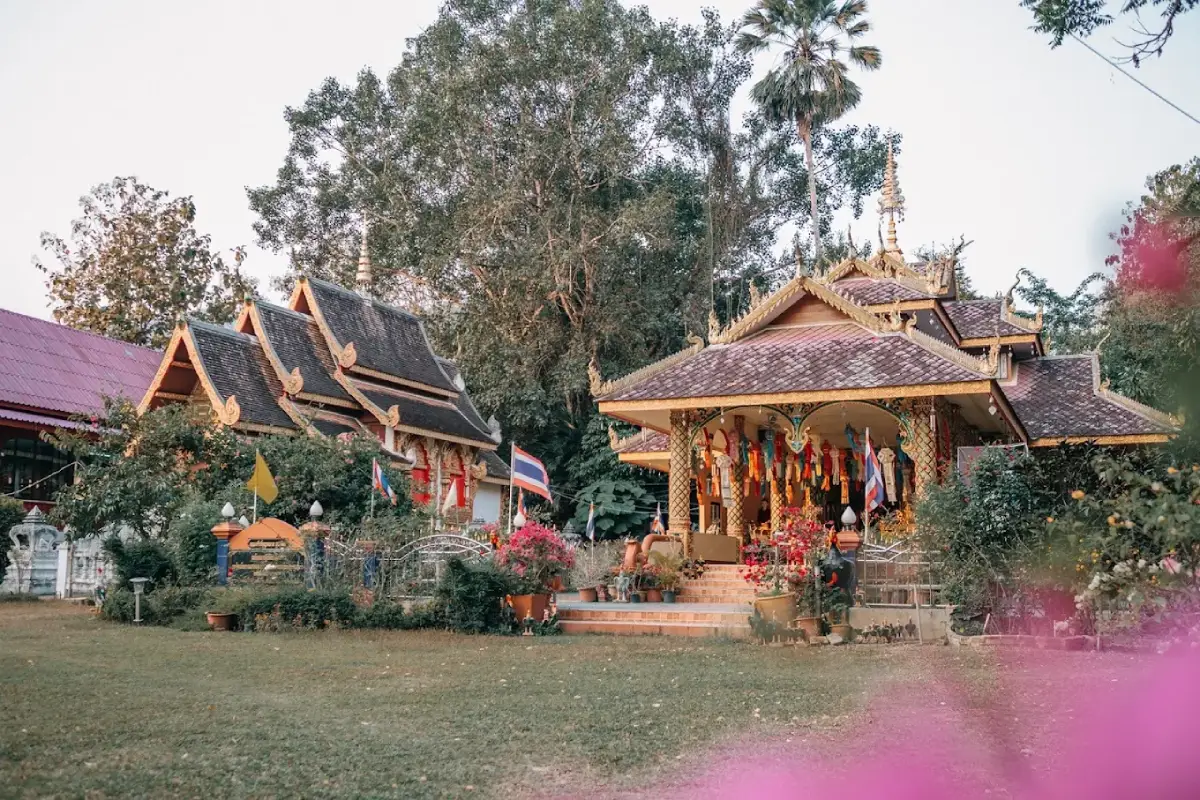
Wat Mueang Kuet is located in Moo 1, Ban Mueang Kuet, Kuet Chang Subdistrict, Mae Taeng District, Chiang Mai Province. It is a public Buddhist temple under the Mahanikaya order and an important spiritual center for Ban Mueang Kuet. The temple was officially permitted to be established in 1927 and received its royal ubosot boundary on 21 June 1991. Today, Wat Mueang Kuet remains an active community temple led by Phra Athikan Tha Rattanawanno, serving local residents through merit-making, Dhamma listening, Buddhist ceremonies, community gatherings, and the annual worship of Phra That Kao Na Maha Mongkhon Khiri Si Mueang Kuet.
Wat Mueang Kuet is more than a village temple. It stands in an old settlement area associated with the Mae Taeng River, local legends, and community memory. The name “Mueang Kuet” is connected with a local story that the area was once called “Mueang Nguet.” According to local tradition, a herd of wild elephants came to feed along the Mae Taeng River. Some elephants slipped on rocks and disappeared into the river without a trace. This unusual event gave the place the name “Nguet,” which later became “Kuet.”
Ban Mueang Kuet is an old community in Kuet Chang Subdistrict. The village is closely related to the Mae Taeng River, mountains, forests, and routes linking Mae Taeng with upland communities. Local traditions describe Mueang Kuet as an ancient settlement that may have developed in a period close to other old Lanna communities such as Chiang Mai, Phrao, and Wiang Haeng. Although detailed archaeological studies are not widely available, the community memory gives Wat Mueang Kuet a deep cultural role as the spiritual center of this old settlement.
The village’s development is strongly connected with water and terrain. Early households settled near the Mae Taeng River, but seasonal flooding gradually caused residents to move to higher ground. This process shaped the expansion of Ban Mueang Kuet and the relationship between settlement, river, and temple. Wat Mueang Kuet therefore stands in a place that represents both Buddhist faith and the geographical history of the community.
The importance of Wat Mueang Kuet is also connected with the older administrative history of the area. Ban Mueang Kuet was once associated with the former Khwaeng Mueang Kuet, governed at one time by Khun Kuet Khiriwong. Later, the area became part of Kuet Chang Subdistrict. This makes Wat Mueang Kuet significant not only as a temple, but also as a religious landmark in the area that gave Kuet Chang its local identity.
Historical temple information records that Wat Mueang Kuet is located at No. 50, Moo 1, Ban Mueang Kuet, Kuet Chang Subdistrict, Mae Taeng District, Chiang Mai Province. Community history also mentions that during the restoration of the old vihara in 1989, a wooden inscription in Khmer script was found, recording the year 1739. Although the inscription is no longer available, this story gives the temple a historical depth that reaches further back than its official establishment in 1927.
One of the most important local stories connected with Wat Mueang Kuet concerns King Naresuan the Great. Local tradition says that Mueang Kuet was a resting point for King Naresuan’s army on the route toward Wiang Haeng. The story also mentions Kruba Phrom Maha Panya, or Kruba Noi, an abbot in the past who is believed to have discussed Dhamma with King Naresuan when the king passed through the area. Local tradition further says that King Naresuan planted a Bodhi tree in front of Wat Mueang Kuet. This tree remains an important symbol of the temple’s historical memory.
Wat Mueang Kuet is also associated with generations of respected monks. The list of known abbots begins with Kruba Kantharakh, also known as Kruba Khao, followed by Kruba Phrom Maha Panya, Kruba Phrom Sen, Kruba Luang Inta, Phra Arun Aruno, and many other abbots through to Phra Athikan Tha Rattanawanno. This succession reflects the temple’s long-standing role in preserving Buddhist practice and community faith.
The temple has several important structures. These include a Lanna-style ubosot, which was formerly an old vihara before being restored as an ubosot, a vihara built in 1986, Phra That Kao Na Maha Mongkhon Khiri Si Mueang Kuet built in 2008, the monument of King Naresuan the Great built in 2008, a multipurpose hall, monks’ residences, a kitchen and dining hall, restrooms, a village elderly center, a village fund office, storage buildings, and a mountain water tank. These structures show that the temple functions both as a religious place and as a community-use space.
The Lanna-style ubosot is one of the key structures to observe. It is connected with formal monastic acts and became especially important after the temple received its royal ubosot boundary. Since it was originally an old vihara before being restored as an ubosot, the building reflects the temple’s continuity and adaptation over time. It preserves the sacred role of the old structure while serving current monastic functions.
The vihara serves as an important space for worship, chanting, and Buddhist activities. The temple also preserves respected Buddha images and religious objects, including a brick-and-plaster Buddha image in the posture of subduing Mara, two Phra Singh 3 images, a Phra Pin image, ceremonial candlesticks, a Dhamma chest, and parts of a Buddha throne structure. These objects show the temple’s role as a place where Buddhist faith and local heritage are preserved.
Phra That Kao Na Maha Mongkhon Khiri Si Mueang Kuet is one of the most important highlights of Wat Mueang Kuet today. It is a sacred chedi within the temple and a key place of worship for local residents and visitors. The chedi area gives the temple a strong visual and spiritual identity. From this area, visitors can experience the quiet atmosphere of Ban Mueang Kuet, with surrounding hills, fields, and the Mae Taeng River landscape.
The monument of King Naresuan the Great is another important point within the temple. It reflects the local legend that connects Mueang Kuet with the king’s military route toward Wiang Haeng. Visitors can therefore make merit, worship at the Buddhist temple, and pay respect to King Naresuan within the same temple compound. This combination of Buddhism and historical memory gives Wat Mueang Kuet a distinctive identity.
Wat Mueang Kuet is also visited by devotees who come to pay respect to the Buddha handprint, Phra Bat Kueak Kaew, and the temple chedi. These sacred points are part of the temple’s living devotional landscape. Local belief also includes stories about sacred water wells and community faith connected with the temple grounds. These traditions help keep the temple culturally alive and meaningful to local people.
The temple’s major annual event is the Phra That Kao Na Maha Mongkhon Khiri Si Mueang Kuet bathing ceremony. This event is organized with the local community and Kuet Chang Subdistrict Administrative Organization. It is not only a religious ceremony, but also a community gathering that brings people together to make merit, pay respect to the chedi, and preserve the bond between Wat Mueang Kuet and Ban Mueang Kuet.
Other Buddhist activities at Wat Mueang Kuet include Buddhist holy day merit-making, the rains retreat, the end of the rains retreat, Kathin, robe-offering ceremonies, Dhamma listening, and community Buddhist events throughout the year. The temple’s halls and community spaces are important because they support gatherings, elderly activities, village fund activities, local meetings, and public community events.
The temple’s community role remains strong. In 2026, Sala Wat Mueang Kuet was used as a venue for a local public meeting and community development planning activity in Ban Mueang Kuet. This shows that the temple still functions as a central public space for the village, connecting monks, residents, local administration, and community development.
The atmosphere of Wat Mueang Kuet is peaceful and closely tied to the natural landscape of the community. Visitors can experience a temple near fields, mountains, the Mae Taeng River, and village life. The beauty of the temple is not only in its buildings, but also in its rural Lanna setting. Visitors who come to make merit can experience both Buddhist faith and the natural surroundings of Ban Mueang Kuet.
Important things to see at Wat Mueang Kuet include the Lanna-style ubosot, the vihara, Phra That Kao Na Maha Mongkhon Khiri Si Mueang Kuet, the monument of King Naresuan the Great, important Buddha images, religious objects, naga stairway details, community halls, and the surrounding village landscape. Visitors should walk quietly, dress respectfully, and treat the ubosot, vihara, chedi, and monument areas with care.
Wat Mueang Kuet is suitable for travelers interested in old community temples, Lanna local history, stories of King Naresuan, community chedis, and ecological tourism routes in Kuet Chang. Ban Mueang Kuet and Kaeng Kuet are known for community-based tourism, rafting on the Mae Taeng River, riverside restaurants, homestays, and natural scenery. The temple can therefore be included in an itinerary that combines worship, community tourism, and nature.
Traveling to Wat Mueang Kuet is most convenient by private car, rental car, or hired vehicle. From Chiang Mai city, take the Chiang Mai-Mae Rim-Mae Taeng route or the Chiang Mai-Fang road toward Mae Taeng District, pass Mae Malai, then continue toward Ban Mae Ta Man and Ban Mueang Kuet in Kuet Chang Subdistrict. This is the same general route used to reach Kaeng Kuet and Mae Taeng elephant attractions. Travel time from Chiang Mai city is usually about 1 hour depending on traffic.
Travelers using public transportation should first reach Mae Malai or Mae Taeng District, then continue by local transport, hired vehicle, or pickup service to Ban Mueang Kuet. A private vehicle is more practical because it allows visitors to combine Wat Mueang Kuet, Kaeng Kuet, Ban Mueang Kuet, community homestays, and riverside restaurants in one trip. Visitors continuing to Huai Kub Kab or other upland destinations should check road conditions and travel time in advance.
A suitable route can begin at Wat Mueang Kuet in the morning for worship and a visit to Phra That Kao Na Maha Mongkhon Khiri Si Mueang Kuet. After that, continue to Kaeng Kuet for riverside relaxation, local food, or rafting on the Mae Taeng River. If time allows, visitors can continue to Huai Kub Kab Village, Mae Taeng Elephant Camp, Mae Ta Man Elephant Camp, or other community-based tourism destinations in Kuet Chang.
Overall, Wat Mueang Kuet is a meaningful temple with several layers of value. It has official temple history dating from 1927, a royal ubosot boundary from 1991, older local traditions, stories connected with King Naresuan, important temple structures, Phra That Kao Na Maha Mongkhon Khiri Si Mueang Kuet, and a continuing role as the spiritual center of Ban Mueang Kuet. The temple is ideal for travelers who want to understand Mae Taeng through Buddhism, local history, the Mae Taeng River, and Lanna community life.
| Name | Wat Mueang Kuet |
| Location | Moo 1, Ban Mueang Kuet, Kuet Chang Subdistrict, Mae Taeng District, Chiang Mai Province |
| Address | No. 50, Moo 1, Ban Mueang Kuet, Kuet Chang Subdistrict, Mae Taeng District, Chiang Mai 50150, Thailand |
| Contact Number | 053-104-044 |
| Temple Type | Public Buddhist Temple Under The Mahanikaya Order |
| History / Temple Status | Officially permitted to be established in 1927 and received its royal ubosot boundary on 21 June 1991 |
| Abbot / Caretaker | Phra Athikan Tha Rattanawanno |
| Highlights | Lanna-style ubosot, Phra That Kao Na Maha Mongkhon Khiri Si Mueang Kuet, King Naresuan monument, Bodhi tree connected with local tradition, and peaceful community-temple atmosphere near the Mae Taeng River |
| Main Structures | Lanna-style ubosot, vihara, Phra That Kao Na Maha Mongkhon Khiri Si Mueang Kuet, King Naresuan monument, multipurpose hall, monks’ residences, kitchen, dining hall, and community-use areas |
| Sacred Objects | Buddha image in the posture of subduing Mara, Phra Singh 3 images, Phra Pin image, ceremonial candlesticks, Dhamma chest, Buddha throne remains, Buddha handprint, Phra Bat Kueak Kaew, and the temple chedi |
| Community Role | A spiritual center for Ban Mueang Kuet, used for Buddhist ceremonies, merit-making, Dhamma listening, chedi bathing ceremonies, community meetings, and local activities |
| Open Days | Daily |
| Opening Hours | 08.00 - 17.00 |
| Travel Information | From Chiang Mai city, take the Chiang Mai-Mae Rim-Mae Taeng route or the Chiang Mai-Fang road, pass Mae Malai, then continue toward Ban Mae Ta Man and Ban Mueang Kuet in Kuet Chang Subdistrict. Private car, rental car, or hired driver is recommended |
| Current Status | Open as a community temple and cultural attraction in Ban Mueang Kuet, Kuet Chang Subdistrict, Mae Taeng District, Chiang Mai Province |
| Important Traditions | Phra That Kao Na Maha Mongkhon Khiri Si Mueang Kuet bathing ceremony, Buddhist holy day merit-making, rains retreat, end-of-rains retreat, Kathin, robe-offering ceremonies, and Dhamma listening |
| Visitor Etiquette | Dress respectfully, keep quiet, avoid disturbing monks and worshippers, and treat the ubosot, vihara, chedi, and King Naresuan monument with respect |
| Nearby Tourist Attractions | 1. Kaeng Kuet, about 2 km 2. Mae Taeng Elephant Camp, about 6 km 3. Mae Ta Man Elephant Camp, about 7 km 4. Huai Kub Kab Village, about 12 km 5. Mok Fa Waterfall, about 24 km |
| Nearby Restaurants | 1. Lung Sem Kaeng Kuet, about 2 km, Tel. 095-449-1658 2. Pa Nee Kaeng Kuet, about 2 km, Tel. 089-701-6441 3. Chang Yim Kaeng Kuet, about 2 km, Tel. 081-603-4210 4. Stay Wild & Café, about 5 km 5. Baan Suan Chomchan Mae Taeng, about 20 km, Tel. 053-047-111, 089-433-5819 |
| Nearby Accommodations | 1. Huaykubkab Himm-Mok Homestay, about 12 km, Tel. 098-525-1943, 065-757-3193, 096-006-1212 2. Kaeng Kuet With A View, about 2 km 3. Stay Wild & Café, about 5 km 4. Grand Hostel Maetang, about 22 km, Tel. 099-987-9432 5. Mok Far Mont Ngo Resort, about 32 km, Tel. 081-671-3006 |
Frequently Asked Questions (FAQ)
Q: Where is Wat Mueang Kuet located?
A: Wat Mueang Kuet is located at No. 50, Moo 1, Ban Mueang Kuet, Kuet Chang Subdistrict, Mae Taeng District, Chiang Mai 50150, Thailand.
Q: What are the opening days and hours of Wat Mueang Kuet?
A: Wat Mueang Kuet is open daily from 08.00 to 17.00.
Q: When was Wat Mueang Kuet officially established?
A: Wat Mueang Kuet was officially permitted to be established in 1927 and received its royal ubosot boundary on 21 June 1991.
Q: What is the main highlight of Wat Mueang Kuet?
A: The main highlights are the Lanna-style ubosot, Phra That Kao Na Maha Mongkhon Khiri Si Mueang Kuet, King Naresuan monument, the Bodhi tree connected with local tradition, and the peaceful community-temple atmosphere near the Mae Taeng River.
Q: How is Wat Mueang Kuet connected with King Naresuan the Great?
A: Local tradition says that Mueang Kuet was a resting point for King Naresuan the Great’s army on the route toward Wiang Haeng, and that he planted a Bodhi tree in front of Wat Mueang Kuet.
Q: Who is the abbot of Wat Mueang Kuet?
A: Phra Athikan Tha Rattanawanno is the abbot of Wat Mueang Kuet.
Q: What important festival is held at Wat Mueang Kuet?
A: The important event is the bathing ceremony of Phra That Kao Na Maha Mongkhon Khiri Si Mueang Kuet, along with Buddhist holy day merit-making, Kathin, robe-offering ceremonies, and Dhamma listening.
Q: What nearby places can be visited with Wat Mueang Kuet?
A: Nearby places include Kaeng Kuet, Mae Taeng Elephant Camp, Mae Ta Man Elephant Camp, Huai Kub Kab Village, Mok Fa Waterfall, and community-based tourism destinations in Kuet Chang.
 Category: ●Places of Worship
 Group: ●Temple
Last Update : 12 HourAgo
 Last Update : 12 HourAgo
 Click to Access the Navigation Map GPS
 Muang Chiang Mai(121)Chom Thong(47)Mae Chaem(25)Chiang Dao(33)Doi Saket(68)Mae Taeng(85)Mae Rim(69)Samoeng(29)Fang(71)Mae Ai(62)Phrao(70)San Pa Tong(105)San Kamphaeng(66)San Sai(73)Hang Dong(74)Hot(32)Doi Tao(22)Omkoi(11)Saraphi(74)Wiang Haeng(15)Chai Prakan(28)Mae Wang(32)Mae On(22)Doi Lo(34)Galyani Vadhana(1)


