
lovethailand home >North Travel Attractions >Chiang Mai Travel Attractions >Mae Chaem >Chang Khoeng > Wat Ban Chiang
TL;DR: Wat Ban Chiang is located at Moo 3, Chang Khoeng Subdistrict, Mae Chaem District, Chiang Mai Province. Highlights include Phra Chao Saen Tong, the hexagonal chedi, the mural-painted ubosot, and the ancient Wat Prasat archaeological area within the temple.
Wat Ban Chiang
Operating day: Daily
Operating time: 08.00 - 17.00
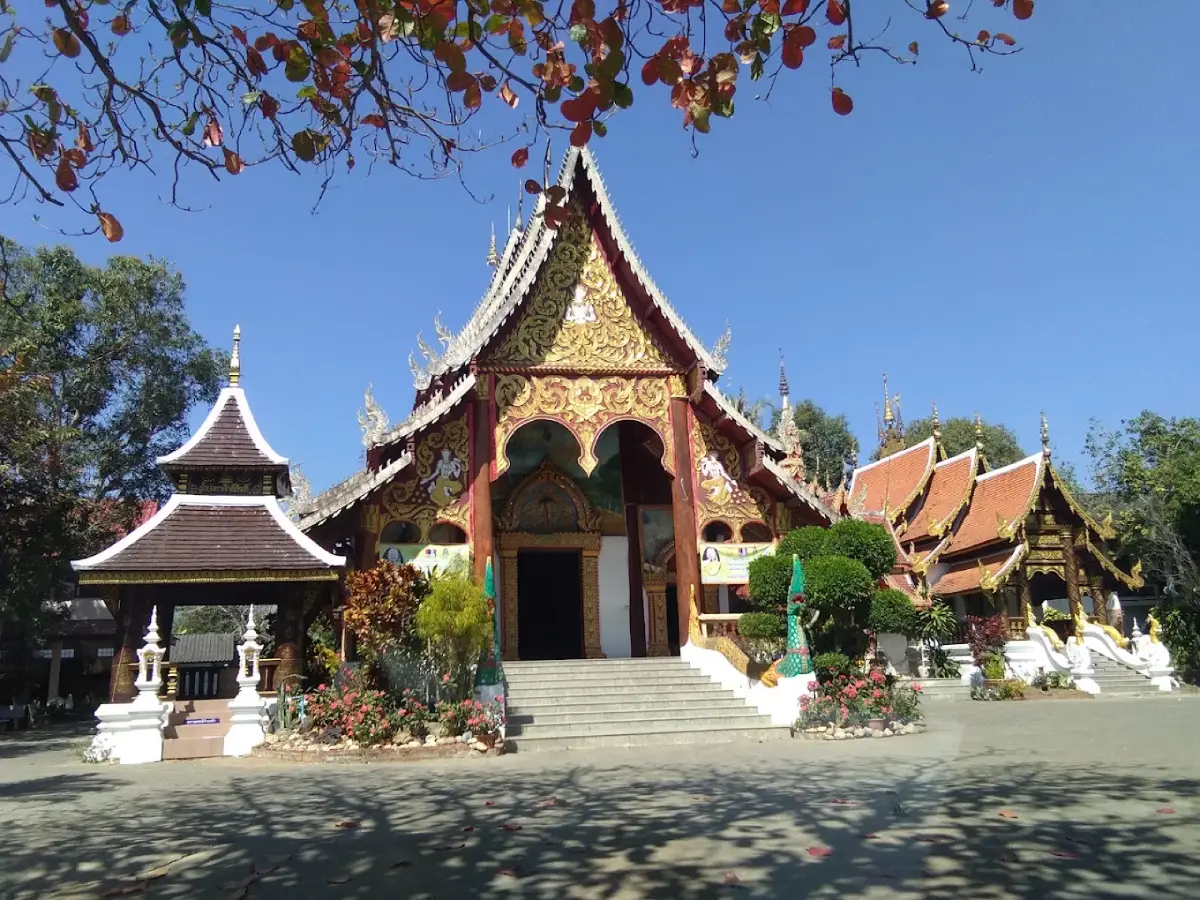
Wat Ban Chiang, also known locally as Wat Chiang, is a community Buddhist temple in Moo 3, Chang Khoeng Subdistrict, Mae Chaem District, Chiang Mai Province. It is a Mahanikaya temple, a registered local place of worship, and one of Mae Chaem’s most culturally significant temple sites. The temple was officially established in 1874, while local cultural records trace the history of Wat Chiang back to 1431. Today, the temple is especially important as the home of Phra Chao Saen Tong, a sacred Buddha image deeply revered by the people of Mae Chaem.
Wat Ban Chiang is located approximately 2 km north of Mae Chaem District Office. The temple’s commonly referenced coordinates are 18.51094 latitude and 98.35895 longitude. Its setting reflects the character of Mae Chaem as a mountain-valley district where temples, villages, agricultural land, and older cultural routes remain closely connected. A visit to Wat Ban Chiang is therefore not only a temple visit but also an introduction to the cultural landscape of Mae Chaem.
The temple’s most important spiritual highlight is Phra Chao Saen Tong. This sacred bronze Buddha image is in the subduing Mara posture and is associated with the Chiang Saen third-period, or Singha 3, artistic style. The image is approximately 20 inches wide across the lap and about 23 inches high. Local tradition says that the image was created by Khun Luang Malangka, also known in local memory as Khun Luang Wilangka. Before being enshrined at Wat Chiang, Phra Chao Saen Tong was originally kept at the abandoned temple site of Thung Yang Mai, also remembered locally as Tong Yang Mai.
Phra Chao Saen Tong is strongly connected with Mae Chaem’s traditional beliefs about rain and agricultural fertility. In years when rainfall was insufficient or the seasons became uncertain, local residents would carry the image in a procession to pray for rain. This tradition reflects the life of a farming community where rainfall, water, and seasonal balance were central to survival. For this reason, Phra Chao Saen Tong is more than an important Buddha image; it is a symbol of protection, continuity, and the shared faith of Mae Chaem.
According to local historical accounts, Phra Chao Saen Tong was moved from the abandoned temple of Thung Yang Mai to the Mae Chaem District Office around 1957 because the monastic and local authorities were concerned about possible theft or loss. In 1966, Phra Thammamoli, the Ecclesiastical Regional Governor of Region 7, ordered that the image be brought to Wat Chiang so that it could be preserved more securely and worshipped properly by the public.
The image is also associated with several accounts of miraculous events. One well-known local story says that when Phra Chao Saen Tong was brought to Wat Chiang, rain fell immediately. Whether approached as faith, oral tradition, or cultural memory, these stories show how deeply the image is embedded in the identity of Mae Chaem. They also explain why Wat Ban Chiang holds a special status among the temples of the district.
Wat Ban Chiang is also important as an archaeological and historic site. The Fine Arts Department identifies an ancient monument within the western side of Wat Ban Chiang that was formerly known as Wat Prasat. The ancient site is aligned on an east–west axis and consists of a chedi and a viharn. The chedi is a prasat-style stupa topped by a bell-shaped form, with Lanna-style lotus mouldings supporting a recessed central structure decorated with niches on all four sides.
The niche frames are ornamented with arched forms and makara motifs issuing naga forms at the ends. Above them are additional lotus mouldings and an octagonal band, while the original upper section has collapsed. Around the base of the chedi, archaeological evidence shows a circumambulatory platform on all four sides. The viharn lies to the east of the chedi and has a rectangular plan; its surviving elements include the main hall area and the Buddha image base.
Based on the architectural form of the chedi and viharn, together with archaeological materials found during excavation and conservation work in 2021, including northern high-fired ceramics from the Phan kilns in Chiang Rai and the San Kamphaeng kilns in Chiang Mai, the ancient monument at Wat Ban Chiang has been dated to around the 21st–22nd Buddhist centuries, or roughly 300–400 years ago. This makes the temple an important place for understanding Lanna-period religious architecture in Mae Chaem.
Because of this layered history, Wat Ban Chiang should be viewed on two levels at once. It is an active community temple where monks and local residents continue to use the grounds for Buddhist practice. At the same time, it preserves archaeological evidence from an older sacred site within the same compound. This combination gives the temple a deeper value than a normal village temple or a simple sightseeing stop.
The temple’s chedi, sometimes described as a relic chedi, is another distinctive feature. It stands behind the mondop of Phra Chao Saen Tong, between the viharn and the ordination hall. The chedi is hexagonal and approximately 18 metres high. Its shape is unusual when compared with common Thai chedi forms. Mae Chaem residents refer to its form as “song pha um,” meaning that it resembles a cloth wrapping a sacred relic. Local tradition says that a Brahma named Kharatika brought a piece of the Buddha’s robe to be enshrined inside the chedi.
This tradition gives the chedi meaning beyond its architectural form. It functions as a sacred object in Buddhist belief and as a place of worship connected to relic symbolism. Visitors who come to pay respect to Phra Chao Saen Tong should also take time to observe the chedi, as it completes the sacred axis of the temple area.
The ubosot, or ordination hall, is another important feature of Wat Chiang. Its roof structure is made from hardwood, while its walls are coated with plaster. Inside are mural paintings depicting the life of the Buddha and the Ten Jataka stories. These murals served not only as decoration but also as visual teaching tools, helping local communities learn Buddhist narratives through painted images. For travelers interested in Lanna Buddhist art, the ubosot provides an important context for understanding how religious knowledge was communicated in village temples.
Taken together, the temple’s main elements include Phra Chao Saen Tong, the hexagonal chedi, the mural-painted ubosot, and the ancient Wat Prasat archaeological area. These features make Wat Ban Chiang one of the most meaningful temples in Mae Chaem. It is not a place to visit quickly only for a photograph; it is a temple where religious faith, archaeology, art history, and community life overlap.
Wat Ban Chiang also remains active in contemporary community life. Phra Khru Wirakit Sunthon is the abbot of Wat Ban Chiang and is associated with the monastic administration of Chang Khoeng Zone 1. In 2023, the temple was visited by senior officials from the Ministry of Interior as part of the “Wat Pracha Rat Sang Suk” community-development initiative. During the visit, the abbot welcomed the delegation and led them around the temple compound.
That visit highlighted Wat Ban Chiang’s continued role as a community centre. The temple was presented not only as a sacred and historic site but also as a space for social development, environmental learning, herbal knowledge, local health activities, waste-reduction practices, and sufficiency-economy projects. This contemporary role shows that Wat Ban Chiang remains a living institution in Mae Chaem rather than a monument preserved only for tourism.
The temple is also connected with the Ha Peng tradition, the full-moon festival of the fifth lunar month. Cultural records describe this day as an important merit-making occasion at Wat Chiang. Local residents from different Mae Chaem communities bring offerings to the temple, and many people come to worship Phra Chao Saen Tong. The Ha Peng tradition therefore links local Buddhist practice, community participation, and devotion to the sacred Buddha image.
In northern Thai Buddhist culture, the offering procession is an important communal act. Offerings may include items prepared by households and communities for donation to the temple. The fact that people from different villages traditionally gathered at Wat Chiang on this occasion shows that the temple’s significance extended beyond the immediate village of Ban Chiang.
For cultural travelers, Wat Ban Chiang is most rewarding when approached as a layered site. Phra Chao Saen Tong reveals the spiritual heart of the temple. The chedi and archaeological remains show the depth of its historic foundation. The murals in the ubosot reflect Buddhist visual culture. The Ha Peng tradition reveals community practice. The temple’s recent development work shows how Buddhist spaces continue to adapt to current social needs.
A good way to explore the temple is to begin at the area of Phra Chao Saen Tong, then walk toward the chedi behind the mondop, continue to the ubosot, and finally observe the ancient monument area on the western side of the compound. This sequence allows visitors to move from living worship toward historical remains and to understand the temple as a continuity rather than as separate attractions.
Visitors should treat the ancient remains with care. Do not climb on structures, touch old surfaces, place objects on archaeological bases, or use the temple grounds in a way that could damage the site. When photographing the Buddha image, murals, monks, or religious activities, follow any instructions displayed at the temple and ask permission when appropriate.
Dress modestly when visiting Wat Ban Chiang. Shoulders should be covered, and trousers or skirts should be of appropriate length. Remove shoes before entering designated sacred areas, keep your voice low, and avoid standing or posing disrespectfully in front of Buddha images. These guidelines are especially important because Wat Ban Chiang is still an active place of worship for local residents.
Getting There from Chiang Mai city can be done by driving south on Highway 108 through Hang Dong, San Pa Tong, and Chom Thong. From Chom Thong, continue via Highway 1009 toward Doi Inthanon and connect with Highway 1192 down to Mae Chaem. This mountain route includes steep sections and many curves, so drivers should allow sufficient time and use caution.
An alternative route follows Highway 108 toward Hot and the Op Luang area before connecting to Highway 1088 toward Mae Chaem. This longer route is useful for travelers who want to combine Mae Chaem with Op Luang or who are approaching from southern Chiang Mai Province. Once in Mae Chaem town, continue approximately 2 km north toward Chang Khoeng and Ban Chiang.
Within Mae Chaem, traveling by private car, rental car, or motorcycle is the most practical option. Temples and cultural sites are spread across different communities, and public transport options are limited. If you plan to visit several temples in one day, bring drinking water, allow time for mountain roads, and avoid rushing between sites.
Wat Ban Chiang can be combined with several nearby temples. Wat Phrao Num, Wat Ku, and Wat Phutthoen are each about 1 km away, while Wat Chang Khoeng is about 2 km away and Wat Pa Daet is about 4 km away. Together, these sites form a compact Mae Chaem temple route suitable for travelers interested in local history, Buddhist art, and Lanna religious culture.
With more time, travelers can extend the itinerary toward Wat Yang Luang, Wat Kong Kan, or Mae Chaem’s teen jok weaving communities. Mae Chaem is a district where temples, textile traditions, farming landscapes, and local beliefs are closely connected. Wat Ban Chiang therefore works best as part of a cultural route rather than as a stand-alone stop.
Nearby food options include Jam A Rom Ancient Tom Yum Noodle, Khuang Na Restaurant, Pema Cafe, Hean Mae Ui, and Mae Chaem Gate Restaurant. These places are located within a short drive of the temple and are practical choices before or after visiting Wat Ban Chiang and other temples in Chang Khoeng.
Accommodation is also available in Mae Chaem and nearby areas. Loft Room 71 is very close to Wat Ban Chiang, while Take View Mueang Chaem Homestay is in Ban Bon Na. Phu Chaem House, Phu Pha Home, and Hug Khao at Mae Chaem are additional options within the district. Staying overnight gives visitors enough time to explore the temple route without returning to Chiang Mai the same day.
The best time to visit Wat Ban Chiang is during the cooler parts of the day, especially in the morning or late afternoon. Morning visits are suitable for paying respect and observing the temple quietly, while the afternoon can be used for extending the route to nearby temples. During the rainy season, visitors should be careful on wet surfaces and mountain roads. In the cool season, mornings and evenings in Mae Chaem can be cooler than Chiang Mai city.
For photography, the temple offers several meaningful angles: the mondop of Phra Chao Saen Tong, the hexagonal chedi, the archaeological area, and the quiet atmosphere of a historic community temple. Avoid using flash near murals or old surfaces, and do not arrange photo poses that interfere with worshippers or religious activities.
The real value of Wat Ban Chiang lies in the way it combines several layers of Mae Chaem’s identity. Phra Chao Saen Tong represents faith. The chedi and ancient monument represent Lanna architectural history. The Ha Peng tradition represents communal Buddhist practice. The temple’s modern social-development activities show how a historic temple continues to serve present-day community needs.
For travelers who want to understand Mae Chaem beyond rice terraces and mountain views, Wat Ban Chiang is an essential stop. It reveals Mae Chaem as a place of deep spiritual memory, living Buddhist culture, local art, and historic continuity. Visiting the temple with patience and respect allows travelers to see why this small valley town has such a strong cultural identity.
| Name | Wat Ban Chiang, also known as Wat Chiang |
| Temple Type | Community Buddhist temple in the Mahanikaya tradition and an important historic temple site of Mae Chaem |
| Location | Moo 3, Chang Khoeng Subdistrict, Mae Chaem District, Chiang Mai Province |
| Coordinates | 18.51094, 98.35895 |
| Distance From Mae Chaem District Office | Approximately 2 km north |
| Official Establishment | 1874 |
| Historical Background | Local cultural records trace Wat Chiang back to 1431, and the ancient monument within the compound was formerly known as Wat Prasat |
| Abbot | Phra Khru Wirakit Sunthon |
| Important Buddha Image | Phra Chao Saen Tong, a bronze Buddha image in the subduing Mara posture, associated with Chiang Saen third-period or Singha 3 style, approximately 20 inches wide and 23 inches high |
| Highlights | Phra Chao Saen Tong, the hexagonal chedi, the mural-painted ubosot, and the ancient Wat Prasat archaeological area within the temple compound |
| Historic Monument | The chedi and viharn on the western side of the temple, formerly known as Wat Prasat, dated to around the 21st–22nd Buddhist centuries or roughly 300–400 years ago |
| Chedi | A hexagonal chedi about 18 metres high, standing behind the mondop of Phra Chao Saen Tong; locals describe its form as “song pha um” |
| Ubosot | Hardwood roof structure, plastered walls, and mural paintings depicting the life of the Buddha and the Ten Jataka stories |
| Important Tradition | Ha Peng, the fifth lunar month full-moon merit-making tradition, when local residents gather to make offerings and worship Phra Chao Saen Tong |
| Main Areas / Zones | Mondop of Phra Chao Saen Tong, ubosot, chedi, ancient Wat Prasat area, and community activity areas within the temple compound |
| Current Status | Active Buddhist temple and community religious centre in Chang Khoeng Subdistrict |
| Travel Information | From Chiang Mai, take Highway 108 toward Chom Thong, then Highway 1009 and Highway 1192 to Mae Chaem, or travel via Highway 108 through Hot and Op Luang before connecting to Highway 1088. From Mae Chaem town, continue about 2 km north. |
| Nearby Tourist Attractions | 1. Wat Phrao Num — approx. 1 km 2. Wat Ku — approx. 1 km 3. Wat Phutthoen — approx. 1 km 4. Wat Chang Khoeng — approx. 2 km 5. Wat Pa Daet, Mae Chaem — approx. 4 km |
| Nearby Restaurants | 1. Jam A Rom Ancient Tom Yum Noodle — approx. 2 km, Tel. +66 81 167 5992 2. Khuang Na Restaurant — approx. 2 km, Tel. +66 87 183 6931 3. Pema Cafe — approx. 3 km, Tel. +66 88 229 5692 4. Hean Mae Ui — approx. 4 km, Tel. +66 93 039 3819 5. Mae Chaem Gate Restaurant — approx. 5 km, Tel. +66 85 671 3061 |
| Nearby Accommodations | 1. Loft Room 71 Mae Chaem — approx. 1 km, Tel. +66 61 273 1989 2. Take View Mueang Chaem Homestay — approx. 3 km, Tel. +66 96 102 4162 3. Phu Chaem House — approx. 6 km, Tel. +66 81 024 6223 4. Phu Pha Home — approx. 6 km, Tel. +66 64 350 2333 5. Hug Khao at Mae Chaem — approx. 7 km, Tel. +66 93 140 1254 |
Frequently Asked Questions (FAQ)
Q: Where is Wat Ban Chiang located?
A: Wat Ban Chiang, also known as Wat Chiang, is located in Moo 3, Chang Khoeng Subdistrict, Mae Chaem District, Chiang Mai Province, about 2 km north of Mae Chaem District Office.
Q: Why is Wat Ban Chiang important?
A: Wat Ban Chiang is important because it houses Phra Chao Saen Tong, preserves a distinctive chedi and ancient monument, and remains an active community temple in Mae Chaem.
Q: What is Phra Chao Saen Tong?
A: Phra Chao Saen Tong is a sacred bronze Buddha image in the subduing Mara posture, associated with Chiang Saen third-period or Singha 3 style, and is highly revered by the people of Mae Chaem.
Q: What is the Ha Peng tradition at Wat Chiang?
A: Ha Peng is the full-moon merit-making tradition of the fifth lunar month, when Mae Chaem residents gather at Wat Chiang to make offerings and worship Phra Chao Saen Tong.
Q: What is distinctive about the chedi at Wat Chiang?
A: The chedi is hexagonal, about 18 metres high, and has an unusual form locally described as “song pha um,” resembling a cloth wrapping a sacred relic.
Q: How do I travel from Chiang Mai to Wat Ban Chiang?
A: Take Highway 108 toward Chom Thong, continue via Highway 1009 and Highway 1192 to Mae Chaem, or use the longer route through Hot and Op Luang via Highway 1088. From Mae Chaem town, continue about 2 km north.
Q: What nearby temples can be combined with Wat Ban Chiang?
A: Nearby temples include Wat Phrao Num, Wat Ku, Wat Phutthoen, Wat Chang Khoeng, and Wat Pa Daet, all suitable for a Mae Chaem cultural temple route.
Q: What should visitors keep in mind when visiting Wat Ban Chiang?
A: Visitors should dress respectfully, avoid touching or climbing on ancient structures, keep quiet in sacred areas, and ask permission before photographing monks, residents, or religious activities.
 Category: ●Places of Worship
 Group: ●Temple
Last Update : 5 DayAgo
 Last Update : 5 DayAgo
 Click to Access the Navigation Map GPS
Wat Ban Chiang Map
Recommend

 Muang Chiang Mai(121)Chom Thong(47)Mae Chaem(25)Chiang Dao(33)Doi Saket(68)Mae Taeng(85)Mae Rim(69)Samoeng(29)Fang(71)Mae Ai(62)Phrao(70)San Pa Tong(105)San Kamphaeng(66)San Sai(73)Hang Dong(74)Hot(32)Doi Tao(22)Omkoi(11)Saraphi(74)Wiang Haeng(15)Chai Prakan(28)Mae Wang(32)Mae On(22)Doi Lo(34)Galyani Vadhana(1)


