
lovethailand home >North Travel Attractions >Chiang Mai Travel Attractions >Mae Chaem >Chang Khoeng > Wat Noi
TL;DR: Wat Noi is located at Moo 7, Ban Pa Thoe, Chang Khoeng Subdistrict, Mae Chaem District, Chiang Mai Province, open Daily, hours 08.00 - 17.00.
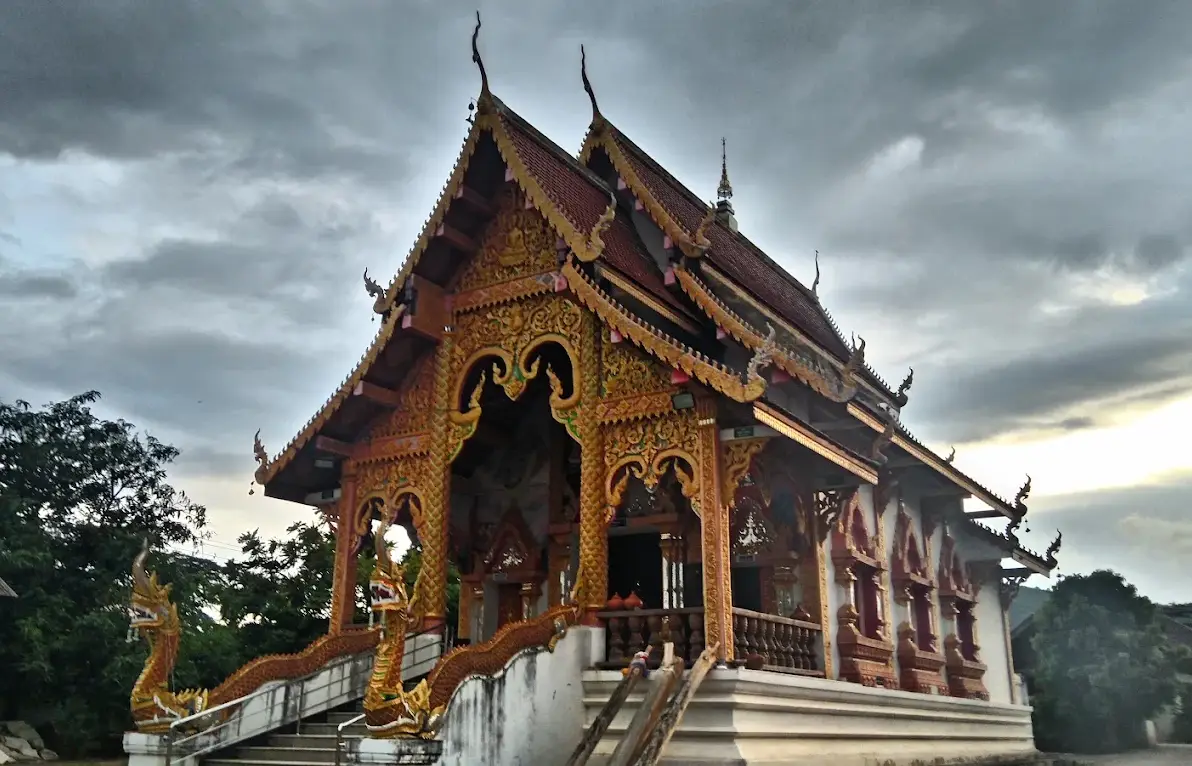
Wat Noi
Open Days: Daily
Opening Hours: 08.00 - 17.00
Wat Noi is located in Moo 7, Ban Pa Thoe, Chang Khoeng Subdistrict, Mae Chaem District, Chiang Mai Province. It is a local Buddhist temple under the Maha Nikaya tradition and serves as the community temple of Ban Pa Thoe. The temple was officially permitted to be established in B.E. 2370 and received its royal boundary in B.E. 2545. Wat Noi is suitable for travelers who want a calm temple visit, merit-making, and a deeper understanding of village-level Buddhist life in Mae Chaem.
The significance of Wat Noi lies in its role as the village temple of Ban Pa Thoe and in its history of revival and relocation. Community information records that the original temple was once located in the middle of rice fields between Ban Phrao Num and Ban Pa Thoe. It later became abandoned, like many old temple sites in Mae Chaem. The temple was later revived when Khru Ba Sopha encountered the abandoned site during his journey and wished to restore it as a place for meditation and Buddhist practice.
The story of Wat Noi shows the close relationship between monks and villagers. In B.E. 2435, Khru Ba Sopha traveled from San Pa Tong District in search of his father, who had moved to Mae Chaem. On the route between Ban Phrao Num and Ban Pa Thoe, he found the abandoned temple and decided to restore it. He discussed the matter with local residents, and the temple was gradually brought back to religious life. This makes Wat Noi a meaningful example of a revived community temple.
Later, in B.E. 2498, Tu Luang Kham, the abbot at that time, together with Ban Pa Thoe villagers, built a new temple within the village area. The relocation was practical: the former temple site was difficult for villagers to access because they had to walk along rice-field ridges over a long distance. In B.E. 2503, villagers helped move the large Buddha image from the old site to the new temple. The original name, Wat Noi, was kept for continuity and for administrative convenience.
This relocation story gives Wat Noi strong cultural value. The Buddha image was not simply moved as a physical object; it represented the faith and continuity of the community. By moving the Buddha image and preserving the original temple name, villagers connected the old religious site with the new village temple. Wat Noi therefore preserves both memory and active Buddhist practice.
The name “Wat Noi” sounds simple, but it is important to the identity of the community. “Noi” means small, but in this context it does not imply that the temple is unimportant. Instead, it reflects the character of a local village temple that remains close to the people. The value of Wat Noi lies not in its size or fame but in its revival history, its relocation, and its ongoing role as the spiritual center of Ban Pa Thoe.
Ban Pa Thoe is Moo 7 of Chang Khoeng Subdistrict in Mae Chaem District. The village is described as a local northern Thai community with lowland areas, waterways, and surrounding mountains. It is located to the west of Mae Chaem town and is not far from the district center. The village has Wat Noi as its community temple, making the temple central to religious and cultural life in the village.
The local economy and daily life of Ban Pa Thoe are closely connected with agriculture. Community information mentions rice farming, corn, vegetable growing, general labor, trading, and animal raising. Wat Noi should therefore be understood within this rural setting. It is a temple surrounded by village life, agricultural rhythms, and local traditions rather than an attraction separated from the community.
Wat Noi is more than a place for individual worship. It is a community space for Buddhist observances, merit-making, sermons, and village ceremonies. Local cultural calendars include Makha Bucha, village life-prolonging ceremonies, the northern Thai New Year, respect-paying ceremonies for elders, Visakha Bucha, Asalha Bucha, Buddhist Lent, Tan Kuai Salak, the end of Buddhist Lent, Kathin, Yi Peng, and New Year prayer activities. These events show how the temple remains connected with community life throughout the year.
The religious life of Ban Pa Thoe also reflects the wider Lanna cultural pattern in which Buddhism and local beliefs coexist. Most residents are Buddhist, while local beliefs and ritual traditions continue to shape community life. Wat Noi therefore functions not only as a registered temple but also as a space where faith, memory, and local identity meet.
Chang Khoeng Subdistrict has several community temples, including Wat Chang Khoeng, Wat Ku, Wat To Ruea, Wat Doi Sakan, Wat Thung Yao, Wat Noi, Wat Phrao Num, Wat Phuttha En, Wat Mae Pan, and Wat Huai Rin. This temple network reflects the northern Thai village structure, where each temple serves its own community while forming part of the wider Buddhist landscape of Mae Chaem.
In the broader context of Mae Chaem District, Wat Noi helps complete the cultural picture of the area. Mae Chaem is widely known for rice terraces, Pa Bong Piang, Doi Inthanon routes, and scenic rural landscapes, but village temples such as Wat Noi show how Buddhism continues to support local life. They reveal the quiet religious side of Mae Chaem that may not appear in general travel itineraries.
The atmosphere of Wat Noi is calm and local. Visitors should expect a village temple rather than a commercial tourist attraction. The experience is best appreciated through quiet worship, respectful observation, and an understanding that the temple is still used by the local community. Travelers interested in cultural context should pay attention to the temple’s setting in Ban Pa Thoe and its connection with the history of the former temple site.
For travelers interested in local history, Wat Noi offers a meaningful story. Its important details include its establishment in B.E. 2370, its former abandoned location between Ban Phrao Num and Ban Pa Thoe, its revival by Khru Ba Sopha, the later relocation into Ban Pa Thoe, the transfer of Buddha images to the new temple, and the royal boundary granted in B.E. 2545. These details give the temple strong cultural value without exaggerating it into a major tourist landmark.
For those interested in local wisdom, Ban Pa Thoe also has community knowledge related to agriculture, vegetable growing, weaving, local food, dessert-making, and animal raising. While these are not temple features in a narrow sense, they help visitors understand the cultural setting of Wat Noi. The temple and the village should be seen together because the temple’s role is shaped by the community around it.
Getting to Wat Noi is most convenient by private car or rental car. Travelers can enter Mae Chaem District and continue toward Chang Khoeng Subdistrict and Moo 7 Ban Pa Thoe. Roads in Mae Chaem may include curves, village roads, agricultural areas, and narrower local roads, so careful driving is recommended, especially during the rainy season or early morning when mist and wet road surfaces may occur.
Travelers coming from Chiang Mai city can reach Mae Chaem by routes through Chom Thong and Doi Inthanon or through Hot District, depending on road conditions and itinerary. Because Mae Chaem involves mountain roads and rural sections, visitors should allow enough travel time. Once in Mae Chaem, continue toward Chang Khoeng Subdistrict and Ban Pa Thoe.
Wat Noi can be combined with nearby temples in Chang Khoeng, including Wat Phrao Num, Wat Buppharam, Wat Ban Chiang, Wat Bon Na, Wat Thung Yao, Wat Chang Khoeng, Wat Ku, and Wat Phuttha En. This route is suitable for travelers who want to understand different layers of Mae Chaem’s religious landscape, from central temples and old community temples to smaller village temples with local stories.
Travelers who want to combine culture and nature can also connect Wat Noi with Mae Chaem rice fields, San Nong Reservoir, Ban Thung Yao, Pa Bong Piang, and scenic viewpoints in the district. A balanced itinerary may begin with temple visits in the morning and continue to rural landscapes later in the day. This gives the trip a mix of faith, community history, and natural scenery.
The best time to visit is in the morning or late afternoon, when the weather is more comfortable and the temple atmosphere is usually calm. During the rainy season, travelers should check weather and road conditions because some village and mountain roads may become wet or slippery. A private vehicle gives the most flexibility for visiting Wat Noi and nearby places in the same trip.
Visitors should dress modestly, speak respectfully, and observe proper Thai temple manners. Shoes should be removed where required, especially before entering worship areas. If monks, villagers, or community groups are using the temple, visitors should give them space. Wat Noi is a living religious site for the local community, not only a sightseeing location.
From a cultural writing perspective, Wat Noi should be presented through verified details: its location in Moo 7, Ban Pa Thoe, Chang Khoeng Subdistrict, Mae Chaem District; its status as a Maha Nikaya local temple; its establishment in B.E. 2370; its revival from an abandoned site; its relocation into the village; and the royal boundary granted in B.E. 2545. These details are enough to show the temple’s historical and cultural value without exaggeration.
Meals and accommodation are best planned around Mae Chaem town, Chang Khoeng, and nearby areas where there are more restaurant and lodging choices than in the immediate village area. Visitors can stop at Wat Noi for worship and cultural exploration, then continue to nearby temples, restaurants, homestays, rice-field viewpoints, Pa Bong Piang, or routes toward Doi Inthanon.
In summary, Wat Noi is a Maha Nikaya community temple in Moo 7, Ban Pa Thoe, Chang Khoeng Subdistrict, Mae Chaem District, Chiang Mai Province. It was officially permitted to be established in B.E. 2370 and received its royal boundary in B.E. 2545. Its main value lies in its history as a revived temple, its relocation into Ban Pa Thoe, its role as the village temple, and its connection with the agricultural and cultural life of Mae Chaem.
| Name | Wat Noi |
| Type | Local Buddhist temple under the Maha Nikaya tradition |
| Location | Moo 7, Ban Pa Thoe, Chang Khoeng Subdistrict, Mae Chaem District, Chiang Mai Province |
| Address | Moo 7, Ban Pa Thoe, Chang Khoeng Subdistrict, Mae Chaem District, Chiang Mai 50270 |
| Highlights | Village temple of Ban Pa Thoe, formerly an abandoned temple site between Ban Phrao Num and Ban Pa Thoe before being revived and relocated into the village |
| History | Officially permitted to be established as a temple in B.E. 2370 and received its royal boundary in B.E. 2545 |
| Important Historical Notes | The original temple was located in rice fields between Ban Phrao Num and Ban Pa Thoe. It became abandoned, was revived by Khru Ba Sopha, and was later relocated into Ban Pa Thoe with Buddha images moved from the old site |
| Distinctive Features | A local village temple reflecting Buddhist life, agricultural rhythms, and the community identity of Ban Pa Thoe in Chang Khoeng Subdistrict |
| Travel Information | Travel by private car or rental car into Mae Chaem District, then continue toward Chang Khoeng Subdistrict and Moo 7 Ban Pa Thoe |
| Current Status | Open for visits and worship |
| Open Days | Daily |
| Opening Hours | 08.00 - 17.00 |
| Nearby Tourist Attractions | 1. Wat Phrao Num, about 1 km 2. Wat Buppharam, about 2 km 3. Wat Ban Chiang, about 3 km 4. Wat Bon Na, about 4 km 5. Wat Phra That Chang Khoeng, about 5 km |
| Nearby Restaurants | 1. Mae Chaem Gate Restaurant, about 5 km, Tel. 085-671-3061 2. Sikon Restaurant, about 5 km, Tel. 087-067-8193 3. Moo Inter Mae Chaem, about 5 km, Tel. 061-354-2369 4. Chadaporn Mae Chaem Restaurant, about 5 km, Tel. 081-883-6737 5. Khuang Na Restaurant, about 7 km |
| Nearby Accommodations | 1. Huen Jam Rat, about 5 km, Tel. 089-687-1415 2. The Say Ba Homestay at Mae Chaem, about 5 km 3. Phu Chaem House, about 7 km, Tel. 081-024-6223 4. Kowit Maechaem Farmhouse, about 10 km, Tel. 091-858-4546, 085-625-1743 5. Hug Khao Homestay Mae Chaem, about 14 km, Tel. 090-261-3805 |
Frequently Asked Questions (FAQ)
Q: Where is Wat Noi located?
A: Wat Noi is located in Moo 7, Ban Pa Thoe, Chang Khoeng Subdistrict, Mae Chaem District, Chiang Mai Province.
Q: What are the opening days and hours of Wat Noi?
A: Wat Noi is open daily from 08.00 to 17.00.
Q: What type of temple is Wat Noi?
A: Wat Noi is a local Buddhist temple under the Maha Nikaya tradition in Chang Khoeng Subdistrict, Mae Chaem District.
Q: When was Wat Noi established?
A: Wat Noi was officially permitted to be established as a temple in B.E. 2370.
Q: When did Wat Noi receive its royal boundary?
A: Wat Noi received its royal boundary in B.E. 2545.
Q: What is notable about Wat Noi’s history?
A: The original temple was located in rice fields between Ban Phrao Num and Ban Pa Thoe. It later became abandoned, was revived by Khru Ba Sopha, and was eventually relocated into Ban Pa Thoe for easier community access.
Q: Is Wat Noi suitable for travelers?
A: Yes. It is suitable for travelers who want a quiet Buddhist temple visit and a local cultural stop in Mae Chaem District.
Q: What nearby attractions can be combined with Wat Noi?
A: Travelers can combine the visit with Wat Phrao Num, Wat Buppharam, Wat Ban Chiang, Wat Bon Na, and Wat Phra That Chang Khoeng.
 Category: ●Places of Worship
 Group: ●Temple
Last Update : 7 DayAgo
 Last Update : 7 DayAgo
 Click to Access the Navigation Map GPS
 Muang Chiang Mai(121)Chom Thong(47)Mae Chaem(25)Chiang Dao(33)Doi Saket(68)Mae Taeng(85)Mae Rim(69)Samoeng(29)Fang(71)Mae Ai(59)Phrao(70)San Pa Tong(105)San Kamphaeng(66)San Sai(73)Hang Dong(74)Hot(32)Doi Tao(22)Omkoi(11)Saraphi(74)Wiang Haeng(15)Chai Prakan(28)Mae Wang(32)Mae On(22)Doi Lo(34)Galyani Vadhana(1)


