
lovethailand home >North Travel Attractions >Chiang Mai Travel Attractions >Phrao >San Sai > Wat Phra That Klang Jai Mueang
TL;DR: Wat Phra That Klang Jai Mueang is located at Moo 8, San Sai Subdistrict, Phrao District, Chiang Mai Province, open Daily, hours 08.00 – 17.00.

Wat Phra That Klang Jai Mueang
Open Days: Daily
Opening Hours: 08.00 – 17.00
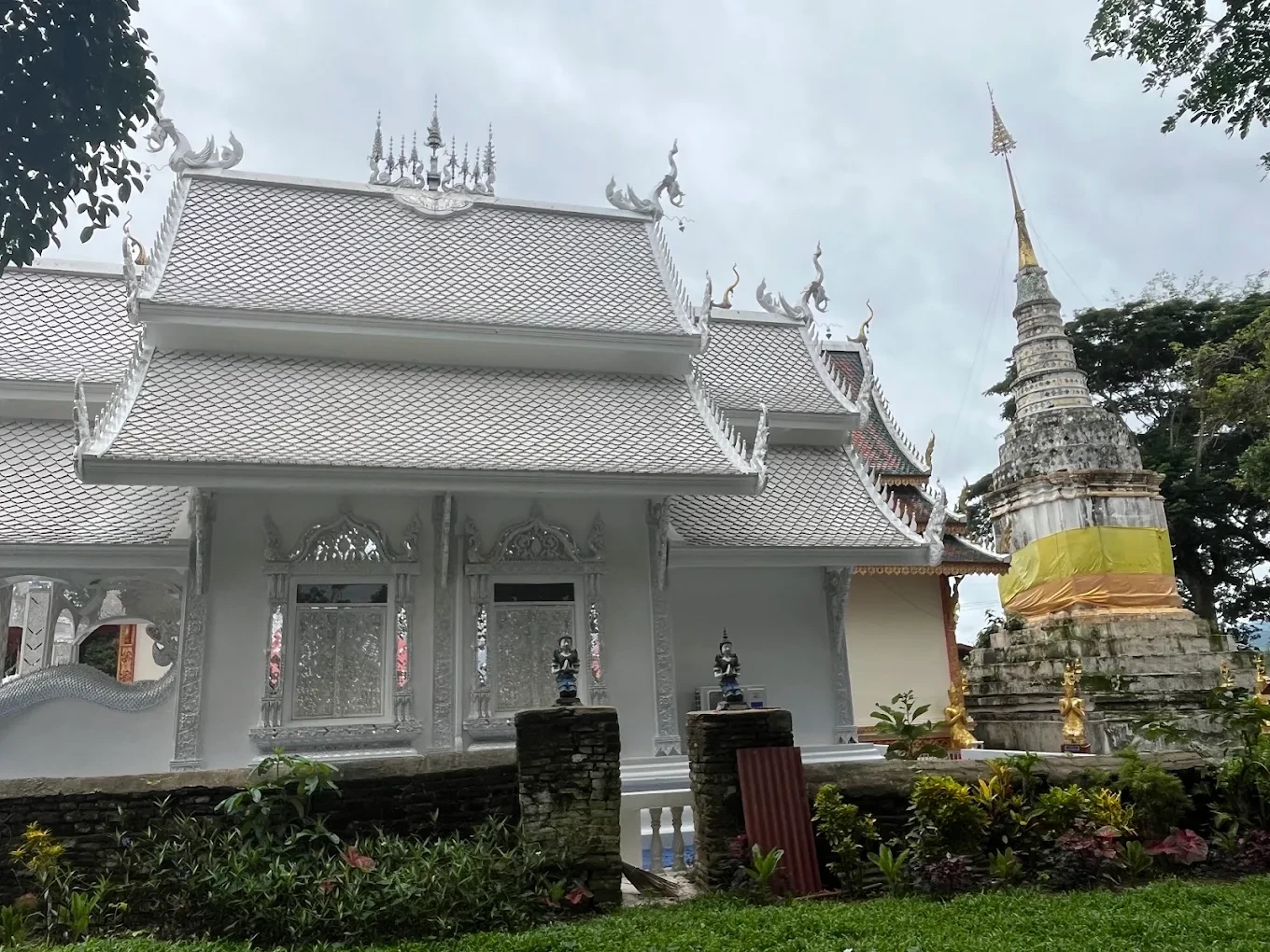
Wat Phra That Klang Jai Mueang is a local non-royal Buddhist temple under the Mahanikaya order, located in Moo 8, San Sai Subdistrict, Phrao District, Chiang Mai Province. The temple was officially permitted to be established in 1385. Its abbot is Phra Athikan Bunsi Sukhathammo. The temple is one of the most important sacred places in Phrao because it is associated with the concept of the city’s navel, or “sadue mueang,” the spiritual center of Wiang Phrao Wang Hin. Its main sacred monument is a Lanna-style chedi with indented corners, historically connected with King Kuena Thammikarat, Khruba Chao Siwichai, an ancient inscription, relic containers, silver and gold candles, sacred Bodhi trees, and the annual Phra That Klang Jai Mueang bathing ceremony.
The meaning of Wat Phra That Klang Jai Mueang goes beyond that of an ordinary community temple. The name “Klang Jai Mueang” means the heart or center of the town, while the older name “Sadue Mueang” refers to the navel of the city. In Lanna urban belief, the center of a city is not only a geographical point; it is a spiritual axis that supports civic well-being, sacred protection, and community identity. For this reason, Wat Phra That Klang Jai Mueang is both a temple, a relic shrine, a historical site, and a symbolic center of Phrao.
The main chedi of Wat Phra That Klang Jai Mueang is a Lanna-style structure with indented corners. Its form gives the monument a strong northern Thai architectural character, with a clear rhythm of base, body, corners, and sacred verticality. The original chedi is associated with the reign of King Kuena Thammikarat. An inscription mentions Thursday, the seventh waxing day of the sixth lunar month, the Year of the Rat, 1385, and gives the temple the name Wat Sadue Mueang. This makes the temple one of the historically deepest sacred sites in Phrao District.
The temple’s origin in the period of King Kuena reflects a time when Buddhism played a central role in Lanna city-building and sacred geography. Establishing a temple at the city’s navel was not simply a religious act; it was also a way to define the city’s spiritual center. The chedi therefore functions as a sacred axis, a source of communal faith, and a marker of the stability of Wiang Phrao Wang Hin.
A major restoration took place when Khruba Chao Siwichai, the revered saint of Lanna, traveled to Phrao around 1929. During the restoration, a black stone inscription was found, along with sacred objects such as relic containers, silver candles, gold candles, and other items associated with relic worship. These objects were placed within the chedi and became part of the temple’s sacred memory. Khruba Chao Siwichai’s restoration added another important historical layer to the temple, making it deeply meaningful to the people of Phrao and to devotees of Lanna Buddhism.
The discovery of the black stone inscription is especially important because it connects the temple with the year 1385 and the older name Wat Sadue Mueang. The inscription gives local memory a strong historical anchor and helps explain why the temple has long been regarded as the spiritual center of Phrao. The discovery of relic containers and silver and gold candles further confirms the site’s role as a place of relic devotion and merit-making in the past.
Wat Phra That Klang Jai Mueang is also part of the Khruba Chao Siwichai devotional route in Phrao. The story of his restoration work shows how revered northern monks helped revive temples, relic shrines, and sacred monuments across Lanna. The temple is therefore important not only as an ancient relic site, but also as a living memorial of community faith and Buddhist restoration in the modern period.
The temple area is also connected with stories of sacred Bodhi trees. In Buddhist culture, the Bodhi tree is deeply respected because it is associated with the Buddha’s enlightenment. Local stories connect the temple with Bodhi trees, miracles, and the name of Ban Si Kham, a nearby community whose name is linked with the act of supporting a sacred Bodhi tree. These stories add another layer of meaning to the temple and connect its sacred landscape with community memory.
Ban Si Kham, Moo 8 of San Sai Subdistrict, is closely associated with Wat Phra That Klang Jai Mueang. The village name is linked with local stories about the sacred Bodhi tree and the act of supporting it. The community around the temple is therefore not merely a residential area; it is a living landscape that preserves Buddhist legend, civic memory, and local devotion. Temple and village have grown together as a shared sacred and social space.
The annual Phra That Klang Jai Mueang bathing ceremony is an important tradition that reflects the relationship between temple and community. Villagers and local institutions support the ceremony as a way to honor the relic shrine and maintain the auspicious identity of the town. In Lanna Buddhist culture, bathing a relic shrine is an act of devotion, purification, and communal renewal. It brings villagers back to the temple to make merit, pay respect, and strengthen their connection with local Buddhist heritage.
In addition to the relic-bathing ceremony, Wat Phra That Klang Jai Mueang is also connected with Kathin, Pha Pa, Buddhist holy days, Buddhist Lent, the end of Lent, ancestor-related merit-making, and other Lanna merit traditions. These activities keep the temple active within the annual rhythm of community life. Wat Phra That Klang Jai Mueang is therefore not only a historical monument, but also a living temple where people continue to worship, chant, make merit, and gather as a community.
The temple plays several roles in the community. Spiritually, it is a place for relic worship, merit-making, Dhamma listening, and Buddhist ceremonies. Historically, it preserves the concept of the city’s navel and the sacred geography of Wiang Phrao. Culturally, it carries stories of King Kuena, Khruba Chao Siwichai, sacred Bodhi trees, and the annual relic-bathing ceremony. Socially, it is a shared place of faith for Ban Si Kham and the people of Phrao. As a destination, it is one of the most meaningful stops on Phrao’s sacred travel routes.
The distinctive value of Wat Phra That Klang Jai Mueang lies in its combination of multiple layers: an ancient chedi from the period of King Kuena, a black stone inscription, relic containers, silver and gold candles, Khruba Chao Siwichai’s restoration, sacred Bodhi tree traditions, and the status of being the navel of Wiang Phrao Wang Hin. The temple is therefore ideal for travelers who want to understand Phrao through history, faith, architecture, local legend, and Lanna Buddhist culture.
Important points to appreciate at the temple include the chedi, the relic worship area, the temple courtyard, the Bodhi tree area, and places connected with Khruba Chao Siwichai. Visitors should take time to observe the Lanna architectural character of the chedi and pay respect with calmness. The best way to understand the temple is to see it together with the history of Phrao, the story of the city’s navel, and the devotion of the local community.
Wat Phra That Klang Jai Mueang is also suitable for travelers following the route of four revered spiritual figures in Phrao: Luang Pu Khao Anālayo, Luang Pu Waen Sujinno, Khruba Chao Siwichai, and Phra Achan Man Phurithatto. This route shows that Phrao is not only an agricultural valley town, but also a landscape of temples, relic shrines, and sites connected with major Buddhist teachers. Wat Phra That Klang Jai Mueang represents the Khruba Chao Siwichai dimension of this sacred route.
A meaningful route from Wat Phra That Klang Jai Mueang can be arranged in several ways. Travelers focusing on San Sai Subdistrict can continue to Wat Tha Ma Kiang, Wat San Sai, Wat Nong Pit, and Phra That Doi Nang Lae. Travelers interested in Phrao town can continue to Wat Klang Wiang, Wat Nong O, Wat Kham Sum, Wat Pa Siao, and Wat Mae Koi. Those who want to extend the route toward Mae Pang Subdistrict can visit Wat Doi Mae Pang, Wat Phra That Doi Namo, and Mon Hin Lai Waterfall.
For visitors interested in Phrao history, Wat Phra That Klang Jai Mueang should be paired with Wat Klang Wiang. Wat Klang Wiang reflects later layers of Phrao civic history and the Inthakhin city pillar, while Wat Phra That Klang Jai Mueang represents the older sacred concept of the city’s navel. Visiting both sites helps travelers understand Phrao through its civic center, sacred center, and changing historical periods.
Wat Phra That Klang Jai Mueang is suitable for travelers interested in ancient relic shrines, Lanna architecture, King Kuena, Khruba Chao Siwichai, Phrao legends, sacred Bodhi trees, and relic-bathing traditions. Visitors who prefer quiet cultural travel should come in the morning or late afternoon. Those who want to experience community faith should plan around the relic-bathing ceremony or important Buddhist festivals.
Getting There is easiest by private car, rental car, or local hired transport. From Chiang Mai city, travel along the Chiang Mai–Mae Jo–Phrao route toward Phrao District, then continue into San Sai Subdistrict, Moo 8. In a map application, search for “Wat Phra That Klang Jai Mueang, San Sai, Phrao” to avoid confusion with similarly named places. A private vehicle is the most practical way to connect the temple with nearby temples, restaurants, accommodations, and natural attractions.
The best time to visit is in the morning or late afternoon, when the weather is more comfortable for worship, walking, and photography. A half-day itinerary works well for San Sai and Phrao town temples, while a full-day itinerary can include Mae Pang Subdistrict, Wat Doi Mae Pang, Wat Phra That Doi Namo, and Mon Hin Lai Waterfall.
Visitors should dress modestly, speak quietly, respect monks and local worshippers, and avoid entering private monastic areas without permission. Around the chedi, relic worship area, Bodhi tree, and ceremonial spaces, photography should be done respectfully. If a ceremony, merit-making event, or relic-bathing tradition is taking place, local participants should be given priority because the temple remains an active religious place used by the community.
Overall, Wat Phra That Klang Jai Mueang is one of the most important temples in Phrao District. It brings together Lanna city history, the concept of the city’s navel, relic devotion, Khruba Chao Siwichai’s restoration, an ancient inscription, sacred Bodhi tree traditions, and the annual Phra That bathing ceremony. It is an ideal destination for travelers who want to understand Phrao through Buddhism, local history, sacred architecture, and living community faith.
| Name | Wat Phra That Klang Jai Mueang |
| Former / Related Names | Wat Sadue Mueang / Phra That Klang Jai Mueang / Phra That Jai Klang Mueang |
| Location | Moo 8, San Sai Subdistrict, Phrao District, Chiang Mai Province |
| Temple Type | Local Non-Royal Buddhist Temple Under The Mahanikaya Order |
| History | Officially established as a temple in 1385; associated with King Kuena Thammikarat and the name Wat Sadue Mueang, meaning the city’s navel of Wiang Phrao Wang Hin |
| Main Chedi | Lanna-style chedi with indented corners; originally built in the period of King Kuena Thammikarat and later restored during the Khruba Chao Siwichai era |
| Main Sacred Objects / Features | Phra That Klang Jai Mueang Chedi, black stone inscription, relic containers, silver candles, gold candles, sacred Bodhi trees, and relic worship area |
| Important Figures | King Kuena Thammikarat And Khruba Chao Siwichai, The Revered Saint Of Lanna |
| Abbot / Caretaker | Phra Athikan Bunsi Sukhathammo |
| Importance | Spiritual center of Phrao, the city’s navel of Wiang Phrao Wang Hin, and a key site on the Khruba Chao Siwichai sacred route |
| Highlights | Relic worship, Lanna chedi architecture, Wat Sadue Mueang history, Khruba Chao Siwichai restoration story, sacred Bodhi trees, and the Phra That bathing ceremony |
| Main Areas / Zones | Chedi courtyard, relic worship area, Bodhi tree area, temple courtyard, merit-making area, and ceremonial area |
| Important Activities / Ceremonies | Phra That Klang Jai Mueang bathing ceremony, Kathin, Pha Pa, Buddhist holy day merit-making, Buddhist Lent, end-of-Lent activities, ancestor-related merit-making, and local Lanna merit-making |
| Community Role | Spiritual center of Ban Si Kham and Phrao people, used for worship, merit-making, relic devotion, and preserving the memory of the city’s navel |
| Open Days | Daily |
| Opening Hours | 08.00 – 17.00 |
| Travel Information | Best reached by private car, rental car, or local hired transport from Chiang Mai along the Chiang Mai–Mae Jo–Phrao route, then into San Sai Subdistrict, Moo 8 |
| Current Status | Active community temple and important relic shrine in San Sai Subdistrict, Phrao District, Chiang Mai Province |
| Nearby Tourist Attractions | 1. Wat Tha Ma Kiang, about 5–8 km 2. Wat San Sai, about 6–9 km 3. Wat Nong Pit, about 7–10 km 4. Phra That Doi Nang Lae, about 8–12 km 5. Wat Klang Wiang, about 10–14 km 6. Wat Nong O, about 11–15 km 7. Wat Doi Mae Pang, about 25–32 km 8. Mon Hin Lai Waterfall, about 35–45 km |
| Nearby Restaurants | 1. Nong Prince Chicken Rice, about 10–15 km, Tel. 094-559-0182 2. 135 Cafe, about 12–17 km, Tel. 083-549-6399 3. Krua Jae Kee Wild Food And River Fish, about 12–18 km, Tel. 084-488-8560 4. Shong Cha Café, Mae Pang Branch, about 25–32 km, Tel. 080-258-2854 5. Tiao Kwai Nan Daeng, about 27–34 km, Tel. 065-983-5978 |
| Nearby Accommodations | 1. PK Hotel / PK Hostel, about 10–15 km, Tel. 088-992-2444 2. Phrao Boutique Hotel, about 10–15 km 3. Phrao Place, about 10–15 km 4. Khoom Kam Kaew, about 18–24 km 5. Siam Lanna Homestay, about 18–25 km 6. Mae Pang Camping, about 28–36 km, Tel. 061-313-2422 |
Frequently Asked Questions (FAQ)
Q: Where is Wat Phra That Klang Jai Mueang located?
A: Wat Phra That Klang Jai Mueang is located in Moo 8, San Sai Subdistrict, Phrao District, Chiang Mai Province.
Q: Why is Wat Phra That Klang Jai Mueang important?
A: The temple is regarded as the city’s navel, or sacred center, of Wiang Phrao Wang Hin and remains an important spiritual center of Phrao.
Q: When was Wat Phra That Klang Jai Mueang established?
A: The temple was officially established in 1385, with historical links to King Kuena Thammikarat and the older name Wat Sadue Mueang.
Q: What is special about the main chedi?
A: The main chedi is a Lanna-style structure with indented corners. It is connected with an ancient inscription, relic containers, silver and gold candles, and later restoration by Khruba Chao Siwichai.
Q: How is Wat Phra That Klang Jai Mueang connected with Khruba Chao Siwichai?
A: Khruba Chao Siwichai played an important role in restoring the temple, making it a key sacred site on the Khruba Chao Siwichai route in Phrao District.
Q: What are the opening days and hours of Wat Phra That Klang Jai Mueang?
A: Wat Phra That Klang Jai Mueang is open daily from 08.00 to 17.00.
Q: What important tradition is associated with Wat Phra That Klang Jai Mueang?
A: The important tradition is the Phra That Klang Jai Mueang bathing ceremony, a local merit-making event honoring the relic shrine.
Q: What nearby places can be visited with Wat Phra That Klang Jai Mueang?
A: Nearby places include Wat Tha Ma Kiang, Wat San Sai, Wat Nong Pit, Phra That Doi Nang Lae, Wat Klang Wiang, Wat Nong O, Wat Doi Mae Pang, and Mon Hin Lai Waterfall.
 Category: ●Places of Worship
 Group: ●Temple
Last Update : 4 DayAgo
 Last Update : 4 DayAgo
 Click to Access the Navigation Map GPS
Wat Phra That Klang Jai Mueang Map
Recommend

 Muang Chiang Mai(121)Chom Thong(47)Mae Chaem(25)Chiang Dao(33)Doi Saket(68)Mae Taeng(85)Mae Rim(69)Samoeng(29)Fang(71)Mae Ai(59)Phrao(70)San Pa Tong(103)San Kamphaeng(66)San Sai(73)Hang Dong(73)Hot(32)Doi Tao(22)Omkoi(11)Saraphi(74)Wiang Haeng(15)Chai Prakan(28)Mae Wang(32)Mae On(22)Doi Lo(34)Galyani Vadhana(1)


