
lovethailand home >North Travel Attractions >Chiang Mai Travel Attractions >Phrao >Wiang > Wat Klang Wiang
TL;DR: Wat Klang Wiang is located at Ban Kham Sum Wiang, Khuean Phet Road, Moo 2, Wiang Subdistrict, Phrao District, Chiang Mai Province, open Daily, hours 08.00 – 17.00.

Wat Klang Wiang
Open Days: Daily
Opening Hours: 08.00 – 17.00
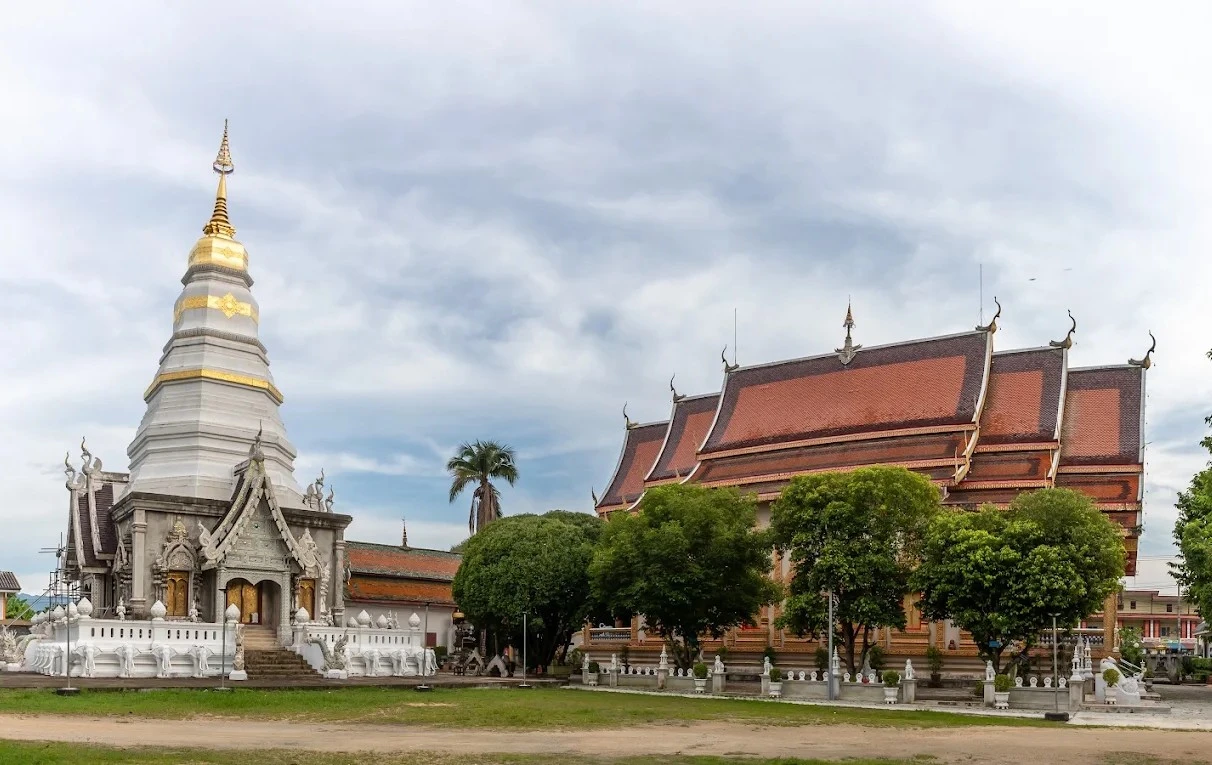
Wat Klang Wiang is a local non-royal Buddhist temple under the Mahanikaya order, located in Ban Kham Sum Wiang on Khuean Phet Road, Moo 2, Wiang Subdistrict, Phrao District, Chiang Mai Province. The temple land covers 3 rai, 2 ngan, and 70 square wah under Nor Sor 3 document number 14. Formerly known as Wat Si Bun Rueang Klang Wiang or Wat Si Bun Rueang, the temple is closely connected with the historical revival of Wiang Phrao Wang Hin under Phaya Khuean Mueang, whose original name was Bunma, and remains one of the most important religious and cultural landmarks in Phrao District.
Wat Klang Wiang stands in Ban Kham Sum Wiang, a significant community in Wiang Subdistrict. Its name reflects its position and role within the old town context of Phrao. The temple is associated with Khuean Phet Road, a name that links the area with Phaya Khuean Mueang and the development of roads and settlement patterns in Wiang Phrao. Wat Klang Wiang is therefore not merely a village temple; it is a religious site tied to urban memory, community structure, and the historical development of Phrao.
The temple boundaries show that Wat Klang Wiang stands within a dense community setting. To the north, the temple borders local residences. To the south, it borders the Phrao–Wiang Pa Pao highway. To the east and west, it borders public roads. This location makes the temple a central religious and community space, surrounded by houses, roads, public movement, and the everyday life of Phrao town.
The history of Wat Klang Wiang is closely related to Phaya Khuean Mueang, originally named Bunma, who governed Wiang Phrao Wang Hin between 1858 and 1901. During his administration, scattered communities were gathered to rebuild Wiang Phrao. The urban planning concept of Nop Buri Si Nakhon Ping Chiang Mai was used as a model for Wiang Phrao Wang Hin. This historical role made Phaya Khuean Mueang an important figure in the memory of Phrao, and Wat Klang Wiang became one of the religious landmarks reflecting that period of urban revival.
Wat Klang Wiang was originally known as Wat Si Bun Rueang Klang Wiang. It was established by Phaya Khuean Mueang together with Phra Khru Ba Kham Mun Khamphira, the ecclesiastical leader of Phrao at the time. The temple received its Wisungkhamsima in 1893, with a consecrated boundary measuring 6 meters wide and 9 meters long. This gave the temple formal religious status for important monastic acts and confirmed its importance within the Buddhist and civic life of Phrao.
One of the important historical objects connected with Wat Klang Wiang is the pair of large bells known locally as maha khanto. They were offered to the temple and contain inscriptions in Fak Kham script. The bells are meaningful not only as religious objects, but also as evidence of local literacy, Lanna culture, and Buddhist devotion in old Phrao. Their presence reflects how material offerings to temples could preserve both faith and historical memory.
The temple buildings include an ubosot, sermon hall, viharn, monks’ residences, multipurpose hall, and a building for the Buddhist scripture school. These buildings allow Wat Klang Wiang to serve multiple functions: Buddhist ceremonies, monastic residence, community gatherings, religious education, and public activities. The temple remains a living community institution rather than only a historical attraction.
The ubosot of Wat Klang Wiang is an important structure. It was built in 1929 and is regarded as one of the important old religious structures of Phrao. As the space for key monastic ceremonies, the ubosot represents the temple’s religious authority and its long-standing role in the local Sangha. Its continued presence also helps preserve the architectural and religious memory of Phrao town.
The important sacred objects at Wat Klang Wiang include a chedi, stucco Buddha images, a Lanna-style Phra Phuttha Sihing image in the Maravijaya posture, an ornamented Buddha image, another Buddha image in the Maravijaya posture, and a Buddha image in the Abhaya or “forbidding relatives” posture. These sacred objects give the temple strong artistic and devotional value. They allow visitors to appreciate Lanna Buddhist art, different Buddha postures, and the symbolic meanings of Buddhist iconography.
The ornamented Buddha image and the Buddha image in the forbidding-relatives posture add further depth to the temple’s sacred art. The ornamented Buddha reflects a refined tradition of representing the Buddha with elevated symbolic dignity, while the forbidding-relatives posture recalls Buddhist teachings related to restraint, reconciliation, and peace. Together with the Phra Phuttha Sihing image, these objects make Wat Klang Wiang an important place for both worship and cultural learning.
The Inthakhin pillar of Phrao is one of the most important features of Wat Klang Wiang. In 1986, the Phrao district chief, village headmen, government agencies, the district Sangha, merchants, and local residents jointly built the Inthakhin or city pillar of Phrao within the temple grounds. The pillar was created as an auspicious symbol for the town and its people. Its location inside Wat Klang Wiang makes the temple a point where civic belief, Buddhist faith, and local identity meet.
The annual Inthakhin worship ceremony, also known locally as Sai Khan Dok, is one of the temple’s most important traditions. It is held around the transition between the eighth and ninth northern lunar months, roughly May to June. Government agencies, private organizations, and local residents participate in rituals honoring the guardian spirits of Phrao, celebrating the city pillar, and bringing the temple’s Buddha image for public worship. The multi-day event also includes cultural performances and community activities.
Wat Klang Wiang also has a statue of Khruba Chao Insom Sumano of Wat Thung Noi. It was created on June 27, 2015 by Phra Khru Palat Mongkhon Sitthiwat together with government agencies, merchants, and local residents to honor the monk’s virtue and conduct. The statue provides another point of reverence for visitors and connects the temple with the memory of respected local monks in Phrao.
The 80th Birthday Anniversary Maharaj Building inside Wat Klang Wiang serves as a learning and community facility. It is used as a non-formal education center for Wiang Phrao Subdistrict and as a village meeting hall. This shows how the temple continues to support education and community activities. In the Lanna context, the connection between temple, village, and learning remains visible at Wat Klang Wiang.
The temple also has an important history of Buddhist education. Its Buddhist scripture school, Dhamma section, opened in 1962, and the Pali section opened in 1990. This educational role makes Wat Klang Wiang a place where Buddhist knowledge has been transmitted to monks, novices, and the wider community. It is therefore both a historical temple and a center of Buddhist learning in Phrao District.
The known abbots of Wat Klang Wiang include Khruba Kham Mun Khamphira, Phra Chandi Punnapannya, Phra Yana Montri, Phra Inta Nuan Nak, Phra Po Suthammo, Phra Poi Tiya, Phra Puang Kham Tui Khiao, Phra Thawisak Aphiwanno, Phra Pathom Pannatharo, Chao Athikan Sa-at Arinchayo, who served from 1978 to 1983, and Phra Baidika Suthep Tejapunyo from 1983 onward. This succession of abbots reflects the temple’s continuity in religious administration and service to Phrao.
The distinctive value of Wat Klang Wiang lies in the way it brings together multiple layers of meaning: Phaya Khuean Mueang and the rebuilding of Wiang Phrao, the old name Wat Si Bun Rueang Klang Wiang, an old ubosot, a chedi, Lanna Buddha images, the Inthakhin city pillar of Phrao, bells with Fak Kham inscriptions, Buddhist scripture education, community buildings, and the annual Sai Khan Dok tradition. The temple is therefore one of the most complete places to understand Phrao through religion, history, art, education, and community life.
Wat Klang Wiang plays many roles in the community. Spiritually, it is a place for merit-making, Dhamma listening, offerings, Buddhist holy days, monastic acts, and ceremonies. Historically, it preserves the memory of Phaya Khuean Mueang and the revival of Wiang Phrao. Culturally, it serves as the center of the Inthakhin tradition and local performances. Educationally, it has supported Buddhist scripture learning. Socially, it provides spaces for meetings and public activities.
Visitors should begin by paying respect to the temple’s important Buddha images, including Phra Phuttha Sihing, the Maravijaya Buddha images, and the forbidding-relatives Buddha image. They can then visit the ubosot, chedi, Inthakhin pillar, statue of Khruba Chao Insom Sumano, and key buildings within the temple compound. The temple is best appreciated slowly, as it remains an active religious place as well as a historical and cultural landmark.
Wat Klang Wiang is suitable for travelers interested in old temples, Phrao history, Lanna Buddhist art, Buddha images, the Inthakhin tradition, Buddhist education, and cultural travel in northern Thailand. Visitors who come during the Sai Khan Dok ceremony will see the temple’s role as a civic and spiritual center more clearly. Visitors who come on ordinary days will experience a quieter atmosphere and can focus on the temple’s architecture, sacred objects, and historical meaning.
Getting There is convenient because Wat Klang Wiang is located in Wiang Subdistrict, Phrao District. From Chiang Mai city, travel along the Chiang Mai–Mae Jo–Phrao route into Phrao District, then continue to Ban Kham Sum Wiang on Khuean Phet Road, Moo 2. The temple is close to the Phrao district center and can be reached easily by private car, rental car, or local hired transport. In a map application, search for “Wat Klang Wiang, Phrao, Chiang Mai” to avoid confusion with temples of the same name in other provinces.
A meaningful route from Wat Klang Wiang can include nearby temples in Phrao town such as Wat Thung Luang, Wat Phra Chao Lan Thong, Wat Kham Sum, Wat Pa Siao, and other community sites in Wiang Subdistrict. Travelers who want to expand the route into Mae Pang Subdistrict can continue to Wat Doi Mae Pang, Wat Phra That Doi Namo, Wat Mae Pang, Wat Mae Phaeng, Wat Huai Ngu, and Wat Huai Sai. Nature-based extensions can include Mon Hin Lai Waterfall, Mae Saluam Reservoir, and other natural sites in Phrao.
The best time to visit is in the morning or late afternoon, when the weather is more comfortable for worship, walking, and photography. Travelers interested in the temple’s most important local tradition should plan for the period between the eighth and ninth northern lunar months, roughly May to June, when the Inthakhin or Sai Khan Dok ceremony is held. This period reveals the temple’s role as a center of civic faith and community identity.
Visitors should dress modestly, speak quietly, respect monks and local worshippers, and avoid entering private monastic areas without permission. If a ceremony, merit-making event, or Inthakhin celebration is taking place, local participants should be given priority. Photography should be done respectfully, especially around the ubosot, Buddha images, Inthakhin pillar, and ceremonial areas. Wat Klang Wiang remains an active religious place, not only a sightseeing location.
Overall, Wat Klang Wiang is one of the most important temples in Phrao District. It brings together the history of Phaya Khuean Mueang, the revival of Wiang Phrao, an old ubosot, a chedi, Lanna Buddha images, the Inthakhin city pillar, Buddhist scripture education, community functions, and the annual Sai Khan Dok tradition. It is an ideal destination for travelers who want to understand Phrao through Buddhism, local history, Lanna art, and living community culture.
| Name | Wat Klang Wiang |
| Former Name | Wat Si Bun Rueang Klang Wiang / Wat Si Bun Rueang |
| Location | Ban Kham Sum Wiang, Khuean Phet Road, Moo 2, Wiang Subdistrict, Phrao District, Chiang Mai Province |
| Temple Type | Local Non-Royal Buddhist Temple Under The Mahanikaya Order |
| Temple Land | 3 Rai, 2 Ngan, 70 Square Wah, Nor Sor 3 Document No. 14 |
| Boundaries | North: local residences; South: Phrao–Wiang Pa Pao highway; East: public road; West: public road |
| History | Associated with Phaya Khuean Mueang, originally named Bunma, and the rebuilding of Wiang Phrao Wang Hin |
| Wisungkhamsima | Granted in 1893; consecrated boundary measuring 6 meters wide and 9 meters long |
| Religious Buildings | Ubosot, Sermon Hall, Viharn, Monks’ Residences, Multipurpose Hall, Buddhist Scripture School Building, and 80th Birthday Anniversary Maharaj Building |
| Main Sacred Objects | Chedi, Stucco Buddha Images, Lanna-Style Phra Phuttha Sihing In Maravijaya Posture, Ornamented Buddha Image, Maravijaya Buddha Image, And Forbidding-Relatives Buddha Image |
| Important Features | Inthakhin City Pillar Of Phrao, Old Ubosot, Statue Of Khruba Chao Insom Sumano, Bells With Fak Kham Inscriptions, And Buddhist Scripture School |
| Important Activities / Ceremonies | Inthakhin Worship Or Sai Khan Dok Around The Eighth To Ninth Northern Lunar Months, Kathin, Pha Pa, Buddhist Holy Days, Buddhist Lent, End-Of-Lent Activities, And Local Lanna Merit-Making |
| Education | Buddhist Scripture School, Dhamma Section Opened In 1962 And Pali Section Opened In 1990 |
| Known Abbots | Khruba Kham Mun Khamphira, Phra Chandi Punnapannya, Phra Yana Montri, Phra Inta Nuan Nak, Phra Po Suthammo, Phra Poi Tiya, Phra Puang Kham Tui Khiao, Phra Thawisak Aphiwanno, Phra Pathom Pannatharo, Chao Athikan Sa-at Arinchayo, And Phra Baidika Suthep Tejapunyo |
| Open Days | Daily |
| Opening Hours | 08.00 – 17.00 |
| Facilities | Parking, Male/Female/Accessible Toilets, Wiang Phrao Non-Formal Education Center, And 80th Birthday Anniversary Maharaj Building |
| Travel Information | Best reached by private car, rental car, or local hired transport from Chiang Mai along the Chiang Mai–Mae Jo–Phrao route to Ban Kham Sum Wiang, Khuean Phet Road, Moo 2, Wiang Subdistrict |
| Current Status | Active temple and important religious site in Wiang Subdistrict, Phrao District, Chiang Mai Province |
| Nearby Tourist Attractions | 1. Wat Thung Luang, about 1–2 km 2. Wat Phra Chao Lan Thong, about 1–3 km 3. Wat Kham Sum, about 1–3 km 4. Wat Pa Siao, about 2–4 km 5. Wat Doi Mae Pang, about 15–20 km 6. Wat Phra That Doi Namo, about 18–22 km 7. Mon Hin Lai Waterfall, about 25–35 km 8. Mae Saluam Reservoir, about 25–35 km |
| Nearby Restaurants | 1. Restaurants And Cafés In Phrao Town, about 1–5 km 2. Nong Prince Chicken Rice, about 5–8 km, Tel. 094-559-0182 3. 135 Cafe, about 7–10 km, Tel. 083-549-6399 4. Krua Jae Kee Wild Food And River Fish, about 8–12 km, Tel. 084-488-8560 5. Shong Cha Café, Mae Pang Branch, about 16–20 km, Tel. 080-258-2854 6. Tiao Kwai Nan Daeng, about 18–22 km, Tel. 065-983-5978 |
| Nearby Accommodations | 1. PK Hotel / PK Hostel, about 3–5 km, Tel. 088-992-2444 2. Phrao Boutique Hotel, about 3–6 km 3. Phrao Place, about 3–6 km 4. Khoom Kam Kaew, about 8–12 km 5. Siam Lanna Homestay, about 10–15 km 6. Mae Pang Camping, about 18–25 km, Tel. 061-313-2422 |
Frequently Asked Questions (FAQ)
Q: Where is Wat Klang Wiang located?
A: Wat Klang Wiang is located in Ban Kham Sum Wiang on Khuean Phet Road, Moo 2, Wiang Subdistrict, Phrao District, Chiang Mai Province.
Q: What was the former name of Wat Klang Wiang?
A: The temple was formerly known as Wat Si Bun Rueang Klang Wiang or Wat Si Bun Rueang.
Q: How is Wat Klang Wiang connected with the history of Phrao?
A: The temple is connected with Phaya Khuean Mueang, originally named Bunma, and the historical rebuilding of Wiang Phrao Wang Hin.
Q: What are the important sacred objects at Wat Klang Wiang?
A: Important sacred objects include a chedi, stucco Buddha images, a Lanna-style Phra Phuttha Sihing in Maravijaya posture, an ornamented Buddha image, a Maravijaya Buddha image, and a Buddha image in the forbidding-relatives posture.
Q: What is the most important tradition at Wat Klang Wiang?
A: The most important tradition is the Inthakhin worship ceremony or Sai Khan Dok, held around the eighth to ninth northern lunar months, roughly May to June.
Q: What are the opening days and hours of Wat Klang Wiang?
A: Wat Klang Wiang is open daily from 08.00 to 17.00.
Q: What kind of travelers is Wat Klang Wiang suitable for?
A: It is suitable for travelers interested in old temples, Phrao history, Lanna Buddhist art, Buddha images, Inthakhin tradition, Buddhist education, and cultural travel in northern Thailand.
Q: What nearby places can be visited with Wat Klang Wiang?
A: Nearby places include Wat Thung Luang, Wat Phra Chao Lan Thong, Wat Kham Sum, Wat Pa Siao, Wat Doi Mae Pang, Wat Phra That Doi Namo, Mon Hin Lai Waterfall, and Mae Saluam Reservoir.
 Category: ●Places of Worship
 Group: ●Temple
Last Update : 1 DayAgo
 Last Update : 1 DayAgo
 Click to Access the Navigation Map GPS
Wat Klang Wiang Map
Recommend

 Muang Chiang Mai(121)Chom Thong(47)Mae Chaem(25)Chiang Dao(33)Doi Saket(68)Mae Taeng(85)Mae Rim(69)Samoeng(29)Fang(71)Mae Ai(59)Phrao(70)San Pa Tong(104)San Kamphaeng(66)San Sai(73)Hang Dong(74)Hot(32)Doi Tao(22)Omkoi(11)Saraphi(74)Wiang Haeng(15)Chai Prakan(28)Mae Wang(32)Mae On(22)Doi Lo(34)Galyani Vadhana(1)


