
lovethailand home >North Travel Attractions >Chiang Mai Travel Attractions >Phrao >Mae Pang > Wat Huai Sai (Mae Pang)
TL;DR: Wat Huai Sai (Mae Pang) is located at Ban Huai Sai, Moo 8, Mae Pang Subdistrict, Phrao District, Chiang Mai Province, open Daily, hours 08.00 – 17.00.

Wat Huai Sai (Mae Pang)
Open Days: Daily
Opening Hours: 08.00 – 17.00
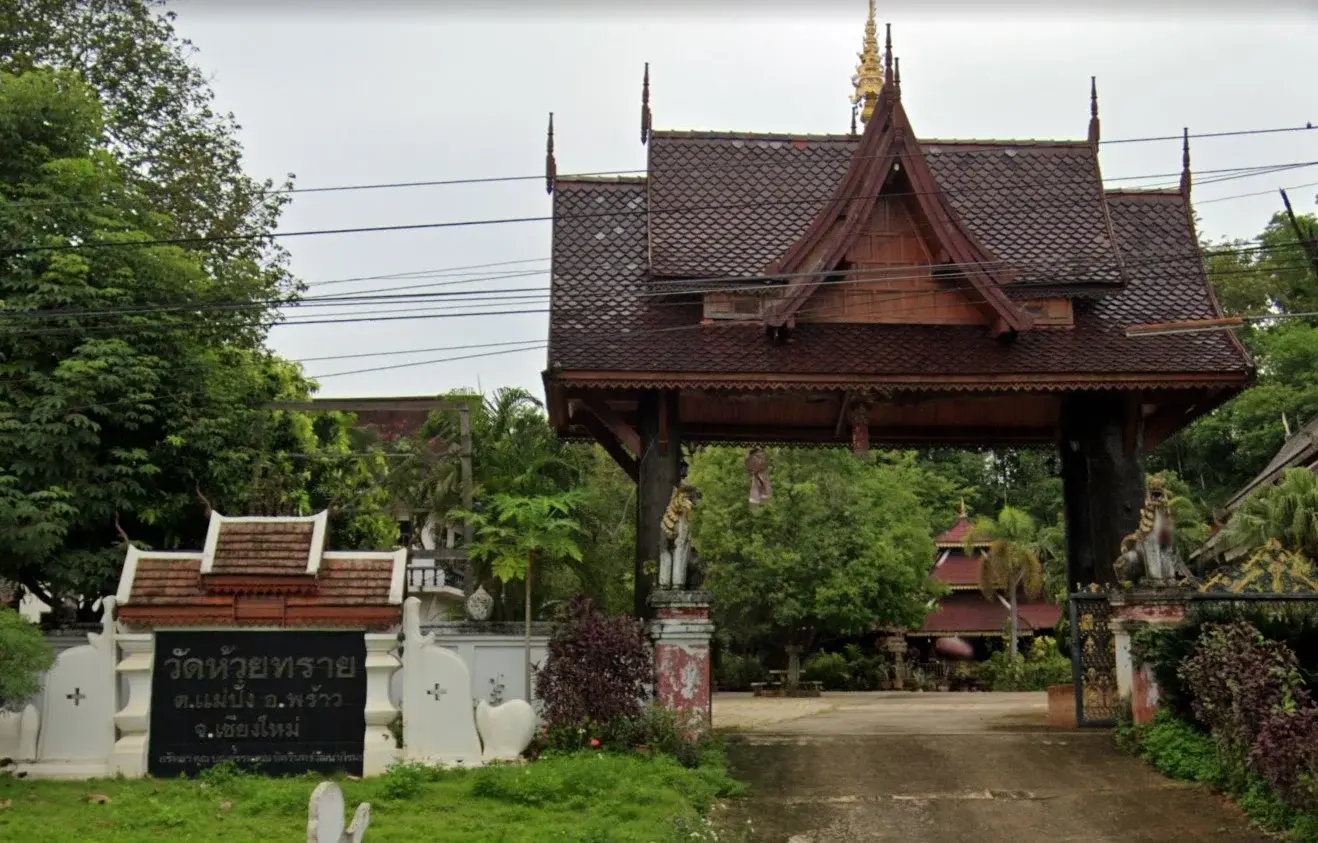
Wat Huai Sai (Mae Pang) is a local non-royal Buddhist temple under the Mahanikaya order, located in Moo 8, Ban Huai Sai, Mae Pang Subdistrict, Phrao District, Chiang Mai Province. The temple was officially permitted to be established in 1920, and its abbot is Phra Thongsuk Siriwatthano. Wat Huai Sai is the community temple of Ban Huai Sai, closely connected with the agricultural landscape, waterways, village roads, and Lanna Buddhist traditions of Mae Pang Subdistrict.
Ban Huai Sai is Moo 8 of Mae Pang Subdistrict. It belongs to the rural Lanna landscape of northern Thailand, where houses, farmland, streams, local roads, water sources, and surrounding mountains shape daily life. The name Huai Sai suggests a landscape connected with streams, sand, water flow, and alluvial ground. The temple name therefore reflects local geography as well as the identity of the village it serves.
Mae Pang Subdistrict is located south of Phrao District center, about 16 kilometers from the district office. The area is generally a plain surrounded by mountains, with hills and rivers running through parts of the subdistrict. Mae Pang has 15 villages, and Ban Huai Sai is Moo 8. This setting gives Wat Huai Sai a clear village context: it stands within a community shaped by farming seasons, local water systems, village roads, and Buddhist practice.
The establishment year of 1920 makes Wat Huai Sai a community temple with more than a century of history. A village temple of this age reflects the long-term stability of the community, the faith of local residents, the presence of monks, and the cooperation of villagers who maintained a Buddhist center close to their homes. Wat Huai Sai is therefore important as both a religious site and a community landmark of Ban Huai Sai.
In rural Lanna society, a village temple is more than a place for worship. It is a moral center, a gathering space, a ceremonial site, and a place where community memory is preserved. Wat Huai Sai has supported merit-making, Buddhist observance, family-related ceremonies, ancestor-related merit-making, and annual village events. This gives the temple a deep role in the social and religious structure of Ban Huai Sai.
Phra Thongsuk Siriwatthano is the abbot of Wat Huai Sai. In a community temple, the abbot plays an important role in caring for the temple grounds, guiding Buddhist activities, maintaining religious order, and sustaining the relationship between monks and villagers. A temple such as Wat Huai Sai depends on cooperation among monks, temple committee members, village leaders, elders, and local devotees.
The atmosphere of Wat Huai Sai is quiet, modest, and closely connected with village life. The main experience for visitors is merit-making, worship, Dhamma listening, and observing the role of a community temple within a living rural settlement. The temple is most meaningful when seen together with Ban Huai Sai, local roads, farmland, streams, water sources, and the broader temple network of Mae Pang Subdistrict.
Mae Pang has a dense religious landscape. Local information lists temples, relic sites, and a meditation center within the subdistrict. Wat Huai Sai is part of this wider Buddhist landscape along with Wat Mae Pang, Wat Mae Phaeng, Wat Doi Mae Pang, Wat Phra That Doi Namo, Wat Thung Buak Khao, Wat Pradu, Wat Phra Chao Ton Luang, Wat Mon Hin Lai, Wat Ban Kham Sum Wiang, Wat Huai Ngu, and Wat San Kamphaeng. Together, these sites show how strongly Buddhism is woven into local village life.
Wat Huai Sai plays several roles in the community. Spiritually, it is a place for worship, merit-making, offering food to monks, listening to Dhamma, observing Buddhist holy days, and joining ceremonies. Socially, it is a shared space for Ban Huai Sai residents. Culturally, it helps preserve Lanna Buddhist traditions such as Buddhist Lent, the end of Lent, Kathin, Pha Pa, ancestor-related merit-making, and seasonal ceremonies connected with agricultural life.
Kathin, Pha Pa, Buddhist holy days, Buddhist Lent, the end of Lent, ancestor-related merit-making, and seasonal merit activities keep Wat Huai Sai active within the annual rhythm of the village. These activities allow residents to support monks, maintain the temple, prepare offerings, gather as families, and strengthen community relationships. The temple therefore functions as a meeting point of religion, tradition, kinship, and local unity.
Mae Pang communities are closely connected with agriculture, local labor, small businesses, and rural livelihoods. A village temple such as Wat Huai Sai is naturally linked with agricultural rhythms: merit-making after harvest, seasonal ceremonies, offerings, and community gatherings. This relationship between temple and farming life gives the temple practical meaning in everyday village life.
The distinctive value of Wat Huai Sai lies in its role as the village temple of Ban Huai Sai, a community whose name is connected with streams, sand, water sources, and farmland. The temple is not a large-scale tourist attraction, but its value lies in authenticity, continuity, and community use. It is suitable for travelers who want to understand Phrao through real village temples rather than only through major attractions.
Important points to appreciate at Wat Huai Sai include the worship area, temple courtyard, merit-making area, ceremonial spaces, and the quiet atmosphere of a village temple. Visitors should move respectfully, dress modestly, and give priority to local worshippers if a ceremony is taking place. The temple is best appreciated as part of Ban Huai Sai, not as a quick standalone sightseeing stop.
Wat Huai Sai can be connected with several nearby temples and sacred sites in Mae Pang Subdistrict, including Wat Mae Pang, Wat Mae Phaeng, Wat Doi Mae Pang, Wat Phra That Doi Namo, Wat Thung Buak Khao, Wat Pradu, Wat Phra Chao Ton Luang, Wat Mon Hin Lai, Wat Ban Kham Sum Wiang, Wat Huai Ngu, and Wat San Kamphaeng. These temples form a route that combines community temples, hill temples, relic sites, and local Buddhist traditions.
A meaningful route from Wat Huai Sai can include Wat Huai Ngu, Wat Mae Phaeng, Wat Mae Pang, Wat Pradu, and Wat Thung Buak Khao for a community-temple route. Travelers who want to add forest-practice and spiritual history can continue to Wat Doi Mae Pang, which is associated with Luang Pu Waen Sujinno. Travelers interested in nature can add Mon Hin Lai Waterfall in Si Lanna National Park.
Wat Doi Mae Pang is one of the important nearby religious destinations in Mae Pang Subdistrict. It is widely associated with Luang Pu Waen Sujinno, a respected forest-practice monk. Visiting Wat Huai Sai together with Wat Doi Mae Pang gives travelers a balanced view of Mae Pang: Wat Huai Sai represents community-based village Buddhism, while Wat Doi Mae Pang represents the forest-practice and meditation dimension of the area.
Mon Hin Lai Waterfall is a major natural attraction connected with Mae Pang and Phrao. It is located in Si Lanna National Park and is known as a nine-tier waterfall on Doi Mon Hin Lai. Adding this natural route to a temple itinerary helps visitors see Mae Pang through both cultural and natural landscapes: temples, communities, fields, streams, mountains, and forested waterfall terrain.
Getting There is easiest by private car, rental car, or local hired transport. From Chiang Mai city, travel toward Phrao District along the Chiang Mai–Mae Jo–Phrao route, then continue into Mae Pang Subdistrict and Ban Huai Sai, Moo 8. Before departure, search for “Wat Huai Sai Mae Pang Phrao” or “Wat Huai Sai (Mae Pang)” in a map application to avoid confusion with other temples of the same name in Chiang Mai and other provinces.
The best time to visit is in the morning or late afternoon, when the weather is more comfortable and the temple atmosphere is calm. Travelers planning to explore Mae Pang Subdistrict should allow a half-day or full-day route. The late rainy season and cool season are especially suitable for cultural travel in Phrao because the rural landscape, hills, and village roads are more pleasant for slow exploration.
Visitors should dress modestly, speak quietly, respect monks and local worshippers, and avoid entering private monastic areas without permission. If a ceremony or merit-making activity is taking place, local participants should be given priority. Around worship and ceremonial areas, photography should be done respectfully because Wat Huai Sai remains an active religious place used by the local community.
Overall, Wat Huai Sai (Mae Pang) is a valuable community temple of Mae Pang Subdistrict. It preserves an establishment year of 1920, continues to serve as the spiritual center of Ban Huai Sai, and is closely connected with the streams, water sources, farmland, mountains, and Lanna Buddhist traditions of Phrao District. Its importance lies in the way it brings together local faith, community memory, agriculture, water, and the wider sacred landscape of Mae Pang in one living village temple.
| Name | Wat Huai Sai (Mae Pang) |
| Location | Ban Huai Sai, Moo 8, Mae Pang Subdistrict, Phrao District, Chiang Mai Province |
| Address | Moo 8, Ban Huai Sai, Mae Pang Subdistrict, Phrao District, Chiang Mai 50190, Thailand |
| Temple Type | Local Non-Royal Buddhist Temple Under The Mahanikaya Order |
| History | Officially established as a temple in 1920; community temple of Ban Huai Sai, Moo 8, Mae Pang Subdistrict |
| Importance | Spiritual center of Ban Huai Sai, connected with waterways, farmland, village life, and Lanna community traditions |
| Highlights | Merit-making, worship, learning about Ban Huai Sai community temple life, and connecting the route with Wat Mae Pang, Wat Doi Mae Pang, Wat Phra That Doi Namo, and Mon Hin Lai Waterfall |
| Distinctive Features | Village temple whose name is connected with streams, sand, water sources, farmland, and the valley landscape of Mae Pang Subdistrict |
| Main Areas / Zones | Worship area, temple courtyard, merit-making area, ceremonial area, and monastic residential area |
| Community Role | Used for merit-making, Dhamma listening, Buddhist ceremonies, annual merit events, and preservation of Ban Huai Sai’s Lanna traditions |
| Important Activities / Ceremonies | Kathin, Pha Pa, Buddhist holy day merit-making, Buddhist Lent, end-of-Lent activities, ancestor-related merit-making, and local Lanna merit-making |
| Abbot / Caretaker | Phra Thongsuk Siriwatthano |
| Open Days | Daily |
| Opening Hours | 08.00 – 17.00 |
| Travel Information | Best reached by private car, rental car, or local hired transport from Chiang Mai toward Phrao District, then into Mae Pang Subdistrict and Ban Huai Sai, Moo 8 |
| Current Status | Active community temple in Mae Pang Subdistrict, Phrao District, Chiang Mai Province |
| Nearby Tourist Attractions | 1. Wat Huai Ngu, about 3–5 km 2. Wat Mae Pang, about 5–7 km 3. Wat Mae Phaeng, about 6–8 km 4. Wat Doi Mae Pang, about 7–9 km 5. Wat Phra That Doi Namo, about 8–10 km 6. Wat Thung Buak Khao, about 8–10 km 7. Wat Pradu, about 10–12 km 8. Mon Hin Lai Waterfall, about 18–25 km |
| Nearby Restaurants | 1. Local Restaurants In Ban Huai Sai And Mae Pang Subdistrict, about 1–8 km 2. Shong Cha Café, Mae Pang Branch, about 6–10 km, Tel. 080-258-2854 3. Tiao Kwai Nan Daeng, about 8–12 km, Tel. 065-983-5978 4. Nong Prince Chicken Rice, about 20 km, Tel. 094-559-0182 5. 135 Cafe, about 22 km, Tel. 083-549-6399 6. Krua Jae Kee Wild Food And River Fish, about 24 km, Tel. 084-488-8560 |
| Nearby Accommodations | 1. Local Homestays In Mae Pang Subdistrict, about 5–10 km 2. Mae Pang Camping, about 8–12 km, Tel. 061-313-2422 3. Khoom Kam Kaew, about 18 km 4. Siam Lanna Homestay, about 20 km 5. PK Hotel / PK Hostel, about 23 km, Tel. 088-992-2444 6. Phrao Boutique Hotel, about 24 km |
Frequently Asked Questions (FAQ)
Q: Where is Wat Huai Sai (Mae Pang) located?
A: Wat Huai Sai (Mae Pang) is located in Moo 8, Ban Huai Sai, Mae Pang Subdistrict, Phrao District, Chiang Mai 50190, Thailand.
Q: What is the history of Wat Huai Sai (Mae Pang)?
A: Wat Huai Sai was officially established as a temple in 1920. It is a Mahanikaya community temple of Ban Huai Sai and serves as the spiritual center of Moo 8, Mae Pang Subdistrict.
Q: Who is the abbot of Wat Huai Sai (Mae Pang)?
A: The abbot of Wat Huai Sai (Mae Pang) is Phra Thongsuk Siriwatthano.
Q: What are the opening days and hours of Wat Huai Sai (Mae Pang)?
A: Wat Huai Sai (Mae Pang) is open daily from 08.00 to 17.00.
Q: What makes Wat Huai Sai (Mae Pang) special?
A: Its value lies in its role as the community temple of Ban Huai Sai, connected with streams, water sources, farmland, Lanna Buddhist traditions, and the wider temple network of Mae Pang Subdistrict.
Q: How can travelers get to Wat Huai Sai (Mae Pang)?
A: The temple is best reached by private car, rental car, or local hired transport from Chiang Mai toward Phrao District, then into Mae Pang Subdistrict and Ban Huai Sai, Moo 8.
Q: What kind of travelers is Wat Huai Sai (Mae Pang) suitable for?
A: It is suitable for travelers interested in local Lanna temples, village temples in Phrao, Mae Pang temple routes, and quiet cultural travel.
Q: What nearby places can be visited with Wat Huai Sai (Mae Pang)?
A: Nearby places include Wat Huai Ngu, Wat Mae Pang, Wat Mae Phaeng, Wat Doi Mae Pang, Wat Phra That Doi Namo, Wat Thung Buak Khao, Wat Pradu, and Mon Hin Lai Waterfall.
 Category: ●Places of Worship
 Group: ●Temple
Last Update : 1 WeekAgo
 Last Update : 1 WeekAgo
 Click to Access the Navigation Map GPS
Wat Huai Sai (Mae Pang) Map
Recommend

 Muang Chiang Mai(121)Chom Thong(47)Mae Chaem(25)Chiang Dao(33)Doi Saket(68)Mae Taeng(85)Mae Rim(69)Samoeng(29)Fang(71)Mae Ai(59)Phrao(70)San Pa Tong(103)San Kamphaeng(66)San Sai(73)Hang Dong(73)Hot(32)Doi Tao(22)Omkoi(11)Saraphi(74)Wiang Haeng(15)Chai Prakan(28)Mae Wang(32)Mae On(22)Doi Lo(34)Galyani Vadhana(1)


